







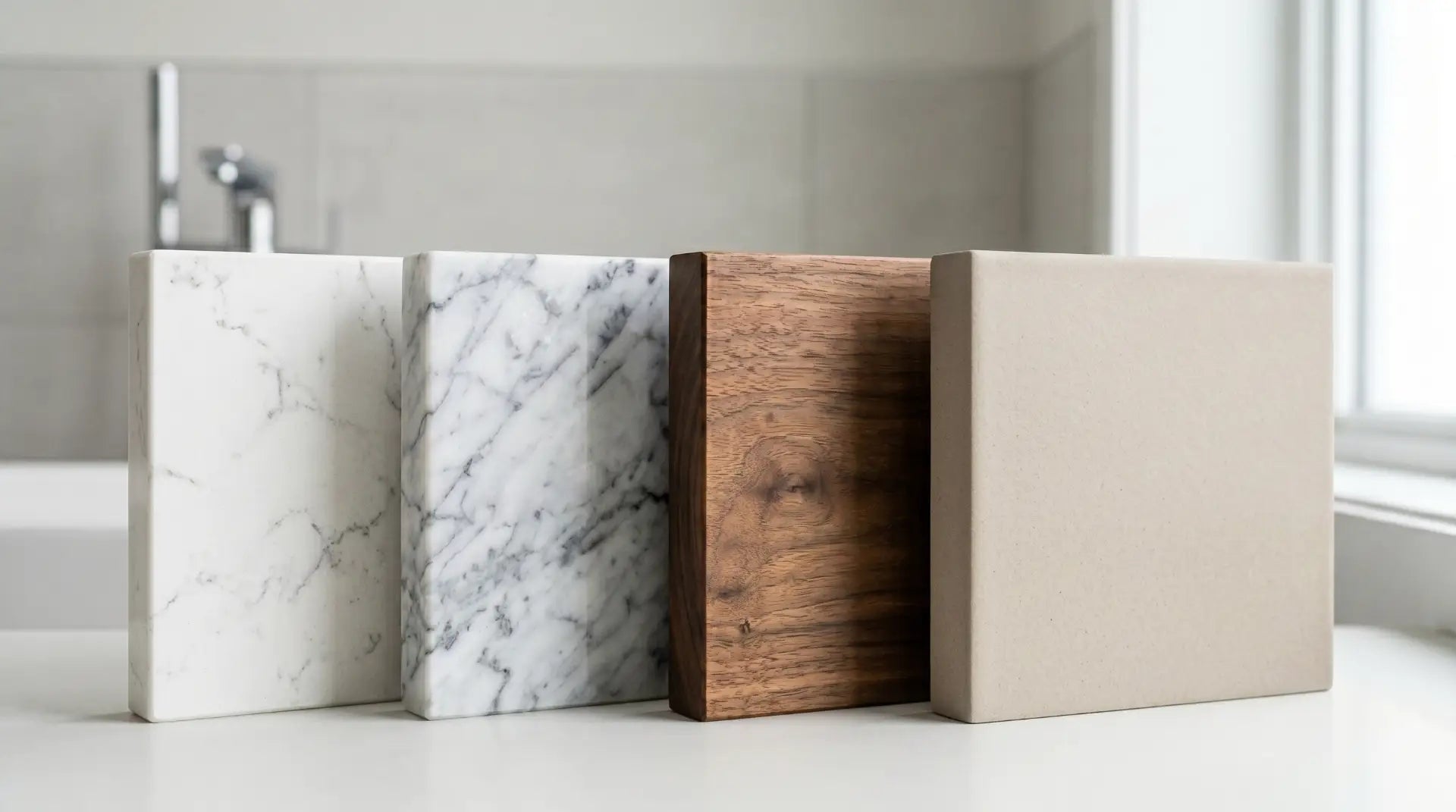
The countertop is the most-touched surface in your bathroom - and the material you choose determines maintenance, durability, and aesthetics for the life of the vanity. This is the complete guide to making the right call.
The vanity countertop is the surface that gets splashed every morning, wiped down every day, and contacted by every personal care product in the bathroom. It's also the visual centerpiece of the vanity - the material that defines whether the piece reads as a premium fixture or a builder-grade box. Getting the material right matters more than most buyers realize when they're comparing product listings by color and style alone.
This guide compares the six most common vanity top materials - quartz, marble, cultured marble, wood, concrete, and porcelain/ceramic - across every dimension that matters in real bathroom use: durability, maintenance requirements, cost, moisture resistance, and aesthetics. By the end, you'll know exactly which material fits your bathroom, your habits, and your budget - and which ones to avoid for your specific situation.
A marble top that photographs beautifully can etch and stain within six months of daily exposure to toothpaste, mouthwash, and face wash - all mildly acidic products that damage polished marble on contact. A quartz top that appears less distinctive in a showroom will look identical 15 years later with no sealing, no etching repairs, and no specialized cleaning products. The material decision is first a performance decision, then an aesthetic one. This guide covers both dimensions in the order that actually matters for long-term satisfaction.
These cards summarize each material's core performance profile before the full deep-dive sections below. Use them as a quick orientation, not a final decision tool.
Each section below covers performance, real-world pros and cons, the bathroom contexts where the material excels, and what to look for when buying a vanity top in that material.

Quartz is engineered stone - typically 93-94% crushed quartz bound with polymer resins and pigments. This manufacturing process produces a surface that is non-porous by design, which means it does not absorb water, toothpaste, hair dye, makeup, or any of the other substances that regularly contact a bathroom countertop. It does not need to be sealed at installation or ever. It resists scratching better than most natural stones and is not vulnerable to the acid etching that damages marble surfaces on contact with everyday bathroom products.
In terms of aesthetics, quartz is available in virtually every color and pattern - including convincing Carrara marble, Calacatta marble, concrete, solid white, solid black, and a wide range of veined patterns that look indistinguishable from natural stone at conversational distance. At 60 inches and wider, a quality quartz top maintains consistent pattern across the full width without the visible seam that compromises multi-piece stone tops. For most buyers, quartz is the correct material choice - not the "safe" choice, but the genuinely best-performing option for the use environment.
- Non-porous - never needs sealing
- Acid-resistant - won't etch from toothpaste, mouthwash, face wash
- Scratch-resistant - harder than marble
- Consistent pattern available across full top width
- Available in every color, including convincing marble looks
- Extremely long lifespan with minimal care
- Most widely available in pre-built vanity tops
- Not heat-resistant - hot styling tools can damage the resin binder
- Cannot be refinished in place - damage requires replacement
- Costs more than cultured marble or porcelain at entry level
- Veining patterns are repeated, not unique like natural stone
- Very heavy - professional installation recommended for wide tops

Real marble is a metamorphic limestone - porous, calcareous, and uniquely beautiful. Each marble slab is genuinely one-of-a-kind, with veining patterns created by millions of years of mineral movement through limestone beds. No two slabs are identical, which is the source of marble's irreplaceable aesthetic quality. Carrara marble - the most common bathroom choice - has a soft white background with delicate gray veining that photographs beautifully and works with virtually every bathroom finish.
The maintenance reality of real marble is the information that most people discover after installation rather than before it. Marble is calcareous - meaning it is chemically reactive to acids. Toothpaste, mouthwash, hand soap, face wash, and most personal care products are mildly acidic. On an unsealed or under-sealed marble surface, these products etch the polished finish on contact - creating dull, semi-permanent marks that are not a stain but a surface-level chemical change. Etching can be removed by a stone restoration professional, but not by cleaning alone, and it returns with continued use. Marble in a daily-use master bathroom requires sealing every 6-12 months and careful avoidance of acidic products - which is a maintenance commitment most buyers underestimate.
- Genuinely unique - every slab is one of a kind
- Unmatched natural aesthetic - no engineered stone replicates it exactly
- Increases home value perception when well-maintained
- Cool to the touch - a tactile quality stone enthusiasts value
- Can be honed (matte) to reduce visible etching over time
- Etches from toothpaste, mouthwash, and most bathroom products
- Requires sealing every 6-12 months - without exception
- Stains from oils, dyes, and pigmented products if unsealed
- Chips more easily than engineered stone at edges and corners
- Most expensive natural stone option at the vanity scale
- Etching removal requires professional stone restoration
Marble in a daily-use bathroom requires accepting a patina. No amount of sealing prevents etching entirely when the surface is exposed to acidic products daily. Many homeowners who choose marble for aesthetics come to appreciate the patina that develops over time - but buyers who expect a marble top to look showroom-new five years after installation in a primary bathroom will be consistently disappointed. Honed (matte) marble shows etching less visibly than polished marble and is the better choice for high-use bathrooms.

Cultured marble is a manufactured product - ground limestone combined with polyester resin, cast into a mold and finished with a clear gel-coat surface. Despite the name, it contains no actual marble. It is, however, a legitimate and practical vanity top material with specific performance advantages that are frequently underappreciated by buyers focused on premium natural materials. The gel-coat surface is non-porous and requires no sealing. Cultured marble tops are available with integrated sinks - a single molded piece with no seam between the basin and counter - which eliminates the caulk joint that is the most common maintenance problem on separate-sink countertops.
The limitations of cultured marble are primarily aesthetic and surface-durability related. The gel-coat surface scratches and dulls over time in ways that engineered quartz does not, and once scratched, the damage is difficult to repair without professional buffing. Abrasive cleaners - which many households use in bathrooms - damage the gel-coat rapidly. Cultured marble also has a more limited aesthetic range than quartz or natural stone; the patterns available are recognizably manufactured rather than stone-like at close range. For a guest bathroom, secondary bathroom, or budget primary bathroom renovation, however, cultured marble is a sound and practical choice.
- Lowest cost of any vanity top option at this performance level
- Available with integrated sink - eliminates the caulk joint entirely
- Non-porous gel-coat - no sealing ever required
- Lightweight - easier DIY installation than stone options
- Repair scratches with automotive gel-coat polishing compounds
- Gel-coat scratches from abrasive cleaners and rough sponges
- Limited aesthetic range - patterns read as manufactured at close range
- Yellows over time with UV exposure in sun-facing bathrooms
- Cannot be cut or customized in the field like stone slabs
- Shorter lifespan than quartz at the same price point long-term

Wood vanity tops - typically solid teak, white oak, bamboo, or walnut with a marine-grade or bathroom-specific finish - are among the most visually distinctive bathroom countertop choices available. In a bathroom with natural light, a well-finished wood top adds genuine warmth and material richness that no engineered stone replicates. Teak in particular has natural oils that give it reasonable moisture resistance, and it has a long history in wet-environment applications (boat decks, outdoor furniture) that demonstrates its relative durability among wood species.
The performance reality of wood in a bathroom is one of the most context-dependent of any countertop material. In a dry-use vanity zone - a powder room, a makeup vanity away from the sink, or a bathroom where the countertop rarely contacts standing water - a properly sealed wood top can perform well for years. In a primary bathroom where water is constantly splashing the countertop from two daily users, wood requires frequent resealing, immediate drying after every use, and acceptance that the surface will develop character marks over time. Standing water on an improperly sealed wood surface causes warping and discoloration within months.
- Warmest, most natural aesthetic of any vanity top material
- Each piece is unique - natural grain patterns vary continuously
- Can be sanded and refinished to remove surface damage
- Teak's natural oils provide better baseline moisture resistance
- Excellent design complement to natural stone tile and warm fixtures
- Warps and stains if standing water is not dried immediately
- Requires annual oiling or sealing at minimum
- Not compatible with vessel sinks in most configurations
- Can crack in low-humidity environments (dry climates)
- Most expensive when combined with professional installation and finishing
- Not practical in bathrooms with high daily splash exposure

Concrete vanity tops are custom-fabricated - cast in a mold, cured, finished, and sealed. No two are exactly alike, and the gray-matte aesthetic they produce is unavailable from any other material at the same character level. Concrete works best in industrial, modern, or deliberately raw aesthetic bathrooms where the material's inherent texture and variation are a design asset rather than an imperfection. It pairs naturally with matte black hardware, large-format tile, and exposed-concrete or plaster wall treatments.
The practical challenge of concrete as a vanity top is sealing and maintenance. Unsealed concrete is highly porous - it will stain from toothpaste, mouthwash, and colored personal care products within days of use. Proper sealing (typically a penetrating sealer plus a topcoat) is non-negotiable, and the seal degrades over time from bathroom product contact and cleaning. Concrete also develops hairline surface cracks over time as the slab cures - which is a design characteristic some owners appreciate and others find problematic. Its weight is also significantly greater than quartz or stone tops of the same dimensions, requiring structural reinforcement of the vanity cabinet in most cases.
- Unique industrial aesthetic unavailable from any other material
- Fully customizable - any shape, integrated drains, custom edges
- Surface can be ground and refinished by a professional
- Color can be added during mixing for a range of gray tones
- Natural hairline cracking is part of the aesthetic in design contexts
- Extremely porous without sealing - stains immediately from daily products
- Most expensive option per square foot due to custom fabrication
- Very heavy - requires structural cabinet and floor support assessment
- Hairline surface cracks appear over time as the slab cures
- Sealing must be maintained rigorously - not a low-maintenance material

Porcelain and ceramic tile have been used as bathroom countertop surfaces for decades - they are durable, water-resistant, and highly affordable. Glazed porcelain tile is non-porous and resistant to staining and chemical damage in a way that natural stone is not. Large-format porcelain tiles (18×18 inches or larger) reduce grout joint frequency significantly compared to smaller tile formats, which addresses the primary maintenance challenge of tiled vanity tops. In a budget renovation context, a well-installed large-format porcelain vanity top can look clean, contemporary, and last decades without significant maintenance.
The main practical limitation of porcelain tile as a vanity top is grout. Grout joints - even when properly sealed - accumulate toothpaste, soap residue, and discoloration over years of daily use. Small-tile formats with dense grout networks are particularly challenging to keep clean and are considered dated in current bathroom design. Large-format tile with tight epoxy grout joints is a significantly better approach, but it requires precise installation on a level, well-prepared substrate to avoid visible lippage between tiles.
- Lowest cost of all vanity top materials at scale
- Glazed surface is non-porous and stain-resistant
- Individual tiles can be replaced without full countertop replacement
- Available in a vast range of colors, formats, and patterns
- DIY-friendly for experienced tilers
- Grout joints accumulate stains and require ongoing cleaning and sealing
- Small-format tile grout networks are very difficult to keep clean
- Tiles can crack at edges and corners from impact
- Grout can discolor permanently in high-use primary bathrooms
- Reads as builder-grade in a high-end bathroom renovation context
| Material | Durability | Maintenance | Moisture Resistance | Sealing | Cost (installed) | Best Use |
|---|---|---|---|---|---|---|
| Quartz | Excellent | None | Excellent | Never | $50-$150/sq ft | Any bathroom |
| Marble | Moderate | High | Moderate | Every 6-12 months | $75-$250/sq ft | Low-traffic, powder rooms |
| Cultured Marble | Good | Low | Good | Never | $20-$65/sq ft | Budget primary, guest baths |
| Wood | Moderate | Moderate-High | Low-Moderate | Annually (minimum) | $60-$200/sq ft | Powder rooms, dry vanities |
| Concrete | Good (sealed) | Moderate | Moderate | Every 1-3 years | $100-$300+/sq ft | Modern / industrial design |
| Porcelain | Good | Moderate (grout) | Good | Grout annually | $10-$40/sq ft | Budget renovations |
- This is a primary or master bathroom used daily by one or two people
- You want zero sealing, zero special cleaning products, and zero maintenance protocols
- You want a marble aesthetic without marble's maintenance requirements
- You're installing a double sink vanity at 72 inches or wider and need a single-slab top
- Long-term durability matters more than having an authentic natural material
- Budget is moderate to generous and you want the best performance for it
- The bathroom sees low to moderate daily use - not a primary bath for two active users
- You genuinely love natural stone and are prepared to seal annually without exception
- You will switch to pH-neutral cleaners and use blotting rather than wiping for spills
- You accept that etching is part of the natural patina of real marble in bathroom use
- Budget is generous and aesthetics are the primary decision driver
- This is a guest bathroom, powder room, or secondary bathroom
- Budget is the primary constraint and you need to maximize function per dollar
- An integrated sink (no caulk joint) is a priority for low-maintenance installation
- It's a rental property or a bathroom that will be renovated again in 10-15 years
- The vanity is in a powder room or a dry-use area not adjacent to the primary sink zone
- Warmth and natural material character are the dominant aesthetic priorities
- You are prepared to oil or reseal the surface at least annually
- You will dry the surface after every water contact and use waterproof bath mats
- Teak is the species of choice for maximum baseline moisture resistance
- Concrete: The bathroom has a deliberate industrial or modern aesthetic, and you want a custom-fabricated top that no off-the-shelf material can replicate. Budget is generous. You accept active sealing maintenance.
- Porcelain: Budget is the primary driver, you prefer large-format tiles with epoxy grout, and you are comfortable with annual grout maintenance. Best suited for secondary bathrooms and budget primary bathroom renovations.
Shop bathroom vanities with the right top at Bathify
Browse the full collection - vanities pre-configured with quartz, cultured marble, and more - in every width, style, and finish. Hotel-quality finishes, for less.


