







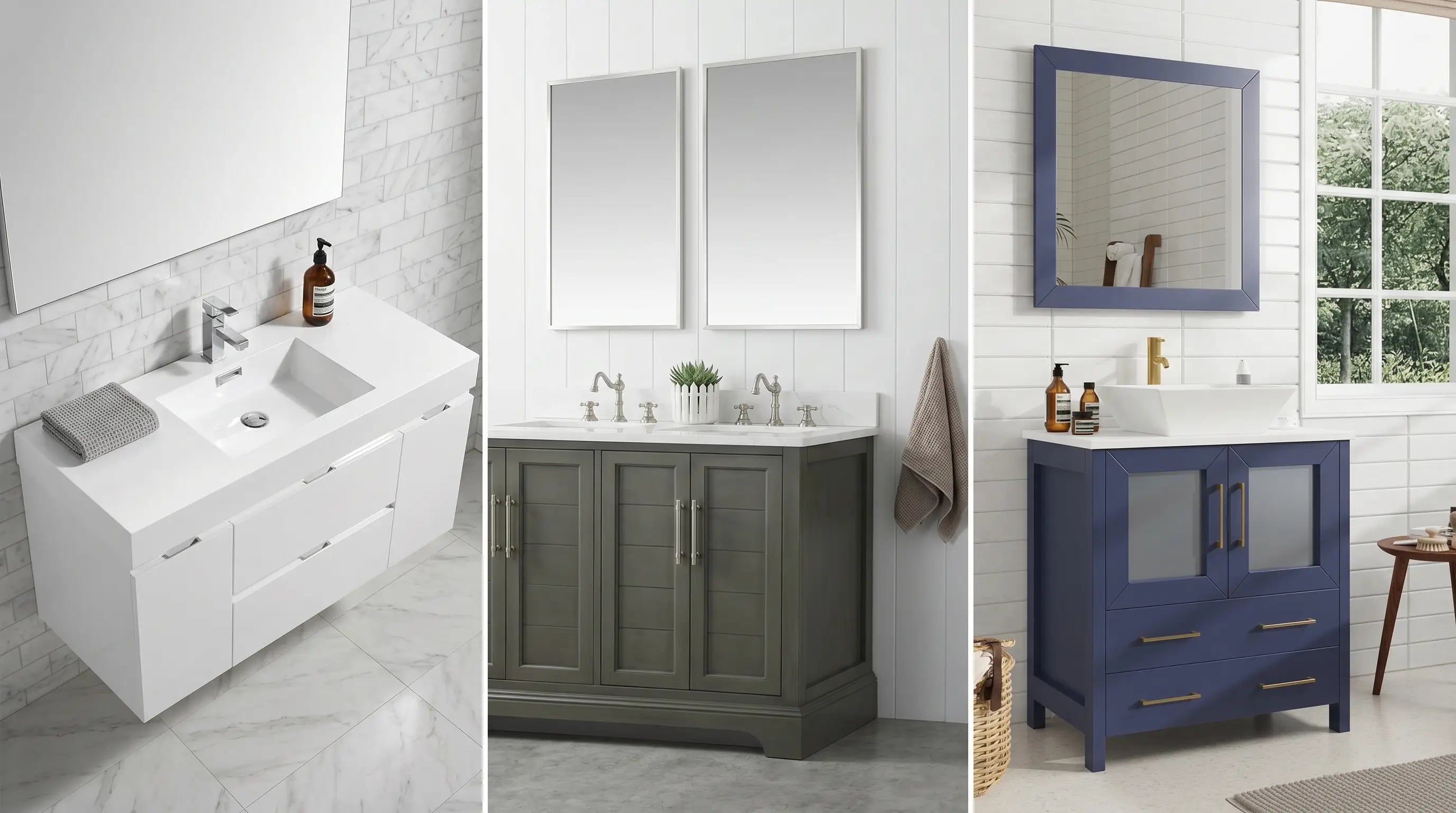
Modern and transitional are the two top-selling bathroom vanity styles in the US - and they're often confused for each other. This guide breaks down the exact design differences so you can choose with confidence.
Walk into any Bathify collection and two styles dominate the bestseller list: modern and transitional. They're close enough that shoppers routinely confuse them - both lean clean, both avoid heavy ornamentation, and both photograph beautifully in the same neutral bathrooms that fill home design feeds. But they're different in ways that matter, and choosing the wrong one for your bathroom's existing architecture creates a visual mismatch that no amount of styling can fully resolve.
This guide breaks down every meaningful design difference between modern and transitional bathroom vanities - cabinet lines, door profiles, hardware, finishes, countertop choices, and the bathroom contexts where each style performs best. By the end, the right choice for your bathroom will be obvious.
A bathroom vanity is typically the largest single piece of furniture in the bathroom - and the visual anchor everything else is styled around. A modern vanity in a traditionally framed bathroom (raised-panel doors, ornate mirrors, classic tilework) creates immediate visual friction that reads as unfinished. A transitional vanity in a truly contemporary space can read as slightly dated. Style isn't subjective decoration in bathroom design - it's structural. Getting it right sets up every other decision; getting it wrong is the reason bathroom renovations "never feel quite right" despite good materials and execution.
These two panels summarize the core design DNA of each style. Use them as a quick reference before reading the deeper attribute breakdowns below.
Zero ornament.
Modern restraint.
These are the five design details that create the visual difference between a modern vanity and a transitional one. Understanding each one helps you identify which style you're looking at in a product listing - and which will work in your bathroom.
The cabinet door profile is the single most reliable way to identify which style a vanity belongs to. Modern vanities use flat-front slab doors - a single unbroken panel with no internal frame, rail, or recess. The surface is completely flat from edge to edge, which gives the cabinet its geometric, furniture-quality appearance. Transitional vanities use shaker panel doors - a five-piece construction with a flat center panel set inside a frame of four rails. The recessed center is shaker's defining feature: it creates subtle depth and shadow without the decorative complexity of a raised panel. If you see a door with a recessed rectangular center framed by flat rails, it's transitional. If the door face is one flat, unbroken plane, it's modern.
Hardware is where modern and transitional diverge most visibly in daily use. Modern vanity design treats hardware as a problem to be minimized - push-to-open mechanisms, integrated grooves routed into the door edge, or ultra-thin bar pulls in a single matte finish are the acceptable options. The goal is zero visual interruption of the door plane. Transitional design treats hardware as an intentional accent. Bar pulls in brushed gold, brushed nickel, or matte black - sized at 5 to 8 inches - are the most common choice. Round cup pulls or small knobs appear on drawer fronts in more classically oriented transitional pieces. The hardware finish is always matched to the faucet and towel bar, creating a consistent metal story across the bathroom.
The quickest way to tell if you're looking at a modern or transitional vanity in a product listing: look at the hardware first, then the door profile. No visible hardware (or ultra-thin flat bar pulls) on a flat-front door = modern. Visible bar pulls or knobs in a warm metal finish on a shaker door = transitional. These two features together are nearly never mixed within a single style category.
Cabinet finish is where modern and transitional speak entirely different color languages. Modern vanities default to a deliberately restricted palette: matte white lacquer, flat black, concrete gray, dark walnut veneer, or two-tone combinations of any of the above. The finishes are cool-toned and consistent - you rarely see warmth or variation in a true modern vanity. Transitional vanities use a much broader and warmer palette: bright white, warm off-white, greige (gray-beige), navy, sage, and natural wood tones are all part of the transitional vocabulary. Shaded finishes - a slightly darker gray-blue or a deep navy - that would feel too heavy in a modern context read as sophisticated and grounded in a transitional one.
| Finish / Color | Modern Vanity | Transitional Vanity |
|---|---|---|
| Matte white lacquer | ✓ Core finish | ✓ Core finish |
| Warm off-white / cream | Too warm - avoid | ✓ Classic transitional |
| Flat / matte black | ✓ Statement modern | Less common - works with brushed gold hardware |
| Concrete gray / charcoal | ✓ Strong modern choice | Works in contemporary-transitional crossover |
| Navy / deep blue | Too warm in most contexts | ✓ Top transitional color 2024–2026 |
| Sage green / olive | Rarely used | ✓ Growing transitional accent |
| Natural wood veneer | ✓ Warm modern (flat-front) | ✓ Natural transitional (shaker) |
| Two-tone (body + doors) | ✓ Sophisticated modern | ✓ Popular transitional configuration |
Both styles default to quartz, but they use it differently. Modern vanities pair with quartz in solid white, solid gray, or concrete-look patterns - and always with a square or mitered edge profile. The edge is crisp, sharp, and visually flush with the cabinet top. Transitional vanities use quartz in marble-look patterns - Carrara-style white with gray veining, warm Calacatta-style with gold or brown veining - and pair it with an eased, beveled, or slightly rounded edge that softens the transition between the counter surface and the side. The edge profile is a low-cost way to confirm which style a vanity top belongs to: square edge is modern; eased or beveled edge is transitional.
Modern vanities are typically either floating (wall-mounted with no visible legs or base) or floor-standing with a completely flush, closed base that creates an unbroken box from counter to floor. No feet, no bun feet, no decorative toe kick detail - the base is as flat and geometric as the cabinet doors. Transitional vanities more commonly include a defined toe kick, an open base with furniture-style legs, or a slightly raised base that creates visual separation between the cabinet and the floor. Furniture legs - tapered or straight - appear on some transitional pieces and would be entirely out of place on a modern design. This proportion difference is part of why transitional vanities feel warmer and more "furniture-like" than modern ones, even when both are made from similar materials.
The floating wall-mount vanity - one of Bathify's most popular configurations - is inherently a modern design choice. Its defining visual feature (the exposed floor beneath the cabinet) creates the geometric, hovering quality that is core to modern aesthetics. If you want a floating vanity but prefer transitional character, look for a floating model with shaker panel doors and brushed gold hardware - the transitional detailing softens the contemporary format without compromising the open-floor visual that makes floating vanities so effective in small bathrooms.
These three vanities represent the clearest examples of each design approach in Bathify's current collection - and collectively illustrate the practical differences that make each style right for a specific bathroom context.

A flat-front slab-door vanity with push-to-open drawer and door mechanisms is the purest expression of modern bathroom design - no hardware, no rails, no visual interruption of the cabinet face. In matte white, this vanity works in any contemporary bathroom as a neutral anchor. In flat black or dark gray, it becomes a statement piece in a monochromatic or two-tone scheme. The key design discipline of a true modern vanity at this level: every detail that could be eliminated has been - what remains is deliberately restrained, and the quality reads in the material surfaces and the precision of the construction, not in decoration.
- Flat-front doors with push-to-open or integrated-groove hardware are the non-negotiable modern indicators - if the cabinet door has any rail, frame, or recess, it's not a modern piece regardless of finish color
- Soft-close, full-extension drawer slides are the quality differentiator at this price point - they're what separates a vanity that looks modern from one that performs like a premium piece
- Square-edge quartz is essential - even a slightly eased edge begins to soften the geometry and moves the piece toward transitional territory
- Wall-mount (floating) installation amplifies the modern aesthetic significantly - if the vanity is available in both floor and wall-mount configurations, wall-mount is almost always the stronger modern presentation

A shaker-panel vanity in white or navy with brushed gold hardware and a Carrara-look quartz top is the most complete expression of transitional design - and the most consistent top-seller in Bathify's vanity collection. The shaker door brings familiar craftsmanship character; the clean white or deep navy finish keeps it from reading as traditional; the brushed gold hardware adds warmth and a premium material contrast that elevates the overall composition. This is the combination that works in virtually any American bathroom style - from a 1990s colonial that needs updating to a newly built home where the owners want warmth without going full contemporary.
- True shaker construction uses five pieces (one center panel + four rails) - a routed-groove door that mimics a shaker profile without actual rail construction is a quality shortcut that reads as less premium in person
- Match hardware finish exactly to the faucet and towel bar - the metal consistency across the bathroom is what makes transitional design look intentional rather than assembled
- Marble-look quartz is the correct countertop for transitional - real marble is beautiful but requires sealing, is prone to etching from bathroom products, and is increasingly replaced by high-quality quartz lookalikes that perform identically but without the maintenance
- Plywood box construction with a furniture-grade door is the quality standard - a transitional vanity at this price point should outlast two renovation cycles without drawer face or door finish degradation

Two-tone vanities - typically a dark or medium-toned cabinet body with a white or light countertop - occupy the precise overlap between modern and transitional. The color contrast is inherently contemporary (a modern sensibility), but two-tone configurations are available in both flat-front and shaker door styles, which means the door profile determines which style camp it lands in. A flat-front dark-base vanity with push-to-open hardware reads as modern. The same color combination with a shaker door and brushed gold bar pulls reads as transitional. Two-tone is the most versatile configuration in Bathify's collection - and the right hardware choice is what finalizes its style identity.
- Confirm the door style before ordering - product listings for two-tone vanities sometimes describe only the color combination without clearly indicating whether the door is flat-front or shaker. This is the most important specification to verify
- The contrast ratio matters - a very dark base (charcoal, navy, black) with a bright white top creates maximum visual impact; a medium gray base with an off-white top creates a softer, more restrained two-tone effect. Choose based on how much visual weight you want the vanity to carry
- Coordinate the dark base color with the floor tile or wall color - a two-tone vanity reads best when the dark tone echoes another element in the bathroom rather than appearing isolated
- White quartz with a square edge serves both style directions - it's clean enough for modern and light enough to work with the marble-look character preferred in transitional bathrooms
Run through your bathroom's existing conditions against this matrix. Where you land most consistently is the style that will integrate most naturally - and require the least additional work to pull together.
- Existing trim and door style assessed: Panel molding or raised-panel interior doors → transitional. Flat-panel or no-detail doors → modern works
- Faucet finish identified: Brushed gold or oil-rubbed bronze → transitional. Matte black or brushed nickel → either, depending on door style
- Tile style noted: Large-format porcelain → modern. Subway, hex, or herringbone → transitional or either
- Mounting type decided: Wall-mount (floating) → lean modern. Floor-standing → either style works
- Door style chosen: Flat-front slab = modern. Shaker panel (recessed center) = transitional. This is the single most important decision
- Hardware selected: Push-to-open or thin groove = modern. Visible bar pull or knob in warm metal = transitional. Matched to faucet finish
- Countertop edge confirmed: Square or mitered edge = modern. Eased or beveled edge = transitional
- Color palette confirmed: Cool neutrals (white, gray, black) = either. Warm tones (off-white, navy, sage, warm wood) = transitional strongly preferred
- Resale context considered: Transitional has broader buyer appeal across US markets - relevant if renovation is partially for resale value
Find your style at Bathify
Shop modern and transitional bathroom vanities in every width, finish, and countertop configuration. Hotel-quality finishes, for less.


