







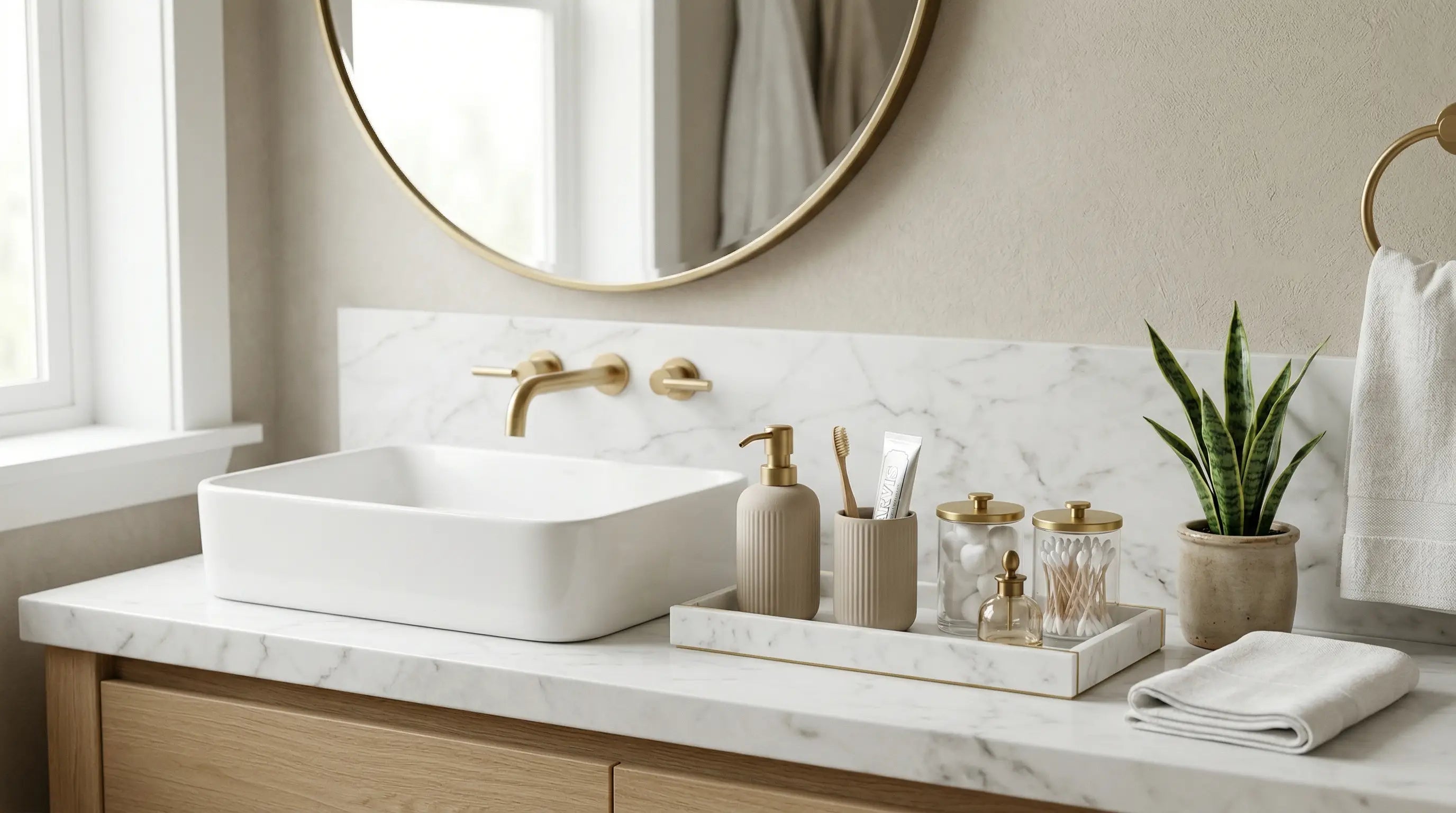
A well-styled vanity is one of the highest-impact upgrades in any bathroom - and it requires fewer pieces than most people think. Here's exactly what to buy, what to skip, and where everything goes.
The vanity is the focal point of almost every bathroom - it's where you start and end each day, and it's the surface that most visitors see. Yet it's also the most commonly misorganized surface in the home. Most bathroom counters suffer from the same problem: too many items that don't belong there competing with the few items that genuinely do. The result is clutter that makes the bathroom feel smaller, harder to clean, and less functional than it should be.
This guide cuts through the noise. It covers every category of vanity accessory worth buying - trays, dispensers, organizers, mirrors, lighting, and decor - explains exactly where each item should be placed on the counter, and tells you what to move off the counter entirely. Whether you have a compact single-sink vanity or a wide double vanity with substantial counter space, the same three-zone principle applies.
Research by the National Kitchen & Bath Association (NKBA) consistently finds that 40% of the items on an average bathroom counter belong in a drawer, cabinet, or should be removed from the bathroom entirely. The solution is not a larger vanity - it's a deliberate accessory strategy. A matched set of purpose-specific accessories (a tray, two to three dispensers, a small organizer, and one or two thoughtfully placed decor items) provides every function a bathroom counter needs while eliminating the visual noise that makes counters feel cluttered regardless of their size.
Every vanity counter, regardless of size, works best when organized into three distinct zones. Understanding this framework first determines which accessories you actually need - and prevents buying items that will add to clutter rather than reduce it.
Interior designers who specialize in bathrooms consistently follow the "odd number" rule for vanity styling: display items in groups of one or three, never two or four. A single statement soap dispenser, or a trio of matched canister jars, reads as intentional. Two items of similar height side by side reads as forgotten. Apply this rule especially in Zone 3 styling - one plant or one candle, not one of each.
These accessories are organized by function, from the most essential daily-use items to storage solutions and finishing touches. For each one, placement guidance is included alongside what to look for when buying.
These are the items that every vanity needs regardless of counter size. They live front and center, they're used multiple times every day, and they should be the first accessories you select because everything else is built around them.

The soap dispenser is the most-used item on any vanity counter and the piece that sets the design language for everything else. Because it's used five to ten times a day and sits permanently on the counter, it has more visual and functional impact than any other single accessory - which is why it deserves to be chosen first and chosen well. The material of your soap dispenser should be the material you carry through the rest of your vanity accessories: ceramic, brushed metal, glass, or stone resin. Everything else on the counter should either match or complement it.
- Choose the material of your soap dispenser first - it will anchor your entire vanity aesthetic. Matte black, brushed gold, brushed nickel, white ceramic, and natural stone resin are the most versatile in 2026
- Metal pump heads (brass or stainless steel) are the only durable option - plastic pump mechanisms corrode or break within 12–18 months of daily hand-soap exposure
- A dispenser with a weighted base or non-slip bottom prevents tipping - especially important on polished stone or quartz counters where movement is easiest
- Buy in a set if you plan to have matching pieces - coordinated soap dispenser and toothbrush holder sets from the same line ensure perfect finish matching, which is nearly impossible to achieve by purchasing separately

The toothbrush holder is the second most essential vanity accessory and the one most commonly chosen as an afterthought - which is why so many bathroom counters feature a mismatched plastic holder next to a carefully chosen soap dispenser. A matched toothbrush holder and soap dispenser, bought as a set in the same finish and material, is the single fastest way to make a vanity look curated rather than assembled. In functional terms, the toothbrush holder's most important feature is adequate drainage - toothbrush holders that trap water harbor bacteria and degrade toothbrush bristles faster.
- Buy as a matched set with your soap dispenser whenever possible - even slight variation in finish shade (e.g., matte black vs. satin black) is immediately visible in bathroom lighting
- Drainage is the most important functional feature - a holder with an open bottom or drainage holes prevents water from pooling at the base, which is where bacterial growth concentrates
- Wide-opening slots (1 inch or more) accommodate electric toothbrush heads as well as manual - choosing a holder that can't fit your toothbrush type is the most common buying mistake
- For electric toothbrushes: wall-mounted charging holders that keep the unit off the counter entirely are often the cleaner solution - they free counter space and eliminate cord clutter

A vanity tray is arguably the most impactful single piece in a bathroom accessory set - not because of what it holds, but because of what it does visually. A tray groups items together into a single intentional unit, which transforms a collection of objects on a counter into a styled vignette. Without a tray, five items look like clutter. With a tray, those same five items look like a composed set. Interior designers consistently cite the tray as the easiest way to add perceived organization to any surface without actually organizing anything - and in a bathroom context, that visual calm is part of the product's value proposition.
- Size the tray to your contents, not to the counter - the tray should be slightly larger than the items it holds, with a visible border of 1-2 inches around them. An oversized tray that fills the counter creates a different kind of visual weight
- Marble and stone resin trays are the premium choices - they add genuine material luxury to the counter and are water-resistant without sealing in most cases
- Mirrored glass trays visually expand small vanity counters by reflecting light - a useful design trick for compact bathrooms where the counter area feels cramped
- Avoid trays with complex internal dividers - a simple flat tray with a raised edge is more versatile than one with fixed compartments, which may not accommodate your actual items
Zone 2 is where most bathroom counter problems originate. Items that are used regularly but not daily - skincare products, cotton rounds, Q-tips, hair accessories - tend to accumulate in disorganized piles that take over the counter. These accessories contain them properly.

Canister jars - also sold as apothecary jars or bathroom canisters - are the most effective dual-function accessory in any vanity set. They store the items that most commonly create counter clutter (cotton rounds, Q-tips, hair ties, bath salts) while adding visual interest and height variation to the counter display. A set of two or three graduated canisters in the same material - clear glass, frosted glass, ceramic, or stone - creates the kind of composed grouping that makes a vanity look styled rather than merely organized. They also make their contents visible, which is a genuine functional benefit: you can see at a glance when you're running low on cotton rounds without opening anything.
- Clear or lightly frosted glass is the most practical material - you can see contents without opening, and glass doesn't absorb odors or stain from colored bath salts
- Graduated heights (a tall, medium, and short canister) create visual rhythm on the counter - three identically sized containers look static and don't maximize the visual potential of the grouping
- Hinged lids or simple lift-off tops are the most practical for daily use - screw-top lids require two hands to open and discourage the quick access that makes these containers actually useful
- Match the lid material to your other metal finishes - brass-lidded glass canisters next to brushed gold dispensers, chrome lids with brushed nickel fixtures, and so on

Skincare product bottles - toners, serums, moisturizers, SPF - are the primary source of vanity counter clutter in most adult bathrooms. They're used in a daily sequence, kept on the counter for accessibility, and tend to multiply over time. A countertop skincare organizer corrals these bottles into a defined footprint: upright, visible, and sequenced in the order you use them. This is one of the few cases where a multi-compartment accessory outperforms a tray - the dividers keep tall bottles from falling and allow significantly more storage per square inch of counter space than a flat tray can provide.
- Measure your tallest bottle before purchasing - most skincare organizers are sized for standard 3-4 oz serum bottles, but don't accommodate the taller 6–8 oz toner or moisturizer formats
- Clear acrylic makes it easy to identify products at a glance without moving them - particularly useful when you're maintaining a multi-step skincare routine in the morning rush
- Corner organizers (L-shaped or triangular footprint) are among the highest-value accessories for compact vanities - they occupy space that is otherwise unusable and don't encroach on the primary counter area
- Removable dividers are more versatile than fixed compartments - your bottle collection will change as products run out and are replaced with different sizes, and the organizer should accommodate that
The mirror - whether it's your primary bathroom mirror or an additional countertop mirror - is the most functional and visually significant element of any vanity. The right mirror choice, or the right accessories around an existing mirror, has more impact on the vanity's overall quality than any other single decision.

Most bathrooms are lit overhead - which creates shadows on the face that make grooming, makeup application, and skincare routines significantly harder than they need to be. An LED mirror solves this by positioning light at the level of your face rather than above it, providing front-lit or backlit illumination at the vanity that eliminates shadows and dramatically improves grooming accuracy. CRI (Color Rendering Index) is the critical specification: a CRI of 90 or above means the light reproduces colors accurately, so what you see in the mirror matches what you'll look like in natural daylight. Below CRI 80, makeup colors and skin tones are distorted.
- CRI 90+ is non-negotiable for any mirror used for makeup or skincare - below CRI 80, skin tones render with a yellow or green cast that causes over-application of makeup and incorrect SPF shade matching
- Adjustable color temperature (3,000K warm to 5,000K daylight) allows you to match the lighting of wherever you'll most often be seen - warm for evening environments, daylight for outdoor or office settings
- Anti-fog heated glass panels eliminate the frustration of a steamed mirror after a shower - an indirect time and water saving, since foggy mirrors prompt running more cold water to clear steam faster
- Dimmable LED mirrors extend LED lifespan and cut energy use for low-demand tasks like evening moisturizing - a 70% brightness reduction cuts energy use proportionally

A countertop magnifying mirror is one of the most underrated vanity accessories - it's used every day by anyone who applies makeup, tweezers eyebrows, applies skincare, or wears contact lenses, and yet most bathrooms lack one entirely. A high-quality magnifying mirror in a finish that matches the rest of the vanity hardware reads as a design element as well as a functional tool. The most common magnification levels are 5x (general grooming and makeup), 7x (detail work and tweezing), and 10x (contact lens handling and precision skincare). For most people, a dual-sided 1x/5x or 1x/7x mirror covers all needs in a single piece.
- 5x magnification is the most versatile for general use - sufficient for makeup application, tweezing, and contact lenses without the claustrophobic close-up of 10x, which most people find difficult to use
- True optical glass mirrors are noticeably sharper than plastic-coated alternatives - the difference is immediately obvious when comparing at the same magnification level
- Match the mirror frame and arm finish to your faucet finish - a brushed gold mirror with a brushed nickel faucet reads as mismatched even when both are individually attractive
- Adjustable-arm wall-mounted magnifying mirrors are the best space-efficient option - they fold flat when not in use, eliminating the permanent counter footprint of a freestanding model
Zone 3 is where the vanity becomes a styled space rather than just an organized one. These items have minimal function and maximum visual purpose - use them sparingly, and resist the urge to fill the counter with them.

The bathroom tumbler - used for rinsing after brushing, mouthwash, or simply as a water glass at the sink - is one of the most overlooked pieces in a vanity set. Most people use a plastic cup, a paper cup dispenser, or simply cup their hands under the faucet. A ceramic, glass, or metal tumbler that matches the soap dispenser and toothbrush holder completes the vanity set and eliminates one more item of plastic from the counter. In terms of visual contribution, a well-chosen tumbler adds a third height element to the Zone 1 grouping - creating a natural hierarchy between the soap dispenser, toothbrush holder, and rinse cup that makes the set look composed.
- Buy as part of a matched bathroom accessory set - a four-piece set (soap dispenser, toothbrush holder, tumbler, and soap dish or tray) from the same product line ensures identical finish, wall thickness, and glaze throughout
- Weighted bases prevent tipping during the quick placement-and-removal motion of daily use - a tumbler that tips easily gets moved off the counter permanently within a week
- Avoid thin glass tumblers for daily bathroom use - tempered glass or thick-walled ceramic is significantly more resistant to the small drops and impacts that happen when someone's in a rush in the morning
- If you prefer not to have a cup on the counter at all, a wall-mounted cup holder (matching the vanity hardware finish) is a clean alternative that keeps the counter open

Zone 3 requires exactly one item, not several. A reed diffuser or a single well-chosen candle placed at the back corner of the vanity counter is the standard "finishing touch" that interior designers use to signal that a space is curated. It adds height, scent, and a visual anchor at the back of the counter without consuming meaningful functional space. The vessel matters as much as the product - a diffuser or candle in a ceramic, glass, or stone vessel that echoes the materials used elsewhere on the counter reads as intentional, while a commercial candle jar in a product-branded container does not, regardless of quality. This is one of the easiest places to add a genuine sense of considered design.
- Choose a vessel - not just a product. A reed diffuser in a hand-thrown ceramic vessel or a candle poured in a stone resin jar is a decor object; a commercial branded candle tin is a product. The vessel's material is what makes the difference on the counter
- Reed diffusers are the more practical choice for bathrooms than candles - they provide continuous subtle scent without requiring a flame, which is a safety concern in a room with towels and tissue nearby
- Scent intensity matters more in a bathroom than almost any other room - choose a lighter fragrance (white tea, eucalyptus, or light citrus) rather than a heavy floral or amber, which can feel overwhelming in a small enclosed space
- Discipline is the key design principle for Zone 3: add one item and stop. A candle and a plant and a framed print and a crystal is not Zone 3 styling - it is Zone 1 and 2 clutter wearing decorative packaging
Understanding what to remove from the counter matters as much as understanding what to add. These are the most common items that NKBA designers consistently flag as "counter clutter" - items that have better homes elsewhere in the bathroom.
| Item currently on your counter | Where it actually belongs | Reason to move it |
|---|---|---|
| Hair dryer, flat iron, curling iron | Drawer insert, wall-mounted holder, or under-sink cabinet | Largest counter space consumers. Wall-mounted or drawer storage frees significant counter area instantly |
| Makeup bag or cosmetic case | Drawer or dedicated makeup organizer inside cabinet | Bags on counters signal unfinished organization. A drawer insert is more accessible and takes zero counter space |
| Medications and vitamins | Medicine cabinet or dedicated closed shelf | Humidity degrades most medications. A medicine cabinet is the correct location - and keeps them out of reach of children |
| Backup or spare products (extra shampoo, soap) | Under-sink cabinet or linen closet | Backstock belongs in storage - only the active bottle should be on the counter or in a dispenser |
| Decorative items in multiples (multiple plants, multiple candles) | One item maximum - the rest to shelves, windowsill, or another room | Zone 3 should contain one item. Every additional "decorative" piece beyond that is clutter with better lighting |
| Hand lotion (multiple bottles) | One bottle in Zone 1, the rest to under-sink or drawer storage | One lotion bottle is a vanity item. Three lotion bottles are a collection - and collections belong in storage |
The single most common visual mistake on bathroom vanity counters is mismatched finishes between accessories and hardware. The faucet finish - brushed nickel, matte black, brushed gold, chrome, or oil-rubbed bronze - should be the controlling finish for every metal element on and around the vanity.
Match your vanity accessories to your faucet finish, not your fixture brand. Faucet finish is the most dominant metal element on the counter because it's the largest and most permanent. Your soap dispenser pump, toothbrush holder rim, mirror frame, magnifying mirror arm, canister lid, and tray hardware should all align with this finish. "Close enough" is not close enough in a small, well-lit space - bathroom lighting shows finish variation that would be invisible in a living room context. When in doubt, choose a coordinating set from a single manufacturer line, which guarantees finish consistency across all pieces.
| Faucet finish | Accessory finish match | Pairs well with | Avoid with |
|---|---|---|---|
| Brushed gold / PVD brass | Brushed gold or satin brass | White ceramic, marble, warm-toned stone | Chrome or cold-gray accessories |
| Matte black | Matte black throughout | White ceramic, concrete, light wood, terrazzo | Polished chrome or warm gold |
| Brushed nickel | Brushed nickel or satin nickel | Cool stone, gray tile, white, light blue | Warm brass or gold tones |
| Polished chrome | Polished chrome or bright stainless | White tile, mirrors, bright environments | Matte finishes of any metal |
| Oil-rubbed bronze | Oil-rubbed bronze or dark bronze | Warm wood tones, cream, earthy tile | Bright chrome or matte black |
- Zone 1 — Soap dispenser: Ceramic or stainless body with metal pump head. Choose this first - it sets the finish and material direction for everything else
- Zone 1 — Toothbrush holder: Matched set with soap dispenser. Open base for drainage. Wide-opening slots for electric toothbrush heads
- Zone 1 — Vanity tray: Marble, stone resin, or mirrored glass. Sized to items, not to counter. Groups Zone 1 into a single composed unit
- Zone 1 — Tumbler / rinse cup: Same collection as dispenser and toothbrush holder. 8-10 oz capacity. Weighted base
- Zone 2 — Canister set: Graduated heights in clear or frosted glass with metal lids matching faucet finish. 2-3 pieces maximum
- Zone 2 — Skincare organizer: Clear acrylic or ceramic with multiple compartments. Sized to your tallest bottle. Corner unit if counter is compact
- Mirror — LED vanity mirror: CRI 90+ minimum, adjustable color temperature 3,000K–5,000K, anti-fog heated glass, dimmable
- Mirror — Countertop magnifying mirror: 5x–7x magnification, matching metal finish to faucet, weighted non-slip base or wall-mounted arm
- Zone 3 — Styling item: One reed diffuser or candle in a ceramic or glass vessel. Back corner placement only. Everything else off the counter
Shop Vanity Accessories at Bathify
From matched ceramic accessory sets and marble vanity trays to LED mirrors and countertop organizers - every accessory in this guide is available at Bathify. Free shipping on orders over $50, USA-wide.


