







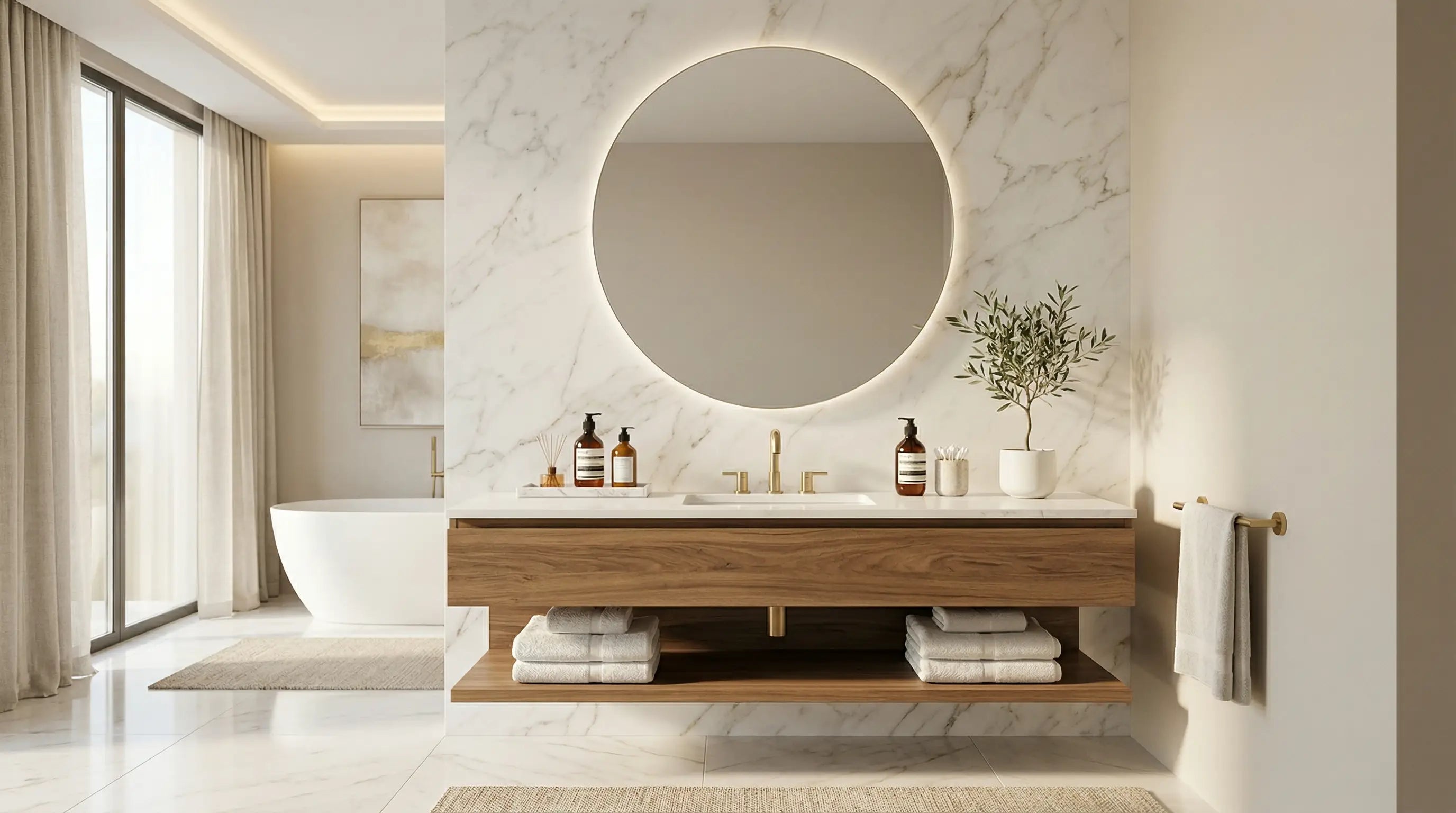
Everything you need to know about choosing, styling, and investing in bathroom accessories - from daily essentials to luxury upgrades that transform your space.
Your bathroom is no longer just a functional room. It's where you start and end every day - and the products filling it either upgrade that experience or quietly diminish it. Yet most homeowners spend thousands on tile and vanities, then shop for accessories as an afterthought.
This guide changes that. I have compiled the most comprehensive resource available for homeowners who want to make smart, informed decisions about every bath product category - from the everyday essentials to the statement pieces that define a bathroom's character.
A National Association of Realtors study found that bathroom renovations - including accessories - return an average of 71 cents on every dollar spent at resale. More importantly, Houzz's 2024 Bathroom Trends Report found that 68% of homeowners who upgraded their bathroom accessories reported significantly higher daily satisfaction with their home - without a single structural change.
The 5 Non-Negotiable Bathroom Essentials
Before worrying about aesthetics, every bathroom needs these five categories covered. These are the products that directly affect daily comfort, hygiene, and safety - and skimping on any of them shows.
1. Non-slip bath mat
The single most safety-critical accessory in any bathroom. The CDC reports that over 235,000 bathroom injuries requiring emergency care occur annually in the United States - the majority slip-related. A quality bath mat with proper suction or grip backing is non-negotiable.
What separates a great mat from a mediocre one: look for a weight of at least 1,800 GSM for cotton mats (higher means more absorbent and more grip), a non-slip TPR or latex backing, and a machine-washable construction. Memory foam mats offer superior comfort but require longer dry times - factor that in for high-traffic bathrooms.
For families with children or elderly members, consider a full bath mat set: one inside the tub or shower stall, one immediately outside. The outside mat handles 80% of slip risk - it's where weight shifts occur as you step out of a wet space.
2. Soap dispenser (liquid & lotion)
Matching soap dispensers are one of the highest visual-impact, lowest-cost upgrades you can make. Replacing four to six mismatched plastic pump bottles with a unified set immediately makes a bathroom look more curated and intentional.
Material hierarchy for longevity: stainless steel > ceramic > glass > plastic. Pump mechanisms are the failure point on most dispensers - look for a metal pump head and a minimum 300ml capacity to avoid constant refilling.
3. Toilet paper holder
Often overlooked, but it's one of the first things guests interact with. A wobbly, corroded, or mismatched holder undermines the entire room. The key buying consideration: ensure your mounting hardware matches the rest of your bathroom's finish (chrome, matte black, brushed nickel, etc.) - mixing finishes is the most common beginner mistake in bathroom design.
4. Towel bar or ring
Towels stored properly between uses dry faster, stay hygienic longer, and don't develop the musty smell that comes from balling them on hooks. A towel bar that allows the towel to hang fully open is the gold standard. Rings work for hand towels; bars are superior for bath towels.
5. Waste bin with lid
A lidded bathroom waste bin is a hygiene essential that most homeowners undervalue until they don't have one. The lid reduces airborne bacteria spread from the bin by up to 60% according to hygiene studies. Step-open mechanisms are the most hygienic (hands-free) and the most durable. Size recommendation: 3–5 litres for most bathrooms; avoid anything larger that becomes a dominant visual presence.
- Non-slip bath mat with suction/grip backing (1,800+ GSM for cotton)
- Matching soap dispenser set (liquid + lotion) in durable material
- Toilet paper holder matching your bathroom's metal finish
- Towel bar sized to allow full towel spread (not a hook)
- Step-open waste bin with liner, 3–5 litres
Bathroom Storage & Organisation Solutions
Storage is where most bathroom organisation fails — not because of space, but because of the wrong products in the wrong places. A well-organised bathroom feels twice as large as it actually is. A poorly organised one feels chaotic regardless of its size.
"The average bathroom contains 47 individual products - yet only 30% of bathrooms have adequate storage designed for that volume."
Houzz Bathroom Trends Report, 2024Over-toilet storage
The space above the toilet is chronically underused in most homes. A freestanding over-toilet etagere or a wall-mounted cabinet in this zone can add 8–12 cubic feet of storage without occupying floor space. This is especially valuable in smaller bathrooms where every square foot matters.
Under-sink organisation
The cabinet beneath the sink is the most chaotic storage zone in the average bathroom. The fix is simple: tiered pull-out organisers that work around the plumbing, plus a lazy Susan for round or awkwardly shaped products. Before buying any under-sink organisers, measure the interior dimensions and the pipe position — they vary widely.
Shower & bath zone storage
Products in the shower are exposed to constant humidity, which destroys untreated wood and low-grade metal. For shower caddies and shelves: aluminium or 304-grade stainless steel are the only materials worth purchasing. A tension-pole caddy works without drilling; a corner shelf with wall anchors is more stable and can hold heavier items like conditioner bottles.
Interior designers recommend thinking of bathroom storage in three zones: daily use (countertop and within arm's reach), weekly use (under sink and cabinet interiors), and seasonal/spare (overhead or linen storage). Assigning every product to a zone before buying storage eliminates 90% of bathroom clutter permanently.
Shower Accessories & Upgrades
No single upgrade has a higher impact-per-dollar ratio than a shower head replacement. It takes under 30 minutes, requires no plumbing expertise, and the difference in daily experience is immediate and dramatic.
Shower heads: what the specs actually mean
Flow rate (GPM) is the most important specification. Standard shower heads use 2.5 GPM; EPA WaterSense certified heads use 2.0 GPM or less. The difference in perceived pressure is negligible with a quality head, but the annual water savings are substantial. For households on well water or with low pressure, look for a head specifically marketed for low-pressure performance - the internal nozzle design determines pressure experience more than GPM.
| Shower head type | Best for | Avg. price range | Installation |
|---|---|---|---|
| Fixed wall-mount | Consistent single users, minimalist spaces | $30 – $200 | 10 min DIY |
| Rainfall (ceiling or wall) | Luxury experience, larger showers | $80 – $600 | DIY to plumber |
| Handheld + slide bar | Families, elderly, pets, cleaning | $40 – $300 | 20 min DIY |
| Dual (fixed + handheld) | Versatility seekers, multi-person households | $100 – $500 | 20–30 min DIY |
| Multi-function panel | Spa-style experience, master bathrooms | $300 – $2,000+ | Plumber required |
Shower curtains vs glass enclosures
Glass enclosures are the premium choice for any permanent bathroom - they're easier to clean long-term, visually open the space, and never need replacement. However, quality curtains with weighted hems and rust-resistant rings are a perfectly valid choice for rental homes, guest bathrooms, or budget renovations. The key variable: fabric curtains require more frequent washing; PEVA or vinyl curtains are more water-resistant but less breathable.
When selecting a shower curtain rod, a curved curtain rod adds approximately 25% more interior shower space. It's a $30–60 upgrade that meaningfully reduces the "clammy curtain on skin" experience — one of the most common complaints about standard showers.
Towel Solutions - Bars, Warmers & Hooks
Towels are in use in your bathroom every single day, which means their storage hardware is among the most-touched surfaces in your home. Getting this right pays dividends in comfort, hygiene, and aesthetics simultaneously.
Towel bars vs hooks: the real comparison
Bars allow towels to hang fully open, which means they dry in 3–4 hours rather than 8–12 hours on a hook. Faster drying = less bacterial growth = fresher-smelling towels. For bath towels, a bar is always the hygienic choice. Hooks are appropriate for robes and hand towels only.

Towel bars & rings
Choose a bar length that's at least the width of your widest towel. Standard bars come in 18", 24", and 30" — for a full bath towel, a 24" minimum is required.
Shop towel bars
Heated towel rails
Electric towel warmers are the single most-loved luxury bathroom upgrade among Bathify customers. Plug-in models install in minutes and use less electricity than a light bulb.
Shop towel warmersHeated towel rail buying guide
The defining specification for a towel warmer is BTU output (British Thermal Units) - this determines how quickly and thoroughly it heats. For a standard bath towel: a minimum of 150 BTU is required; 200–300 BTU is ideal for cold climates. Electric plug-in models are the easiest to install and can be positioned anywhere near an outlet. Hardwired models connect to your home's electrical system and require an electrician, but allow for cleaner installation with no visible cord.
In a 2023 survey of 1,200 Bathify customers, heated towel rails ranked as the #1 bathroom accessory purchase they were "most glad they made." Among customers in northern states and Canada, 91% said it changed their morning routine in a meaningful way. Average operating cost: $15–25 per year for a standard electric model.
Vanity & Countertop Accessories
The countertop is the visual centrepiece of most bathrooms. What sits on it — and more importantly, how organised it appears — determines the room's overall impression more than almost any other single factor.
The vanity tray: the designer's secret weapon
A vanity tray containing your soap dispenser, a candle, and 2–3 curated items does more for bathroom aesthetics than almost any other single purchase. It transforms random objects into an intentional vignette. Materials ranked by durability and aesthetics: marble (premium, occasional sealing required) > alabaster > lacquered bamboo > acrylic (avoid — scratches easily).
Mirror and medicine cabinet considerations
If you have a choice between a flat mirror and a medicine cabinet mirror, always choose the cabinet. The storage gained is disproportionate to the aesthetic cost — modern medicine cabinet designs are now indistinguishable from flat mirrors at a glance. Look for soft-close hinges (they prevent slamming that loosens mounting hardware over time) and interior lighting if the mirror is your primary grooming surface.

LED bathroom mirrors — the upgrade most homeowners don't know they need
An LED-backlit or front-lit mirror changes the quality of bathroom lighting fundamentally. Most bathrooms have overhead lighting that creates shadows directly beneath the face — the worst possible light for grooming. A front-lit LED mirror provides even, shadow-free illumination at exactly the right height. Dimmer functionality and colour temperature adjustability (3,000K–6,000K) are worth the premium on any grooming mirror.
Budget vs Luxury: What's Actually Worth Spending On
Not all bathroom accessories benefit equally from a higher budget. This framework - developed from years of customer feedback and product testing - tells you exactly where to spend and where to save.
| Product category | Spend more | Why it matters | Save here instead |
|---|---|---|---|
| Shower head | ✓ Yes | Used daily; pressure & durability vary enormously by price | Shower curtain rings |
| Towel bar / rail hardware | ✓ Yes | Cheap mounting hardware fails; a falling bar damages wall | Decorative shelving |
| Towel warmer | ✓ Yes | Cheap heating elements fail within 1–2 years | Over-toilet storage |
| Bath mat | ✓ Yes | Non-slip backing quality is safety-critical | Soap dish (cosmetic only) |
| Waste bin | ✗ No | Function doesn't improve much above $30-40 | Invest in towel bar instead |
| Toilet brush | ✗ No | Replaced frequently regardless of quality | Invest in soap dispenser instead |
The "finish rule" applies across all price points: choose one metal finish for all hardware and stick to it. A $25 toilet paper holder in matte black that matches your $180 towel bar looks intentional. A $60 toilet paper holder in chrome next to a brushed nickel bar looks like a mistake. Finish consistency costs nothing and elevates everything.
The Finish Guide: Choosing the Right Metal for Your Bathroom
Metal finish is the design decision most homeowners make unconsciously - and then regret when they see how disparate pieces look together. Here's what each major finish says about a bathroom and how to work with each one.
Polished Chrome
The most versatile and timeless finish. Highly reflective, pairs with almost any tile color, and is the easiest to clean. The default choice for transitional and traditional bathrooms. Note: shows water spots and fingerprints more than matte finishes.
Matte Black
The dominant choice for modern and contemporary bathrooms since 2019. Extremely forgiving with water spots and fingerprints. Pairs best with white, grey, or light-colored tiles. Avoid in very small, dark bathrooms where it can feel visually heavy.
Brushed Nickel
Warm, understated, and broadly compatible. Less reflective than chrome, which makes it easier to maintain. The safest choice for transitional bathrooms where you're mixing old and new elements. Ages gracefully over time.
Brushed Gold / Brass
The statement finish for luxury and maximalist bathrooms. Works exceptionally well against dark tiles, marble, and deep color palettes. Requires commitment - mixing brushed gold with other finishes rarely works. Best as an all-in choice.
Accessories for Small Bathrooms
A small bathroom isn't a design limitation - it's a design constraint that, properly understood, produces better outcomes than an unlimited space. The best small-bathroom accessories share three characteristics: they work vertically, they serve multiple functions, and they keep the floor clear.
- Go vertical: Every inch of wall space above eye level is storage potential. Floating shelves between the toilet and ceiling can hold 18+ months of toilet paper and stored products without taking a square inch of floor space.
- Choose wall-mounted over freestanding: Wall-mounted soap dispensers, toothbrush holders, and toilet paper holders free up countertop and floor space that makes the room feel larger.
- Use recessed niches in the shower: A recessed niche (tiled shelf built into the wall) eliminates shower clutter entirely. If a full renovation isn't possible, a corner shelf that doesn't protrude more than 3" achieves a similar visual effect.
- Mirrors larger than you think necessary: The most powerful visual trick in small bathroom design. A mirror that spans most of a wall doubles the perceived depth of a room. This doesn't cost more - it just requires intention.
- Over-door storage: The back of a bathroom door can hold robes, towels, hair tools, and more. Over-door hooks and racks require no installation and add zero to the room's visual footprint when the door is open.
Interior designers consistently return to three rules for small bathrooms: (1) keep the floor clear - every item on the floor makes the room feel smaller; (2) use consistent color for walls, grout, and accessories - fewer visual breaks = perceived larger space; (3) one large statement piece (a dramatic mirror, a freestanding towel warmer) reads better than ten small accessories fighting for attention.
Eco-Friendly & Sustainable Bath Products
Bathroom product consumption has a meaningful environmental footprint - the average household goes through approximately 300 single-use plastic bath product containers per year. Sustainable swaps in the bathroom are among the most impactful changes a household can make, and they've become significantly more appealing aesthetically in recent years.
The highest-impact sustainable swaps
- Refillable soap & shampoo dispensers: Eliminating single-use bottles is the single largest plastic reduction you can make in the bathroom. Quality dispensers with reliable pump mechanisms pay back their cost within 6–8 months in product savings.
- WaterSense certified shower head: Reduces water consumption by 20% or more without sacrificing pressure. At average water rates, this saves $150–350 annually depending on household size.
- Bamboo accessories: Bamboo is technically a grass, not a wood - it grows to harvest size in 3 - 5 years versus 20+ years for hardwood. For soap dishes, trays, and shelving, bamboo is an excellent sustainable alternative that looks premium.
- Organic cotton bath mats and towels: GOTS-certified organic cotton uses 88% less water and 62% less energy to produce than conventional cotton. It also performs better over time - organic cotton towels maintain their softness through more wash cycles.
- LED bathroom lighting: If your bathroom still has incandescent or halogen bulbs, switching to LED reduces bathroom energy use by 75%. Smart LED mirrors with built-in lighting are both a functional upgrade and an efficiency upgrade.
Frequently Asked Questions
What bath accessories should I buy first?
Start with the five non-negotiables: a quality non-slip bath mat, matching soap dispensers, a toilet paper holder, a towel bar, and a lidded waste bin. These cover daily function and hygiene.
How do I choose accessories that match my bathroom style?
Choose one metal finish and use it across all hardware. Keep colors consistent with 2–3 tones to create a clean and cohesive look.
Are expensive bathroom accessories worth the investment?
Yes for functional items like shower heads and towel bars. For decorative items, mid-range products are usually enough.
What are the best bath accessories for small bathrooms?
Use wall-mounted items, vertical storage, and large mirrors to save space and make the bathroom feel bigger.
How long do bathroom accessories typically last?
Most hardware lasts 10–20 years, while items like bath mats and soap dispensers may need replacement every few years.
Can bathroom accessories improve resale value?
Yes, they improve the overall look and feel of the bathroom, which helps create a better impression for buyers.
Ready to Upgrade Your Bathroom?
Explore Bathify's curated collection of premium bath accessories, from everyday essentials to luxury statement pieces - with free ground shipping on orders over $50.


