







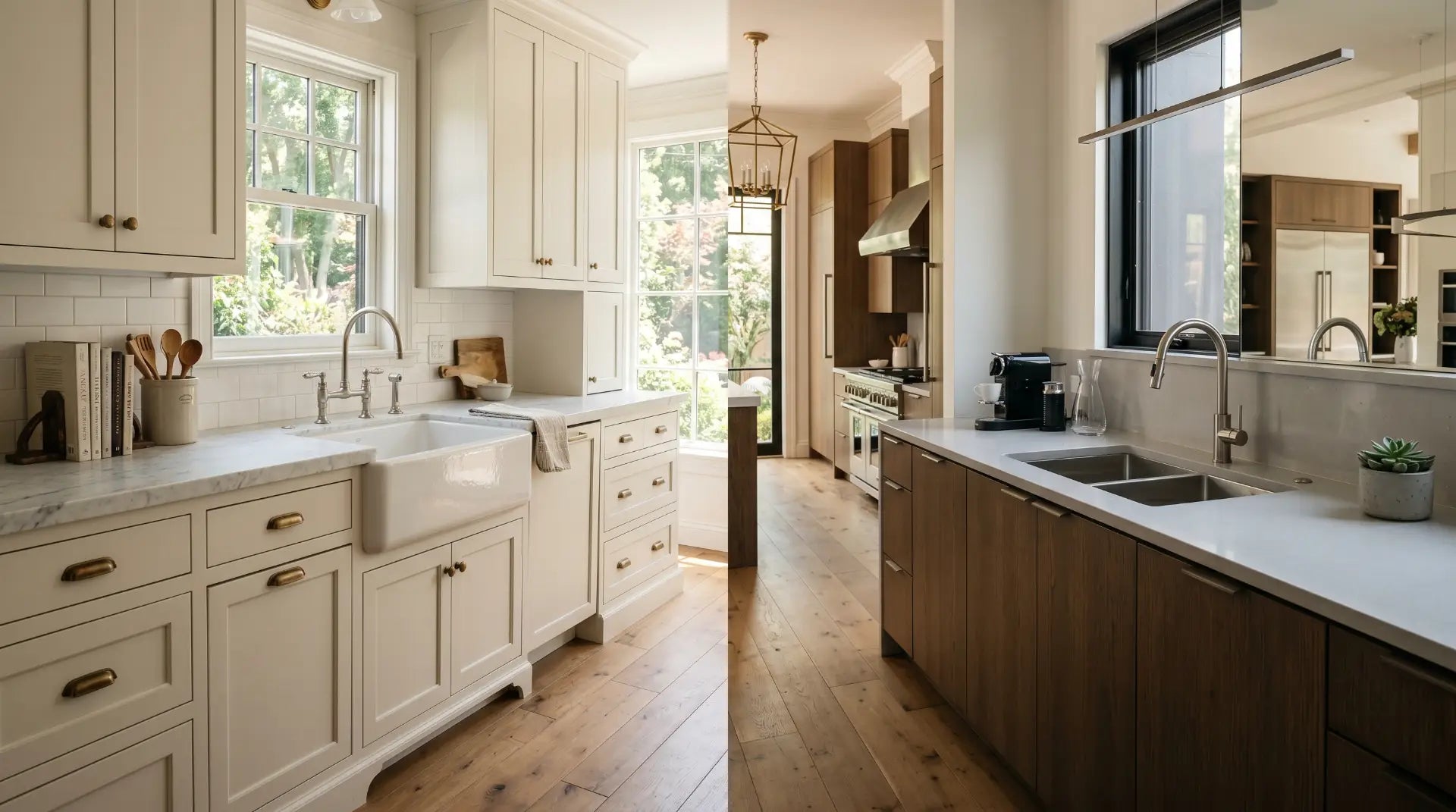
Both are beautiful. Both are popular. But they serve different kitchens, different budgets, and different lifestyles. This is the honest, side-by-side breakdown that actually helps you decide - no filler, no fence-sitting.
- The Real Difference Between a Farmhouse Sink and an Undermount Sink
- Quick Comparison: 10 Categories, Head to Head
- Design & Aesthetics: Which Sink Defines a Kitchen More?
- Installation: What You're Actually Committing To
- Material Options: What Each Sink Style Comes In
- Day-to-Day Maintenance: The Honest Story
- Cost Comparison: Sink, Modification & Installation
- Which Sink Fits Your Kitchen? A Practical Fit Guide
- Resale Value: Does the Sink Type Actually Matter?
- Who Should Choose What: A Decision Framework
- Pre-Purchase Checklist: Before You Order Either Sink
- Frequently Asked Questions
- More From This Series
At a structural level, the difference is simple. An undermount sink mounts beneath the countertop - the countertop surface extends to the edge of the cutout, and the sink hangs below it, held in place by clips and silicone. There is no rim above the counter surface, no visual break, and no seam to trap debris. The result is a seamless, low-profile installation that works with any kitchen design direction and integrates invisibly into the countertop material.
A farmhouse sink - also called an apron-front sink - is architecturally different. Instead of sitting below the counter, the front of the sink extends past the cabinet face and is exposed, forming the visible "apron." The countertop sits on top of the sink sides and back, but the front is proud of everything - the cabinets, the toekick, the counter edge. This is what creates the distinctive farmhouse look: that bold, uninterrupted front face that makes the sink a visual centerpiece rather than a functional element that disappears into the counter.
The most common mistake in this decision is choosing based on aesthetics alone. Farmhouse sinks require cabinet modifications that not every kitchen can accept, weigh significantly more than undermount sinks, and cost more to install. Undermount sinks require stone or solid-surface countertops and professional installation. Both choices have genuine trade-offs. This guide works through each one - honestly - so you can make the right call for your specific situation rather than the aspirational one from a kitchen magazine.

A farmhouse sink changes the visual hierarchy of a kitchen. In virtually every kitchen style - traditional, transitional, modern farmhouse, Shaker, cottage - the apron front becomes the first thing the eye lands on when entering the room. The exposed front panel, typically 8 to 10 inches tall and spanning the full width of the sink, reads as an architectural element rather than a plumbing fixture. A white fireclay apron front against white shaker cabinets is a subtle, tone-on-tone detail; the same sink against dark navy or green lower cabinets is a dramatic, magazine-worthy contrast.
This is a significant advantage if the goal is a kitchen with a strong design identity. It is a potential limitation if the kitchen design is minimal, contemporary, or industrial - styles where the sink is meant to disappear into the work surface rather than define it. A brushed stainless farmhouse sink works in a modern industrial kitchen; a white fireclay apron front reads as period-specific and can feel stylistically mismatched in a sleek, handleless-door contemporary kitchen.

An undermount sink is designed to disappear. The countertop surface - quartz, granite, marble, concrete - runs to the edge of the cutout and wraps down the exposed edge in a finished profile, and the sink hangs below it invisibly. There is no rim, no apron, no visual break. The counter is continuous and the sink is subordinate to it. This is exactly what makes undermount the right choice when the countertop is the design statement - a dramatic waterfall quartz edge, a book-matched stone slab, a thick concrete pour - or when the design priority is a clean, calm work surface that doesn't compete for attention.
Undermount sinks work in every kitchen style without exception. They are the default specification in contemporary kitchens, mid-century modern kitchens, industrial kitchens, and high-end transitional kitchens. A matte black undermount in a dark kitchen reads as intentional and curated. A standard stainless undermount in a bright white kitchen is invisible in the best possible sense - it contributes without demanding attention. This universal compatibility is one of the most underrated advantages of the undermount format.
If your kitchen design is built around a farmhouse or transitional aesthetic and you want the sink to be a defining visual element, a farmhouse sink delivers an emotional impact that an undermount cannot replicate. If your design is modern, contemporary, or the countertop is the hero of the space, an undermount serves the room better. Neither choice is aesthetically inferior - the right answer is context-specific.
This is the section most comparison articles underplay - and it is the one that causes the most expensive surprises. Installation complexity and cost differ significantly between the two sink types, and for many homeowners, the installation requirements are the deciding factor.

Installing a farmhouse sink in a kitchen that was not built for one is a multi-trade project. The front rail of the base cabinet - the horizontal face-frame member that runs across the top of the cabinet opening - must be cut away or removed entirely to allow the apron front to extend forward past the cabinet face. This is finish carpentry work, not plumbing. In some cabinet configurations, the entire face frame must be rebuilt around the sink opening. The cabinet floor may also need a support frame built from 2×4 lumber or plywood to carry the weight of a fireclay or cast iron sink - which can exceed 150 lbs before water is added.
The countertop cutout also changes with a farmhouse sink. Most farmhouse sinks require the countertop to be cut back to the rear of the apron front, which means the countertop stone overhangs the sink sides and back but terminates at the front - a specific cut that must be planned with the stone fabricator before the slab is templated. If the countertop is already installed, this cut requires in-place stone work, which is more expensive and higher-risk than a shop cut. The drain location also shifts: farmhouse sink drains are typically set further back in the cabinet than undermount drains, which can require plumbing repositioning.
- Cabinet front rail cut or removed - finish carpentry, not included in standard plumbing labor
- Cabinet floor reinforcement confirmed - weight-bearing support frame for fireclay or cast iron
- Countertop fabricator briefed on sink model before the slab is templated - cannot be added after
- Plumbing rough-in confirmed as compatible with new drain position - repositioning adds $150-$400
- Sink weight confirmed with installer - delivery handling for heavy fireclay requires advance coordination
- If retrofit model: confirm apron height matches the specific cabinet configuration before ordering

An undermount sink installs from below the countertop - the countertop sits on top of the sink's rim, and mounting clips attach to the underside of the stone with silicone creating the waterproof seal. There is no cabinet modification required (no face rail cutting, no support framing for typical stainless and composite models). The countertop does need to have the sink cutout made by the fabricator - which is standard practice and included in most countertop fabrication quotes when the sink is specified at the time of templating.
The critical requirement is countertop material. Undermount installation requires a countertop material strong enough to support the sink from below and create a waterproof bond at the rim - quartz, granite, marble, concrete, and solid surface all work. Laminate countertops are not compatible with undermount sinks; the weight and moisture exposure causes the laminate to swell, warp, and delaminate at the cutout edge over time. If your current countertops are laminate and you are not replacing them, an undermount sink is not the right choice - consider a top-mount instead.
Farmhouse sink installation is not harder in a skilled contractor's hands - it is simply more work, involving more trades, more coordination, and more permanent changes to the cabinet. If you are doing a full kitchen remodel where the cabinets, countertops, and plumbing are all being replaced simultaneously, the incremental complexity of a farmhouse sink is manageable and the cost premium is relatively modest. If you are doing a targeted sink replacement without disturbing the cabinets or countertops, an undermount is significantly easier and cheaper to execute correctly.
Both farmhouse and undermount sinks are available in multiple materials - but the material choices are not identical between the two formats, and the material you want may constrain which format is practical.
| Material | Available as Farmhouse? | Available as Undermount? | Weight | Best Known For |
|---|---|---|---|---|
| Fireclay | Yes - the classic choice | Limited - rarely specified as undermount | 100-175 lbs - the heaviest option | Glossy white glaze, timeless aesthetic, extreme durability against stains and acids |
| Stainless Steel (16-gauge) | Yes - brushed finish reads as modern farmhouse | Yes - the most common undermount material | 35-65 lbs depending on size | Durability, garbage disposal compatibility, widest size selection, most affordable quality option |
| Granite Composite | Yes - growing availability in apron-front format | Yes - premium undermount choice | 45-80 lbs | Quiet operation, matte stone finish, available in multiple colors including matte black |
| Cast Iron Enamel | Yes - classic farmhouse material | Yes but uncommon - weight complicates undermount mounting | 130-200 lbs - very heavy | Extremely durable enamel coating, classic look similar to fireclay but heavier and more chip-prone |
| Copper | Yes - specialty/artisan applications | Rarely specified | 25-40 lbs | Unique aging patina, antimicrobial surface - a niche choice that gains character over time |
If you want a farmhouse sink but your kitchen already has a garbage disposal and you plan to keep it, choose stainless steel or granite composite - not fireclay. Fireclay can develop micro-fractures over time from the vibration of a garbage disposal motor - a problem that typically takes three to five years to manifest but is difficult and expensive to fix once it appears. Stainless and composite farmhouse sinks are garbage disposal compatible without any additional consideration. This is one of the most common material-selection mistakes in farmhouse sink purchases, and it is almost never mentioned at the point of sale. Check out the full kitchen sink buying guide for a full material breakdown.

The basin of a farmhouse sink is one of the easiest surfaces in the kitchen to clean - the deep single bowl has no divider to trap debris, and the generous depth keeps water and food particles contained within the basin during washing. For stainless farmhouse sinks, the same care principles apply as any stainless surface: wipe dry after heavy use to prevent mineral deposits in hard-water areas, avoid abrasive scrubbers that leave scratches in the brushed finish. For fireclay, the glossy glaze is non-porous and resists staining well - a soft cloth and mild dish soap is the entirety of the routine maintenance.
The additional consideration for farmhouse sinks is the apron front. Because it is an exposed vertical surface positioned at hip or upper-thigh height - exactly where cooking splatter, water drips, and toddler hands make contact - the apron front accumulates grime on a different timeline than an undermount sink's invisible underside. Wiping the apron front daily (or every few days for lower-traffic kitchens) is the habit that separates a farmhouse sink that looks beautiful for twenty years from one that shows water marks and residue within the first year. This is not a difficult task - it takes thirty seconds - but it is one that an undermount sink owner never has to think about.

The primary maintenance advantage of an undermount sink is the countertop-to-sink interface. With no rim above the countertop surface, wiping the counter directly into the sink requires no lifting, no navigating a ridge, and no concern about debris collecting at a seam. This is a daily-use advantage that becomes more noticeable over time - the absence of a problem is easy to take for granted until you use a top-mount or retrofit to a drop-in and immediately notice the seam collecting debris around the rim.
The periodic maintenance task unique to undermount sinks is the silicone seal at the countertop-to-sink junction. A quality installation with a premium silicone sealant will hold for many years without attention, but the seal should be visually inspected annually and resealed every two to five years depending on usage and cleaning chemical exposure. A degraded seal allows water to penetrate between the sink and the countertop, which in stone countertops causes discoloration and in the cabinet below causes mold and wood damage. If the seal is maintained, this is a non-issue. If it is ignored and fails, the repair is more involved than a simple re-seal.
Undermount sinks have a meaningful advantage in day-to-day maintenance because there is no apron to wipe and no seam to accumulate debris. For high-use family kitchens where countertop cleaning efficiency matters, this is a genuine daily quality-of-life difference. For households that cook seriously and clean carefully, the extra thirty seconds of apron wiping required by a farmhouse sink is not a burden - it is just part of the sink's upkeep. The right answer depends on how much attention to routine cleaning your household realistically applies.
The true cost of each sink type is not the price on the product page - it is the all-in cost including installation labor, cabinet modification (if required), countertop coordination, and plumbing adjustments. Here is a realistic cost breakdown for a standard US kitchen renovation scenario.
| Your Kitchen Situation | Farmhouse Viable? | Undermount Viable? | Recommendation |
|---|---|---|---|
| Full remodel - new cabinets, new countertops, new plumbing rough-in | Yes - ideal scenario | Yes - ideal scenario | Full remodel is the best time for a farmhouse sink. Everything is open. Specify the sink before cabinets are ordered so the base cabinet is built correctly from the start. |
| New countertops, existing cabinets staying | Possible - requires cabinet modification | Yes - specify sink at templating | Undermount is significantly easier. Farmhouse is possible if the existing cabinet can be modified, but confirm with a cabinet installer before ordering the sink. |
| Sink replacement only - cabinets and countertops staying | Difficult - countertop must be re-cut | Possible - same-size replacement is easiest | Undermount replacement is practical if the new sink's cutout dimensions are close to the old sink's. Farmhouse in an existing countertop requires stone cutting in place - expensive and high-risk. |
| 36" base cabinet with front rail that can be modified | Yes - standard farmhouse scenario | Yes - oversized for undermount; consider a workstation | A 36" cabinet with a modifiable front rail is the sweet spot for a farmhouse sink. An undermount in a 36" cabinet works but leaves counter space on either side of the cutout - consider a wider undermount or workstation format. |
| 30" base cabinet or smaller | Not recommended - farmhouse sinks require 33-36" minimum | Yes - the standard undermount scenario | Undermount is the correct choice for 30" or smaller cabinets. Most fireclay farmhouse sinks require at least a 33" cabinet; stainless farmhouse sinks start at 30" but look cramped at that width. |
| Laminate countertops staying | Possible (top-mount farmhouse only) | No - undermount requires solid surface countertop | If laminate countertops are staying, neither a standard undermount nor a farmhouse undermount is appropriate. A top-mount farmhouse (drop-in apron) is available and works with laminate, though it reads as less premium than a true undermount installation. |
| Garbage disposal staying or planned | Stainless or composite farmhouse only | Yes - all materials compatible | If a garbage disposal is staying, do not specify fireclay or cast iron farmhouse - vibration risks are real. Stainless or granite composite farmhouse and all undermount types are garbage disposal compatible. |
Both farmhouse and undermount sinks contribute positively to kitchen resale value - but in different ways and for different buyer profiles.
A well-executed farmhouse sink installation - clean apron, matching faucet finish, coordinated cabinet color - generates a stronger emotional response from buyers than an undermount sink of equivalent quality. It is a "wow" moment in a listing walkthrough that an undermount rarely achieves, because an undermount is expected in a renovated kitchen while a farmhouse sink is memorable. This emotional response translates to faster offer timelines in markets where farmhouse and transitional aesthetics are popular - suburban US markets, the Northeast, the Midwest, and the South particularly.
The limitation is that farmhouse sinks are more stylistically specific than undermount sinks. A buyer who is not drawn to farmhouse aesthetics will not respond positively to an apron-front sink - and in urban high-density markets where contemporary and minimal aesthetics dominate, a fireclay farmhouse sink in a white shaker kitchen can read as off-trend rather than aspirational. Know your market before making the farmhouse commitment as a resale strategy.
A quality undermount sink is now the expected standard in any renovated American kitchen above the entry price point. Its presence does not generate excitement - but its absence in a kitchen that has new quartz countertops and new appliances will be noticed by buyers as an inconsistency. The resale contribution of an undermount sink is less about generating enthusiasm and more about not triggering concern: a buyer who sees a drop-in sink with a worn rim seam in an otherwise updated kitchen will start mentally calculating renovation costs. An undermount in good condition removes that friction entirely.
For listings, an undermount stainless or composite sink in a coordinated finish - paired with a pull-down faucet in the same metal family as the cabinet hardware - is the safe, broad-market specification that performs across buyer profiles without polarizing anyone. It is the specification that real estate agents and stagers consistently recommend before listing.
- You are doing a full kitchen remodel where cabinets and countertops are being replaced - the best and lowest-cost window for farmhouse installation
- Your kitchen design is farmhouse, transitional, Shaker, or cottage - styles where the apron front reads as designed-in rather than retrofitted
- You have or are installing a 36" base cabinet that can accept or be modified for an apron-front sink
- You do not plan to use a garbage disposal - or you are choosing stainless or composite, not fireclay
- Your household cleans regularly and a daily 30-second apron wipe is not a burden you resent
- Resale is not an immediate concern, or you are in a market where farmhouse kitchens are in high demand
- You want the sink to be a feature you notice and appreciate every time you cook - not a background element
- You are replacing a sink without major cabinet or countertop work - undermount replacement is dramatically simpler
- Your kitchen design is contemporary, modern, industrial, or minimal - styles where the sink should disappear into the counter
- Your base cabinet is 30" or smaller - farmhouse sinks do not proportionally fit narrower configurations
- You have a garbage disposal and plan to keep it - undermount is compatible with all materials
- You want the lowest-friction daily maintenance experience - no apron to wipe, crumbs wipe directly into the basin
- You are preparing to sell and want the broadest possible buyer appeal across market segments
- Your countertop is a dramatic statement material - quartz waterfall, book-matched stone - and the sink should not compete with it
If you are doing a full kitchen remodel with new cabinets and a 36" sink base, and your design is transitional or farmhouse, get the farmhouse sink. The installation cost premium is worth it and the result is genuinely better for that kitchen. If you are replacing a sink in an existing kitchen, or your design is anything other than farmhouse or transitional, an undermount sink is the more practical, more versatile, and better-value choice. The farmhouse sink trend is real and durable - but it is not the right choice for every kitchen, and the internet's visual bias toward aspirational farmhouse kitchens makes this harder to see clearly. Shop farmhouse sinks → | Shop undermount sinks →
- Cabinet interior width confirmed at 33" minimum; 36" for standard farmhouse proportions
- Cabinet front rail modification confirmed as possible - a cabinet installer or contractor has assessed the specific cabinet
- Cabinet floor confirmed as capable of supporting sink weight - structural support frame planned if fireclay or cast iron
- Countertop fabricator briefed on sink model and apron dimensions before templating - this cannot be done after the slab is cut
- Drain rough-in location confirmed as compatible with new sink drain position - plumber has assessed
- If fireclay: garbage disposal confirmed as not present or not planned
- If retrofit model: apron height confirmed as matching the specific cabinet configuration
- Delivery logistics confirmed - fireclay sinks over 100 lbs require two-person handling; confirm with installer before delivery date
- Countertop material confirmed as compatible with undermount: quartz, granite, marble, concrete, or solid surface - not laminate
- Sink cutout dimensions confirmed with countertop fabricator before slab is templated
- Cabinet interior width measured - new sink confirmed to fit with clearance for mounting clips
- Existing drain location confirmed as compatible with new sink drain position
- Basin depth confirmed at 9" minimum for family kitchens with regular pot and pan washing
- If stainless: gauge confirmed at 16 or 18 - not 20 or 22
- Sound dampening confirmed for stainless undermount - rubberized pad on exterior basin bottom
- Drain assembly confirmed as included or ordered separately
- Faucet hole count confirmed - farmhouse sinks typically have no pre-drilled holes (faucet mounts through countertop); undermount sinks vary
- Faucet finish selected and confirmed as matching the dominant cabinet hardware finish
- Sink grid or basin protector ordered in the correct model-specific size - not a universal-fit product
- Licensed plumber confirmed for installation - neither sink type is a reliable DIY install for first-time renovators
Shop farmhouse and undermount sinks at Bathify
Browse our full collection of farmhouse sinks, undermount sinks, and kitchen faucets - all shipped free across the continental United States. Free shipping on orders over $50.


