







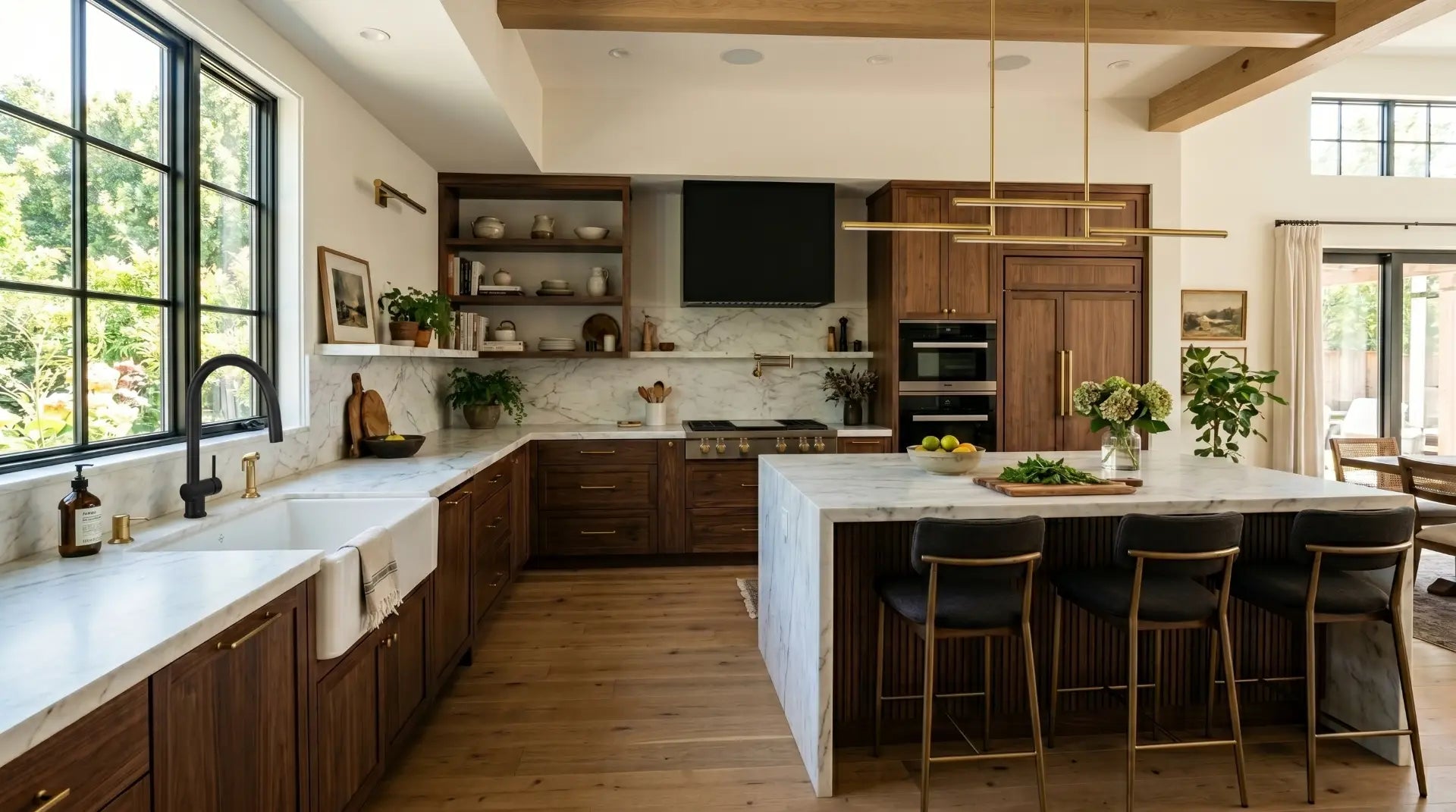
The kitchen sink is the most-used fixture in your entire home - the average American uses it more than eight times a day. Choosing the wrong one means years of compromise. This guide covers every style, material, configuration, and size decision so you can buy right the first time.
- Why the Kitchen Sink Is the Most Consequential Fixture Decision in a Remodel
- Mount Types: Undermount vs. Top-Mount vs. Farmhouse vs. Workstation
- Sink Materials: Stainless Steel vs. Granite Composite vs. Fireclay vs. Cast Iron
- Sink Material vs. Countertop Compatibility Matrix
- Kitchen Sink Sizes: What Fits Your Cabinet and How to Measure
- Drain Placement: Center vs. Rear-Offset and Why It Matters
- Single Bowl vs. Double Bowl: Which Configuration Is Right for You?
- Stainless Steel Gauge Explained: Why 16-Gauge Beats 22-Gauge Every Time
- Farmhouse Sinks: Fireclay vs. Stainless vs. Granite Composite
- Workstation Sinks: The Upgrade Worth Considering
- Faucet Compatibility: Hole Count, Spread & What to Check Before You Buy
- Budget Matrix: Where to Spend and Where to Save
- Complete Kitchen Sink Buying Checklist
- Frequently Asked Questions
- More From This Series

Every fixture decision in a kitchen remodel has trade-offs, but none are as permanent or as visible as the sink. Unlike cabinet hardware or light fixtures - which can be swapped out in an afternoon - changing a kitchen sink means cutting countertops, replacing plumbing connections, and potentially modifying the cabinet base. Most homeowners live with their sink choice for 15 to 25 years. Getting it right the first time is not just about aesthetics; it is about daily quality of life.
The sink also anchors the visual center of the kitchen work zone. In open-plan American kitchens where the sink faces the living or dining area, the sink, faucet, and countertop combination is one of the first things a guest or buyer sees. A correctly specified sink in the right material and mount style reads as a completed, coherent kitchen. A drop-in self-rimming sink in an otherwise premium quartz countertop renovation signals a budget compromise that undermines the entire room's perceived value.
Most homeowners start by browsing sink styles and fall in love with a look before confirming whether it fits their cabinet, countertop, or plumbing configuration. The correct order is to lock in the mount type first (which is determined by your countertop material and cabinet construction), then choose the material that fits your usage pattern, then confirm sizing, then select bowl configuration, and finally verify faucet hole compatibility. Each decision constrains the next. Reversing this order is the source of most costly sink purchase mistakes.
The mount type is the single most important structural decision in selecting a kitchen sink - it determines countertop compatibility, cabinet modification requirements, cleaning ease, and the overall visual quality of the sink installation. Here is an honest comparison of all four formats available at Bathify.

An undermount sink attaches to the underside of the countertop, leaving the countertop surface flush and uninterrupted to the edge of the sink cutout. There is no rim, no seam to collect food debris, and no visual break between the countertop and the basin. Wiping the counter directly into the sink is possible - a practical advantage that makes undermount the dominant choice in professionally designed American kitchens and the near-universal specification in homes listed above the median in any US metro market.
The requirement: the countertop must be a solid material capable of supporting the sink weight from below - quartz, granite, marble, concrete, or solid surface. Undermount installation is not compatible with laminate countertops, which cannot support the load or form a waterproof bond at the rim. If you are upgrading from laminate to quartz as part of your renovation, specify the undermount sink simultaneously so the countertop fabricator can cut the opening and create the finished edge in one visit. Adding the sink cutout after the countertop is installed costs significantly more.
- Countertop material confirmed as solid surface capable of undermount support
- Cabinet base width and front-to-back depth measured - sink must fit within the cabinet opening with clearance for clips and plumbing
- Sink opening dimensions confirmed with countertop fabricator before the slab is cut
- Plumber contacted to confirm drain location works with the new sink depth

A top-mount sink (also called a drop-in sink) is lowered into a countertop cutout from above, with a rim that overlaps and rests on the counter surface. It is the easiest sink type to install - often a genuine DIY-friendly project - and it is compatible with every countertop material including laminate. This makes it the dominant choice for rental properties, budget-conscious kitchen refreshes, and situations where the countertop is not being replaced.
The trade-off is the rim. That visible seam where the sink rim meets the countertop surface traps water, food particles, and grime at its edges - it is the first place a kitchen cleaning routine fails over time, and it is the detail that distinguishes a top-mount installation from an undermount one in listing photography and in-person showings. If your budget includes new countertops, step up to undermount - the visual and maintenance improvement is substantial for a modest cost difference.
A farmhouse sink - also called an apron-front sink - extends forward to the cabinet face, with the front panel of the sink (the apron) replacing the traditional cabinet face rail. The result is a sink with a deep basin, a distinctive visual presence, and a classic profile that has moved from a purely rural aesthetic to a mainstream design choice across contemporary, transitional, and traditional American kitchens. A fireclay farmhouse sink in a white kitchen is one of the most photographed and aspirational kitchen details in current US renovation design.
The installation requirement is the critical factor: almost every base cabinet manufactured before 2010 requires modification to accept a farmhouse sink - the front rail of the cabinet must be removed or trimmed, and the cabinet box may need reinforcement to carry the additional weight of a fireclay or cast iron apron-front sink. This is not a DIY retrofit in most cases. Budget for professional cabinet modification in addition to the plumber's installation time. The result, when done correctly, is a sink that reads as architecturally integrated and purpose-built rather than dropped into the kitchen as an afterthought.
A workstation sink adds integrated rails or ledges running along the interior rim of the sink - purpose-built to hold sliding accessories like cutting boards, colanders, drying racks, and knife holders. The concept turns the sink from a place where water runs to a fully functional prep station that can handle washing, prepping, draining, and drying simultaneously without consuming any counter space. For open kitchens, it also creates a visual focal point that signals a serious cooking environment rather than a standard residential sink installation.
Most workstation sinks are stainless steel undermount models - the interior rail system requires precision manufacturing that favors stainless construction, and the undermount format provides the clean perimeter the ledge system needs to function. The accessories are typically included or available as a set; confirm that the cutting board, colander, and rack provided are sized to the specific sink model before purchasing, as workstation accessories are not interchangeable across brands or sizes.
If you are replacing a top-mount sink and your countertops are staying, measure the existing cutout opening before ordering a new sink. The new sink's cutout dimensions must match or be close to the existing opening - a sink with a significantly smaller cutout will leave an exposed gap in the countertop; one with a larger cutout requires cutting into finished stone. Most top-mount replacement sinks are designed to use the existing cutout dimensions of common standard sizes, but verify before purchasing. Undermount replacements require re-cutting and edge finishing - always coordinate with a stone fabricator.
Material determines how a sink sounds, feels, performs under heat and impact, ages over time, and reads visually against your countertop and cabinetry. Each material has genuine strengths and genuine limitations - choosing the right one is a function of your usage pattern, your kitchen's design direction, and your maintenance preferences.
Stainless steel is the dominant kitchen sink material in the United States - accounting for the majority of new kitchen sink installations - and for good reason: it is durable, hygienic, compatible with both undermount and top-mount configurations, available across every price range, and visually consistent with modern, transitional, and industrial kitchen aesthetics. It does not rust, crack, or chip under normal use. It handles heat from hot pots and pans without damage. It is easy to clean.
The variable that determines whether a stainless steel sink is worth buying is gauge - the thickness of the steel measured inversely (a lower number means thicker steel). A 16-gauge stainless sink is robust, quiet, and durable; a 22-gauge sink is thin, resonant (loud when dishes are placed in it), and prone to denting. The section on gauge below covers this in full, but the headline rule is: never buy below 18-gauge for a daily-use family kitchen, and target 16-gauge if budget allows. The cost difference between a 16-gauge and 22-gauge sink from the same brand is often $100-$200 - a trivial amount relative to the lifetime of the product.
The other variable: sound dampening. Quality stainless sinks include a rubberized coating sprayed onto the exterior bottom of the basin that significantly reduces noise from water flow and dish contact. Confirm that the sink you are purchasing has this coating - it is not universal on lower-price models, and its absence is immediately apparent in daily use.
Granite composite sinks are manufactured from approximately 80% crushed granite bonded with 20% acrylic resin - the result is a non-porous, matte-finish sink that is significantly quieter than stainless steel, highly resistant to scratches and chips, and available in a range of colors (black, graphite, white, beige, sand) that do not exist in stainless. This is the fastest-growing segment of the US kitchen sink market, and the reason is straightforward: granite composite delivers a premium look that coordinates naturally with stone countertops, performs better acoustically than any stainless alternative, and requires less maintenance attention than fireclay or cast iron.
The trade-offs are weight (granite composite sinks run 40-60 lbs before installation, which can add cost to professional installation) and price - a quality granite composite undermount sink costs $400-$1,000, which is more than equivalent stainless models. Light-colored composite sinks (white or beige) also show mineral deposits more readily in hard-water markets - Chicago, Phoenix, Dallas - and require periodic descaling to maintain appearance. Dark composite sinks hide mineral buildup but can show metal marks from pots and pans, which typically wipe off with a non-abrasive cleaner.
Fireclay is manufactured by shaping clay into the sink form and firing it at temperatures exceeding 2,000°F - a process that fuses the clay and glaze into a single, dense, non-porous material. The result is a sink with a glossy white surface that is highly resistant to staining, scratching, and acids - and one that maintains its bright white finish without the yellowing that affects older porcelain-on-cast-iron sinks over time. Fireclay is the premium choice for farmhouse-style apron-front sinks and is the material most commonly specified in high-design American kitchens where the sink is intended as a visual focal point.
The limitations are weight and impact sensitivity. Fireclay farmhouse sinks typically weigh 100 to 175 pounds - requiring cabinet reinforcement and professional installation in nearly every application. The glazed surface, while highly durable, can chip if a heavy cast iron pan or a sharp object is dropped directly into the basin. These chips are visible and repairable, but they require a repair kit and attention. Fireclay sinks also are not recommended for installation above garbage disposal units - the vibration can create micro-fractures over time. If you plan to keep your garbage disposal, a stainless farmhouse sink is a more compatible choice.
Cast iron kitchen sinks are built from a solid iron core coated with multiple layers of porcelain enamel that is fused at high heat. The result is an extraordinarily heavy, dense sink - typically 125 to 200 lbs for a standard undermount or top-mount model - that is one of the most scratch-resistant and chip-resistant surfaces available in any residential sink. The enamel coating is harder than stainless steel and significantly more resilient than the glaze on a fireclay sink when it comes to impact from heavy cookware. A well-maintained cast iron sink in a pre-war American kitchen can still be in functional, visually intact condition after 70 years of use. Brands like Kohler and American Standard have manufactured cast iron kitchen sinks in the US market since the early twentieth century.
The enamel is also available in a wide range of colors beyond white - bisque, black, cobalt, and various heritage tones that simply do not exist in stainless or composite - making cast iron the material of choice for kitchens where a specific color accent at the sink is part of the design intent. The practical trade-offs are weight and sound. The sheer mass of a cast iron sink requires substantial cabinet reinforcement - more than composite or fireclay in most installations - and a plumber experienced with heavy sink placement. Unlike granite composite, cast iron transmits rather than absorbs sound at the basin surface; sound dampening pads underneath are essential and usually included in quality models. The enamel can also craze (develop hairline surface cracks) if subjected to sudden, severe thermal shock - pouring boiling water directly from a pot into a cold dry basin repeatedly over many years can eventually compromise the glaze. Running cold water into the basin simultaneously prevents this.
Not every sink material works with every countertop material - and not every mount type is structurally viable on every surface. This is the table most buying guides skip, and it is the one that prevents the most costly renovation mistakes. Use it to confirm your sink and countertop combination before ordering either.
| Countertop Material | Stainless Steel | Granite Composite | Fireclay | Cast Iron Enamel | Key Considerations |
|---|---|---|---|---|---|
| Quartz | Ideal | Ideal | Compatible | Compatible | The most accommodating countertop material - supports all sink types. Undermount is the standard specification. Confirm fabricator has experience with the specific sink profile, especially for farmhouse cutbacks. |
| Granite (Natural Stone) | Ideal | Ideal | Compatible | Compatible | Same as quartz - all undermount configurations viable. Natural granite slabs vary in thickness; confirm the slab thickness can accommodate undermount clip depth before ordering a heavy cast iron or fireclay sink. |
| Marble | Compatible | Compatible | Use Caution | Use Caution | Marble supports undermount installation but is softer and more brittle than granite or quartz - the weight of a fireclay or cast iron sink (100-200 lbs) concentrated at the cutout edges creates fracture risk over time. Professional assessment of slab thickness and support required before specifying heavy sink materials in marble countertops. |
| Butcher Block (Wood) | Compatible | Compatible | Use Caution | Use Caution | Undermount on butcher block requires a waterproof seal at every edge - wood that is consistently wet at the cutout will swell, warp, and delaminate within a few years if not properly sealed and maintained. Stainless and composite are the better material choices here; fireclay and cast iron weight can stress wood at the cutout edge. Top-mount is the more reliable configuration for butcher block when sealing is uncertain. |
| Concrete | Ideal | Ideal | Compatible | Compatible | Poured-in-place concrete countertops can accommodate integral (cast-in) sink forms or standard undermount cutouts. Confirm with your concrete fabricator - integral concrete sinks are formed during the pour and are not an add-on decision. For undermount, concrete thickness and reinforcement must be specified for the sink weight. |
| Soapstone | Compatible | Compatible | Compatible | Compatible | Soapstone is dense and non-porous - it handles undermount installation well. The characteristic dark gray aesthetic pairs naturally with fireclay (classic contrast) or dark composite (cohesive matte pairing). Soapstone fabricators are less common than granite or quartz shops; confirm availability of a specialist before specifying this combination. |
| Laminate | Top-mount only | Top-mount only | Not compatible | Not compatible | Laminate cannot support undermount installation - it lacks the structural rigidity to hold a sink from below and cannot form a waterproof bond at a cut edge. All laminate countertop sink installations must be top-mount (drop-in). Fireclay and cast iron are not appropriate with laminate at any configuration due to weight and water ingress risk. If your goal is an undermount or farmhouse sink, the laminate countertop must be replaced as part of the project. |
Kitchen sink sizing is determined by two measurements: the overall sink dimensions and the cabinet opening dimensions. These are not the same thing, and confusing them is one of the most common sink purchase errors. Here is how to measure correctly and what standard sizes to expect.
| Cabinet Width | Typical Sink Opening | Recommended Sink Size | Bowl Configuration | Notes |
|---|---|---|---|---|
| 24" | Approximately 20-21" interior | 21" × 15" single bowl | Single bowl only - too narrow for double | Common in galley kitchens and apartments; limited to compact undermount or top-mount options |
| 27" | Approximately 23-24" interior | 23" × 17" single or small double bowl | Single bowl preferred; shallow double possible | Allows for a functional single bowl or a 50/50 double in limited configurations |
| 30" | Approximately 26-27" interior | 27" × 19" - the US standard | Single or double bowl; the most common size for single-bowl upgrades | Most Common - the dominant cabinet size in US residential kitchens; widest selection of sink models at this width |
| 33" | Approximately 29-30" interior | 30" × 20" or 32" × 20" | Single large bowl or 60/40 double bowl - the most functional double configuration | Recommended Upgrade - provides a genuinely deep and functional single bowl or a practical double that does not compromise either side |
| 36" | Approximately 32-33" interior | 32-33" × 20-22" farmhouse or large undermount | Farmhouse apron-front at this width; workstation sinks and premium undermount double bowls | Farmhouse Territory - at 36", a farmhouse sink is proportionally correct; most standard undermount sinks will look small relative to the cabinet opening |
Bigger is almost always better when it comes to kitchen sink basin depth. The standard basin depth in entry-level sinks is 7-8 inches - functional but inadequate for washing large stock pots, sheet pans, or tall pitchers without tilting and spilling. Specify a minimum basin depth of 9 inches, and target 10 inches for a family kitchen where large cookware is regularly washed. At this depth, even a 16-inch wide basin becomes genuinely functional for serious cooking. Depth is the dimension most commonly sacrificed to reduce sink weight and cost, and it is the one you will notice every single time you wash a pot.
Drain placement is the specification that almost no buying guide mentions - and the one that routinely surprises homeowners on installation day. Where the drain sits within the sink basin determines two things: where the P-trap assembly sits inside the cabinet, and how much usable storage space remains underneath the sink once the plumbing is connected. Getting this wrong does not make the sink non-functional, but it can make the under-sink cabinet significantly less useful for the entire life of the renovation.
| Drain Position | P-Trap Location | Under-Sink Storage | Best For | Watch Out For |
|---|---|---|---|---|
| Center Drain | P-trap sits centered in the cabinet, typically at mid-height - takes up central under-sink space | Moderate - the centered P-trap and drain assembly limits usable cabinet space on both sides; storage bins and organizers must work around the pipe centerline | Standard configurations where under-sink storage is not a priority; deep single-bowl sinks where the drain position has no practical alternative | Center drain P-traps are more visible from the front of an open cabinet and can make standard under-sink organizer products harder to fit; measure P-trap height before purchasing any sliding storage systems |
| Rear-Offset Drain | P-trap sits toward the back of the cabinet, tucked against the rear wall - clears the front two-thirds of the cabinet floor | Best - the majority of the cabinet floor is clear and flat, making it compatible with pull-out drawers, tiered organizers, and full-width storage systems without accommodation for a centered pipe | Any kitchen where under-sink organization is a priority; kitchen island installations; kitchens with 30" or smaller base cabinets where every inch of storage matters | The rough-in drain in the wall must align with the rear-offset position - if you are replacing an existing center-drain sink with a rear-offset model, the plumber will need to move or extend the stub-out; budget $100-$300 for this adjustment |
| Left or Right Offset Drain | P-trap sits to one side of the cabinet - useful in double-bowl sinks to clear the space under the larger bowl | Good on the opposite side; restricted on the drain side - plan storage accordingly | 60/40 double-bowl sinks where the offset drain maximizes clearance under the larger bowl; workstation sinks with accessories that need a clear basin floor | Side-offset drain position is model-specific - confirm before ordering and verify plumber can accommodate the offset position with the existing rough-in location |
Rear-offset drain sinks cost no more than center-drain equivalents - the drain position is a manufacturing specification, not a premium upgrade. The only additional cost is plumbing adjustment if the existing stub-out is centered. For new builds and full renovations where the plumber is already on-site, moving the stub-out to the rear costs almost nothing. For replacement-only projects, confirm the existing rough-in position before selecting a sink with a rear-offset drain - or budget for the plumber's adjustment visit.
The drain position is listed in the sink's specification sheet, not always in the product title or marketing copy. When comparing sinks online, look for terms like "rear drain," "back drain," or "offset drain" in the spec table. If the drain position is not stated, assume it is centered. For workstation sinks - where the basin floor is frequently used as a functional work surface with accessories - a rear or offset drain keeps the usable floor area maximally clear and prevents the drain from interfering with cutting board or colander placement.
The single-bowl versus double-bowl debate has a clearer answer in 2026 than it did a decade ago - the rise of the dishwasher as the primary dish-cleaning tool in American homes has shifted the calculus significantly in favor of single bowls for most kitchen configurations. Here is an honest comparison.
| Configuration | Best For | Limitations | Verdict |
|---|---|---|---|
| Single Bowl | Households with a dishwasher; serious cooks who wash large pots and sheet pans; kitchens with a 30" or 33" cabinet where a double would produce two undersized bowls | No built-in partition for separating dirty and rinsed dishes without a dishwasher; no segregated soaking zone | Recommended for most - the most functional configuration for modern dishwasher-equipped kitchens; allows for the widest basin and most usable workspace |
| 50/50 Double Bowl | Kitchens without a dishwasher; households that hand-wash everything and need a dedicated soap side and rinse side | In a 30" cabinet, each bowl is only approximately 13-14" wide - too narrow for large pots; creates two compromised workspaces rather than one functional one | Use with caution - in a 30" or smaller cabinet, both bowls become too narrow to be genuinely useful; only practical in a 33" or wider cabinet |
| 60/40 Double Bowl | Households that want both a main washing zone (larger bowl) and a prep or rinse zone (smaller bowl); kitchens with a 33" or wider cabinet | The 40% bowl is still limited in width - useful for straining, soaking, or bar prep but not for large cookware | Best double-bowl option - provides one usable main bowl and a practical secondary zone without equally compromising both; requires a 33" cabinet minimum |
| Single Bowl with Divider / Workstation | Households that want the best of both formats - a full-width basin with the option to create zones using removable cutting boards, colanders, and racks | Higher upfront cost for the sink and accessories; accessories must match the specific sink model | Best overall configuration - provides maximum flexibility without permanently sacrificing basin width; the workstation format makes this practical and visually cohesive |
The 50/50 double bowl was designed for a time when every dish was hand-washed - one side for soapy water, one side for rinsing. In a kitchen with a dishwasher (which describes most American households today), the double bowl creates two narrow, less functional basins where one large functional basin would serve better. The design professionals who specify kitchens at the mid-to-premium price point almost universally recommend single bowl or workstation format for clients who have a dishwasher. The exception is a 33"+ cabinet where a 60/40 bowl creates a genuinely useful primary basin.
Gauge is the thickness measurement used for stainless steel sinks, and it is one of the most misunderstood specifications in the kitchen fixture market. The confusion comes from the numbering: a lower gauge number means thicker steel. A 16-gauge sink is significantly thicker and more durable than a 22-gauge sink. Here is the practical breakdown of what each gauge level means for daily use.
| Gauge | Thickness (inches) | Noise Level | Dent Resistance | Best For | Verdict |
|---|---|---|---|---|---|
| 14-gauge | 0.078" | Very low with dampening | Exceptional - commercial-grade | Commercial kitchens; professional-grade residential applications | Overkill for most homes - significant weight and cost premium over 16-gauge for marginal daily-use benefit |
| 16-gauge | 0.060" | Low with sound dampening | Excellent - minimal flex or denting under normal use | Daily-use family kitchens; any household that cooks regularly | Recommended - the sweet spot for residential kitchen sinks; specify this and accept no substitution |
| 18-gauge | 0.050" | Moderate - sound dampening important at this gauge | Good - acceptable for most household use patterns | Moderate-use households; secondary kitchens; kitchens where a 16-gauge is not available in the preferred size | Acceptable - the minimum acceptable gauge for a primary kitchen in a residential remodel |
| 20-gauge | 0.036" | High - resonates noticeably with dishes and water | Moderate - flexes under pressure; prone to minor denting over time | Rental properties, very low-use applications, budget replacements where longevity is not the priority | Not recommended - the noise and flex are immediately noticeable and persist for the life of the sink |
| 22-gauge+ | 0.030" or less | Very high - significant noise from water and dishes | Poor - dents from normal cookware impact | Spec-grade rental installations; extreme budget applications | Avoid entirely - the noise level alone makes this an unpleasant daily-use experience; the product will not look presentable after two years of normal use |
Farmhouse sinks are available in three primary materials in the US market, each producing a different aesthetic and performance profile. The mount type (apron-front) is the same; the material determines everything else.
A fireclay farmhouse sink is the sink that appears in nearly every design magazine kitchen, every aspirational Pinterest board, and every professionally staged farmhouse-style kitchen. The bright white glaze and the clean, glossy apron create a visual presence that no other material replicates exactly. If this look is the goal, fireclay is the only material that achieves it authentically - stainless and composite approximations read as second choices against a fireclay original.
The practical reality: fireclay farmhouse sinks require professional installation, cabinet modification in most kitchens, and acceptance that the glossy surface will chip if subjected to heavy impact. For a household with young children who throw pots and pans, a stainless or composite farmhouse may be more appropriate. For a kitchen where the sink is a considered design feature and longevity of appearance is the priority, fireclay is unmatched. Browse fireclay farmhouse sinks at Bathify →
A stainless farmhouse sink delivers the apron-front silhouette with the practical advantages of stainless steel - garbage disposal compatibility, lighter installation weight (typically 40-60 lbs vs. 100+ lbs for fireclay), and a lower price point for an equivalent basin size. The aesthetic reads as modern farmhouse or industrial farmhouse rather than traditional farmhouse - the brushed steel apron and interior are consistent with contemporary kitchen design rather than the heritage aesthetic that fireclay evokes.
Specify 16-gauge for a stainless farmhouse sink - the same rule applies as for standard stainless undermount models. Stainless farmhouse sinks also look appropriate in kitchens that are not exclusively farmhouse in style; the brushed apron front works in transitional and modern kitchens where fireclay would read as stylistically mismatched. Shop stainless farmhouse sinks at Bathify →
A granite composite farmhouse sink splits the difference between fireclay and stainless - it offers the matte, non-porous surface of composite material in an apron-front silhouette, at a weight (typically 60-80 lbs) and price point ($600-$1,200) between the two. The color options available in composite - black, graphite, off-white, and sand - make it particularly versatile in contemporary farmhouse and transitional kitchen designs where a pure white fireclay would be too traditional and a stainless apron would be too industrial. A matte black granite composite farmhouse sink in a dark-cabinet kitchen is one of the most striking kitchen focal points available in the current US market. Explore granite composite sinks at Bathify →
The workstation sink is the most significant kitchen sink innovation of the past decade, and it is the format most frequently requested by homeowners who cook regularly and have limited counter space. The concept is simple: stainless steel rails or ledges run along the interior rim of the sink, providing a staging area for sliding accessories - cutting boards, colanders, drying racks, knife holders - that sit in the sink basin without using counter space.
The quality of a workstation sink is determined primarily by the rail system and the accessories included. The rails should be integrated into the sink body - not added as a separate clip-on system - and the accessories should slide smoothly along the full rail length. A cutting board that wobbles or binds is a daily frustration; one that moves cleanly and locks at any position is genuinely useful. Check that the cutting board is made of a food-safe material (solid wood or high-density polyethylene) rather than the thin bamboo sheets included with budget workstation sinks that warp within six months of moisture exposure.
The basin depth is also critical in a workstation format: the accessories sit in the sink, which means the colander and drying rack reduce the effective water depth below them. Specify a minimum basin depth of 10 inches for a workstation sink - at 9 inches or less, the accessories restrict water use in the basin below in a way that frustrates daily cooking tasks. The basin should also be a minimum of 27 inches wide to allow the cutting board to be large enough for practical prep work. Shop undermount kitchen sinks at Bathify →
- Rail system integrated into sink body - not a clip-on accessory system
- Cutting board material: solid wood or HDPE - not thin bamboo
- Basin depth minimum 10 inches confirmed - accessories reduce effective water depth
- Basin width minimum 27 inches for a functional prep cutting board
- 16-gauge stainless steel confirmed - workstation sinks carry more abuse than standard undermounts
- Sound dampening confirmed - the rail system and accessories amplify basin resonance if dampening is absent
- Colander and drying rack confirmed as compatible with rail width - accessories are model-specific
One of the most common kitchen renovation planning failures is selecting a sink and faucet independently without confirming that the hole configuration of the sink matches the faucet's installation requirements. Here is how to avoid it.
| Faucet Type | Holes Required | Sink Compatibility | Notes |
|---|---|---|---|
| Single-Hole / Single-Handle Pull-Down | 1 hole in sink or countertop | Compatible with 1-hole sinks; additional holes can be covered with a deck plate | Most pull-down faucets use a single-hole configuration - the most common in modern kitchen design |
| Two-Handle (Centerset or Widespread) | 3 holes - center for spout, two for handles | Requires a 3-hole sink or countertop; center hole for spout, handle holes at 4" (centerset) or 8"+ (widespread) spread | Less common in modern kitchen faucets than bathroom configurations - confirm spread matches your sink's pre-drilled spacing |
| Bridge Faucet | 2 holes at 8" spread | Requires specific 2-hole, 8" spread sink configuration - not universal | A traditional or farmhouse aesthetic choice; confirm the sink has the correct hole spacing before ordering the bridge faucet |
| With Deck Accessories (soap dispenser, side spray, hot water) | Additional holes per accessory | Pre-drilled sinks often include knockout locations for accessories; confirm count before purchase | Accessories can fill pre-drilled holes if the faucet configuration does not use them - plan accessories simultaneously with faucet and sink selection |
Match your kitchen faucet finish to your sink hardware, drawer pulls, and light fixtures for a cohesive kitchen. The principle is identical to bathroom fixtures: one dominant finish across all metal surfaces - faucet, cabinet hardware, range hood accents, and light fixtures - produces a kitchen that reads as designed rather than assembled. Matte black hardware with a matte black kitchen faucet is the dominant choice in contemporary American kitchens in 2026; brushed nickel and stainless remain strong in transitional designs. Polished chrome is no longer considered a premium finish in new kitchen work.
| Decision | Spend More Here | Where to Save | Priority |
|---|---|---|---|
| Gauge (stainless) | 16-gauge steel - the difference between a sink that ages well and one that dents and resonates within three years | Brand name - a 16-gauge sink from a mid-tier brand performs identically to a designer brand at the gauge level | High |
| Mount type | Undermount over top-mount if your countertop allows - the maintenance and aesthetic improvement is substantial | Nothing - mount type is a binary structural decision, not a quality spectrum | High |
| Basin depth | Minimum 9-10" depth - you will notice a shallow basin every time you wash a pot | Basin width beyond 30" - a 27" deep single bowl is more useful than a 33" shallow double bowl | High |
| Sound dampening | Confirm it is included - the acoustic difference between a dampened and undampened stainless sink is significant and impossible to retrofit | The brand or finish of the dampening pad - function matters, not appearance | High |
| Material | Fireclay if farmhouse is the goal and appearance longevity is the priority - the genuine material is worth the premium over imitations | Granite composite over fireclay if budget is a constraint - performance is comparable for most households | Medium - context dependent |
| Workstation accessories | A solid wood or HDPE cutting board - the accessory that fails first in workstation sinks is always the thin bamboo cutting board | The colander and drying rack - basic versions perform identically to premium-branded equivalents | Medium |
| Grid / sink protector | A sink grid that fits the basin exactly - a universal grid that doesn't sit flat damages the basin bottom over time and looks cheap | Material of the grid - a powder-coated steel grid performs identically to a stainless grid at a lower price | Medium |
- Cabinet interior width measured - sink width confirmed to fit with 2-3" clearance for clips and plumbing
- Front-to-back cabinet depth measured - sink depth confirmed to fit within the base
- Basin depth confirmed at 9" minimum; 10" for heavy cooking households
- Countertop material confirmed as compatible with mount type selected (see countertop matrix above)
- Drain position confirmed - center, rear-offset, or side-offset - and plumber briefed on stub-out alignment
- Existing drain location confirmed as compatible with new sink drain position
- If stainless: gauge confirmed at 16 or 18 - not 20, 22, or unspecified
- If stainless: T-304 grade steel confirmed - not T-201
- If stainless: sound dampening confirmed - rubberized coating on basin exterior
- If composite: stone-to-resin ratio confirmed at approximately 80/20
- If fireclay: weight confirmed with installer - cabinet reinforcement arranged
- If fireclay: garbage disposal compatibility confirmed (or confirmed as not planned)
- If cast iron: cabinet reinforcement confirmed - 125-200 lb load capacity assessed by contractor before delivery
- Faucet hole count and spread confirmed against sink pre-drilled holes or planned countertop holes
- Number of accessory holes (soap dispenser, side spray, etc.) confirmed against countertop fabricator plan
- Sink grid or basin protector ordered that matches the specific basin dimensions - not a universal-fit model
- If workstation: cutting board, colander, and drying rack confirmed as model-compatible accessories
- Plumber confirmed for installation - undermount, farmhouse, and workstation sinks are not DIY installs in most configurations
- If farmhouse: cabinet modification contractor confirmed - apron-front cabinet prep required before sink delivery
- If countertop is new: fabricator briefed on sink model, cutout dimensions, and hole count before slab is cut
- Drain assembly (strainer, basket, drain kit) confirmed as included or ordered separately - not all sinks include the drain
Shop kitchen sinks, faucets & accessories at Bathify
Browse our curated collection of undermount sinks, farmhouse sinks, granite composite sinks, and kitchen faucets - all shipped free across the continental United States.


