







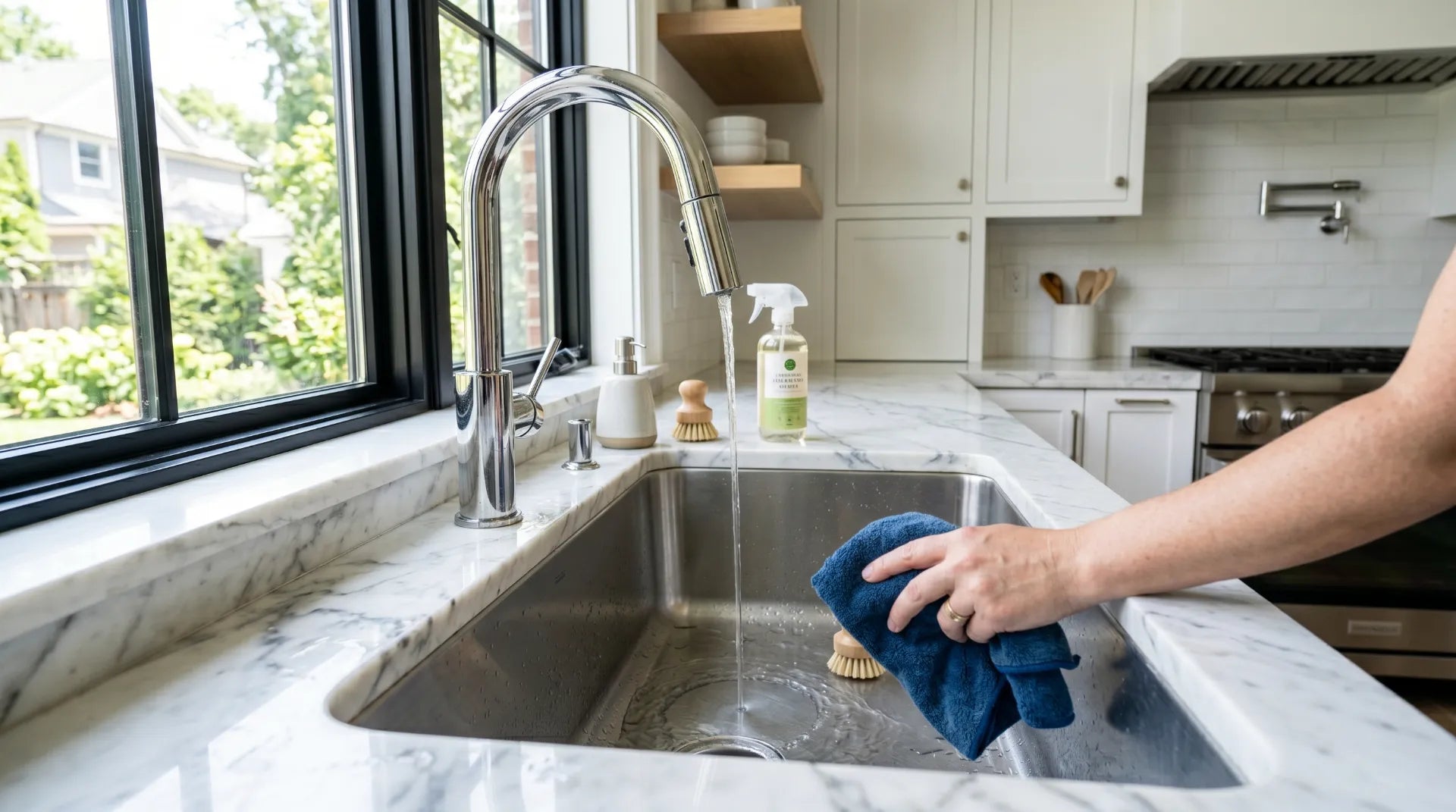
Most stainless steel sink damage isn't caused by use - it's caused by the wrong cleaner applied the wrong way. This guide gives you the exact daily, weekly, and deep-clean routines that keep a stainless sink looking new for 20 years, plus the specific products and tools that are safe versus the ones that will permanently ruin your finish.
Stainless steel is one of the most forgiving sink materials in the kitchen - but only when you clean it correctly. The same households that spend $600 on a 16-gauge Blanco or Kraus sink and then clean it with steel wool and bleach will have a visibly scratched, discolored basin within a year. The households that rinse and wipe it dry daily and use baking soda with a microfiber cloth weekly will have a sink that looks essentially new at the 15-year mark. The difference is not effort - the correct routine takes less time than the wrong one. The difference is knowing which three things permanently damage stainless and avoiding them.
This guide covers the complete maintenance system for a stainless steel kitchen sink: the 60-second daily habit that prevents 80% of buildup, the weekly baking soda clean that restores shine without touching the finish, the monthly Bar Keepers Friend protocol for stubborn stains, and the specific fixes for the six most common problems - water spots, rust, scratches, grease film, drain odor, and hard water mineral scale. It also tells you exactly which products are safe and which will ruin the finish, including several that are labeled "stainless steel cleaner" but cause more damage than they prevent.
Before reading any further: chlorine bleach destroys the chromium oxide protective layer that makes stainless steel "stainless." Steel wool and hard abrasive pads leave permanent cross-grain scratches that catch grease and accelerate staining. And leaving steel cookware, cast iron, or canned goods sitting in the sink creates rust transfer stains that are difficult to remove and happen faster than most homeowners expect. Avoid all three, and most stainless sinks are nearly bulletproof. Our complete guide to stainless steel sink materials and gauges covers what to look for when buying; this guide covers what to do after it's installed.
Rinse after every use. Wipe with grain using a microfiber cloth. Dry completely. Once a week, baking soda paste + soft cloth + rinse + dry. Monthly, Bar Keepers Friend for stains.
That routine - executed consistently - is genuinely all most stainless steel sinks need to look excellent for their entire lifespan. The grain direction matters on every single wipe. The drying after every rinse eliminates 90% of water spot complaints. The baking soda weekly removes grease film and restores the brushed look. Bar Keepers Friend once a month handles anything tougher. Every other product or technique in this guide is a solution to a specific problem that those four habits will mostly prevent from developing in the first place.

Stainless steel has a grain - the directional pattern of fine parallel lines left by the brushing or polishing process during manufacturing. On most kitchen sinks, the grain runs horizontally across the basin. On some models, it runs at a slight diagonal. You can see it by looking at the sink surface at an angle in good light - the lines are always there, even on satin-finish sinks where they appear subtle.
Every cleaning stroke that crosses the grain leaves a micro-scratch perpendicular to those lines. A single cross-grain stroke with even a soft cloth won't be visible. But done repeatedly over months - because nobody thinks about grain direction while rinsing a coffee mug - those cross-grain micro-scratches accumulate into a dull, hazy web of fine lines that makes the sink look permanently dirty even when it's clean. This is the primary cause of what homeowners describe as a stainless sink that "doesn't look like it used to."
Check the grain direction before you clean, not after: On Blanco stainless sinks - including the Stellar, Quatrus, and Precision models available at Bathify - the grain typically runs parallel to the longest dimension of the sink. On Kraus Kore workstation sinks, check the interior wall of the basin at the rear - the grain direction there tells you the orientation. If you're ever unsure, run your fingertip very lightly across the surface in two perpendicular directions - the direction that feels slightly smoother to the touch is with the grain.

The daily habit is the most important maintenance step in this entire guide - more impactful than any product, any deep-clean technique, or any specialized tool. Stainless steel problems compound over time. Water spots that are rinsed away immediately leave no trace. Water spots left to dry repeatedly over weeks build into a white mineral film that requires Bar Keepers Friend and real effort to remove. The daily habit breaks that cycle at its source.
After doing dishes, cooking prep, or any food-related activity in the sink, run warm water across the entire basin surface - walls, floor, and drain area. This flushes away food particles, acidic liquids (lemon juice, vinegar, tomato sauce), and any cleaning product residue before they have time to act on the steel. Acidic foods left in contact with stainless for extended periods can cause surface etching and discoloration over time.
Use a clean microfiber cloth, soft sponge, or non-scratch scrub pad to wipe the basin interior and walls with the grain. Apply light, even pressure - you're wiping, not scrubbing. This removes any remaining soap film, loose food particles, and light grease from cooking residue. Do not use the rough side of a standard kitchen sponge - the abrasive layer on most dish sponges is too aggressive for regular use on stainless and will micro-scratch the finish over time.
Rinse the basin one final time to clear any loosened debris, then dry the entire surface with a clean, dry microfiber or cotton cloth. Drying is the step most people skip - and it's the step that makes the biggest visible difference. Every drop of tap water that evaporates on a stainless surface leaves a mineral deposit. In hard water areas (most of the US Southwest, Midwest, and Mountain West - Phoenix, Denver, Dallas, Las Vegas, Salt Lake City), water contains enough dissolved calcium and magnesium that even one week of skipping the dry step creates visible white spotting.
Before walking away: remove any steel cookware, cast iron pans, canned goods, or metal utensils sitting in or against the sink basin. These are the primary cause of rust transfer stains - the reddish-brown spots that appear on the stainless surface near where metal items rested. Cast iron pans are the worst offenders: even a few hours of contact between damp cast iron and stainless steel creates rust transfer. Steel wool and steel scrub pads left resting in the sink do the same thing, faster. Remove them every time.

Baking soda (sodium bicarbonate) is the correct weekly cleaner for stainless steel sinks. It is mildly abrasive - fine enough to clean without scratching, but gritty enough to lift grease film and surface deposits that rinsing alone doesn't remove. It is pH neutral to mildly alkaline, which means it won't damage the chromium oxide layer that protects stainless steel. It is also non-toxic, odorless, and costs about $1 per pound at any US grocery store, Home Depot, or Target. No stainless steel cleaner sold in a premium-branded spray bottle at $12-$18 outperforms it for weekly maintenance. Several perform worse.
Run warm water across the entire sink interior - walls, basin floor, drain area - until the surface is evenly wet. You're not soaking it; you just need enough moisture for the baking soda to adhere and form a working paste on contact.
Dust baking soda liberally across the wet sink surface - basin floor, walls, and around the drain collar. A few tablespoons is sufficient for a single-bowl 30" sink; use more for a 33" or 36" basin or a double-bowl configuration. You want a visible powder coat across the entire surface, not just a light dusting.
Using the soft (non-abrasive) side of a clean sponge or a damp microfiber cloth, work the baking soda across the entire surface with steady, linear strokes following the grain direction. Use moderate pressure - you're polishing, not scrubbing. Work from the far edge toward the drain, covering the full basin floor, then do each wall in turn. Pay extra attention to the corners at the drain collar, which is where grease and food residue accumulates fastest.
If any areas have visible buildup - light water spotting, grease film, food residue - let the baking soda sit damp on those spots for two to three minutes before scrubbing again. The mild abrasive action increases significantly when the baking soda has time to slightly dissolve the deposit before you apply friction.
Rinse all baking soda residue from the basin with warm water. Follow with a single drop of mild dish soap worked across the surface with a soft cloth, then rinse again. The dish soap removes the grease film that baking soda loosens but doesn't fully dissolve - this two-step combination (baking soda for mechanical cleaning, dish soap for grease emulsification) is more effective than either alone.
Dry the entire sink surface with a clean dry cloth. For a finishing touch that extends the time between cleanings and gives the sink a subtle sheen: apply 3-4 drops of food-grade mineral oil to a soft cloth and buff it into the dry stainless surface with the grain. The mineral oil creates a thin barrier that repels water and reduces deposit adhesion - meaning your next week's cleaning starts from a cleaner baseline. Wipe off any excess. This step is optional but noticeably extends the clean appearance between weekly cleans.

Hard water - water with high dissolved calcium and magnesium content - is the number one maintenance challenge for stainless steel sinks in most of the US. Water hardness above 120 ppm (milligrams per liter) is common throughout the Southwest, Midwest, Mountain West, and parts of the South. Cities like Phoenix (water hardness ~250-330 ppm), Las Vegas (~280-340 ppm), Denver (~80-250 ppm depending on source), and Dallas (~150-200 ppm) have some of the hardest municipal water in the country. In these areas, skipping the daily dry step creates visible white spotting within days. Extended neglect builds a white film that covers the entire basin and requires real removal effort.
White vinegar is the correct solution for regular mineral deposit removal on stainless steel. The acetic acid in distilled white vinegar dissolves calcium carbonate deposits (the main component of hard water scale) without damaging the chromium oxide protective layer on stainless steel - as long as you dilute it properly and don't leave it in contact for extended periods.
A 50/50 solution of distilled white vinegar and water is the correct concentration. Undiluted white vinegar (5% acidity) is too strong for regular contact with stainless steel - it can temporarily dull the finish and, with repeated undiluted use, may begin to affect the protective layer. The diluted 2.5% solution dissolves mineral deposits effectively without these risks.
Spray the vinegar solution across the stained areas - don't drench the sink, but make sure spotting areas are well coated. Let it sit for 3 to 5 minutes. For heavy white scale around the drain collar, soak a folded paper towel in the vinegar solution and lay it directly on the deposit for 5 minutes. The acid needs contact time to dissolve the mineral bonds.
Wipe with a soft cloth following the grain. The dissolved minerals wipe away with minimal pressure. Rinse with clean water immediately after - don't leave vinegar sitting on the surface after you've wiped. Dry completely with a clean dry cloth to prevent new deposits from forming instantly.
Rust spots on a stainless steel sink are almost never the sink itself rusting. Grade 304 stainless steel - used in quality sinks from Blanco, Kraus, and other premium manufacturers - contains 18% chromium and 8% nickel (hence the "18/8" designation common in product listings), which creates a passive chromium oxide layer that is highly resistant to corrosion. When you see rust on the surface of a 16-gauge 304 stainless sink, it is almost always rust transferred from an external source - and the fix depends on correctly identifying which source caused it.
Cast iron pans, carbon steel cookware, steel wool pads, and regular steel scrubbing pads left resting in a wet stainless sink deposit iron oxide (rust) onto the stainless surface. Even brand-new cast iron can do this. The iron particles embed in micro-scratches or surface imperfections and oxidize, creating reddish-brown spots that look exactly like the sink itself is rusting. The spots are superficial - the chromium layer beneath is intact - but they require removal before they penetrate deeper into surface irregularities.
Apply a small amount of Bar Keepers Friend (powder or soft cleanser form) to a damp soft cloth. Work it onto the rust spots with the grain using moderate circular pressure just on the stained area, then finish with grain-direction strokes. Let sit 1-2 minutes, then rinse completely. For stubborn spots, repeat. The oxalic acid in Bar Keepers Friend dissolves iron oxide without damaging the chromium layer. Prevention: never let cast iron, steel wool, or canned goods sit in the sink.
In older homes with galvanized or iron water supply pipes - common in homes built before 1970 in cities like Chicago, Philadelphia, Pittsburgh, and Baltimore - iron particles in the water supply deposit rust-colored sediment in the sink basin, particularly around the drain and faucet exit point. The rust arrives with the water and settles as it evaporates. This is different from cookware transfer: it forms more uniformly across the basin rather than in localized spots where a pan rested.
Same Bar Keepers Friend treatment as above for existing staining. For ongoing prevention: install a sediment filter on the cold water supply under the sink ($25-$80 at Home Depot or Lowe's - changed annually). This treats the source rather than requiring constant cleaning of the symptom.
Chlorine bleach - including bleach-based sprays, chlorinated drain cleaners, and pool chemicals - chemically attacks the chromium oxide layer that makes stainless steel corrosion-resistant. With enough contact, it breaks down this passive protective layer and allows the underlying iron in the steel alloy to oxidize - producing genuine rust from the sink material itself, not from external transfer. Bleach-damaged stainless develops patchy rust in the areas where the bleach contacted the surface, and these areas are genuinely harder to treat because the substrate itself has been affected.
For mild bleach-induced surface rust: Bar Keepers Friend with extended contact (3-5 minutes), multiple applications. For severe bleach damage where the underlying steel is affected: professional polishing with an oxalic acid treatment may partially restore, but deep bleach damage is very difficult to fully reverse. The only permanent fix for severe cases is sink replacement - which is why "never use bleach on a stainless steel sink" is the absolute rule, not a suggestion.
Not all scratches are equal on a stainless sink. Understanding which type you're dealing with determines whether you're looking at a 10-minute fix or a permanent feature of your sink's character.
| Scratch Type | Appearance | Cause | Fixable? | How to Address |
|---|---|---|---|---|
| Surface hairlines (with grain) | Fine parallel lines that blend into the brushed finish | Normal use - plates, cutlery, pots sliding across basin | Yes - mostly | Bar Keepers Friend with grain-direction buffing. These blend into the existing brushed pattern and become nearly invisible after polishing. |
| Cross-grain scratches | Lines perpendicular to the grain; catch light at an angle; create hazy appearance | Cleaning with wrong technique - circular scrubbing, abrasive pads against grain | Partial | Bar Keepers Friend with very light pressure following grain direction, multiple passes. Can improve significantly but deep cross-grain scratches don't fully disappear. |
| Deep gouges | Clearly visible indentations - you can feel them with a fingernail | Impact damage - heavy dropped items, knife slips, tools | No | Cannot be removed with cleaning products. Accept as character or consult a stainless polishing service (available in most metro areas for $150-$350). Prevent future damage: use a sink grid on the basin floor. |
| Steel wool fiber scratches | Random web of fine bright lines in all directions | Cleaning with steel wool or hard abrasive scrubbers | Partial | Bar Keepers Friend with grain-direction strokes can improve texture significantly. Prevent: never use steel wool on stainless sinks - ever. |
A sink grid is the single best investment for scratch prevention: A stainless steel basin grid - a fitted wire rack that sits on the floor of the basin - protects the sink bottom from virtually all impact and sliding damage. Blanco, Kraus, and Ruvati all offer model-specific grids for their sinks (typically $30-$80). On a high-quality sink like the Blanco Stellar or Kraus Kore workstation, adding a basin grid at installation will keep the basin floor looking new for years while the walls take the normal wear of daily use. It is a significantly more effective protection investment than any stainless steel protective coating spray.
Bar Keepers Friend is the gold-standard stainless steel cleaner for dealing with anything the weekly baking soda routine doesn't fully address. Its active ingredient is oxalic acid - a naturally occurring organic acid that dissolves iron oxide (rust stains), calcium carbonate (mineral scale), and many organic stains without damaging the chromium layer that protects stainless steel. It is safe for all grades of stainless steel when used correctly. The powder form and the Soft Cleanser form are both effective; the powder is slightly more abrasive (useful for stubborn stains) and the Soft Cleanser is gentler (better for regular monthly maintenance on quality finishes).
Wet the sink basin with warm water. Shake a small amount of Bar Keepers Friend powder onto a damp soft cloth or sponge - about a teaspoon for the basin floor, a little more for a full deep clean. For the Soft Cleanser, squeeze a small ribbon onto the cloth. Less is more: over-applying increases rinse time and wastes product. A $4 canister of Bar Keepers Friend lasts 4-6 months of monthly sink use.
Apply with firm, even pressure in strokes that follow the grain direction precisely. Cover the entire basin in overlapping passes - don't scrub in circles. For stain areas, apply slightly more pressure but maintain grain direction throughout. For the drain collar and corners, use a soft toothbrush or small brush with Bar Keepers Friend to reach into the junction where basin floor meets wall - this is where grease and scale accumulate most heavily.
For rust spots, mineral scale, or food stains: let the Bar Keepers Friend sit damp on the area for 60 seconds before a second application of friction. The oxalic acid needs contact time to work. Do not let it dry on the surface - a dried Bar Keepers Friend residue is harder to rinse and can leave a powdery film. If it starts to dry, add a small amount of water and keep it moist.
Rinse with warm water, running your hand across the surface to confirm all product has been removed. Oxalic acid residue left on the surface is not dangerous, but it leaves a faint film that attracts dust and reduces the clean appearance. Rinse until the surface feels clean and neutral to the touch. Check the drain collar specifically - residue collects there easily.
Dry with a clean dry cloth. After a Bar Keepers Friend clean, the surface is particularly clean and receptive to mineral oil - this is the ideal time to apply the optional mineral oil finish. Apply 4-5 drops to a dry cloth, buff across the surface with the grain, and wipe off excess. The result is a sink that looks newly installed for the next few weeks.
- Baking soda (sodium bicarbonate) - best weekly cleaner
- Mild dish soap (Dawn, Seventh Generation, etc.)
- Bar Keepers Friend powder or Soft Cleanser - monthly deep clean
- Diluted white vinegar (50/50 with water) - hard water deposits; rinse immediately
- Food-grade mineral oil - finishing and protection
- Microfiber cloths - daily and weekly wiping
- Soft sponge (non-scratch side only)
- Soft nylon brush - drain collar and corners
- Warm water - always rinse with warm, not cold
- Bon Ami powder - similar to Bar Keepers Friend; safe alternative
- Chlorine bleach (including diluted bleach) - destroys chromium layer
- Steel wool pads - embedded iron particles cause rust transfer
- Brillo pads / SOS pads - steel wool + soap; same problem
- Hard abrasive scrubbing pads (green Scotch-Brite) - permanent scratching
- CLR, Lime-Away, or commercial lime dissolvers - too acidic; damages finish with repeated use
- Oven cleaners (lye-based) - highly caustic; permanently damages stainless
- Undiluted concentrated acids (muriatic, hydrochloric)
- Abrasive powdered cleansers with hard grit (Ajax original) - too aggressive vs. Bar Keepers Friend
- Pool chemicals or chlorinated products near the sink
- Silver polish or metal polishes not rated for stainless steel
| Product / Tool | Safe for Stainless? | Use Case | Notes |
|---|---|---|---|
| Baking soda | Yes - weekly | Weekly deep clean, grease film removal, light staining | Best overall weekly cleaner. Safe at any frequency. Cheap and effective. |
| Bar Keepers Friend (powder) | Yes - monthly | Monthly deep clean, rust stains, mineral scale, discoloration | Do not use more than monthly. Most effective stain remover available for stainless. |
| White vinegar (diluted 50/50) | Yes - as needed | Hard water mineral deposits, white spotting | Rinse immediately after use. Do not leave in contact. Never undiluted. |
| Dish soap (mild) | Yes - daily | Daily grease removal, general cleaning | Safe at any frequency. Most effective when used after baking soda to emulsify loosened grease. |
| Mineral oil (food-grade) | Yes - monthly | Surface protection, fingerprint resistance, shine enhancement | Apply sparingly to dry surface. Food-safe. Extends time between cleans noticeably. |
| Chlorine bleach | Never | N/A | Destroys the chromium oxide passive layer. Causes irreversible corrosion over time. No amount is safe for regular use. |
| Steel wool / Brillo pads | Never | N/A | Double damage: scratches the surface AND leaves iron particles that rust and transfer to the stainless. |
| Green Scotch-Brite pad | Never | N/A | Too abrasive for stainless sink surfaces. Use only the white or blue soft-side sponge versions. |
| CLR / Lime-Away | Avoid | N/A - diluted vinegar is safer for mineral deposits | Highly acidic formulations designed for porcelain and tile. Repeated use on stainless causes finish dulling and potential corrosion. |
Calcium and magnesium carbonate deposits from evaporating hard water. Universal in US cities with hard water - Phoenix, Las Vegas, Denver, Dallas, Chicago, Salt Lake City. Appears as white haze, spots, or a uniform milky film over the entire surface.
Diluted white vinegar (50/50 with water) sprayed across surface, 3-5 min contact, soft cloth wipe with grain, rinse immediately, dry completely. For heavy buildup: Bar Keepers Friend with 2-minute contact time, grain-direction scrub, thorough rinse, dry. Prevention: dry the sink completely after every use - non-negotiable in hard water areas.
Iron oxide transfer from cast iron cookware, steel wool, canned goods, or rust in water supply. The sink itself is not rusting - the iron is external. Spots appear where the contaminant rested in contact with the wet stainless surface.
Bar Keepers Friend applied with a damp soft cloth directly on the spots. Work with the grain, moderate pressure, 1-2 minute contact. Repeat if needed - most transfer rust clears in 1-2 applications. Rinse thoroughly, dry. Prevention: never leave cast iron, steel wool pads, or canned goods resting in the sink.
Accumulated grease from cooking residue, dish soap buildup, and organic matter that has bonded to the stainless surface. Appears as a dark, slightly iridescent film that doesn't rinse away with water alone. Common in heavily used cooking kitchens.
Baking soda paste (mix with just enough water to form a thick paste) applied to the entire surface, work with grain using soft cloth, 3-minute contact, scrub again, add 2 drops dish soap and continue scrubbing, rinse thoroughly, dry. The baking soda lifts the grease mechanically; the dish soap emulsifies it chemically. Together they remove buildup that water alone never will.
Heat discoloration from boiling water poured directly into the sink, or from a hot pot or pan placed directly on the basin surface. The chromium oxide layer refracts light differently at elevated temperatures, creating a visible color shift that looks like an oil slick. It is a surface optical effect, not damage to the underlying steel.
Bar Keepers Friend with the grain using moderate pressure, 1-2 minute contact, rinse, dry. Heat discoloration responds well to Bar Keepers Friend in most cases. Prevention: never place hot pans directly on the stainless surface - use a trivet or the sink grid. When draining boiling pasta water, let it cool slightly or run cold water simultaneously to bring the temperature down before it contacts the basin.
Organic buildup - food particles, grease, biofilm - in the drain collar, basket strainer, and the P-trap below the sink. The stainless basin itself doesn't hold odor; the drain assembly and drain interior are the source. This is not a cleaning failure - it's normal organic accumulation in a constantly moist environment.
Remove the basket strainer and clean it with a soft brush and dish soap. Pour ½ cup baking soda followed by ½ cup white vinegar directly into the drain - the fizzing reaction clears biofilm from the drain interior. After 10 minutes, flush with hot water. For persistent odor, follow with boiling water (allow to cool to below 140°F first to prevent P-trap damage). Monthly treatment prevents recurring odor. Replace the basket strainer if it shows visible buildup that brushing won't remove - they cost $8-$20 at any hardware store.
A concentrated calcium carbonate deposit that forms where water consistently evaporates - most often the ring around the drain basket where draining water leaves minerals behind. In hard water areas this forms within weeks and becomes a thick, chalky ring if not treated regularly.
Soak a paper towel in diluted vinegar (50/50) and lay it directly over the drain collar ring. Leave for 5-10 minutes. The vinegar dissolves the calcium directly. Remove the towel, scrub the softened deposit with a soft nylon brush or old toothbrush, rinse, dry. For very heavy buildup, apply Bar Keepers Friend directly to the collar with a brush after the vinegar treatment - the combination of acid dissolution + oxalic acid works faster than either alone. Prevention: include the drain collar in your daily dry-down wipe.
- Always wipe with the grain - never across it, never in circles for primary cleaning strokes
- Dry the sink completely after every use - especially in hard water areas (Phoenix, Las Vegas, Denver, Dallas)
- Never use bleach, steel wool, Brillo pads, green Scotch-Brite, or CLR on stainless
- Remove cast iron, carbon steel pans, and canned goods from the sink immediately after use
- Weekly: baking soda + soft cloth + dish soap + rinse + dry
- Monthly: Bar Keepers Friend with grain-direction application + thorough rinse + dry + mineral oil
- Hard water areas: diluted white vinegar (50/50) for mineral deposits as needed - rinse immediately
- Add a basin sink grid to protect the basin floor from impact scratches
- Don't place hot pots or boiling water directly in the sink - use a trivet or run cold water simultaneously
- Clean the drain collar and basket strainer in your weekly routine - that's where odor and scale concentrate
The gauge of your stainless steel sink - the thickness of the steel - affects cleaning in one meaningful way: thinner-gauge steel (higher gauge numbers: 20, 22) is more susceptible to denting and surface micro-damage from abrasive cleaning tools than thicker-gauge steel (16 or 18 gauge). A 22-gauge sink that gets scrubbed with a moderately abrasive pad shows visible damage faster than a 16-gauge sink subjected to the same treatment, because the thinner steel has less material depth to absorb the abrasive contact before the surface grain is disrupted.
For all gauge levels, the cleaning products and techniques in this guide are appropriate - the difference is only in applied pressure during deep cleans. On a 16-gauge or 18-gauge sink, moderate firm pressure with Bar Keepers Friend is fine. On a 20-gauge or thinner sink, use light pressure and let the product's chemistry do more of the work, with less physical friction. The same rule applies to daily and weekly cleaning: all stainless sinks benefit from soft tools and grain-direction technique, but thinner gauges are less forgiving when that technique is incorrect.
The correct routine takes less time than the wrong one - and keeps your sink looking new for 20 years.
The entire stainless steel sink maintenance system described in this guide takes about 60 seconds per day, 8 minutes per week, and 15 minutes per month. That is not a significant time investment. What makes it powerful is consistency - particularly the daily dry-down, which single-handedly prevents the hard water spotting and mineral film that most homeowners describe as their primary stainless sink frustration.
The three rules that matter most: Always clean with the grain - every stroke, every time. Never use bleach, steel wool, or hard abrasive pads. Dry the sink completely after every use. Follow those three rules and use baking soda weekly with Bar Keepers Friend monthly, and a quality 16-gauge stainless steel sink will look essentially new at year fifteen.
If your sink currently has problems: Rust spots → Bar Keepers Friend, grain-direction. Hard water scale → diluted vinegar, rinse immediately, dry. Cross-grain scratches → Bar Keepers Friend with light grain-direction buffing (improves but doesn't fully reverse). Blue discoloration → Bar Keepers Friend, with the grain. Grease film → baking soda + dish soap, rinse, dry. Most stainless sink problems are fixable or significantly improvable with two products and one technique: Bar Keepers Friend, baking soda, and the grain direction.
If you're still choosing a stainless sink, look for 16-gauge 304-grade stainless with sound dampening at Bathify - the thicker steel is significantly more forgiving of real kitchen use and maintains its brushed appearance far longer under the same cleaning routine as thinner alternatives.
Shop stainless steel kitchen sinks at Bathify - free shipping across the USA
Browse 16-gauge undermount, farmhouse, and workstation stainless steel sinks from Blanco, Kraus, and more - all with free shipping on orders over $50 to the continental US.


