







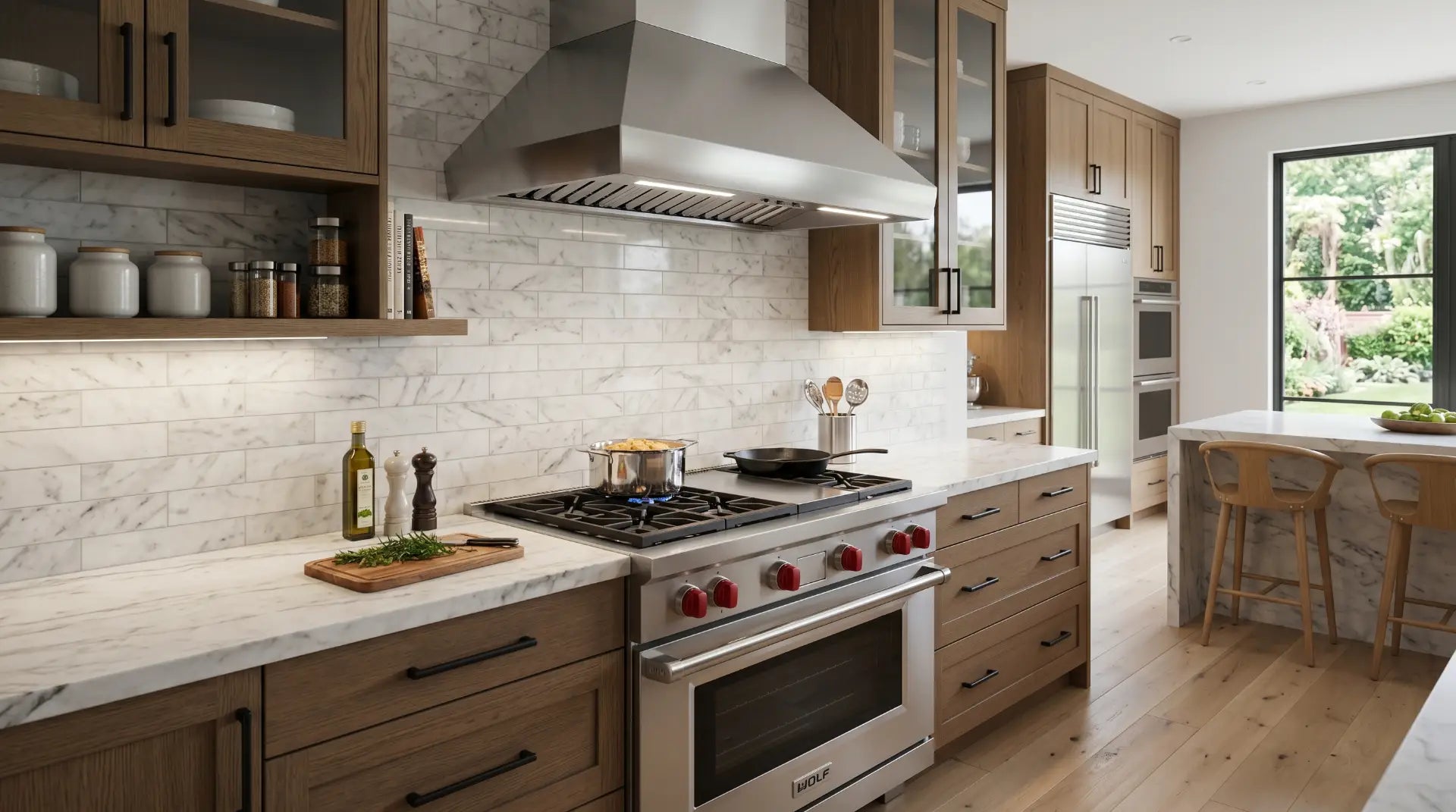
Most comparison guides stop at "vented is better, ductless is the fallback." That's true - and it leaves out the parts that actually matter: which gases a carbon filter cannot capture, how fast filters degrade without you knowing, what makeup air is and when you need it, and the five duct mistakes that make a vented hood perform no better than a ductless one. This guide covers all of it.
The vented vs. ductless range hood question is one of the most Googled kitchen decisions in the US - and one of the most superficially answered. The standard guidance: vented hoods exhaust air to the exterior and are superior; ductless hoods recirculate filtered air and are the compromise when venting isn't possible. Both statements are accurate. Neither one tells you what you actually need to know.
What most guides leave out: which gases a carbon filter physically cannot capture (the omission that makes ductless over a gas range a documented health concern, not just a performance compromise), how quickly carbon filters degrade and what that degradation looks like month by month without visible signs, the makeup air requirement that applies to powerful vented hoods in modern sealed homes, and the installation errors that make a correctly rated vented hood perform no better than a ductless model. This guide covers all of it - in enough detail to make the decision with full information, and to know what to watch for afterward regardless of which type you choose.
If you're still deciding on CFM, hood type, sizing, and whether to buy a wall-mount, under-cabinet, or built-in model, read the Range Hood Buying Guide first. This guide goes deep on one specific decision within that larger framework.
Vented for any gas range. Vented strongly preferred for any primary kitchen. Ductless only when venting is physically impossible and the cooktop is electric or induction.
If you have a gas range - any gas range, regardless of BTU output - a ductless hood is not a safe equivalent to a vented hood. Carbon filters do not capture the combustion byproducts gas burners produce. A ductless hood over a gas range recirculates carbon monoxide, nitrogen dioxide, and formaldehyde back into kitchen air on every cook. This is not a minor performance gap; it is an air quality issue documented in US residential IAQ research and flagged by the EPA.
For electric and induction cooktops where exterior ducting is genuinely impossible - apartments with no accessible exterior wall, condos with prohibitive bylaws - a ductless hood is a reasonable choice, provided carbon filters are replaced on a realistic schedule (every 3-4 months for regular cooking) and the household understands what it does and does not remove. The rest of this guide explains the reasoning behind these positions with enough detail to evaluate your specific kitchen.
Both vented and ductless range hoods start identically: a fan draws air through the hood's capture zone, and that air passes through a metal grease filter - baffle or mesh - that traps large grease particles before they reach the fan motor. This is the step they share. What happens after the grease filter is where the two systems diverge completely.
After the grease filter, air enters the fan housing and is pushed through a rigid metal duct that runs through the wall or ceiling to a cap on the exterior. Grease, steam, smoke, odors, heat, humidity, and all combustion gases leave the building. The kitchen's air is continuously replenished from the building interior. Nothing recirculates. The kitchen ends a cook with genuinely cleaner air than it started with.
After the grease filter, air is pushed through one or two activated carbon (charcoal) filters, then discharged back into the kitchen. Carbon filters adsorb some odor molecules through chemical bonding and trap some additional particulates. But the same air molecules cycle through the kitchen repeatedly - reduced in odor and large particulate, but with combustion gases, moisture, and fine particles still present. Effectiveness degrades as the carbon saturates.
The grease filter in a ductless hood traps large grease droplets just like a vented hood. But grease is not the primary concern over a gas range. Combustion gases - carbon monoxide (CO), nitrogen dioxide (NO₂), formaldehyde (HCHO) - pass through both the grease filter and the carbon filter without being captured. In a vented installation, these gases leave the building. In a ductless installation, they return to the kitchen air.
These are the facts that product listings omit and comparison guides gloss over. Each one materially affects whether a ductless hood is an acceptable choice for your specific situation.

Activated carbon excels at adsorbing large organic odor molecules. What it does not capture are small inorganic gas molecules: carbon monoxide (CO), nitrogen dioxide (NO₂), and formaldehyde (HCHO). These are too small and too chemically stable to bond with carbon filter media at the concentrations and contact times in a residential range hood. Studies from Lawrence Berkeley National Laboratory measuring kitchen IAQ in gas-range homes found that unvented gas cooking significantly elevated NO₂ concentrations - in some cases exceeding EPA outdoor air quality standards within the kitchen itself.
A ductless hood over a gas range does not prevent this. Only exterior exhaustion does. This is the most consequential fact about ductless hoods that most buyers never learn before purchase.
Most manufacturers recommend carbon filter replacement every 6-12 months. For a household cooking daily at moderate to high heat, the actual interval before odor capacity is substantially depleted is 3-4 months. The problem: filter saturation is not visible and not dramatically detectable by smell. A saturated carbon filter looks identical to a fresh one. The only signals are cooking odors that linger slightly longer than before - a change gradual enough that most households don't notice until the filter has been fully saturated for weeks.
Surveys of ductless range hood owners consistently show the majority replace carbon filters once a year at best, and a significant portion never replace them at all. A ductless hood with a saturated filter is functionally a hood with only a grease filter - moving air and trapping grease, while doing zero odor or smoke filtration.

Cooking produces significant water vapor - a pot of boiling pasta releases approximately 0.5 to 1 liter of steam per hour. In a vented installation, this moisture exits the building. In a ductless installation, it recirculates back into the kitchen. Over years of daily cooking, persistent moisture elevation contributes to swelling and warping of wood-fronted cabinet doors, accelerated finish degradation in the cooking zone, condensation inside overhead cabinets, and elevated general kitchen humidity. This cumulative moisture damage is the most common long-term complaint from ductless hood users in home renovation communities - not odor performance, but cabinet damage that wasn't anticipated at purchase.

The grease filter captures large droplets - the ones that would clog the fan motor. It does not capture fine grease mist: microscopic droplets produced at high heat during searing, stir-frying, or frying that stay suspended in air. In a vented hood, this mist exits the building. In a ductless hood, it is partially caught by the carbon filter and partially discharged back into the kitchen with the recirculated air. Over months and years, fine grease mist settles on cabinet exteriors, walls, light fixtures, open shelving, and anything in the cooking zone. In kitchens with painted walls or open shelving near the stove, this is a significant maintenance difference that becomes visible after the first year.

CFM ratings are tested with the fan running in open space - no duct resistance, no filter resistance. For a vented hood, real-world CFM is lower than rated by 15-30% depending on duct configuration. For a ductless hood, the carbon filter cartridges in the airflow path add a further 15-25% resistance reduction beyond the open-air test result. A ductless hood rated at 400 CFM may deliver approximately 300 CFM of actual airflow through the kitchen with new filters installed - and progressively less as those filters load over their service life. When sizing a ductless hood, add 35-40% to your calculated CFM minimum, not the standard 25% buffer applied to vented installations.

A convertible range hood is a vented model sold with an optional recirculating kit that allows ductless operation. Convertible hoods are extremely common in the US market. The issue: most convertible hoods in ductless mode discharge recirculated air from the front face of the hood body - blowing warm, partially filtered air back at the cook at face level rather than upward or away from the cooking zone. Dedicated ductless hoods route recirculated air upward or through the top of the hood body, keeping the discharge out of the cook's immediate airspace. If you're installing ductless, specify a model designed for ductless use - not a convertible vented hood with a bolt-on recirculating adapter.
Some ductless hood users discover that opening a window during cooking seems to help. This is real - but the mechanism is dilution, not filtration. The window adds fresh outdoor air to the kitchen volume, which reduces the concentration of pollutants that the ductless hood is recirculating. The hood's filtration isn't improving; the pollutant concentration is decreasing because the total air volume increased. For light electric cooking, this dilution can make the kitchen feel noticeably cleaner. For gas cooking at high heat, the dilution is insufficient to compensate for the absence of actual combustion gas removal. Opening a window does not transform a ductless installation over a gas range into a functional equivalent of a vented one.
The core of the vented vs. ductless decision is not aesthetics, CFM ratings, or installation convenience - it is this table. Understanding what each system removes, and what it doesn't, is the only way to make a fully informed choice for your cooking setup.
Gas cooking is the largest single source of indoor air pollution in American homes during cooking periods. The combustion of natural gas or propane produces a consistent set of pollutants regardless of what is being cooked: carbon monoxide, nitrogen dioxide, formaldehyde, benzene at high temperatures, and ultrafine particles. These are not produced by the food - they are produced by the gas flame on every cook.
A vented range hood exhausts these gases to the exterior on every cook. A ductless hood returns them to the kitchen. The practical consequence depends on kitchen size, cooking frequency, ceiling height, and window ventilation - but the chemical reality is fixed: a carbon filter does not capture carbon monoxide or nitrogen dioxide at the concentrations and contact velocities present in a residential hood. These molecules leave the carbon filter essentially as they entered it.
If you have a gas range and genuinely cannot install a vented hood due to building configuration: install the highest-CFM ductless hood available (stainless baffle + carbon filters), replace carbon filters every 3-4 months, open windows during every cooking session, and install both a CO detector and an NO₂ detector in the kitchen. These steps reduce exposure - they do not eliminate it. The EPA's Indoor Air Quality Guide does not list ductless hoods as an equivalent alternative for gas range ventilation.
Activated carbon adsorbs odor molecules by bonding them to an enormous internal surface area - roughly 500 to 1,500 square meters per gram. When that surface is fully occupied, no new bonding can occur: the filter is saturated. Unlike a metal grease filter you clean and reuse, a saturated carbon filter cannot be regenerated at home. It must be replaced. And unlike a loaded grease filter - which visibly fills with grease - a saturated carbon filter looks exactly like a new one.
Maximum adsorption capacity. Cooking odors clear quickly. For electric or induction cooking, the difference from a vented hood at this stage is noticeable but manageable.
For households cooking 5+ days per week at moderate to high heat, a meaningful portion of the filter surface is occupied. Odors linger slightly longer. Most households don't notice the change because it's gradual. This is the correct replacement point for optimal performance.
The carbon is substantially full. Odors that would have cleared in 10-15 minutes with a fresh filter now persist for 30-45 minutes or more. Fine grease and smoke aerosols pass through with little resistance. The filter still looks visually clean. Most annual-replacement households are in this zone for months before acting.
Zero meaningful odor, smoke, or gas filtration. The fan runs, the light works, and the hood appears functional - while performing no better than an open grease strainer with airflow. This is the operating state of a large proportion of ductless hoods in US homes after year one.
Daily high-heat cooking (frying, stir-fry, searing) - replace every 3 months. Moderate cooking 4-5 days per week - every 4 months. Light cooking 2-3 days per week - every 5-6 months. Write the installation date directly on the side of each new filter cartridge with a permanent marker. Check it every time you clean the grease filter.
The preceding sections make a strong case for vented hoods - and that case is accurate. But ductless hoods exist for real reasons. The key is distinguishing a genuinely constrained installation from one that's simply avoiding an inconvenient duct run.
When the exterior wall isn't accessible from the cooking position and the building structure or HOA prevents new duct penetrations, ductless is the only practical option. For electric or induction cooktops, this is an acceptable compromise. No combustion gases are produced, and the remaining concerns - moisture, fine grease, odor - are manageable with disciplined filter maintenance and window ventilation during high-moisture cooking.
Island installations require a ceiling duct run. In slab construction - concrete ceilings common in older buildings and commercial conversions - routing a duct through the ceiling cavity is structurally impossible without major work. For induction island cooktops in this configuration, a dedicated ductless island hood or a downdraft system is the practical answer. For gas island cooktops in slab construction, the correct answer is to move the cooktop to a wall position where a wall duct is possible - the combustion gas issue overrides layout preference.
Rental situations frequently prohibit duct penetrations. A ductless under-cabinet hood for a rental with an electric range is a reasonable temporary solution. Set a fixed calendar reminder for filter replacement - don't rely on smell-based detection in a rental where cooking habits and filter history may be unknown.
The most common reason buyers choose ductless when they shouldn't: a duct run that would be difficult - long, requiring elbows, or needing a wall or ceiling opened. "Difficult" and "impossible" are not the same thing. If a duct path exists, install it. The one-time cost of proper ducting is lower than the multi-year health and maintenance costs of an inadequate ductless installation, particularly over any gas range.
Every vented range hood exhausts a volume of air from the home to the exterior. That air must be replaced from somewhere. In older, leaky construction - homes built before the 1990s - the makeup air infiltrates naturally through gaps around windows, doors, and penetrations. In modern tight construction, where homes are built to current energy codes with sealed envelopes, these gaps don't exist. A powerful range hood exhausting 600 to 1,200 CFM in a tight modern home can create significant negative air pressure inside the building.
A powerful hood in a sealed home creates negative pressure that the building resists. Consequences: backdraft dampers on fireplaces and combustion appliances (gas furnaces, water heaters) can reverse, pulling flue gases back into the living space - a condition called backdrafting. The hood's effective CFM drops as it fights static pressure. The IRC (Section R303.6) requires makeup air systems for hoods above 400 CFM in new US construction to prevent exactly this. This is a code requirement most buyers never encounter in product listings.
Older homes have enough unintentional infiltration through unsealed gaps that a 600 CFM hood doesn't create dangerous negative pressure. This is why makeup air is rarely discussed for older homes. The risk emerges when an older home is subsequently weatherized - new windows, exterior foam insulation - after the hood was installed. The additional sealing can push a previously acceptable installation into negative-pressure territory without any change to the hood itself.
Choosing vented is the right decision. Installing it incorrectly eliminates the advantage. Each of these mistakes measurably reduces the effective CFM delivered at the hood opening - in some cases by 50% or more.
| Mistake | What Happens | CFM Impact | The Fix |
|---|---|---|---|
| Undersized duct diameter | A 600 CFM hood on a 4" duct flows approximately 150 CFM. The duct is a choke point no fan power can overcome. | 50-75% loss at severe undersizing | Match duct to CFM: 6" for up to 400 CFM, 7-8" for 400-800 CFM, 10" for 800+ CFM. See the Range Hood Buying Guide duct table. |
| Flexible foil duct used for the main run | Corrugated walls create turbulence and friction resistance far higher than smooth-wall rigid duct. Foil duct also traps grease - a fire hazard in a duct run. | 20-40% loss vs. rigid duct; fire risk | Rigid smooth-wall galvanized steel or aluminum for all runs beyond 2 feet. Flexible duct acceptable only as a final short connector segment. |
| Too many 90° elbows in the run | Each 90° elbow adds approximately 10 feet of equivalent straight duct resistance. Three elbows = 30 extra feet of effective duct length. | 10-15% per elbow; 30-45% for three | Minimize elbows. Where unavoidable, use long-radius swept elbows, not sharp fittings. Upsize duct diameter one step per two elbows. |
| Undersized or stiff-spring exterior wall cap | A wall cap opening smaller than the duct diameter creates backpressure at the exit. Stiff spring-loaded dampers add resistance even at maximum fan speed. | 10-25% loss | Specify a wall cap with opening equal to or larger than duct diameter. Use gravity-flap or motorized dampers, not stiff spring dampers. |
| Venting into an attic, crawl space, or wall cavity instead of the exterior | A code violation in every US jurisdiction. Deposits grease-laden moisture in an enclosed space - fire risk and mold habitat. | No meaningful exhaust; structural damage | Always terminate to the exterior. No exceptions. Roof penetrations require a licensed contractor. |
Removes all combustion byproducts - CO, NO₂, formaldehyde - produced by gas burners on every cook. The only fully safe specification for any gas range installation where a duct path is available.
Carbon filters do not capture combustion gases. Recirculated air returns NO₂ and CO to the kitchen. Acceptable only when venting is physically impossible, with open-window mitigation, CO/NO₂ detectors, and 3-4 month filter replacement schedule.
Still the superior choice - removes steam, fine grease, and odors completely. The moisture and fine grease removal advantages over ductless accumulate significantly over a multi-year period in any primary kitchen.
A genuine option for electric and induction where ducting isn't possible. No combustion gases to worry about. Performance depends almost entirely on how rigorously carbon filters are maintained.
Every liter of steam from boiling and steaming leaves the building. Keeps kitchen humidity controlled, protects cabinet finishes and wood doors, prevents the slow moisture accumulation that damages cabinetry over years.
Carbon filters don't absorb moisture. All steam recirculates back into the kitchen. For households that boil, steam, or pressure-cook frequently, this is a cabinet and finish durability concern over a 3-5 year horizon.
Requires a route from the hood to an exterior termination. Achievable in most single-family homes and many townhouses. Ranges from difficult to impossible in high-rise apartments and condos with concrete construction.
No duct path required. Can be installed in any building type, on any wall, under any cabinet. This installation flexibility is ductless's primary legitimate functional advantage - and for genuinely constrained installations, it is decisive.
Installation premium of $300-$900 over ductless (duct materials + labor + permit). Near-zero ongoing cost - grease filters wash in the dishwasher, no consumables. Amortized over 10 years, the total cost gap narrows significantly.
No installation premium. But carbon filter replacement every 3-6 months at $20-$50 per set equals $40-$200 per year - up to $1,000-$2,000 over a 10-year hood lifespan. The upfront saving is often consumed by filter costs within 3-4 years.
A vented hood achieves its rated airflow at lower fan RPM because it doesn't have carbon filter resistance. Lower RPM means a quieter motor. Quality vented hoods with proper duct installations can sustain 1-2 sones at low speed throughout their lifespan.
The fan must work harder against filter resistance to deliver equivalent airflow. As carbon filters load over their service life, resistance increases and noise increases progressively. A ductless hood that measures 2.5 sones at installation may measure 3+ sones at month six without a filter change.
A properly installed vented hood with exterior termination is what buyers and inspectors expect. Adds functional kitchen value and is not flagged in inspections. Many jurisdictions now require exterior-vented kitchen ventilation in new construction by code.
Inspectors may note the absence of exterior venting, particularly in newer construction. In competitive resale markets where buyers evaluate kitchen finishes carefully, a ductless installation over a gas range can be a negotiation point.
The full range of wall-mount, island, and built-in insert designs is available in vented configurations. The premium design segment - architecturally distinctive hoods - is almost exclusively vented-first. Browse wall-mount, under-cabinet, and built-in hoods at Bathify.
All major finishes (stainless, matte black, brushed nickel) and most standard hood types are available as dedicated ductless models. Selection narrows at higher CFM ratings and premium price points, where most products are vented-first with ductless as a secondary option.
Every cubic foot exhausted to the exterior is HVAC-conditioned air that leaves the building. In cold climates running a 600 CFM hood 45 minutes daily, this is a real and calculable energy cost. This is ductless's only meaningful energy advantage.
No conditioned air is exhausted. In extreme climates with high heating or cooling loads, this produces a small measurable energy saving. For most US households, the annual energy difference is under $50 - a rounding error compared to the total cost differential and health considerations over the hood's lifespan.
Metal grease filters: wash monthly in the dishwasher. Exterior wall cap: inspect annually. No consumable replacement schedule. Total annual maintenance time: under 30 minutes. No ongoing purchase cost.
Carbon filter replacement every 3-6 months - sourcing, purchasing, and installing new cartridges. If replacement is skipped, the hood degrades silently into near-uselessness. Requires active calendar discipline that vented operation does not.
These estimates use a mid-range hood ($350 purchase price for both types) in a standard 30-inch wall configuration with moderate cooking frequency (5 days per week, gas range), comparing a new vented installation against a ductless alternative.
- Duct path to exterior confirmed and mapped - wall, soffit, or roof termination
- Duct diameter confirmed adequate for the hood's CFM - see duct sizing table
- Number of elbows counted and accounted for in CFM sizing - upsize duct diameter if 2+ elbows
- Exterior wall cap sized to match duct diameter - gravity-flap or motorized damper, not stiff spring
- Flexible foil duct excluded from main run - rigid smooth-wall metal only
- Makeup air requirement assessed if post-2000 construction and hood above 400 CFM
- Permit requirement confirmed with local building department for new exterior penetration
- Duct terminates to exterior only - never into attic, crawl space, or wall cavity
- Cooktop is confirmed electric or induction - ductless over gas range is a health risk, not just a performance compromise
- Hood is a dedicated ductless model or a convertible with top-discharge in ductless mode - not front-discharge
- CFM sized at minimum required × 1.40 - not × 1.25 as for vented - to account for filter resistance
- Carbon filter replacement schedule confirmed: every 3-4 months for daily cooking, 5-6 months for light use
- Calendar reminder set before installation day - not "when I notice the smell getting worse"
- CO detector (and NO₂ detector if over a gas range) installed or planned for the kitchen
- Window ventilation plan during high-moisture cooking (boiling, steaming, pressure cooking)
- CFM stated - HVI-certified preferred over manufacturer-only claim
- Sone rating stated at each fan speed - low-speed sone ≤ 1.5 for open-plan kitchens
- Grease filter material confirmed as stainless steel baffle - not aluminum mesh
- Grease filter confirmed as dishwasher-safe
- LED lighting confirmed - not halogen
- Delayed auto-off present - stated explicitly
- Warranty minimum 2 years on parts, 1 year on motor
Vented if you have gas or a duct path. Ductless only for genuinely constrained electric/induction installations - with full understanding of what it does and doesn't do.
The case for vented hoods is overwhelming for gas ranges - it is a health issue, not just a performance preference. A ductless hood over a gas range recirculates combustion gases that carbon filters cannot capture, on every single cook. For electric and induction where a duct path exists, vented is still the better choice for moisture management, total cost of ownership, and freedom from ongoing maintenance obligations.
Ductless installations are appropriate when exterior venting is genuinely physically impossible and the cooktop is electric or induction. They work acceptably in that role - but only when carbon filters are maintained on a realistic 3 to 4-month replacement schedule, not annually or never. A ductless hood with a saturated carbon filter is not a range hood in any meaningful sense. It is a fan attached to a grease trap.
The biggest gap between what product listings tell buyers and what they need to know: most buyers choosing ductless for "convenience" rather than genuine constraint are making a long-term maintenance, air quality, and cabinet durability trade-off they don't fully see at the point of purchase. The one-time cost of a proper duct installation is among the best investments in a kitchen's long-term performance and the household's air quality - particularly over any gas range, in any size kitchen, at any BTU output.


