







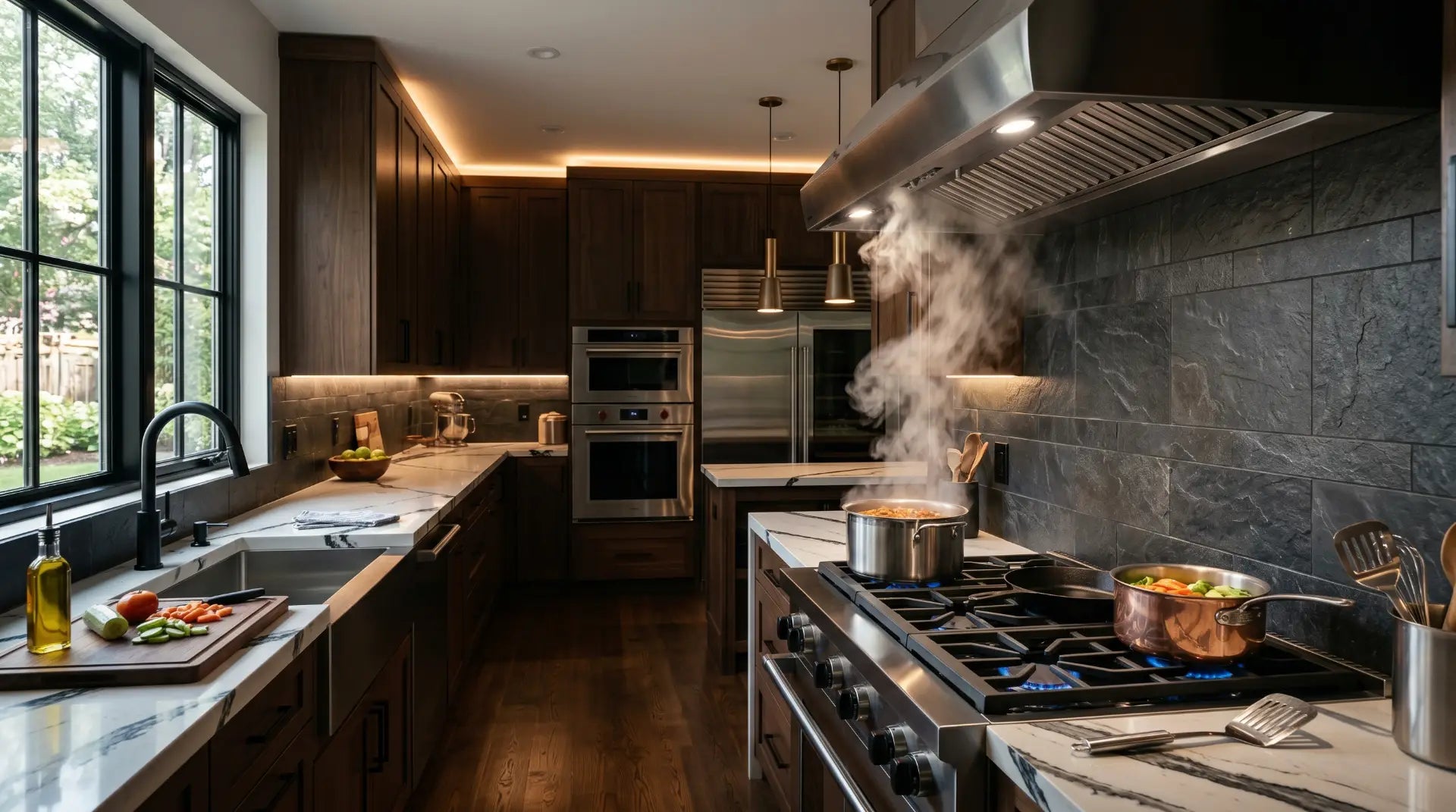
Most range hood buyers choose on looks and regret it on the first high-heat cook. The hood that clears smoke and grease from your kitchen depends on three numbers most listings don't explain clearly: CFM, sone rating, and duct diameter. This guide gives you all three - plus the installation rules that determine whether your new hood actually works or just decorates your wall.
Range hoods are the most under-researched appliance in the kitchen. Buyers spend hours comparing countertop materials, cabinet finishes, and faucet styles - and then select a range hood based on whether it looks good above the stove. The result is a hood that moves air but doesn't actually clear the kitchen, or one that runs so loudly the household stops using it within six months, or one that's installed with a 4-inch duct when it needs 6 inches to work at even half its rated capacity.
This guide prevents all three mistakes. It explains CFM sizing in real terms - including a step-by-step formula you can apply to your own cooktop output - covers the four main hood types and when each is the right choice, and gives you the duct sizing and installation rules that determine whether your hood works as specified or significantly underperforms. It also covers noise ratings, the features worth paying for versus the ones that add cost without adding performance, and ends with a decision tree that produces a clear answer for your specific kitchen in under three minutes.
Range hood selection depends on three pieces of information about your kitchen: (1) your cooktop's total BTU output - found on the burner stickers or the range manual; (2) the width of your cooktop in inches; and (3) whether you have an existing duct path to the exterior or will be installing ductless. If you're also selecting your kitchen faucet at the same time, our Pull-Down vs. Pull-Out Kitchen Faucet Guide covers that decision with the same level of detail.
Match CFM to BTU, width to cooktop, and duct diameter to CFM - in that order. Type comes last.
If you have a gas range with 60,000 total BTUs, you need at least 600 CFM. If your cooktop is 36 inches wide, your hood should be 36 to 42 inches wide. If your hood is rated at 600 CFM, your duct diameter needs to be at least 6 inches - ideally 7 or 8 inches - to deliver that rated airflow without restriction. Once those three parameters are confirmed, you choose the hood type that fits your kitchen's physical layout and aesthetic.
The rest of this guide explains the reasoning behind every step, covers each hood type in detail, and provides the installation information that product listings almost never include - the information that determines whether your hood actually performs at its rated capacity after it's on the wall.
CFM stands for cubic feet per minute - the volume of air the range hood can move through its duct system per minute at maximum fan speed. It is the single performance metric that determines whether a range hood clears smoke, steam, grease, and cooking odors from your kitchen or merely recirculates them. Every other spec - motor type, number of fan speeds, light wattage - is secondary to CFM. A beautifully designed hood with inadequate CFM for your cooktop output is a decorative object. A utilitarian hood with correctly specified CFM clears your kitchen on the first high-heat cook and on every subsequent one.
CFM ratings in product listings are always measured at maximum fan speed, with no duct resistance - meaning the actual effective CFM delivered to your kitchen will be lower than the listed rating once the air is moving through a duct with bends, length, and a termination cap. This is why sizing to the minimum required CFM is a mistake: you need to spec above the minimum to account for real-world duct losses. A commonly used rule of thumb among HVAC professionals is to add 10% to your required CFM for every 90-degree duct elbow, and another 10 to 20% for duct length over 10 feet.
Never buy a range hood rated at exactly your minimum CFM requirement. The listed CFM is an unloaded test result. In a real duct installation, effective CFM at the hood opening is typically 15 to 30% lower than the listed rating. Size your hood 25% above your calculated minimum - this is the single most common correction that prevents performance disappointment after installation.
There are two accepted methods for calculating required CFM - one based on cooktop BTU output (for gas ranges) and one based on kitchen volume (for electric, induction, or unknown BTU configurations). Use whichever applies to your cooktop, and use the higher result if both apply.
- Formula: Total BTU ÷ 100 = Minimum CFM required
- Example: 4-burner gas range, 15,000 BTU per burner = 60,000 total BTU → 600 CFM minimum
- Commercial-style range (e.g. 6-burner, 120,000 BTU): 1,200 CFM minimum - spec a professional insert or built-in hood
- Add 25% buffer: 600 CFM minimum → buy a 750 CFM hood to account for duct losses
- Note: Use total BTU of all burners, not single-burner output. Found on range label or owner's manual.
- Formula: Kitchen length (ft) × width (ft) × ceiling height (ft) × 15 air changes per hour ÷ 60 = CFM
- Example: 12 ft × 14 ft × 9 ft × 15 ÷ 60 = 378 CFM - round up to 400 CFM minimum
- Standard guidance: Electric ranges typically need 200-400 CFM; induction 150-300 CFM (less combustion byproduct)
- Add 25% buffer: 400 CFM minimum → buy a 500 CFM hood
- Note: Electric and induction produce less grease particulate and no combustion gases - lower CFM requirements than gas at equivalent burner count.
A wall-mount range hood is a self-contained unit - fan, filters, lighting, and a chimney-style duct cover - that mounts directly to the wall above a range or cooktop positioned against an exterior or interior wall. The chimney extends from the hood body up to the ceiling, concealing the duct run. Wall-mount hoods are the most architecturally prominent range hood format: the chimney is always visible and is typically the focal point of the cooking wall in the kitchen's design.
The defining requirement for a wall-mount hood is exactly that - a wall. The cooktop must be positioned against a wall that provides a mounting surface and a duct path. This rules out island cooktops. Within that constraint, wall-mount hoods are available across the broadest CFM range (300 to 1,200+ CFM), the widest selection of finishes and designs, and are compatible with both ducted and ductless (recirculating) configurations at most standard sizes.
- Your range or cooktop is against a wall - not an island or peninsula
- You want the range hood to be a visible design element in the kitchen
- You have adequate ceiling height - minimum 8 feet; 9-10 feet ideal for tall chimney proportions
- You have or can create a duct path through the wall or ceiling to the exterior
- You're replacing an existing wall-mount hood on an existing duct run
An under-cabinet range hood mounts to the underside of the upper cabinet directly above the cooktop - the same cabinet that would typically hold dishes or pantry items. The hood body is partially or fully concealed by the cabinet above it, which creates a lower visual profile than a wall-mount chimney. Under-cabinet hoods are the most common range hood type in American kitchens built before 2010, when upper cabinets over the stove were standard layout practice.
The practical advantage of an under-cabinet hood: it uses existing cabinet structure for mounting and allows the duct to run through the cabinet interior and exit through the wall or soffit above - reducing visible ductwork to zero in most installations. The limitation: upper cabinet depth must be compatible with the hood's depth (most are 12 to 24 inches deep, matching standard 12-inch upper cabinet depth), and the CFM ceiling is lower than wall-mount or built-in formats - most under-cabinet hoods max out at 400 to 600 CFM, which is insufficient for high-BTU professional ranges.
- You have an upper cabinet directly above the cooktop - the mounting surface is already there
- Your range is a standard residential 30" or 36" gas or electric model up to 60,000 BTU
- You want minimal visual footprint - the hood disappears under the cabinet
- You're replacing an existing under-cabinet model on an existing duct line
- Budget is a consideration - under-cabinet hoods have the widest selection at $150-$600
A built-in range hood (also called a liner or insert) is a fan-and-filter mechanism without an external housing - it installs inside a custom hood surround built from cabinetry, tile, plaster, or wood. The surround is designed and built separately, typically by the kitchen cabinet maker or contractor, and the insert slides into the cavity at installation. The result is a range hood that looks like a seamless architectural element - a wood-clad box, a plastered arch, a tile-faced chimney - rather than an appliance.
Built-in inserts are available in the highest CFM ratings of any residential format - 600 to 1,800+ CFM - making them the correct specification for professional-grade ranges with 80,000 to 120,000+ total BTU output. The tradeoff: the surround must be designed and built before the insert is specified, meaning the insert dimensions must be known before cabinet construction begins. Measure the insert's minimum cavity dimensions from the product spec sheet and communicate them to the cabinet maker early in the kitchen design process.
- You have a professional or commercial-style range above 60,000 total BTU
- You're doing a new kitchen build or full remodel where the hood surround can be designed from scratch
- Design continuity is a priority - a wood or tile surround matches the cabinet language exactly
- You want the highest CFM available in a residential format
- You have a pot filler - built-in surrounds accommodate pot filler plumbing naturally
An island range hood mounts to the ceiling above a cooktop positioned on a kitchen island or peninsula - away from any wall. It is a visually dominant fixture: hanging from the ceiling in the center of the room, the island hood is one of the most prominent design elements in an open-plan kitchen. Island hoods require a ceiling-exit duct that runs through the ceiling cavity to an exterior wall or roof termination - a more complex duct run than a wall-exit path, and one that typically requires a licensed contractor to plan and install.
Because island cooktops are exposed on all sides (air currents from the open kitchen can displace rising cooking vapors before they reach the hood), island hoods require 15 to 20% more CFM than a wall-position hood for equivalent cooktop output. For a 60,000 BTU island gas range, budget for 700 to 750 CFM rather than the 600 CFM minimum that would apply in a wall configuration. Island hoods also require adequate ceiling height - a minimum of 8 feet, with 9 to 10 feet producing better proportions for the hanging chimney profile.
- Your cooktop is on an island or peninsula - there is no wall to mount to
- Your kitchen is open-plan with 9+ feet of ceiling height
- You have or can create a duct path through the ceiling cavity to the exterior
- You have budget for a more involved installation - ceiling duct runs typically cost more to install than wall runs
- The hood is intended to be a statement design element visible from the living or dining area
CFM determines whether your hood clears air. Physical sizing determines whether it captures cooking vapors before they spread. A correctly sized hood captures grease, steam, and smoke at the source - before they reach room air. An undersized hood lets vapors escape around the edges of the capture zone, which no amount of CFM will compensate for.
| Dimension | Rule | Why It Matters |
|---|---|---|
| Hood Width | Match or exceed cooktop width by 3" on each side (6" total) for gas ranges. Match cooktop width for electric/induction. | Gas flames produce wider vapor plumes than electric elements. A hood narrower than the burner spread lets vapors escape the capture zone at the edges. |
| Mounting Height (gas) | 24" to 30" above the cooktop surface to the bottom of the hood | Too low creates a fire hazard and is a code violation in most jurisdictions. Too high reduces capture efficiency - vapors dissipate before reaching the hood. |
| Mounting Height (electric/induction) | 20" to 24" above the cooktop surface to the bottom of the hood | Electric and induction generate less heat than gas - a lower mounting height is safe and improves capture efficiency without safety risk. |
| Hood Depth | Minimum 20" depth for a 30" cooktop; 24" depth for a 36" cooktop | Hood depth determines the capture zone over the rear burners. A shallow hood over a deep cooktop leaves rear burners outside the capture area. |
| Ceiling Height Clearance | Wall-mount chimneys require 8 ft minimum ceiling; 9-10 ft for standard chimney proportions | A standard wall-mount chimney needs 18-24" of ceiling height above the duct cover top. In 8 ft ceilings, some chimney models will be visually compressed - verify the chimney height range in the product specs. |
This is the decision most buyers research least and regret most. A ducted range hood draws contaminated air through a grease filter, moves it through a duct, and exhausts it to the exterior of the building. A ductless (recirculating) range hood draws contaminated air through a grease filter and a carbon filter, then recirculates the filtered air back into the kitchen. The difference in performance is significant and not fully understood by many buyers until after installation.
| Factor | Ducted (Vented to Exterior) | Ductless (Recirculating) |
|---|---|---|
| Grease removal | Removes grease from kitchen air entirely - exhausted outside | Captures grease in baffle filter - refiltered air returns with residual grease particulate |
| Smoke removal | Removes smoke and combustion gases completely | Carbon filter reduces smoke - does not eliminate it, especially at high heat |
| Odor removal | Eliminates odors - exhausted outside | Reduces odors - carbon filter saturates over time and must be replaced every 3-6 months |
| Humidity | Removes steam and moisture from kitchen | Does not remove moisture - humidity recirculates back into the room |
| Installation | Requires duct path to exterior - wall, soffit, or roof penetration needed | No exterior duct needed - can install anywhere |
| Ongoing cost | Grease filters - wash monthly. Minimal ongoing cost. | Carbon/charcoal filters - replace every 3-6 months. $20-$60 per replacement set annually. |
| Recommended for | All primary kitchens with gas ranges. Any high-volume cooking. New construction. | Secondary kitchens, apartments without duct access, light cooking, condos with no exterior duct option |
This section covers the topic that product listings almost never explain but that determines whether your hood actually delivers its rated CFM. The duct connecting your range hood to the exterior is a physical restriction on airflow. The smaller the duct diameter, the harder the fan must work to move the same volume of air - and the more pressure is lost to turbulence and friction inside the duct. A 600 CFM hood connected to a 4-inch duct will not deliver 600 CFM. It will deliver significantly less, and the fan will work at higher motor stress to achieve even that reduced flow.
| Duct Diameter | Maximum Practical CFM | Notes |
|---|---|---|
| 4" round | ~150 CFM maximum | Adequate only for bathroom fans and very low-output kitchen hoods. Not appropriate for any range hood above 150 CFM - often found in older homes as a holdover from bathroom vent installs. |
| 6" round | ~350-400 CFM practical | Minimum acceptable for a standard 30" under-cabinet or wall-mount hood on an electric range. Restricts hoods rated at 400+ CFM - a 600 CFM hood on a 6" duct will flow closer to 350 CFM. |
| 7" round | ~500-600 CFM practical | Correct spec for 400-600 CFM hoods on standard gas ranges. The most commonly undersupplied duct size in residential kitchens - many builders default to 6". |
| 8" round | ~700-800 CFM practical | Required for 600-800 CFM hoods and high-BTU gas ranges. Correct spec for most wall-mount hoods in the 600-900 CFM range. |
| 10" round | ~900-1,200 CFM practical | Required for commercial-style or built-in inserts on professional ranges above 80,000 BTU. New construction specification for island hoods in high-BTU configurations. |
Many under-cabinet hoods come with a rectangular duct adapter (typically 3¼" × 10" or 3¼" × 14") to match the rectangular opening at the top of the hood body. These rectangular ducts must be converted to round using a transition fitting before entering the wall or ceiling cavity - rectangular duct runs of more than a few feet create significantly more airflow resistance than equivalent round duct. The equivalent round diameter for a 3¼" × 10" rectangular duct is approximately 6" round. For 600+ CFM hoods, insist on a round duct run from the transition fitting onward.
Every 90-degree elbow in your duct run is equivalent to approximately 10 feet of straight duct length in terms of airflow resistance. A duct run with two elbows behaves like a straight run 20 feet longer - which can reduce effective CFM at the hood opening by 15 to 25%. Minimize elbows. Where elbows are unavoidable, use smooth-radius elbows rather than sharp-angle fittings, and upsize the duct diameter by one size (e.g., from 6" to 7") to compensate.
A sone is a unit of perceived loudness - unlike decibels (dB), which measure sound pressure on a logarithmic scale, sones measure how loud something sounds to the human ear on a linear scale. One sone is roughly equivalent to a quiet refrigerator hum. Two sones is twice as loud as one sone. Six sones is approximately the sound level of a normal conversation at arm's length. Range hood manufacturers publish sone ratings at each fan speed - always look at the low-speed sone rating, not the maximum-speed rating. A hood rated at 6 sones at maximum and 1 sone at low is usable at low speed; a hood rated at 4 sones at low is audibly intrusive even on its quietest setting.
Two factors significantly affect the noise level you experience beyond the hood's own rating: duct turbulence and the wall cap or roof cap on the exterior. A duct run with multiple elbows creates turbulence that adds noise. A wall cap that hasn't been sized to match the duct diameter creates backpressure that forces the fan to work harder - adding both motor noise and turbulence noise. Specify a wall or roof cap with an equivalent or larger opening than your duct diameter, and use backdraft dampers that open fully at low pressure - spring-loaded dampers that are stiff to open create audible resistance noise at low fan speeds.
- Stainless steel baffle filters: Dishwasher-safe, capture grease efficiently at high velocity, and last the life of the hood. Mesh aluminum filters are cheaper and less effective - grease passes through at higher flow rates.
- Variable fan speeds (3+): Three speeds minimum - low for ambient ventilation, medium for regular cooking, high for high-heat searing. Six speeds on premium models allow precise noise-vs-performance tuning.
- Delayed auto-off: Fan continues running for 5-15 minutes after cooking stops to clear residual steam and odors from the kitchen. Prevents condensation on cabinet undersides. Worth the premium on any daily-use kitchen.
- Boost mode: A brief maximum-CFM mode (typically 3-5 minutes) triggered by a dedicated button for sudden smoke or high-heat events. Practical for searing, stir-frying, and any high-output cooking moment.
- LED lighting: LED cooktop lighting in the hood uses less energy than halogen, produces less heat over the cooktop, and provides better color rendering for food prep. Standard on mid-range and above; skip hoods still using halogen.
- Grease filter cleaning indicator: A timer or sensor that alerts when baffle filters need cleaning. Prevents the degraded capture efficiency that comes from overloaded filters - one of the most common reasons hoods appear to underperform over time.
- Smartphone app control: Range hoods are single-use appliances operated while cooking - voice or gesture control doesn't add meaningful convenience over a physical panel within arm's reach. App-connected hoods cost $100-$300 more with no performance benefit.
- Touch controls (vs. physical buttons): Touch panels look cleaner but fail more often in a grease and steam environment than physical buttons or dials. Easier to clean in theory - harder to replace when the touch sensor fails.
- Built-in timer without auto-off: A countdown timer that alerts you when to turn off the fan manually is less useful than an auto-off feature - which turns the fan off without requiring your attention.
- Very high CFM ratings for standard residential ranges: A 1,200 CFM hood over a 60,000 BTU gas range is significant overkill - and at 1,200 CFM, makeup air requirements (see installation section below) become a serious concern. Spec to requirement, not to maximum available.
- Decorative chimney extension kits sold separately: Some manufacturers sell basic chimney extensions as separate accessories at $80-$150. This cost should be built into the comparison price when evaluating hoods - a hood that fits your ceiling height without a paid extension is better value than one that requires it.
Range hood installation is more structurally involved than kitchen faucet or sink installation, and the decisions that determine whether it goes smoothly are made before the product arrives - not after. The most important installation considerations to resolve before ordering:
Identify the route from the hood location to the nearest exterior wall or roof - avoiding HVAC runs, electrical panels, and structural beams. Measure the total duct run length and count the number of elbows needed. This determines the duct diameter you'll need (see Duct Sizing section) and whether professional installation is required. In most jurisdictions, duct penetrations through exterior walls require a building permit - verify with your local building department before starting.
Most residential range hoods require a standard 120V / 15-amp dedicated circuit within reach of the hood's power cord (typically 3 to 5 feet). Some high-CFM hoods (900 CFM+) require a 20-amp circuit. Verify the circuit exists at the installation location - adding a new circuit requires a licensed electrician and in most cases a permit. Do not assume the existing circuit from a prior hood is adequately rated for a higher-CFM replacement.
In newer, tightly sealed homes, a range hood exhausting more than 400 CFM creates negative air pressure inside the house - pulling air in through gaps in the building envelope, which can backdraft combustion appliances (furnaces, water heaters, fireplaces) and cause air quality problems. Most US building codes require a makeup air system for hoods above 400 CFM in new construction (International Residential Code R303.6). If you're installing a 600+ CFM hood in a sealed home, consult a licensed HVAC contractor about passive or active makeup air provision before ordering the hood.
Wall-mount range hoods are heavy - 40 to 80 pounds for a full chimney model - and require lag screws into wall studs or a dedicated mounting plate anchored to structural members. Mounting into drywall with toggle bolts alone is not structurally adequate for a wall-mount hood over 30 pounds. Locate studs at the exact installation height and confirm their spacing is compatible with the hood's mounting bracket pattern before ordering. For island hoods, ceiling backing (blocking between joists) must be added before drywall is finished - plan this during rough construction or before drywall patching if retrofitting.
Wall-mount hoods include a chimney that extends from the top of the hood body to the ceiling. Most manufacturers include an adjustable chimney section that telescopes to fit ceiling heights from 8 to 9 feet, with extension kits available for up to 10 or 11 feet. Measure from the bottom of the hood's intended mounting height to the ceiling - the chimney must reach the ceiling cleanly. If your ceiling height is between standard chimney ranges (e.g., 9 feet 4 inches), confirm the exact adjustment range in the product specifications before ordering.
| Criterion | Wall-Mount | Under-Cabinet | Built-In Insert | Island Hood |
|---|---|---|---|---|
| Cooktop position | Against wall | Against wall, under cabinet | Against wall, custom surround | Island or peninsula only |
| CFM range | 300-1,200 CFM | 200-600 CFM | 600-1,800+ CFM | 400-1,200 CFM |
| Max BTU coverage | Up to ~100,000 BTU | Up to ~60,000 BTU | Professional ranges - unlimited | Up to ~100,000 BTU (add 15-20% vs wall) |
| Visual profile | Prominent chimney - design statement | Hidden under cabinet - minimal | Invisible - surround is the design element | Dramatic ceiling fixture - most visible |
| Installation complexity | Moderate - wall studs, duct, electrical | Low - cabinet mounting, existing duct | High - surround construction + insert | High - ceiling duct run, structural backing |
| Duct direction | Top or rear exit | Top through cabinet or rear wall | Top exit through surround | Ceiling exit only |
| Ceiling height needed | 8 ft minimum; 9-10 ft ideal | Standard - no ceiling clearance issue | Dependent on surround design | 8 ft minimum; 9-10 ft ideal |
| Price range | $250-$1,500+ | $150-$600 | $400-$2,000+ (insert only) | $500-$2,500+ |
| Best kitchen match | Standard to large kitchens, wall-position range, open-plan | Compact or galley kitchens, standard residential ranges | New construction, luxury remodels, professional ranges | Open-plan kitchens with island cooktops |
- Total cooktop BTU confirmed - all burners combined, from range label or owner's manual
- Required CFM calculated - BTU ÷ 100 for gas; room volume formula for electric/induction
- 25% CFM buffer added to calculated minimum - purchase CFM target is minimum × 1.25
- Cooktop width measured - hood width should match or exceed by 6" total for gas ranges
- Mounting height measured - 24-30" for gas, 20-24" for electric/induction
- Ceiling height measured - verify chimney adjustment range covers your exact ceiling height
- Overhead clearance to ceiling confirmed for wall-mount and island models
- Duct path to exterior mapped - wall exit, soffit, or roof
- Duct diameter confirmed adequate for the CFM of the chosen hood - see duct sizing table
- Number of elbows in duct run counted - upsize duct diameter one step per two elbows
- Total duct run length measured - add 10% CFM buffer per 10 feet beyond the first 6 feet
- Exterior termination cap sized - opening diameter must match or exceed duct diameter
- Makeup air requirement assessed for hoods above 400 CFM in newer sealed homes
- Permit requirement confirmed with local building department for exterior duct penetration
- CFM stated at maximum speed - HVI certification present (not just manufacturer-claimed)
- Sone rating stated at each fan speed - reject listings showing only maximum-speed noise
- Low-speed sone ≤ 1.5 for open-plan kitchens; ≤ 3 acceptable for closed kitchens
- Baffle filter material confirmed as stainless steel - not aluminum mesh
- Filter confirmed as dishwasher-safe - stated explicitly, not implied
- Chimney height range stated - verify it covers your ceiling height without an extension kit purchase
- Duct outlet size stated - confirms compatibility with your planned duct diameter
- LED lighting confirmed - reject halogen at any price point
- Delayed auto-off present - stated explicitly in feature list
- Warranty minimum 2 years on parts; 1 year on motor - shorter is a quality flag
- Finish matches existing kitchen hardware - pot filler, faucet, cabinet pulls
- Hood width proportionate to range width and wall width - not visually undersized
- Chimney profile matches kitchen style - modern flat chimney vs. traditional curved chimney
Size to BTU first. Match width to cooktop. Specify the duct diameter that actually delivers your rated CFM. Choose hood type last.
The range hood decision is made in the wrong order by most buyers: they choose the type and finish they like, then discover the CFM is insufficient for their range, or the hood arrives and the existing 4-inch duct chokes the airflow to half its rated capacity. The correct order is: calculate required CFM from BTU output → add 25% buffer → confirm duct diameter supports that CFM → confirm width covers the full cooktop → then choose the hood type that fits your kitchen's physical layout and design language.
For the most common US primary kitchen - a wall-position 30-inch gas range with 40,000 to 60,000 total BTU, an upper cabinet, and a standard 8 to 9-foot ceiling - the answer is a 36-inch under-cabinet or wall-mount hood rated at 600 to 700 CFM, connected to a 7-inch or 8-inch duct, with stainless baffle filters, LED lighting, delayed auto-off, and a low-speed sone rating under 2. That specification clears the kitchen completely, runs quietly at the speeds you'll use most, and will perform correctly for a decade with monthly filter cleaning.
For island cooktops, professional ranges, or design-forward kitchens where the hood is a deliberate architectural element, the type and CFM spec change - but the sequencing of the decision doesn't. BTU and duct diameter are always the first two numbers to get right.
Shop range hoods at Bathify - free shipping across the USA
Browse wall-mount, under-cabinet, and built-in range hoods in stainless, matte black, and brushed finishes - all with free shipping on orders over $50 to the continental US.


