







The mount type is the single most consequential structural decision in kitchen sink selection - it determines countertop compatibility, daily cleaning effort, installation cost, and resale value. This guide breaks down every real-world difference so you make the call that fits your countertop, your budget, and the way you actually use your kitchen.
The undermount vs top-mount kitchen sink decision is made backwards by most buyers. They fall in love with a sink's look or material - a sleek stainless undermount, a classic white porcelain drop-in - without first confirming whether their countertop can actually support that mount type. Then the countertop fabricator tells them their laminate surface can't hold an undermount, or their stone slab will need to be recut and sealed in ways they didn't budget for. The sink goes back. The stress is real. The guide below prevents that outcome entirely.
The mount type decision comes down to three questions in order: What countertop material do you have or plan to install? What is your actual daily cleaning tolerance? And what is your installation budget? Answer those three in sequence and the decision is usually clear before you've even looked at a single product listing. This guide walks through each, then scores the two options head-to-head across seven criteria that actually matter in day-to-day kitchen use.
If you have laminate (Formica-style) countertops, the decision is already made: top-mount only. Undermount sinks require the countertop edge at the cutout to be finished and sealed - which laminate cannot support because the particleboard core beneath will swell and fail when exposed to water. If you have quartz, granite, marble, concrete, or solid surface (Corian-style) countertops, both options are available to you. If you're replacing the countertop at the same time as the sink, you have full flexibility. The rest of this guide applies to those with flexibility - or to those choosing their countertop and sink together.
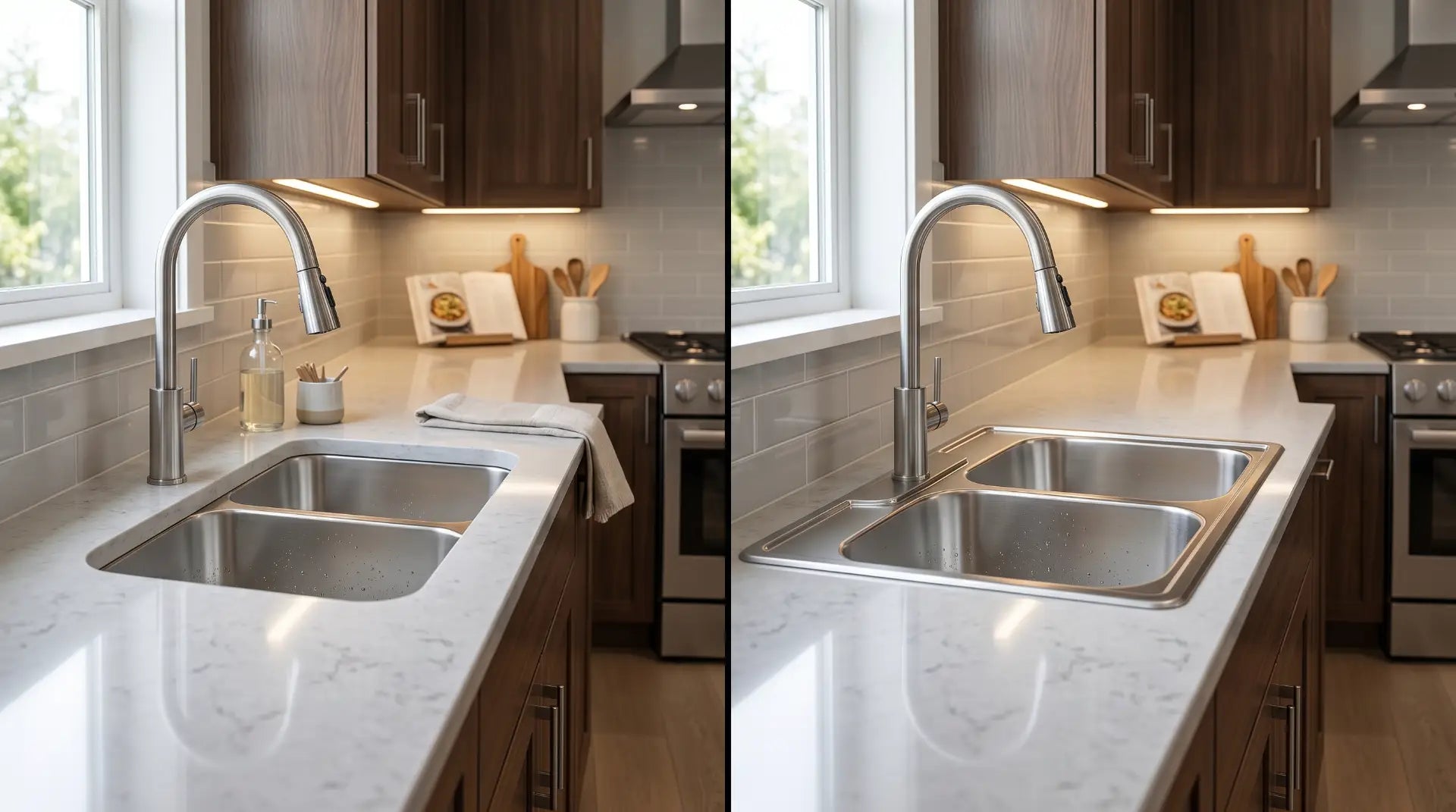
An undermount sink is secured from below the countertop using mounting clips, epoxy adhesive, or a combination of both, with the weight of the sink hanging from the underside of the stone or solid-surface slab. The countertop is cut to the exact sink opening dimensions, and the exposed edge of the countertop at the cutout is finished and sealed by the stone fabricator. The result is a countertop surface that is completely uninterrupted - it flows directly to the edge of the sink basin with no rim, no lip, no seam. Wiping crumbs or liquid from the countertop directly into the sink is genuinely possible and genuinely convenient.
A top-mount sink (also called drop-in) drops into a cutout from above, with a rim or lip that overlaps the countertop surface by typically 1 to 1.5 inches on all sides. The rim rests on the counter, and a clip system beneath the sink draws the rim tight against the countertop surface. A bead of silicone sealant is applied around the rim perimeter to create a water-resistant seal. The weight of the sink is supported by the rim resting on the countertop, rather than by clamps below. Installation is mechanically simpler and can be done by a competent DIYer. The rim-to-counter seam, however, collects food debris every single day - and is the primary ongoing maintenance difference between the two options.
The countertop material determines which options are available to you, not which is "better": Undermount requires a countertop that can have its edge exposed and sealed - quartz, granite, marble, concrete, or solid surface. Top-mount works on every countertop material including laminate, tile, butcher block, and wood. If you're remodeling countertops and sink simultaneously, the decision is about daily convenience and budget. If the countertop stays, the countertop decides.

This is the round that matters most to homeowners who've lived with both options. With an undermount sink, wiping the counter is a single fluid motion - debris goes directly into the basin. There is no rim to catch against, no silicone seam to pick crumbs out of, no raised edge to wipe around. The countertop behaves as one continuous surface that ends cleanly at the sink opening. For households that cook daily, this difference in cleaning experience is cumulatively significant over years of use.
With a top-mount sink, the rim overlapping the counter creates a perimeter seam that requires specific attention every time you clean. Crumbs and liquids collect in the channel between the rim and the countertop surface - even with fresh silicone, the seam is a daily food trap. Over time, the silicone at this seam discolors and can develop mold or mildew in high-moisture kitchens, requiring periodic resealing (typically every 3-5 years). This is manageable, and many households simply adjust their cleaning routine, but it represents a real and ongoing difference in maintenance effort compared to the seamless countertop-to-basin transition of an undermount installation.

Top-mount wins this round by default - it works with every countertop material without exception. Laminate (Formica, Wilsonart), ceramic tile, butcher block, wood plank, concrete, quartz, granite, marble, solid surface: all of them can accept a top-mount sink because the rim rests on the surface and the underlying material is never exposed to water at the cutout edge. This universality is why top-mount has dominated residential kitchens for decades, particularly in homes that still have the laminate countertops installed during the 1980s and 1990s remodel wave.
Undermount requires a countertop material where the cut edge can be exposed and sealed permanently without water infiltration. This means stone (quartz, granite, marble, quartzite), poured concrete, or engineered solid surface (Corian, Swanstone, HI-MACS). Wood and butcher block can technically accept undermount installation, but the exposed edge requires aggressive sealing and ongoing maintenance - most woodworkers and contractors advise against it for a primary kitchen sink. Laminate cannot accept undermount at all: the particleboard core beneath the laminate surface will absorb water at the exposed cutout edge and swell, leading to delamination and eventual structural failure of the countertop at the sink opening.

Top-mount installation is mechanically straightforward: the countertop cutout can be made with a standard jigsaw, the sink drops in from above, mounting clips are tightened from below, and the rim is sealed with silicone. A competent DIYer can complete a top-mount replacement in 2-4 hours with basic plumbing tools and an $8 tube of kitchen-and-bath silicone. When hiring a plumber or handyman, a basic top-mount sink swap on an existing cutout typically runs $150-$350 in labor in most US metro markets (New York, Los Angeles, Chicago, Houston, Phoenix) - less in rural areas, slightly more in San Francisco or Seattle.
Undermount installation is more involved. The sink must be installed before the countertop is placed - because the mounting hardware attaches below the stone slab, and the stone must be cut precisely to the sink's exact dimensions by the countertop fabricator. In a new countertop installation, the undermount sink specification adds approximately $100-$250 to the fabrication cost (for edge finishing at the cutout and sealant). In a countertop replacement scenario, you're essentially paying for the stone cut and polish whether or not you change the sink. The plumbing reconnection adds $150-$300. In a like-for-like undermount swap (same cutout dimensions, no countertop change), a contractor familiar with undermount work can manage the clip-and-epoxy replacement in 3-5 hours, but it requires cutting access from below and is not a recommended DIY project for most homeowners.

A 33-inch undermount sink delivers 33 inches of usable basin width - the entire interior opening equals the listed dimension. A 33-inch top-mount sink delivers approximately 30 to 30.5 inches of usable basin width because the rim overlapping the countertop on each side reduces the interior opening by about 1 to 1.5 inches per side. For large cookware - roasting pans, stockpots, sheet pans - that 2-3 inch difference in interior width is the difference between a pan that fits and one that has to be angled or tilted to get clean.
This sizing gap is most consequential in 30-inch sinks, where the interior dimension of a top-mount may be as small as 27 inches after accounting for the rim - tight for anything larger than a standard dinner plate. In 33-inch and 36-inch sinks the gap is less limiting, but it's still real. When comparing products, look for the listed interior basin dimension rather than the overall sink dimension for an accurate comparison between mount types at equivalent prices.

Undermount is the near-universal specification in professionally designed American kitchens and the default expectation in homes listed above median price in every major US market - New York, Los Angeles, Chicago, Atlanta, Dallas, Denver, Seattle, Miami. Real estate professionals consistently note that a top-mount sink in a kitchen with stone countertops reads as a budget shortcut that buyers notice, while an undermount in the same kitchen is invisible in the best way - it disappears into the design as the intended element. Appraisers in the high-end residential market associate undermount sink specification with premium kitchen renovation quality.
This doesn't mean a top-mount sink damages resale value - in a home with laminate countertops, it's the correct specification and buyers know it. The aesthetic calculus changes when stone countertops are present: a top-mount sink in a kitchen with quartz or granite countertops creates a visual inconsistency that signals incomplete renovation. If you're renovating with resale as a significant consideration and plan to install stone countertops, specify undermount. If the countertops are laminate, the resale consideration is neutral.

The sink material and gauge determine long-term durability - not the mount type. A 16-gauge 304 stainless undermount and a 16-gauge 304 stainless top-mount will last equally long under equivalent kitchen use. A thin 22-gauge version of either mount type will dent, flex, and degrade faster than a quality 16-gauge of either. The material selection (stainless vs. granite composite vs. fireclay) matters far more to durability than whether the sink hangs below or drops into the counter.
The one durability consideration that differs by mount type: the silicone seal at the rim-to-counter junction on a top-mount sink requires periodic renewal. Kitchen silicone at a wet, high-traffic seam typically needs resealing every 3-5 years - a 30-minute task with a tube of silicone from Home Depot or Lowe's, but one that requires attention. An undermount installation also has silicone - at the perimeter below the stone - but this joint is not exposed to daily water contact and typically holds 10+ years without resealing. The epoxy or clip system holding the undermount to the underside of the slab is also very long-lasting under normal conditions. Neither mount type is meaningfully more durable; the top-mount just requires more active maintenance of its seal.

Top-mount sinks span the widest price range of any mount type - from approximately $75 for an entry-level 18-gauge stainless drop-in at Home Depot or Lowe's, through $150-$400 for quality mid-range stainless options, to $600-$1,200 for premium porcelain or cast iron top-mount models. Because top-mount installation is so broadly compatible and DIY-accessible, many budget-friendly options exist at every size and material combination. This mount type genuinely serves every price point without compromise.
Undermount sinks start higher by design - the engineering required to support an undermount installation, the finishing requirements on the exposed basin edge, and the generally more premium market positioning mean quality undermount sinks typically start at $200-$350 for entry-level 18-gauge stainless, $350-$700 for quality 16-gauge stainless (Blanco Stellar, Blanco Quatrus, Kraus Kore, and similar lines available at Bathify), and $800-$2,000+ for granite composite and fireclay undermount options. The sink price alone is higher - and the installation adds another $100-$300 beyond a typical top-mount swap. Budget for both when planning a renovation with undermount specification.
Undermount wins Daily Cleaning, Basin Space, Aesthetics/Resale. Top-mount wins Countertop Compatibility, Installation, and Budget. Round 6 (Durability) is a draw. But score alone doesn't decide - countertop compatibility rules above all.
| Criterion | Undermount | Top-Mount | Winner |
|---|---|---|---|
| Daily Cleaning | Seamless wipe directly into basin - no rim seam | Rim-to-counter seam collects food daily; periodic resealing needed | Undermount |
| Countertop Compatibility | Stone, quartz, solid surface only - laminate excluded | Every countertop material - no exceptions | Top-Mount |
| Installation Cost | $250-$600 total (professional required) | $150-$350 professional or DIY for $0-$50 | Top-Mount |
| Usable Basin Space | Full listed width is usable interior space | Listed width minus ~1.5" rim overlap each side = smaller interior | Undermount |
| Aesthetics & Resale | Standard in designed kitchens; positive resale signal with stone counters | Correct for laminate; reads as incomplete with stone countertops | Undermount |
| Durability | Long-lasting; below-counter silicone holds 10+ years without resealing | Equal longevity; rim silicone needs resealing every 3-5 years | Draw |
| Price Range | $200-$2,000+ sink; higher install - total investment is larger | $75-$1,200 sink; lower install - most affordable total cost | Top-Mount |
This is the practical reference that ends most undermount vs top-mount debates immediately. If you know your countertop material, you know your options. Confirm your material here before looking at any product.
| Your Situation | Recommended Mount | Why |
|---|---|---|
| New kitchen build or full remodel with stone countertops planned | Undermount | You have full flexibility and will be paying for stone installation anyway - the countertop fabricator includes the undermount sink detail in the stone work. The result is the highest-quality kitchen outcome at the lowest marginal cost difference. |
| Existing laminate countertops - replacing sink only | Top-Mount | No choice - laminate can't support undermount. Top-mount is the correct, practical, and only option. Focus budget on sink quality (material, gauge) rather than mount type. |
| Existing stone or quartz countertops - replacing sink only | Undermount | If the existing cutout dimensions match a replacement undermount, the cost of swapping is reasonable ($250-$500 total) and the result is significantly better in daily use. Verify cutout dimensions against replacement sink specs before committing. |
| Budget-constrained renovation - maximizing value per dollar | Top-Mount | Top-mount saves $150-$400 in installation and allows a wider selection at lower price points. A quality 16-gauge top-mount stainless from a reputable brand at $200 outperforms a budget undermount in every functional metric. Spend the savings on sink quality. |
| Rental property or investment property renovation | Top-Mount | Future sink replacements are easier and cheaper with top-mount - a property manager or contractor can swap a top-mount in 2 hours without stone work involvement. Undermount adds complexity and cost to every future replacement. Top-mount is the practical specification for properties that will need multiple sink cycles over their life. |
| DIY installation - no contractor planned | Top-Mount | Top-mount is the mount type designed for DIY. The installation does not require countertop fabrication involvement and can be completed with basic plumbing tools in an afternoon. Undermount replacement on an existing countertop requires working blind from below a stone slab - a genuinely difficult installation that most DIYers should not attempt. |
| Open-concept kitchen, high-visibility primary cooking space, resale focus | Undermount | In a kitchen that will be scrutinized by buyers, photographed for listings, or appraised in a premium market, undermount with stone countertops is the specification that appraisers and buyers associate with a complete, high-quality renovation. The investment difference is real but returns more in perceived value in competitive US markets. |
Countertop material decides it. If you have flexibility, undermount is easier to live with every day - and worth the higher upfront cost.
If you're replacing a sink without changing countertops, your countertop material has already made the decision for you. Laminate, tile, and butcher block: top-mount only, full stop. Quartz, granite, marble, solid surface, or concrete: you have flexibility, and undermount is the better long-term choice for daily use.
Choose undermount if: you're installing new stone countertops; you have existing stone countertops and the replacement sink dimensions match the cutout; you cook daily and want the simplest possible cleaning routine; or you're renovating with resale value in mind and want the specification that buyers and appraisers expect.
Choose top-mount if: your countertops are laminate, tile, or butcher block (no option here - top-mount is mandatory); you're doing a budget-constrained renovation and want to allocate more to sink quality than installation complexity; you're doing a DIY installation; or you're renovating a rental property where future sink serviceability matters.
In either case: prioritize sink material and gauge over mount type. A 16-gauge 304 stainless top-mount outperforms a 22-gauge undermount in every daily-use metric that matters. Browse Bathify's collections of undermount kitchen sinks and top-mount kitchen sinks filtered by material, size, and gauge - both ship free across the continental US on orders over $50.
Shop kitchen sinks at Bathify - free shipping across the USA
Browse undermount and top-mount kitchen sinks in stainless steel, granite composite, and fireclay - in every width and bowl configuration. Free shipping on orders over $50 to the continental US.


