







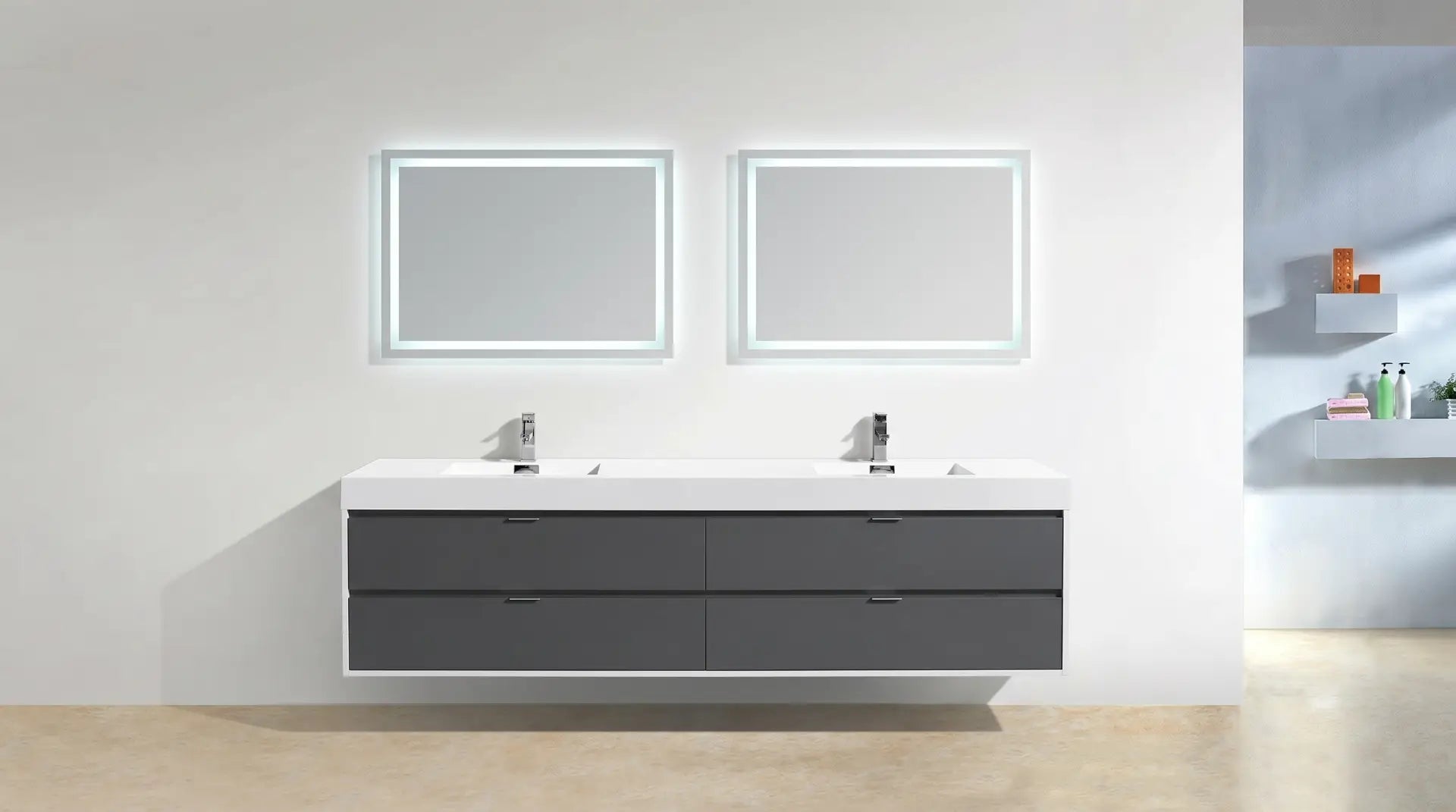
Floating vanities open up floor space, elevate any bathroom's visual weight, and work in more layouts than most people realize. Here are 12 real design configurations - with exactly what makes each one work and how to replicate it.
The floating vanity - wall-mounted, hovering above the floor with no legs, no base, and no toe kick to break the visual line - is the single bathroom upgrade that consistently makes a space look more expensive, more intentional, and more spacious than it did before. The exposed floor beneath the cabinet reflects light, creates depth, and eliminates the visual anchoring that floor-standing vanities impose on a bathroom's proportions.
What makes floating vanities worth an entire design guide is the range of ways they can be executed. A 24-inch floating vanity in a powder room is a completely different design opportunity than an 84-inch floating double sink in a master bathroom. The finish, the mounting height, the countertop material, the hardware - or deliberate absence of it - and the wall treatment behind it all combine to produce a result that is either effortlessly composed or noticeably off. These 12 design configurations break down what works, why it works, and precisely how to replicate it in your bathroom.
A floating vanity is only as good as its wall blocking. Unlike floor-standing vanities that distribute weight through legs to the floor, a wall-mounted vanity transfers its full load - cabinet, countertop, sinks, and contents - directly into the wall. This requires solid blocking (a horizontal wood nailer or steel bracket system) installed between wall studs during framing, or retrofitted through drywall before installation. Without blocking, a floating vanity will pull away from the wall over time regardless of screw quality or installation care. Every design configuration in this guide assumes proper blocking is in place. If your bathroom walls don't currently have it, factor retrofit blocking into your installation plan before ordering.
These 12 designs span every bathroom type, size, and style direction. They're organized from smallest to largest width, then by increasing design complexity. Each one includes the exact design elements that make it work and how to replicate the result in your bathroom.

A 24-inch flat-front vanity in matte black, floating at 34 inches with push-to-open hardware and a square-edge white quartz top, is the most visually powerful configuration available for a powder room. At this small scale, the floating format dramatically amplifies the perceived room size - the exposed floor beneath the cabinet reflects light across the full room width, which is usually 5 feet or less in a powder room. The matte black finish against a light-colored wall (white, warm white, or light gray) creates the contrast that makes this design read as deliberate and high-end regardless of the room's actual square footage.
- Mount at exactly 34 inches from finished floor to countertop top - this is the comfort height standard that makes a powder room feel proportional for adult use
- Keep the wall behind the vanity a solid light tone - a busy tile pattern or dark color behind a 24-inch matte black vanity competes with the vanity rather than framing it
- A single circular mirror in matte black frame, centered above the vanity, is the correct mirror for this design - a rectangular mirror that's wider than the 24-inch vanity creates visual imbalance at this scale
- Pair with a wall-mounted faucet in matte black if budget allows - it removes the faucet from the counter entirely and amplifies the minimal, clean aesthetic of the floating format

A 30-inch white shaker floating vanity with an open bottom shelf - a lower section beneath the main cabinet that is fully exposed, with no doors - solves the small bathroom storage problem without adding visual weight. The main cabinet provides drawer and door storage for daily-use items; the open shelf beneath holds rolled towels, a small plant, or baskets with less frequently used products. This configuration works because it provides more storage than a standard 30-inch floor-standing vanity while maintaining the floor exposure that makes small bathrooms feel larger.
- The open shelf section should be a minimum of 10 inches tall - anything shorter cannot hold a standard rolled hand towel or a 6-inch plant pot, which defeats the storage purpose of the open zone
- Style the open shelf with three items maximum: a basket, a plant, and a candle or small decorative object. More than three items on an open bathroom shelf reads as cluttered rather than intentional
- Pair with brushed nickel or matte black bar pulls on the shaker doors - the hardware finish should match the faucet exactly
- In a narrow bathroom (under 60 inches wide), a white floating vanity with an open shelf is the configuration that maximizes both perceived space and actual storage simultaneously

A 36-inch floating vanity in a warm natural teak or white oak finish, with a vessel sink mounted on a flat wood countertop and a wall-mount faucet, is the closest a bathroom gets to a spa or boutique hotel aesthetic without custom construction. The floating format positions the wood grain at a height where it can be fully appreciated as a material - and the elevated countertop with no under-mount sink cutout keeps the wood surface completely clean and visually continuous. The vessel sink's height is balanced by the lower mounting position of the floating cabinet, maintaining an ergonomic counter height overall.
- Mount 2-4 inches lower than standard comfort height (30-32 inches vs 34 inches) to account for the vessel sink's additional height - the combined height of cabinet mounting + vessel sink height should land at 34-36 inches from floor to sink rim
- Seal the wood countertop with a marine-grade or bathroom-specific penetrating sealer before the first use - apply a maintenance coat annually and dry the surface after every water contact
- A wall-mount faucet is the correct pairing for a vessel sink on a wood surface - a deck-mount faucet requires a hole through the wood top that collects moisture at the seal point over time
- Best suited for a guest bathroom, powder room, or primary bathroom with low daily traffic - not the right configuration for a high-use primary bath where water splash to the countertop is constant

A 36-inch white shaker floating vanity with a Carrara-look quartz top, brushed gold bar pulls, and a brushed gold faucet is the most universally successful bathroom design configuration in Bathify's collection - and the floating format amplifies it. The white shaker brings transitional warmth and familiar craftsmanship character; the Carrara quartz adds the marble aesthetic at zero maintenance cost; the brushed gold hardware creates the warm metal accent that defines contemporary transitional bathrooms in 2026. Floating at 34 inches, this vanity makes a standard primary bathroom feel designed from the moment you walk in.
- Pair with an LED backlit mirror in the same width as the vanity or up to 6 inches wider - centered above the vanity, it provides both functional grooming light and visual symmetry
- Match the brushed gold faucet finish exactly to the drawer pull finish - even slight tone variation between warm brass and cold gold is immediately visible under bathroom lighting
- A subway tile backsplash (either vertical stack or traditional horizontal) between the countertop and the mirror is the classic transitional complement - white or warm-white subway with matching grout creates a serene, cohesive wall zone
- Leave the floor beneath the floating vanity completely clear - no baskets, no storage boxes, no decorative items. The empty floor zone is the design feature; filling it defeats the purpose of the floating format

A 48-inch flat-front floating vanity in deep navy with push-to-open or thin matte black bar pulls and a crisp white quartz countertop is the configuration that defines the most visually confident primary bathroom renovations of 2025-2026. The navy finish commands the wall without making the room feel heavy - because the floating format keeps the lower third of the room visually open. A large-format white or light gray tile floor reflects light underneath the cabinet, creating the contrast that makes the dark finish read as intentional rather than oppressive. This is the design that photographs exactly as good as it looks in person.
- Keep the wall behind the vanity lighter than the vanity itself - a navy vanity against a deep gray wall loses the contrast that makes this design work. White, warm white, or light greige walls are the correct backdrop
- Use large-format floor tile (24×24 inches or larger) in a light tone - the larger the tile, the fewer grout lines, and the more visible the light reflection under the floating cabinet
- A rectangular LED mirror sized to the vanity width or slightly wider is the correct mirror - its clean geometry reinforces the flat-front, hardware-free visual discipline of the vanity
- Choose a matte black faucet - it bridges the dark cabinet and the white counter without introducing a warm metal tone that would compete with the cool modern palette

A 48-inch floating vanity in a concrete-look or dark gray finish paired with a full-width LED backlit mirror creates a bathroom that reads as a deliberately designed contemporary room rather than an assembled collection of fixtures. The concrete-look finish brings industrial character to the flat-front format without requiring actual concrete fabrication. The full-width LED mirror - sized to match the vanity width exactly or extending to the counter edges - adds a horizontal band of light at face height that both illuminates and visually extends the vanity zone. This is the configuration most commonly found in high-end hotel bathrooms and increasingly in US primary bathrooms where the owner wants a hospitality-grade aesthetic.
- Size the LED mirror to match the vanity width exactly - a mirror that's narrower than the vanity breaks the horizontal composition; one that's wider works only if it spans to a logical stopping point (e.g., edge of tile or wall niche)
- Choose a dimmable LED mirror with adjustable color temperature (3,000K-5,000K) - concrete-finish vanities photograph and present best under 4,000K cool white light, which accentuates the gray tones without warming them
- Keep faucet and drain hardware in brushed nickel or matte black - chrome reflects too warmly against concrete-look finishes and creates a visual inconsistency in the material palette
- A light gray or white floor tile maximizes the light-reflection effect beneath the floating cabinet, which is particularly effective with a dark vanity finish where the contrast ratio is highest

A two-tone floating vanity with a white or light upper cabinet and a walnut-veneer or medium-oak lower panel - whether a single lower drawer or a full-height base section - introduces natural warmth into a modern flat-front design without committing to a full wood countertop. The visual split between the white cabinet and the warm wood accent creates horizontal banding that emphasizes the floating vanity's width and adds the material variety that a monochrome design lacks. In natural light, the wood grain at lower cabinet level reads beautifully - it's the right height to be fully visible without being so high that it dominates the composition.
- The wood-to-white split should occur at a natural cabinet division - between a lower drawer section and an upper door section, not at an arbitrary horizontal line across an otherwise unified cabinet face
- Specify engineered wood veneer (not solid wood) for the lower panel - solid wood panels on a floating vanity expand and contract with humidity cycling, causing visible misalignment at the panel joints over time
- Pair with a warm ivory or cream-toned quartz countertop rather than a stark white - the warmer counter tone bridges the white cabinet and the walnut lower without creating a jarring three-tone composition
- Brushed gold bar pulls on the white upper drawers and matte-finished pulls on the wood lower section (or push-to-open on the wood) creates hardware differentiation that reinforces the two-material design intent

Sage green - a muted, gray-green tone that sits between olive and eucalyptus - has become one of the most consistently requested vanity finishes of 2025-2026, and it is particularly effective in the floating format. A 36-inch shaker floating vanity in sage green with a warm Calacatta-look quartz top and brushed gold hardware creates a palette that reads as simultaneously fresh, earthy, and elevated. The floating format prevents the green from feeling heavy - the exposed floor beneath the cabinet keeps the visual weight contained to the cabinet zone, making the color feel like a design accent rather than a dominant tone.
- Pair sage green with warm white or cream walls - a cool gray wall behind a sage vanity pushes the green toward teal and loses the earthy quality that makes this palette work
- A Calacatta-look quartz (warm white with gold veining) is the correct countertop - Carrara quartz (cool white with gray veining) clashes with the warm undertone in sage green
- Brushed gold hardware is the definitive finish choice for sage - brushed nickel reads as cold and disconnected; matte black works but loses the warmth that makes this palette successful
- A round or oval mirror with a brushed gold frame, mounted above the vanity without gap, is the mirror that works with this transitional palette - rectangular mirrors in matte black feel too modern for the earthy sage combination

A 60-inch white shaker floating double sink vanity brings the master bathroom two-user functionality without requiring the full 72-inch wall width that most double vanity buyers assume is mandatory. In the floating format, a 60-inch vanity leaves adequate clearance on both sides in a room as narrow as 78 inches wall-to-wall - three to four inches narrower than a floor-standing equivalent requires for the same visual comfort, because the open floor zone reduces the visual mass of the vanity even when physical clearance is tight. Brushed nickel hardware and faucets keep the palette cool and contemporary without the boldness of matte black.
- Specify a single-slab quartz top - a seam at the center of a 60-inch top (common with two-piece tops) creates a visible joint between the two sinks that collects residue daily
- Two individual LED mirrors (one per sink, 24-28 inches wide each) work better than a single 60-inch mirror at this width - they define each user's zone and provide better individual grooming light
- Confirm that your plumbing rough-in has two drain locations before ordering - at 60 inches, drain centers are typically 14-16 inches from each side wall and 30 inches apart from each other
- Use the same brushed nickel finish on both faucets - mismatched faucet finishes on a double vanity are immediately visible and read as unfinished rather than designed

A 72-inch floating double sink vanity in charcoal, deep navy, or matte black - flat-front, push-to-open, with a white quartz countertop and a full-width LED mirror that spans the entire vanity wall from edge to edge - is the master bathroom configuration that produces the most consistently striking result of any design on this list. The full-width mirror running from tile to tile above a 72-inch dark floating vanity creates a hotel-suite bathroom moment that is almost impossible to achieve with any other combination of standard elements. The mirror's continuous band of light at face height, the dark floating cabinet, and the light floor visible beneath it create a three-layer composition with maximum visual depth.
- Size the LED mirror to span from the outer edge of the vanity to the adjacent tile or wall boundary on each side - the mirror's width should be the full visual width of the vanity zone, not just the 72-inch cabinet width
- Install the mirror directly against the countertop backsplash with no gap - a floating mirror positioned several inches above the countertop breaks the three-band composition that makes this design work
- At 72 inches, verify that the countertop is fabricated as a single slab - a center seam on a 72-inch dark vanity countertop is particularly visible and detracts from the clean modern aesthetic this design requires
- A center support leg or bracket under the countertop is strongly recommended at 72 inches - confirm with the fabricator that the 6-foot quartz span is supported at the center to prevent long-term flex under daily load

Any floating vanity becomes dramatically more impactful with a recessed LED strip mounted to the underside of the cabinet, aimed at the floor. The strip - typically a warm 2700K or neutral 3000K LED tape light, recessed into a small channel cut into the vanity base - creates a soft glow beneath the cabinet that illuminates the floor zone visible under the floating unit. This is the lighting detail most commonly seen in luxury hotel bathrooms and spa environments, and it is achievable in a residential setting for under $150 in materials. The effect is particularly striking in bathrooms with large-format matte tile floors, where the light reflects upward without glare.
- Use a warm 2700K LED tape light - cool white (4000K+) under a vanity creates an institutional, clinical light quality that works against the ambient warmth this effect is meant to produce
- Recess the LED channel into the vanity base by at least half an inch - the strip itself should not be visible when viewed from standing height, only its light on the floor
- Connect to a dimmer switch - the under-vanity glow should be adjustable from full brightness for morning routines to a very low ambient setting for nighttime use
- Matte or honed floor tile diffuses the light softly across the floor without specular glare - polished tiles create bright spots directly below the LED channel that look less refined

An 84-inch two-tone floating vanity - dark lower cabinet, white quartz countertop - with two matching LED mirrors positioned symmetrically above each sink is the maximum expression of the floating vanity format in a residential bathroom. At 84 inches, the floating gap below the cabinet is approximately 7 feet of exposed floor line that creates a visual corridor of space making even a large master bathroom feel architecturally intentional. The two-mirror configuration reinforces each user's individual zone; the two-tone finish gives the wide cabinet visual depth and material interest that prevents a single-color 84-inch vanity from reading as one undifferentiated horizontal block.
- Confirm structural blocking spans the full 84-inch width - a steel mounting bracket system is often specified for vanities this wide to ensure even load distribution across the full wall span
- Each LED mirror should be centered above its respective sink, not centered on the full 84-inch vanity width - sink-centered mirrors are what create the two-zone design reading that makes this configuration work
- At 84 inches, a professional installation team is not optional - this is a two-person minimum job for the cabinet alone, and the countertop requires three people and proper lifting equipment
- Add the under-cabinet LED strip detail from Design 11 at this scale - the 7-foot floor glow beneath an 84-inch floating vanity is the element that makes the space read as truly luxury rather than merely expensive
Every design idea above depends on correct installation. These are the non-negotiable requirements that determine whether your floating vanity looks like the inspiration photo - or develops a tilt, a gap from the wall, or a creak within two years of installation.
Blocking is the foundation of every floating vanity installation. A wall-mounted vanity that is screwed only into drywall - even with wall anchors - will pull away from the wall within 1-3 years under the combined weight of the cabinet, countertop, contents, and daily-use loading. Blocking means a solid horizontal nailer or steel mounting plate installed between wall studs. If your wall doesn't have it during a new build or renovation, a carpenter or experienced installer can retrofit blocking through drywall before the vanity arrives. Confirm blocking is in place before your vanity is delivered - not after.
| Installation requirement | Standard (24-48 in.) | Wide (60-72 in.) | Luxury (84 in.+) |
|---|---|---|---|
| Wall blocking required | Yes - always | Yes - full width | Yes - steel bracket system |
| Installer minimum | 1-2 people | 2 people | 3 people + lifting equipment |
| Plumbing drain rough-ins | 1 | 2 (double sink) | 2 (double sink) |
| Countertop support bracket | Optional | Recommended at center | Required at center |
| Level precision requirement | High - 1/16 in. tolerance | High - 1/16 in. tolerance | Very high - laser level required |
| Under-cabinet LED compatible | Yes | Yes | Yes - most impactful at this width |
| Standard mounting height | 34 in. to countertop top | 34 in. to countertop top | 34 in. to countertop top |
Floating vanities are not DIY-appropriate for most homeowners. The combination of precise leveling, load-rated wall anchoring, countertop placement, and plumbing connections requires either significant hands-on experience with cabinetry installation or a professional. An improperly mounted floating vanity that tilts or separates from the wall requires full removal and reinstallation - and often drywall repair. Budget for professional installation at the time of purchase, not as an afterthought if things go wrong.
Shop floating vanities at Bathify
Browse wall-mount vanities in every width, finish, and style - from 24-inch powder room designs to 84-inch master bathroom statements. Free shipping on orders over $50.


