







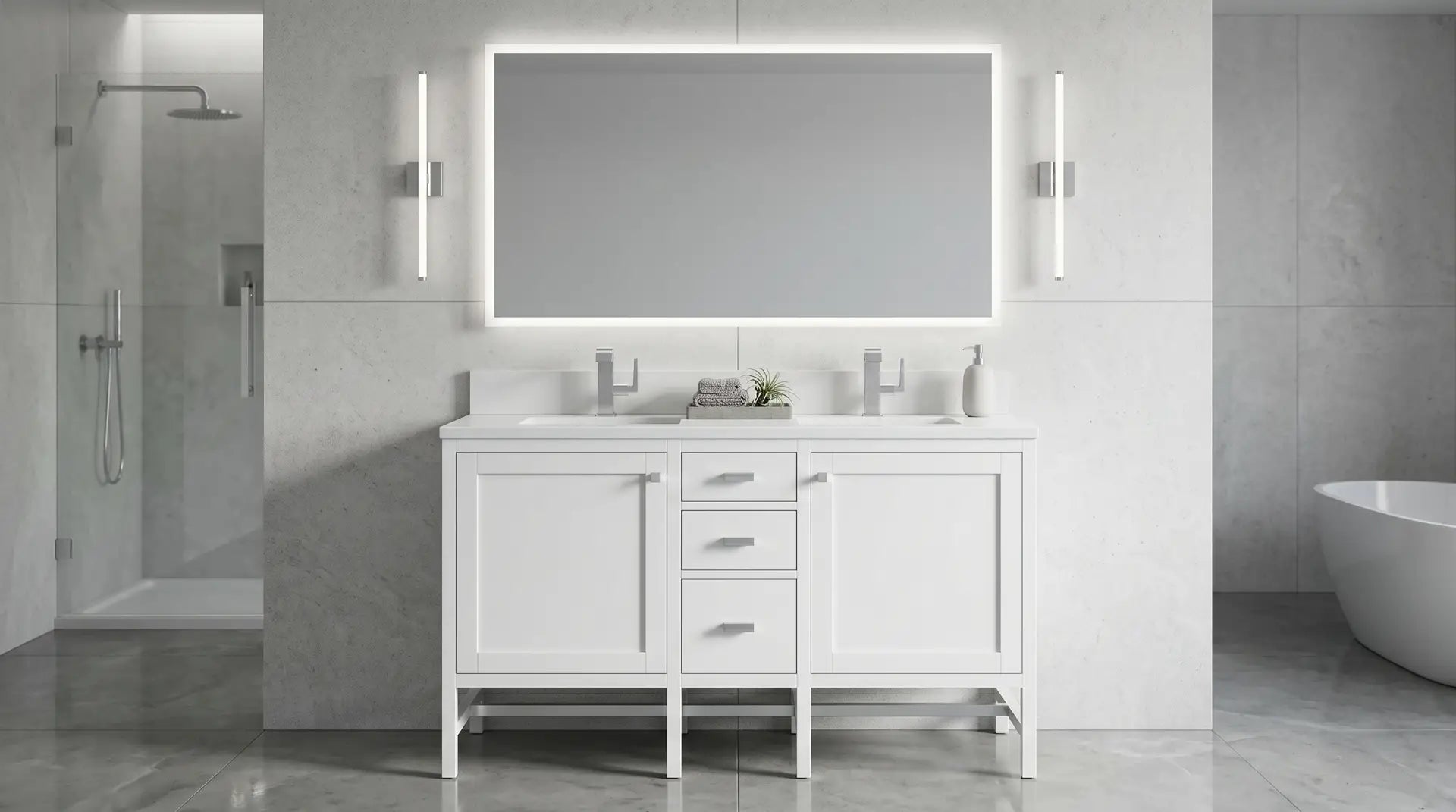
Finish mismatch is the most common design mistake in bathroom renovations - and one of the easiest to avoid. This guide covers every rule for coordinating your vanity, mirror, faucet, lighting, and hardware into a cohesive, intentional space.
A bathroom renovation can have a beautiful vanity, quality tile, and thoughtful lighting - and still feel incomplete. The reason is almost always coordination: a faucet finish that doesn't match the mirror frame, a mirror that's the wrong width for the vanity it sits above, or a light fixture mounted at a height that creates shadows instead of eliminating them. None of these are expensive problems to avoid. They just require knowing the rules before buying any individual piece.
This guide covers every pairing decision between vanity and mirror, faucet and hardware, lighting and frame - with the specific measurements, finish rules, and style-matching logic that turn a collection of bathroom fixtures into a coordinated, designed space.
Every fixture, mirror, light, and hardware piece in a bathroom takes its visual cue from the vanity. The vanity determines the style category (modern, transitional, traditional), sets the dominant color tone, and establishes the finish family that everything else should coordinate with. Start with the vanity and work outward - never the reverse. When the mirror, faucet, and lighting are chosen to coordinate with a specific vanity, the space feels cohesive. When each piece is chosen independently and then combined, finish mismatches and proportion inconsistencies are almost inevitable.
Mirror size relative to vanity is where most bathroom design goes wrong - either from an undersized mirror that looks disconnected from the vanity below it, or an oversized mirror that overwhelms the wall and crowds out other fixtures. The rules here are well-established and consistent across design professionals.

Mirror width: The mirror should be 2-4 inches narrower than the vanity on each side - meaning the total mirror width is 4-8 inches less than the countertop width. For a 36" vanity, the mirror is typically 28-32" wide. For a 48" vanity, 40-44". This gap ensures the mirror appears proportional and gives visual breathing room on both sides for sconces, outlets, or tile details. A mirror wider than the vanity overwhelms the space and looks unanchored.
Mirror height and placement: The bottom of the mirror should sit 5-10 inches above the countertop surface (or above the top of the faucet if the faucet extends above the counter). This spacing prevents faucet splash from reaching the mirror, creates a visual transition between the counter zone and the mirror, and ensures the reflective surface sits at a comfortable eye-level viewing height for standing users.
- Mirror width is 4-8" narrower than countertop width (2-4" per side) - confirmed with measurement
- Bottom of mirror will sit 5-10" above countertop surface or above the tallest point of the faucet
- If side sconces planned: mirror width reduced to 60-70% of vanity width to leave room for fixture placement
- For double vanity: two mirrors are identical in size, shape, and installation height
- Mirror shape chosen: rectangular for modern/contemporary; arched or oval for transitional/traditional
Finish coordination is the design decision with the highest visual impact per dollar of effort. A bathroom where every metal finish coordinates - faucet, mirror frame, drawer pulls, towel bar, toilet paper holder, light fixture - reads as intentionally designed regardless of the individual pieces' price points. A bathroom where each fixture was purchased separately without finish coordination reads as assembled, not designed, no matter how expensive the individual pieces are.
The 2026 approach to finish coordination has evolved from the older "match everything exactly" rule to a more sophisticated framework. Designers now distinguish between the dominant finish (the primary metal used throughout - faucet, hardware pulls, towel accessories) and the accent finish (a second metal used intentionally at a smaller scale to add depth). The ratio that works is approximately 70% dominant to 30% accent. Everything else reads as accidental mixing rather than intentional contrast.
The 70/30 metal mixing rule for 2026: Choose one dominant finish (70% of all metal surfaces - faucet, cabinet hardware, towel bar, toilet paper holder) and one accent finish (30% - typically the mirror frame, light fixture shades, or decorative elements). This ratio creates the intentional contrast that reads as sophisticated layering rather than accidental mixing. Example: matte black faucet and hardware (70%) + brushed gold mirror frame and light fixture (30%) against a white vanity. The layering adds depth without creating visual chaos.
- Dominant finish identified: faucet, cabinet hardware pulls, towel bar, and toilet paper holder will all share this finish
- If mixing metals: accent finish identified (different from dominant) and applied to no more than 30% of metal surfaces - mirror frame, light shades, or decorative elements
- All fixtures from the same finish category confirmed by actual finish name - not assumed by visual similarity
- Faucet finish and cabinet hardware finish confirmed to match: these are in the closest visual proximity to each other and any mismatch is immediately visible
- If applicable: shower fixtures, towel rings, and robe hooks all confirmed in the dominant finish
The mirror is the second most visually dominant element in the bathroom after the vanity - and its relationship to the vanity determines whether the room reads as unified or disjointed. This relationship doesn't require the mirror to exactly match the vanity; it requires the mirror to respond to the vanity intentionally, either through finish coordination, contrast, or style alignment.
| Vanity style | Mirror style that works | Frame finish approach | Shape recommendation |
|---|---|---|---|
| Modern / flat-front | Frameless rectangular; thin metal frame; LED backlit | Match faucet finish OR go frameless - clean geometry is the priority | Rectangular, square, or round - no ornate profiles |
| Transitional / shaker | Simple frame in neutral metal; arched top; thin rectangular | Brushed nickel or brushed gold coordinated with hardware | Arched, rectangular, or oval - moderate frame width |
| Traditional | Framed mirror with profile detailing; ornate frame | Oil-rubbed bronze, antique gold, or warm silver - match hardware finish | Rectangular with decorative frame; oval; arched with keystone detail |
| Farmhouse / rustic | Barnwood frame; black metal frame; distressed finish | Oil-rubbed bronze, matte black, or warm wood tone - coordinates with vanity | Rectangular with substantial frame; arched barn mirror |
| White vanity (any style) | Maximum versatility - works with any mirror finish as contrast | Matte black (modern contrast) or brushed gold (warm luxury) are the strongest 2026 pairings | Any shape - white gives the most freedom for bold mirror choices |
| Dark / navy / charcoal vanity | Light frame provides contrast; frameless works well; brushed gold | Brushed gold or warm nickel against dark cabinet - avoid matching dark frame | Round or rectangular - avoid ornate profiles that compete with dark finish |
| Natural wood (oak, walnut) | Thin metal frame in warm finish; frameless; black frame for contrast | Brushed brass or warm gold coordinates with wood undertone | Simple rectangular; round; avoid heavy ornate frames that fight the wood grain |

Vanity lighting serves two functions simultaneously: it provides task illumination for grooming and it defines the visual composition of the wall above the vanity. Getting it wrong creates harsh facial shadows (from overhead-only lighting), disproportionate fixture sizing, or finish mismatches that undercut the finish coordination established by the faucet and hardware.
The two standard configurations are a light bar above the mirror and sconces on either side of the mirror. Side sconces are functionally superior - they provide even, shadow-free illumination across the face from both sides - but they require wall space on each side of the mirror and limit how wide the mirror can be. Light bars above the mirror are the more common choice and work well in most bathroom layouts.
The lighting fixture finish should match the dominant fixture finish in the bathroom - the same finish family as the faucet and cabinet hardware. Mismatching the light fixture finish while coordinating everything else is one of the more common finish errors, particularly when lighting is ordered from a different source than plumbing fixtures.
- Lighting type decided: bar above mirror (75-80" from floor to center) or sconces on each side (60-65" from floor)
- If sconces: mirror width reduced to 60-70% of vanity width to allow space for side-mounted fixtures
- Light fixture finish confirmed to match dominant metal finish (same as faucet and hardware)
- Bulb color temperature specified: 2700-3000K warm white for grooming accuracy
- CRI specified: 90+ for accurate skin tone and color rendering at the vanity mirror
- If using LED mirror: ambient lighting above may be reduced - consider the combined effect of both sources
The faucet and cabinet hardware (drawer pulls and door knobs) are the two fixture elements in the closest visual proximity to each other on the vanity. Any finish mismatch between them is the first and most obvious design inconsistency a visitor notices. These two elements must be in the same finish - and ideally from the same manufacturer's product line, because the same finish name (brushed nickel, for example) varies meaningfully between brands in undertone, sheen level, and grain direction.
From the faucet and hardware outward, the finish coordination extends to towel bars, towel rings, robe hooks, and toilet paper holders. All of these should share the dominant finish. The light fixture finish also belongs to this coordinated family. The mirror frame is the element with the most flexibility - it can match the dominant finish or serve as the 30% accent finish in a mixed-metal approach.
- Faucet and cabinet drawer pulls confirmed in the same finish - preferably from the same manufacturer's collection
- Towel bar, towel ring, robe hook, and toilet paper holder all confirmed in the dominant finish
- All fixtures from one collection are confirmed by actual finish name verification - not assumed from visual match in separate product photos
- Mirror frame finish decided: matching dominant finish (coordinated look) or accent finish (intentional contrast with 70/30 rule applied)
- Shower fixtures (if visible from vanity zone): in the same dominant finish family
Use this table as your coordination reference for any vanity style. Each row summarizes the finish, mirror style, lighting, and hardware choices that produce a cohesive result for that specific vanity aesthetic.
| Vanity style / finish | Mirror to pair | Dominant fixture finish | Lighting approach |
|---|---|---|---|
| White shaker (transitional) | Brushed gold arched, or frameless LED rectangular | Brushed nickel or brushed gold - from same product family | Warm white bar above; or gold sconces on each side |
| White flat-front (modern) | Frameless LED rectangular; thin matte black frame | Matte black throughout | LED strip above frameless mirror; or matte black bar light |
| Navy / dark blue vanity | Brushed gold round; gold arched; frameless | Brushed gold (dominant warm accent against dark cabinet) | Warm 2700K bar or sconces in brushed gold |
| Natural oak / white oak | Thin gold frame; frameless; round in warm metal | Brushed brass or warm gold - coordinates with wood undertone | Warm gold bar or brass sconces |
| Walnut (dark warm wood) | Warm gold frame; matte black for contrast; frameless | Brushed gold or matte black (both work; pick one and commit) | Warm-toned bar light in chosen dominant finish |
| Greige / warm gray shaker | Brushed nickel frame; frameless; gold for warmth | Brushed nickel (safe, broadly compatible) or brushed gold (warmer) | Brushed nickel bar above; or nickel sconces |
| Charcoal / black flat-front | Frameless LED; brushed gold round; thin gold frame | Brushed gold (creates strong dark-cabinet + warm-metal contrast) | Gold or brass sconces on sides; warm LED mirror |
| Farmhouse / rustic wood | Barnwood frame; black metal frame; distressed warm finish | Oil-rubbed bronze or matte black | Industrial-style bar; lantern sconces; oil-rubbed bronze finish |
- Mirror width = vanity width minus 4-8" total (2-4" per side) - confirmed with measurement
- Bottom of mirror will sit 5-10" above the countertop or the tallest faucet point
- If side sconces: mirror width reduced to 60-70% of vanity width for fixture clearance
- For double vanity: two mirrors identical in size, shape, and installation height
- Dominant metal finish identified and applied to: faucet, cabinet pulls, towel bar, towel ring, robe hook, toilet paper holder
- If mixing metals: accent finish applied to 30% maximum - mirror frame, light shades, or decorative elements only
- Faucet and cabinet hardware confirmed in same finish from same manufacturer collection
- Mirror frame finish decided: matching dominant or intentional 30% accent
- Light placement: bar above (75-80" from floor) or sconces on sides (60-65" from floor)
- Light fixture finish matches dominant metal finish
- Bulb color temperature: 2700-3000K warm white specified
- CRI 90+ specified for accurate grooming-quality color rendering
- Mirror style (frameless, thin metal frame, ornate frame) matches vanity style category
- Mirror shape echoes the bathroom's dominant geometry (rectangular for modern; arched/oval for transitional)
- Hardware profiles (slim vs. substantial) are consistent with vanity door style and overall room formality
- All accessories (soap dispenser, toothbrush holder, decorative items) coordinate with the dominant finish
Shop bathroom vanities and mirrors at Bathify
Browse vanities in every style, finish, and size - with coordinated mirror and fixture options to complete the look. Free shipping on orders over $50.


