






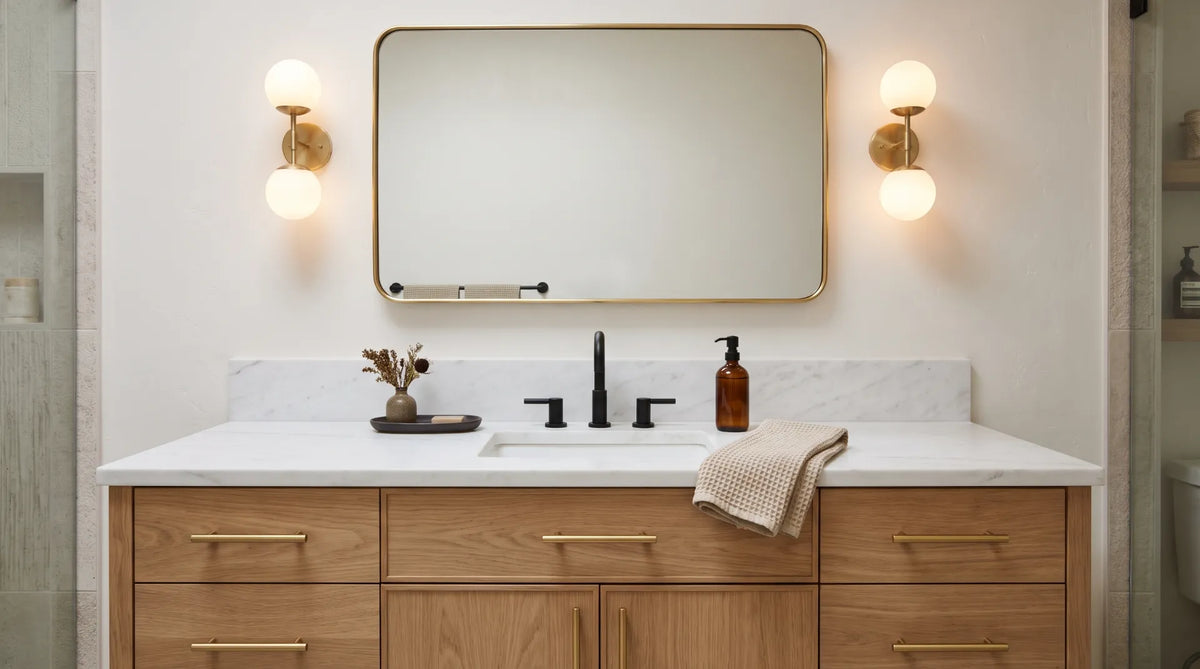
Short answer: yes - and done right, it's the single easiest way to make a bathroom look designed instead of bought in one trip. This guide from Bathify covers how many finishes to use, which metals pair best, and exactly where to place each one.
The "everything must match" rule is one of the most outdated ideas in bathroom design. You can mix metal finishes in a bathroom, and at Bathify it's one of the most common questions we get from US homeowners mid-renovation - usually some version of "I love this matte black faucet, but my shower trim is chrome, is that a problem?" The honest answer is that a deliberately mixed bathroom almost always looks more collected and more expensive than a matchy one, because matched metal reads as builder-grade while mixed metal reads as a choice.
The catch is in the word deliberately. Mixing metals works when it looks intentional and fails when it looks accidental, and the difference comes down to a few rules: limit yourself to two or three finishes, let one clearly dominate, and pair a warm metal with a cool one so the contrast looks purposeful. Our team at Bathify has distilled those rules into the method below, and because Bathify carries faucets, hardware, and lighting in the same coordinating finishes, you can source a mixed-metal scheme from one place instead of chasing finishes across the internet. If you want the broader context first, start with our complete bathroom fixture finishes guide.
Pick one dominant finish for about 60% of the metal in the room, add one accent finish for roughly 30%, and if you use a third, keep it to a 10% decorative detail. Pair warm with cool. Keep your plumbing fixtures consistent and let hardware, lighting, and the mirror carry the contrast. That's the whole method - everything below is how to execute it.
A bathroom where every metal element is identical can feel flat, because there's nothing for the eye to travel toward. Introducing a second finish creates contrast, and contrast is what gives a room depth and a sense of having been styled. This is the same principle interior designers use with texture and color - a single note is safe but static, while a considered pairing feels layered and intentional.
At Bathify, we think about it in terms of two jobs. Your dominant finish does the quiet, unifying work - it's the finish you repeat across the faucet, the shower trim, and the tub filler so the room feels cohesive. Your accent finish does the interesting work - it's the finish you place on the elements you actually want people to notice, like a statement mirror frame, a row of brushed-gold hardware, or a single bold light fixture. When those two jobs are clearly separated, mixing metals stops being a risk and becomes a tool. When they blur together - two finishes fighting for dominance with no clear lead - that's when a bathroom starts to look uncoordinated.
This is the question our team hears most often, right after "can you mix metals at all." The Bathify rule is simple: three finishes is the ceiling, and two is the target for most US bathrooms. One finish should clearly dominate, a second should serve as the accent, and a third - if you use one at all - should appear only as a small decorative note, like a single piece of jewelry rather than a second outfit.
The right number depends heavily on the size of the room, because the smaller the bathroom, the closer the metal elements sit to each other and the faster a third finish starts to read as clutter. Here's how Bathify suggests scaling the finish count to the space:
Every mixed-metal bathroom Bathify would call successful follows the same underlying structure, borrowed from the classic 60/30/10 design ratio. Roughly 60% of the visible metal is your dominant finish, about 30% is your accent, and the final 10% - if present - is a small decorative detail. You don't need to measure anything; the ratio is just a way to make sure one finish is unmistakably in charge.
Usually the plumbing: faucet, shower trim, and tub filler. This is the finish repeated most, so choose something you'll live with happily for years. Bathify customers most often make matte black, chrome, or brushed nickel the dominant finish.
Hardware, lighting, or the mirror frame. This is where a warm metal like brushed gold or champagne bronze earns its keep against a cooler dominant finish. It's also the layer you can change later without a plumber.
A single small element - a drain, a cabinet knob, a tumbler. Skip it entirely in small bathrooms. When used, it should echo one of your other two finishes or sit quietly, never compete.
If something is already installed and expensive to change - a shower valve, a bathtub finish - make that your dominant finish and build the accent around it. Don't fight an element you can't easily swap.
Choose the dominant finish from the hardest element to change. Shower valves and tub fillers are the most disruptive fixtures to swap later, so at Bathify we suggest letting those set your dominant finish, then choosing accents from the bathroom accessories and lighting ranges - the elements you can update in an afternoon.
The single most useful idea in mixing metals is temperature. Just as light has a color temperature, metal finishes read as either warm or cool, and the most reliable mixed-metal schemes pair one of each. A warm-plus-cool combination creates obvious, intentional contrast; two warm metals or two cool metals that aren't identical tend to look like a failed attempt to match.
Here's how Bathify sorts the common bathroom finishes by temperature. Matte black and the true grays sit in the middle as near-neutrals, which is exactly why black is the most forgiving finish to mix - it partners happily with almost any warm metal.
Brushed gold, champagne bronze, polished brass, and oil-rubbed bronze. They add warmth and a sense of luxury, and pull a room toward traditional or glamorous. Explore warm tones in our brushed gold & champagne bronze guide.
Polished chrome, brushed nickel, polished nickel, and stainless. They read clean, modern, and crisp, and keep a bathroom feeling fresh. Compare them in our brushed nickel vs chrome vs polished nickel guide.
Matte black behaves like a neutral and anchors almost any pairing, which is why it's one of Bathify's most-requested dominant finishes. See its upkeep realities in our matte black fixtures guide.
Oil-rubbed bronze and unlacquered brass develop a patina over time, shifting tone as they age. Pair them with stable cool finishes and read our oil-rubbed bronze & brass guide first.
These are the pairings Bathify sees work most consistently in US bathrooms. Each one follows the warm-plus-cool principle, and each is achievable with finishes Bathify stocks across faucets, hardware, and lighting.
This is the pairing behind the "black and gold bathroom" searches, and it's a Bathify favorite for good reason. Matte black as the dominant plumbing finish with brushed gold or champagne bronze accents on hardware and lighting creates high, confident contrast that photographs beautifully and suits modern and transitional spaces alike. It's the combination we'd point a first-time metal-mixer toward.
Polished chrome fixtures with matte black accents (or the reverse) give a clean, slightly industrial edge that works especially well in contemporary bathrooms. Because black is a near-neutral, this pairing feels sharp rather than busy, and chrome's easy upkeep makes it a practical dominant finish for a hardworking family bathroom.
For homeowners who find black-and-gold too bold, this is the gentle version: a cool brushed nickel dominant warmed by champagne bronze accents. The contrast is quieter, which makes it a natural fit for transitional and traditional bathrooms where you still want warmth without drama.
A warmer, more traditional scheme that leans into depth. Deep oil-rubbed bronze as the dominant with brushed gold accents reads timeless and layered. Because both are warm, this one breaks the warm-plus-cool rule on purpose - it works because the two tones are far enough apart in depth and sheen to still contrast clearly. Use it in traditional and craftsman-style bathrooms.
If you remember one placement rule from this guide, make it this one: keep everything that touches water in a single consistent finish, and let the decorative layer carry the contrast. That means your sink faucet, shower trim, tub filler, and any visible drains stay in one finish - your dominant - while towel bars, robe hooks, the mirror frame, lighting, and cabinet hardware can move to the accent finish.
There are two reasons Bathify recommends this. First, the plumbing fixtures are the hardest and most expensive elements to change, so committing them to one finish is the safe choice. Second, the working fixtures sit at eye level around the sink and shower, so keeping them unified gives the room an obvious backbone, and the accent layer then reads clearly as a deliberate second note rather than confusion. Within one line this is effortless - the sink faucets, shower faucets, and tub faucets at Bathify are grouped so you can hold a single finish across all your plumbing before choosing an accent elsewhere.
Hardware should match itself, not necessarily the faucet. Whatever finish you choose for towel bars, rings, and hooks, keep all of them in that one finish so the accent layer looks like a set. The Delta Trinsic hardware line at Bathify comes in six coordinating finishes, so you can buy a full matching accessory set in your accent metal from one series.
Not every element in a bathroom carries the same risk. Some are expensive and disruptive to change, so they deserve your safest finish decision; others swap out in minutes, so they're the perfect place to test a bolder pairing. At Bathify, we tell customers to spend their caution on the fixed elements and their creativity on the easy ones.
| Element | How Hard to Change | Bathify's Advice |
|---|---|---|
| Shower valve & trim | Hard | Make this your dominant finish - swapping it means opening the wall |
| Tub filler | Hard | Keep in the dominant finish, matched to the shower |
| Sink faucet | Moderate | Usually the dominant finish; a confident mixer can make it the accent |
| Lighting & sconces | Moderate | Ideal accent element - a great place for a warm metal |
| Mirror frame | Easy | Strong accent opportunity, or go frameless to stay finish-neutral |
| Towel bars, rings, hooks | Easy | Best place to experiment - cheap to swap, big visual payoff |
| Cabinet hardware (knobs/pulls) | Easy | Accent or detail finish; changing them is a 20-minute job |
The practical upshot: if you're nervous about mixing metals, start on the easy end. Keep your plumbing in one finish, then add a single accent through hardware or a mirror frame. If you love it, you've got a mixed-metal bathroom. If you don't, you've spent very little to find out. A frameless LED mirror is the lowest-risk anchor of all, because it introduces no finish of its own to coordinate.
Small bathrooms and powder rooms are where homeowners worry most about mixing metals - and where Bathify thinks it can be most effective, with one adjustment: cut the finish count to exactly two. In a tight space the fixtures sit within a few feet of each other, so there's no room for a third finish to breathe. Two well-chosen finishes, one dominant and one accent, give you all the contrast you need.
A powder room is genuinely the best room in the house to be bold with a metal pairing. It's low-traffic, it's small enough that premium finishes don't break the budget, and guests experience it as a self-contained moment rather than part of a larger flow - so a confident matte-black-and-gold scheme lands as a design statement rather than a daily commitment. In a small full bathroom, we'd keep it slightly calmer: one dominant plumbing finish plus a single accent on the mirror frame or hardware, and nothing competing for attention beyond that.
The shower is the one place Bathify advises against mixing finishes. Within a single shower, the valve trim, showerhead, handheld, slide bar, and any body sprays should all be the same finish, because they sit together in one tight visual zone and any mismatch there looks like a sourcing error rather than a design choice. Think of the shower as a single object that happens to have several parts.
Where the shower can differ is in relation to the rest of the room. It's perfectly fine for an entire shower system to be your dominant finish while the vanity area carries an accent elsewhere - that's still "match the water, mix the metal" working as intended. The rule is about keeping each functional zone internally consistent, not about forcing the shower to match the towel ring. Bathify groups complete shower faucet systems by finish so every piece inside the shower stays unified.
Most mixed-metal bathrooms that miss the mark fail for the same handful of reasons. Here are the ones Bathify sees most, and the fix for each.
Placing brushed nickel next to chrome, or brushed gold next to polished brass. The finishes are close but not identical, so it reads as a failed match. Fix: push one finish clearly warmer or cooler so the contrast is obvious.
Two finishes used in roughly equal amounts, so neither dominates and the eye doesn't know where to land. Fix: commit to a 60/30 split - one finish clearly leads, the other accents.
Four or more finishes accumulated over time with no plan. Fix: choose the two you like best, keep those, and swap the rest - starting with the cheap, easy-to-change hardware.
Different finishes on the showerhead, valve, and handheld in one enclosure. Fix: keep every piece inside the shower identical; mix finishes only between zones, never within one.
Use this as a quick reference once you've chosen a dominant finish. It shows the accent finishes Bathify would reach for first, and the ones to approach carefully because they land too close to the dominant.
| Dominant Finish | Best Accent Pairings | Pair Carefully With | The Look |
|---|---|---|---|
| Matte Black | Brushed gold, champagne bronze, polished chrome | Oil-rubbed bronze (too close in depth) | Modern, high-contrast, confident |
| Polished Chrome | Matte black, champagne bronze | Brushed nickel, polished nickel (near-match) | Crisp, clean, contemporary |
| Brushed Nickel | Champagne bronze, brushed gold, matte black | Chrome, polished nickel (near-match) | Soft, transitional, warm-cool balance |
| Brushed / Champagne Gold | Matte black, brushed nickel | Polished brass (near-match) | Warm, luxe, statement |
| Oil-Rubbed Bronze | Brushed gold, stainless, cream tones | Matte black (too close in depth) | Traditional, rich, layered |
| Stainless / Polished Nickel | Matte black, champagne bronze | Chrome, brushed nickel (near-match) | Durable, understated, versatile |
One material note worth knowing: warm finishes like champagne bronze and brushed gold are typically produced with a durable PVD (physical vapor deposition) coating, while the texture in a brushed finish comes from a fine directional brushed-metal grain. Both are highly resistant to tarnishing, which is why mixing a PVD gold with a chrome or nickel is a low-maintenance decision as well as an aesthetic one. For how each finish handles water spots day to day, see our upcoming guide on which finish hides water spots and fingerprints best.
The easiest way to mix metals without a sourcing headache is to choose fixtures that each come in several finishes, so you can hold one finish across your plumbing and pick an accent from the same families. These are the Bathify picks our team reaches for when building a two-finish bathroom.
The Trinsic line is Bathify's go-to when the hardware is doing the mixing. It comes in six coordinating finishes - chrome, matte black, champagne bronze, Venetian bronze, stainless, and polished nickel - which means you can keep your faucet in one finish and build a full matching accessory set (towel bars, rings, hooks) in your accent metal from a single series. Its clean, slim profile suits modern and transitional bathrooms equally.
Shop: Delta Trinsic Towel Ring at Bathify → · Browse all bathroom accessories →
A strong choice for the dominant plumbing finish because it's offered in four finishes - champagne bronze, chrome, Lumicoat stainless, and matte black - so whichever direction your scheme leans, the faucet can anchor it. Delta's Lumicoat surface helps resist water spots and fingerprints on the everyday-touch finish, which matters most on the fixture you use every day. Choose matte black here and pair it with brushed-gold hardware for the modern look, or chrome here with a bronze accent for something softer.
The widespread, two-handle format suits larger and double vanities, and like the Broderick it comes in matte black, champagne bronze, chrome, and stainless - the four finishes that cover every common mixed-metal pairing. On a double vanity, keeping both faucets in one Altado finish gives you a strong, symmetrical dominant backbone, leaving the mirror frames and lighting free to carry a warm accent.
When you'd rather simplify the finish puzzle, a frameless LED mirror introduces no metal frame to coordinate, so it sits comfortably in any mixed-metal scheme and never competes with your dominant or accent finish. It's the choice Bathify recommends for homeowners who want contrast from their fixtures but a calm, finish-free focal point above the vanity. If you do want the mirror to carry the accent instead, a framed mirror in your accent metal works too.
Mix on purpose: one dominant finish, one accent, warm meets cool
If you're nervous about mixing: keep all plumbing in one finish and add a single accent through hardware or a mirror frame. Two finishes, clear leader, done. Bathify's frameless LED mirrors keep this even simpler by staying finish-neutral.
For a modern, high-impact look: matte black plumbing with brushed gold or champagne bronze accents. It's the most popular mixed-metal direction for a reason, and the easiest to source from one finish family at Bathify.
For a soft, transitional look: brushed nickel dominant with champagne bronze accents - warmth without drama, ideal for traditional and transitional bathrooms.
In a small bathroom or powder room: exactly two finishes, one accent element. Be bold here - a powder room is the best place in the house to make a finish pairing a statement.
In the shower: never mix. Keep every piece inside the enclosure identical, and treat the whole shower as your dominant finish.
Build Your Mixed-Metal Bathroom at Bathify
Faucets in 25+ finishes, coordinating hardware lines, lighting, and finish-neutral LED mirrors - everything you need to mix metals with confidence, from one store. Free shipping on orders over $50. Shipped across the USA.


