







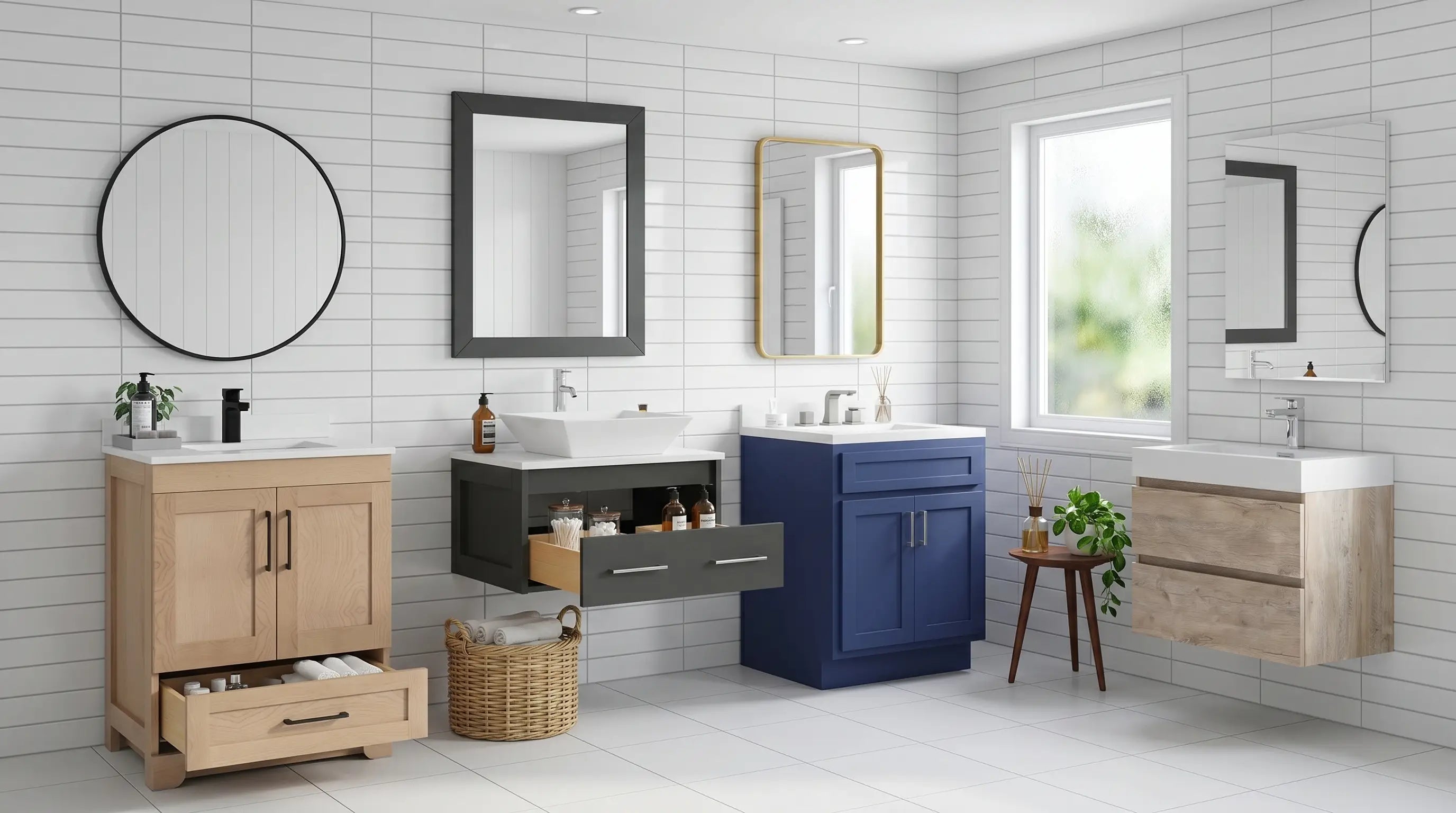
Compact doesn't mean a compromise. This guide covers the best small vanity picks from 18 to 24 inches - with sizing rules, floating vs. freestanding guidance, and what to look for before buying.
A small bathroom vanity is one of the most searched bathroom terms online - and also one of the most misunderstood. Most buyers assume "small vanity" means sacrificing storage, style, or both. The reality is that a well-designed 24-inch vanity can deliver a full-size undermount sink, three dedicated drawers, and a countertop that handles daily routines with zero compromise. The key is knowing what to measure before you shop, what specs actually matter at the compact end of the size range, and which design moves make a tight bathroom feel intentionally curated rather than just small.
This guide covers every small vanity size from 18 to 24 inches - who each size is right for, the best picks for powder rooms and compact guest baths, and the space-saving design tricks that work regardless of which width you choose.
Bathrooms under 50 square feet are where the compact vanity category becomes the correct decision rather than a budget compromise. In a space this size, every inch of floor clearance changes how the room feels and functions daily. A floating 24-inch vanity in a 45-square-foot powder room adds the visual perception of extra square footage by exposing the floor plane beneath it - an effect that no amount of mirror, paint, or tile can fully replicate. Getting the vanity size right in a small bathroom is the single decision with the highest impact on how the room actually feels to use.
These three widths cover the full range of compact vanity options. Each suits a different room type and use case. Knowing which width fits your specific layout - before browsing any product - eliminates the most common small vanity buying mistake: choosing by looks first and discovering the size doesn't work after delivery.
The smallest practical vanity width for a room with a toilet. An 18-inch vanity fits in spaces where even a 24-inch unit would block traffic flow or interfere with the door swing. Usually pairs with a vessel sink or compact integrated bowl - not a standard undermount basin.
A step up from the minimum - 20 inches adds enough depth to accommodate a proper under-mount basin in some designs, while still fitting bathrooms where a 24-inch unit crowds the layout. Less common on shelves than 18 or 24, but the right call for genuinely tight spaces that need more than an 18 delivers.
The 24-inch is the most versatile small vanity size on the market - and the top-selling compact width for good reason. At 24 inches you get a full-size sink, real drawer storage for daily products, and a countertop that functions rather than just exists. Works in powder rooms and compact guest baths alike.
The two measurements that eliminate wrong-size orders: (1) Measure wall to wall and subtract the vanity width - you need at least 2 inches on each side for visual breathing room and cleaning access. (2) Measure from the vanity's intended front edge to the nearest obstruction (toilet edge, door swing, shower door) - US building code requires a minimum of 21 inches of clear floor space in front of the vanity; NKBA recommends 30 inches for comfortable daily use. If your numbers don't meet both requirements before looking at any product, you need a shallower depth or a smaller width - not a smaller clearance tolerance.
These picks represent Bathify's strongest 24-inch and under options across the main use cases - powder rooms, compact guest baths, and small ensuite spaces. Each is selected for the combination of build quality, storage configuration, and finish versatility that justifies the purchase long-term.

The 24-inch floating vanity in white is the single most versatile small bathroom vanity available - and Bathify's consistent top seller in the compact category. Wall-mounted installation raises the cabinet off the floor entirely, visually expanding any bathroom by exposing the floor plane and allowing light to bounce off the tile beneath. In a compact bathroom under 50 square feet, this visual expansion effect is immediate and significant - it changes how the room feels before a single other design decision is made.
At 24 inches, a well-designed floating vanity provides two full-depth drawers (not shallow tray drawers) that handle the daily essentials for a single-user bathroom with no overflow onto the countertop. The integrated or undermount white sink keeps the countertop clean and uninterrupted. White is the correct finish choice for a small bathroom - it reflects light and reads as part of the room rather than as a piece of furniture placed in it.
- Two full-depth drawers - not one full and one shallow tray drawer. A shallow top tray on a 24-inch vanity takes up 30% of the drawer stack height while holding almost nothing of daily value. Full-depth drawers on both levels is the correct configuration for this size
- Push-to-open hardware is the clean modern choice for a floating vanity - visible bar handles on a 24-inch cabinet face are disproportionate and draw too much visual attention in a compact space
- Verify the wall bracket weight rating covers the full loaded cabinet weight - vanity + countertop + contents. A 24-inch floating vanity fully loaded weighs 60–100 pounds; the bracket must be rated accordingly, not just for the cabinet empty weight
- Soft-close drawer slides on both drawers - a floating vanity that slams when a drawer is closed sends a vibration through the wall mount that compounds over time. Soft-close is non-negotiable at any price point in the floating category

The 24-inch white shaker freestanding vanity is the right choice when floating installation isn't feasible - rental properties, walls without accessible studs, or simply a preference for straightforward installation without wall modification. A freestanding 24-inch vanity in a transitional shaker profile coordinates with more existing bathroom styles than any other option at this size. The quartz top is the correct choice over ceramic: it's non-porous, requires no sealing, and holds up indefinitely to the daily cosmetics, toothpaste, and cleaning products of a working bathroom.
- Plywood box construction - at 24 inches, particleboard boxes are structurally marginal because the cabinet is narrow enough that any swell or delamination compromises the entire structure, not just one zone. Verify box material explicitly in product specs, not inferred from price
- The countertop should overhang the cabinet face by at least 1 inch - a flush-face top on a small vanity looks truncated and makes cleaning the cabinet face difficult where it meets the top
- Adjustable leveling feet are worth specifying for a 24-inch freestanding unit - small bathrooms often have slightly uneven floors, and shimming a narrow cabinet takes more effort than simply adjusting threaded feet at installation
- Verify the cabinet-to-wall anchoring method - even freestanding vanities should be anchored with at least one screw to a wall stud to prevent rocking under lateral forces. A 24-inch cabinet with a stone top is top-heavy enough to tip if it's only resting on the floor

The powder room is the one bathroom in a home where a statement vanity finish makes complete design sense - it's a single-use space, typically used briefly by guests, and the vanity is the only major fixture competing for visual attention. A 24-inch matte black or deep navy vanity with a vessel sink turns a functional half-bath into a genuine design moment. The vessel sink raises the basin above the countertop level, creating a sculptural focal point that reads as intentional and luxurious even at the compact 24-inch width. Pair with a wall-mounted faucet (installed 6–8 inches above the vessel rim) and a frameless LED mirror for the complete contemporary powder room composition.
- Cabinet height for vessel sink installations should be 28-30 inches from floor to countertop surface - a full-height 36-inch cabinet with a 7-inch vessel sink creates a basin height of 43 inches, which is too tall for comfortable daily use
- Matte finish over gloss for dark cabinets in a small bathroom - gloss black or gloss navy in a tight space shows every fingerprint and water splash, requiring constant wiping to maintain the clean appearance that makes the statement finish worth choosing
- Wall-mount faucet is the correct pairing for a vessel sink on a small vanity - deck-mount faucets compete with the vessel bowl for visual priority on a narrow 24-inch countertop. A wall-mount faucet keeps the countertop plane clean and uncluttered
- A frameless round or square LED mirror (24-28 inches diameter) at eye level above the vessel completes the composition. Oversized rectangular mirrors on a 24-inch vanity look proportionally mismatched - match the mirror width to the vanity width within 4 inches

Natural wood-finish vanities are the defining 2026 design trend in the compact bathroom category. White oak and walnut veneers bring warmth to a small bathroom in a way that no painted finish can achieve - the grain variation creates visual depth that makes a compact space feel considered and personal rather than space-constrained. A 24-inch floating oak vanity in a bathroom with light tile and warm white walls is the composition that's defined the most photographed compact bathroom renovations of the current cycle. Unlike the dark-statement approach, natural wood works with rather than against the typically limited light in a small bathroom.
- Engineered wood veneer over solid wood front panels for bathroom applications - real wood fronts in a bathroom humidity environment expand and contract with moisture cycles, causing alignment issues within 1–2 years. Engineered veneer (real wood face over stable substrate) handles bathroom humidity far better
- Verify the finish specification - wood veneer in a bathroom must have a sealed, moisture-resistant surface coating. Products without an explicit bathroom-rated finish specification should not be installed in a wet environment, regardless of how they look
- Pair warm wood tones with warm-neutral quartz - a cool gray or heavily veined white quartz fights the warmth of natural wood grain. Ivory, cream, or lightly veined warm white quartz complements oak and walnut tones without competing
- Brushed brass hardware is the correct pairing for natural wood finish vanities in 2026 - it coordinates with the warm undertone of oak and walnut in a way that matte black (cool) or chrome (cool) does not
The corner vanity is the layout solution for powder rooms and bathrooms where even an 18-inch standard vanity would block traffic flow or interfere with the door. By utilizing the unused corner zone, a corner vanity frees up both wall runs for movement and reduces the visual mass of the bathroom fixture footprint. An 18-inch corner vanity in white with an integrated ceramic basin and open shelf beneath is the most space-efficient vanity configuration available - it adds a functional sink with minimal visual weight in a room that needs every square inch of clear floor.
Corner vanities require specific plumbing rough-in positioning - the drain stub-out and supply lines must be positioned in the corner zone, which may require plumber adjustment if your current rough-in is on a flat wall. Confirm rough-in location before ordering any corner vanity to avoid an expensive delivery return.
- Confirm your plumbing rough-in is in or can be moved to the corner zone before ordering - a corner vanity installed without the drain in the right position requires tile cutting and plumbing work that costs far more than the vanity itself
- Open shelf beneath the basin is preferable to a closed cabinet in a corner installation - a cabinet door that opens in a corner creates a swing path that may conflict with adjacent walls or the toilet in a small powder room
- White or very light finish is the correct choice for a corner vanity in a small bathroom - a dark finish in the corner zone of a compact room creates a visual "anchor" that makes the room feel smaller, not more interesting
- Pair with an angled mirror (some corner-vanity mirror models are designed for the diagonal wall plane a corner creates) or a standard round mirror mounted on the adjacent wall above the basin
In a compact bathroom, the choice between floating and freestanding has a bigger visual and functional impact than in any other bathroom size. Here is when each one is right.
| Factor | Floating (wall-mount) | Freestanding (floor-mount) |
|---|---|---|
| Visual space effect | Larger-feeling - floor exposed, light bounces | Neutral - floor covered, heavier visual presence |
| Storage capacity | Moderate - cabinet must be lightweight | Better - floor-to-countertop storage depth |
| Installation complexity | Higher - requires wall blocking, professional recommended | Lower - renter-friendly, DIY-accessible |
| Custom height option | Yes - mount at any height to suit users | No - fixed at manufacture height |
| Floor cleaning | Easiest - mop/vacuum under freely | Harder - toe kick area accumulates dust |
| Renter-friendly | No - requires wall modification | Yes - no permanent wall alteration |
| Best bathroom type | Compact permanent bathroom, modern aesthetic | Rental, traditional/transitional, any small bathroom needing max storage |
The vanity is the right choice - now these are the design decisions that make the space around it work as hard as the vanity itself.
A mirror sized to match or slightly exceed the vanity width is the single most effective visual expansion move in a small bathroom. It doubles the perceived depth of the wall behind the vanity and reflects light from windows and fixtures. For even more benefit: a recessed medicine cabinet replaces the mirror with 4–5 inches of concealed storage - often eliminating the need for additional shelving entirely.
White, light gray, and natural wood finishes reflect more light than dark finishes in a compact space. Glossy or semi-gloss tile behind the vanity bounces light off the wall. A white countertop reflects ceiling light downward onto the vanity surface. These choices don't make the room physically larger - but they make it feel larger, which is what matters in a bathroom you use every day.
Most people focus on vanity width when thinking about space - but depth has a larger impact on how much floor clearance is available. A 24-inch wide vanity at 18 inches deep leaves 3 additional inches of floor clearance compared to a standard 21-inch depth. In a bathroom with 36 inches of total front clearance, that 3 inches is the difference between a comfortable morning routine and a tight one.
Floating shelves or a slim wall cabinet above and to the side of the mirror add storage without taking any floor space. In a 24-inch vanity bathroom, vertical storage above the countertop zone - for toiletries, folded hand towels, and decorative elements - compensates for the reduced drawer count that comes with a compact width. Keep the counter itself clear: a clear countertop in a small bathroom is a design feature, not an oversight.
- Wall-to-wall width measured: Subtract vanity width - confirm at least 2 inches of clearance on each side remains
- Front clearance measured: Distance from vanity face to nearest obstacle confirmed at 21 inches minimum (30 inches preferred for daily use comfort)
- Door swing checked: Bathroom door, shower door, and any cabinet doors confirmed to open fully without hitting the vanity
- Plumbing rough-in confirmed: Drain stub-out and supply lines are in a position compatible with the chosen vanity width and sink placement
- Mount type decided: Floating (wall blocking confirmed available) or freestanding (no wall modification required)
- Cabinet height confirmed: Standard 32–36 inches for undermount sink; 28–30 inches if pairing with a vessel sink
- Storage configuration assessed: Drawers preferred over cabinet doors for daily-use items - verify drawer count and depth in product specs
- Countertop material specified: Quartz (non-porous, no sealing) is recommended for any compact bathroom seeing daily use
- Finish confirmed for the room: Light finishes for most small bathrooms; dark statement finish only in powder rooms with light surrounding walls
- Mirror or medicine cabinet sized: Mirror/cabinet width planned to match or slightly exceed the vanity width - not undersized
Shop small bathroom vanities at Bathify
Browse compact vanities from 18 to 24 inches - floating and freestanding, in every finish and style. Free shipping on orders over $50.


