







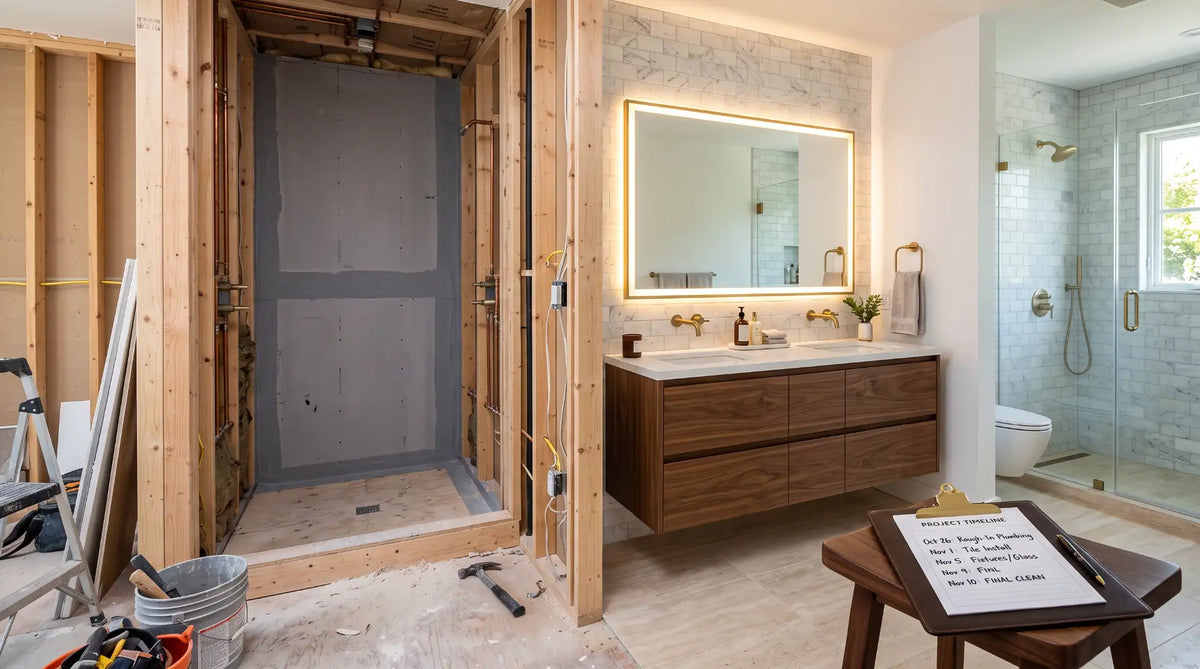
Real week-by-week timelines by budget tier, what actually delays a bathroom renovation, and how to plan fixture orders and daily life around a project that's rarely as fast as the first estimate suggests.
"How long will my bathroom renovation take?" is one of the most common questions Bathify hears from homeowners still in the planning stage - and it's also one of the hardest to answer with a single number, because "bathroom renovation" covers everything from a weekend fixture swap to a three-month layout change. At Bathify, when a customer asks us this directly, our answer always starts with a question back: are you keeping the existing plumbing layout, or changing it? That one decision affects your timeline more than the size of the bathroom, the fixtures you choose, or even the contractor you hire.
This guide breaks down realistic timelines by budget tier - matching the three tiers from Bathify's budgeting guide - walks through what a typical week-by-week mid-range remodel actually looks like, and covers what pushes a timeline past its original estimate, much of which overlaps with what we've already covered in our guide to hidden renovation costs.
If you already know your budget tier, jump to Timeline by Tier, then Week-by-Week for the detail. If your bathroom is the only one in your home, read Living Without a Bathroom During the Renovation before you finalize a start date.
The same three tiers that define your budget also define your timeline, and for the same underlying reason: whether the existing plumbing layout stays exactly where it is.

Fixtures swapped in their existing locations - vanity, toilet, faucet, mirror, hardware, paint. No plumbing moves, usually no permit wait. Most of the timeline is delivery and installation labor, not inspections.

New everything, same footprint: demo, plumbing and electrical rough-in, an inspection, tile, fixture installation, and a punch list. See the week-by-week breakdown below.

Plumbing relocated, walls opened, often multiple inspection stages and the longest lead times on custom materials. See our ROI guide for why this tier also returns the least at resale per dollar spent.
For the full cost breakdown behind each of these tiers, see Bathroom Remodel Cost by Room Size.
This is the sequence a straightforward mid-range remodel - existing layout, new tile and fixtures - typically follows. Add a week or two of buffer for any of the delays covered in the next section.
| Phase | What Happens |
|---|---|
| Week 1 | Demolition and disposal (2-4 days), followed by plumbing and electrical rough-in work behind the newly opened walls |
| Week 2 | Rough-in inspection (scheduling depends on your local permit office), waterproofing membrane, and tile substrate preparation |
| Week 3 | Tile setting for the floor and shower or tub surround, followed by grout cure time before fixtures can be installed on top of it |
| Week 4 | Fixture installation - vanity, toilet, faucet, mirror, and accessories - plus final electrical and plumbing connections |
| Week 5 | Final inspection, punch list items, and touch-ups before the space is fully move-in ready |
Fixtures aren't needed on-site until roughly week three to four of this sequence - but that's exactly why ordering them in week one, not week three, matters. See Order Fixtures Early below.
Every inspection stage - rough-in, and often a final - depends on your local permit office's availability, not just your contractor's. In busier municipalities, waiting a few days to a week for an inspector is common and should be built into your schedule.
The National Association of Home Builders' Remodeling Market Index has consistently tracked remodeler backlogs above the neutral 50 level through 2026, meaning most contractors are booking work weeks or months ahead rather than starting immediately - a good reason to lock in a start date earlier than you think you need to.
Old plumbing, water damage, or a code-required electrical upgrade doesn't just add cost - it adds time, since the discovery itself typically happens mid-demo and any fix has to happen before the next phase can start. See our full breakdown in Hidden Costs in Bathroom Renovations.
Homes covered by the EPA's Renovation, Repair, and Painting Rule require certified containment and cleanup procedures whenever more than six square feet of painted surface is disturbed - a real but often overlooked source of added time, not just added cost, on an older home's renovation.
At Bathify, the most common timeline question our team gets isn't about our shipping speed - it's whether a specific finish is in stock or made-to-order, since that's the detail that actually determines whether a fixture arrives in time for the installation phase of a renovation. In-stock items typically ship quickly; certain finish options across categories like our LED mirrors and wall-mount vanities can carry longer lead times depending on the specific color or finish selected.
Our recommendation: confirm current stock status on the product page as soon as your contractor gives you a start date - not the week installation is scheduled to begin, which by the week-by-week breakdown above is typically week three or four of a mid-range remodel.
A DIY renovation typically takes two to three times longer in calendar weeks than the same scope done professionally - not necessarily because the total labor hours differ, but because DIY work happens in evenings and weekends rather than continuous business-day labor. A mid-range remodel that takes a professional crew four weeks might realistically take a DIY homeowner eight to twelve weekends spread across two to three months.
For a full breakdown of which specific tasks are genuinely safe to take on yourself without extending your timeline unreasonably - and which ones are worth hiring out even if you're comfortable with tools - see DIY vs Professional Bathroom Remodel: Which Actually Saves Money?
If it's the only bathroom in the home, most contractors can sequence the work to keep the toilet functional for all but 24 to 48 hours of a mid-range renovation - typically the day the old toilet comes out and the day the new one goes back in, plus any day the floor around it is actively being tiled. A full gut with a layout change may require a longer gap, in which case a temporary arrangement (a nearby friend or family member, a short-term rental of portable facilities, or scheduling around a trip) is worth planning for in advance rather than discovering mid-project.
Somewhat. Contractor backlogs tend to ease slightly during the winter holiday season and build back up through spring and summer, based on the National Association of Home Builders' quarterly Remodeling Market Index readings - so scheduling a renovation to start in late fall or early winter can sometimes mean a shorter wait to get a contractor on the calendar than starting in peak spring season. Overall remodeling demand has also stayed resilient nationally; per the Harvard Joint Center for Housing Studies' Leading Indicator of Remodeling Activity, home improvement spending has continued to grow through 2026, which keeps contractor calendars fuller than they might otherwise be.
Material and permit office timelines are generally less seasonal than contractor availability itself, though permit offices in some municipalities do slow down around major holidays.
| Tier | Planning & Ordering | Active Work | Total |
|---|---|---|---|
| Cosmetic Refresh | 1-2 weeks (confirm stock, schedule labor) | 3-7 days | ~1-2 weeks active + planning |
| Mid-Range Remodel | 2-4 weeks (permits, fixture selection, contractor scheduling) | 3-6 weeks | ~5-10 weeks start to finish |
| Full Gut / Layout Change | 4-8 weeks (design, permits, custom material lead times) | 6-12+ weeks | ~10-20 weeks start to finish |
The "Total" column reflects the full span from when planning begins to when the bathroom is usable again - most published contractor estimates only quote the "Active Work" column, which is why a homeowner's actual experience often feels longer than the number they were originally told.
Match your timeline expectations to your household's flexibility, not just the calendar
Only bathroom in the home: Prioritize a contractor who can commit to a clear sequencing plan and a maximum 24-48 hour gap without a working toilet - ask this before signing, not after.
Flexible schedule, no rush: Consider starting in late fall or early winter, when contractor backlogs per NAHB data tend to ease slightly compared to peak spring and summer season.
Older home (pre-1978): Add 1-2 weeks of buffer beyond the standard tier estimate for lead-safe work practices and potential hidden-cost discoveries covered in our hidden costs guide.
Hard deadline (holiday, guests, sale): Order every fixture the week you sign your contractor's contract, not the week installation begins, and confirm in-stock status directly on the product page before finalizing your choice.
Order Early, Stay On Schedule - Shop Bathify
Check real-time stock status on every vanity, toilet, faucet, and mirror before your contractor's start date locks in. Free shipping on orders over $50, shipped USA-wide.


