







What a small bathroom remodel actually costs by scope, where Bathify customers see the best return per dollar, and the specific product swaps that make a compact bathroom feel new without a full gut renovation.
A small bathroom actually costs more per square foot to remodel than a large one, and that surprises most homeowners planning their first project. The reason is simple: labor, permits, and fixed costs like a new toilet or vanity don't scale down proportionally with room size, so a 35-square-foot powder room absorbs nearly the same base costs as a 60-square-foot primary bath. At Bathify, we talk to a lot of homeowners who assume "small" automatically means "budget," and the first thing we tell them is to plan around scope, not square footage.
The good news is that a small footprint is also where smart product choices matter most. In a compact bathroom, every fixture is visible, every swap is noticeable, and a handful of well-chosen upgrades - a new mirror, vanity, and faucet - can transform the entire room without touching plumbing or walls. This guide breaks down what a small bathroom remodel really costs at each scope, where Bathify customers see the best return per dollar spent, and the specific smart swaps worth prioritizing.
Start with the three remodel scopes below to figure out which budget bracket fits your goals, then use the cost breakdown and swap comparison table to see exactly where your money should go. The product picks section links directly to the swaps Bathify customers make most often, and the FAQ at the bottom answers the questions we hear most.
Every small bathroom remodel falls into one of three scopes, and picking the right one before you start shopping is the single biggest budget decision you'll make. At Bathify, we generally recommend defining your scope in writing before ordering a single product, because scope creep - deciding mid-project to also replace the tile, or move the toilet a few inches - is where budgets go sideways.
New vanity, mirror or medicine cabinet, faucet, toilet seat or toilet, paint, lighting, and hardware - all swapped in place without opening walls or moving plumbing. The fastest and cheapest way to change how a small bathroom feels.
Everything in a cosmetic refresh, plus new flooring and either a shower surround swap or tub-to-shower conversion. Plumbing rough-in stays in the same location, but wall and floor surfaces are opened up.
Walls, subfloor, and often plumbing locations change. This is the scope where a small bathroom can be reconfigured for a better layout - but it's also where budgets expand fastest, since permits, inspections, and unknowns behind the walls all come into play.
If the layout works and nothing is leaking or failing structurally, a refresh gets you 80% of the visual impact for roughly a quarter of the cost of a full gut. Save the full renovation for when the layout genuinely doesn't work.
These ranges reflect what Bathify customers and industry cost guides typically report for a small bathroom (roughly 30-45 square feet) in 2026, and they assume mid-range fixtures rather than budget-builder-grade or luxury-tier products. Regional labor rates, especially in coastal metro markets, can push the higher end of each range up further.
| Scope | Typical Cost Range | What's Included | Typical Timeline |
|---|---|---|---|
| Cosmetic Refresh | $3,000 - $8,000 | Vanity, mirror/medicine cabinet, faucet, toilet, paint, lighting, hardware - existing layout and plumbing | 3-7 days |
| Partial Remodel | $8,000 - $16,000 | Everything in a refresh, plus new flooring and a tub/shower surround swap or reglaze | 1-2 weeks |
| Full Gut Renovation | $16,000 - $28,000+ | New layout, relocated plumbing, new subfloor, permits and inspections, full fixture package | 3-6 weeks |
Not every line item in a small bathroom budget deserves the same priority. At Bathify, our general guidance is to spend on the items you touch and see every single day, and cut on items that are functionally identical whether you pay more or less.
Faucet, toilet, and shower valve. These get daily physical contact and mechanical wear. A budget faucet with a weak cartridge or a low-quality flush valve will show its age - and start failing - within a couple of years, turning a "savings" into a repeat expense. Mid-range fixtures from established brands are worth the premium here.
Tile square footage and decorative accessories. Large-format tile in a small bathroom actually reduces material and labor cost versus small mosaic tile, because fewer grout lines mean less cutting and setting time - a rare case where the better-looking choice is also the cheaper one. Towel bars, robe hooks, and other accessories can be swapped later without any real cost penalty, so they're a safe place to defer spending.
The vanity and mirror sit in the middle: they're highly visible and worth a reasonable mid-range spend, but compact vanities in the 24-30 inch range are inexpensive enough across Bathify's vanity collection that stretching the budget here rarely means sacrificing quality elsewhere.
A "smart swap" is any upgrade that replaces a fixture in its existing footprint - same plumbing connection, same wall opening, same electrical location - so you get the visual and functional benefit of a new product without the labor cost of moving anything behind the wall. At Bathify, this is the strategy behind almost every small bathroom refresh we see succeed on a tight budget.
The five smart swaps we recommend prioritizing, in order of typical impact-per-dollar: an LED mirror or medicine cabinet in place of a separate mirror-and-light setup, a compact or floating vanity in place of a bulky base cabinet, a single-handle faucet upgrade, fresh paint in a lighter tone, and updated hardware and lighting finishes. None of these require a permit in most jurisdictions when installed in the same location as the fixture they replace.

The vanity is usually the largest single object in a small bathroom, which makes it the highest-leverage swap for changing how the room feels. At Bathify, we generally recommend replacing rather than refacing a small-bathroom vanity, because compact 24-30 inch vanities are affordable enough that full replacement - which also lets you switch to a space-expanding format - typically delivers a better result for a similar or lower total cost than refacing labor alone.
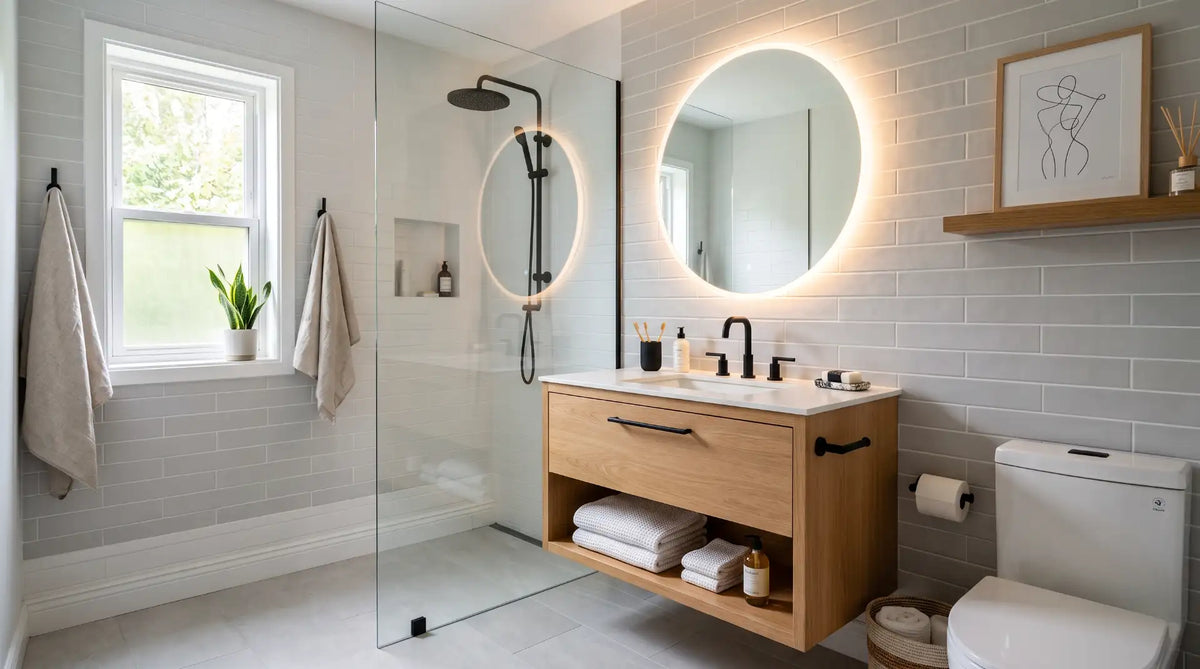
A floating (wall-mounted) vanity is the single most effective vanity choice for a small bathroom. Because the cabinet doesn't touch the floor, the eye reads the full floor area of the room instead of stopping at a solid base - the same visual principle interior designers use to make any small room feel larger. It also simplifies floor cleaning since there's no base to clean around. Compact single-sink vanities in the 24-30 inch range, including vessel-sink and floating designs, are available across Bathify's vanity collection.

Swapping a plain mirror and a separate vanity light bar for a single LED mirror is one of the highest-value changes in a small bathroom budget, because it consolidates two purchases and two installation steps into one fixture - and frees up wall space that a light bar would otherwise occupy, which matters in a tight footprint. At Bathify, LED mirrors are consistently one of the most common single-item swaps in a budget small-bathroom project for exactly this reason.
If storage is also a priority - which it usually is in a small bathroom with limited counter space - a surface-mount LED medicine cabinet is the better swap than a plain mirror. Surface-mount installation requires no wall cutting, unlike a recessed cabinet, which makes it the right no-demo choice for an existing bathroom. A dual sliding-door design is worth considering in especially tight bathrooms, since a swinging cabinet door can hit an adjacent wall or the toilet tank in a compact layout.
An oversized frameless LED mirror is a small-bathroom trick worth knowing. Sizing the mirror at or slightly above the vanity's width - rather than the standard 4-8 inches narrower - visually expands a small bathroom more than almost any other single swap, because the reflected light and depth compensate for the room's limited square footage.

If your budget includes new flooring or a shower surround, tile size is a cost lever most homeowners don't expect. Large-format tile (12x24 inches and up) requires fewer individual pieces, fewer cuts around fixtures, and less grout line labor than small mosaic or subway tile covering the same square footage - which means large-format tile is often cheaper to install per square foot despite looking more premium. According to This Old House, labor - not material - is typically the larger cost driver in a tile installation, which is exactly why reducing the number of pieces and cuts has an outsized effect on the final bill.
Where small-format tile still earns its cost premium is inside the shower pan and on curved or sloped surfaces, where large tile can't conform to the geometry. For everything else - the main shower walls, the floor, a backsplash - large-format tile is both the design-forward and the budget-forward choice for a small bathroom in 2026.
A quick reference for the swap decisions that come up most often in a small bathroom budget conversation, based on the patterns Bathify sees across customer projects.
| Swap This | Not That | Typical Cost Difference | Why It's Smarter |
|---|---|---|---|
| LED mirror (light + mirror combined) | Separate mirror + vanity light bar | Roughly even to slightly less once install labor is counted | One product, one install step, frees up wall space |
| Surface-mount medicine cabinet | Recessed medicine cabinet (existing bathroom) | Save on demo and patch labor | No wall cutting, no drywall repair, same-day install |
| Floating compact vanity | Refacing an old base-cabinet vanity | Often similar or lower total cost | Better long-term result, visually expands the floor |
| Large-format tile | Small mosaic tile (main walls/floor) | Lower labor cost per sq ft | Fewer cuts and grout lines to install |
| Tub reglaze or shower surround swap | Full tub-to-shower demo and re-plumb | Save thousands on plumbing labor | Keeps existing drain/supply locations intact |
The order you tackle a small bathroom refresh in matters almost as much as what you buy, because doing things out of sequence causes rework - and rework is where DIY budgets quietly grow. At Bathify, the sequence we recommend for a no-demo refresh is: paint and ceiling work first (before anything else gets installed and needs protecting), then flooring if it's being replaced, then the vanity and toilet, then the mirror or medicine cabinet, then the faucet and final plumbing connections, and hardware and light fixtures last.
Painting first means you're not taping off a brand-new vanity or masking a new mirror. Installing the vanity before the mirror means you can measure the mirror's height off the actual installed vanity and faucet, not an estimate. Saving hardware and lighting for last avoids scratching new pulls and switch plates while other work is still happening around them.
A homeowner comfortable with basic tools can typically handle painting, hardware and accessory swaps, caulking, a surface-mount medicine cabinet or mirror install, and a plug-in LED mirror without professional help. These are the tasks that make up the bulk of a cosmetic refresh budget, and doing them yourself is where the biggest labor savings live.
Anything involving water supply lines, drain connections, GFCI-protected electrical circuits, or wall demolition should go to a licensed plumber or electrician - both for safety and because most municipal codes require permitted, licensed work for these tasks regardless of DIY skill level. At Bathify, the most cost-effective approach we consistently see is a hybrid one: DIY the cosmetic swaps yourself, and hire a pro only for the plumbing and electrical connection points, such as final faucet supply-line hookups or hardwiring an LED mirror.
The most common budget-blowing mistake we see at Bathify is moving plumbing mid-project - relocating the toilet, sink, or shower drain a few feet for better flow, without accounting for the real cost of opening the floor or wall and rerouting supply and drain lines. What starts as a small layout tweak can add thousands of dollars and multiple days to a timeline that was originally scoped as a no-demo refresh.
Other frequent budget-blowers: ordering fixtures before confirming rough-in dimensions (a returned vanity or toilet costs time and sometimes restocking fees), skipping the permit step on work that legally requires one, and underestimating how much a small mistake - like an undersized exhaust fan - can cost to fix later once tile and drywall are finished. The EPA's WaterSense program is also a useful budget check: WaterSense-labeled toilets and faucets use significantly less water than standard fixtures, which can meaningfully lower a household's water bill over the life of the fixture and is worth factoring into the "cheap now vs. cheaper long-term" decision.
These are the specific swaps Bathify customers reach for most often when refreshing a small bathroom on a budget - each one designed to install in an existing footprint without demolition.

The single swap we recommend most often for a small-bathroom budget refresh: this mirror consolidates task lighting and reflection into one frameless, touch-controlled fixture, freeing the wall space a separate light bar would otherwise take up. The 4000K LED strip delivers accurate, even grooming light, and the rounded corners keep the frameless design from feeling too stark in a compact room.

For small bathrooms with limited counter space, this is the swap that adds real storage without a renovation - it can be surface-mounted directly to the finished wall, with no cutting required. Interior LED lighting, a 3x magnifying mirror inside the door, USB charging ports, and dimmable touch controls make it a genuinely functional upgrade, not just a bigger mirror. A 5-year warranty backs the investment.

In especially small bathrooms, a swinging medicine cabinet door can hit the toilet tank or an adjacent wall - exactly the clearance problem this dual sliding-door design solves. Both doors slide horizontally instead of swinging out, so you get full storage access without needing extra clearance. Two adjustable glass shelves and integrated LED lighting round it out.
Match your budget to a fixed scope - then prioritize the swaps you'll see every day
Tight budget, layout works fine: Cosmetic refresh in the $3,000-$8,000 range. Prioritize the LED mirror or medicine cabinet swap and a compact vanity - these deliver the most visible transformation without touching plumbing.
Moderate budget, surfaces are dated: Partial remodel in the $8,000-$16,000 range. Add new flooring and a shower surround swap or reglaze on top of the refresh list, using large-format tile to control labor costs.
Layout genuinely doesn't work: Full gut renovation. Only take this route if the room's actual configuration - not just its finishes - is the problem, since this is the scope where budgets expand fastest.
Limited counter storage: A surface-mount LED medicine cabinet, like the ICO Bath Jackson at Bathify, solves this without demolition and doubles as your lighting upgrade.
Want the room to feel bigger without a renovation: A floating vanity plus an oversized frameless LED mirror is the single highest-impact combination available in a no-demo refresh.
Shop Small Bathroom Swaps at Bathify
Compact vanities, LED mirrors, and medicine cabinets built for no-demo budget refreshes. Free shipping on orders over $50. Shipped across the USA.


