







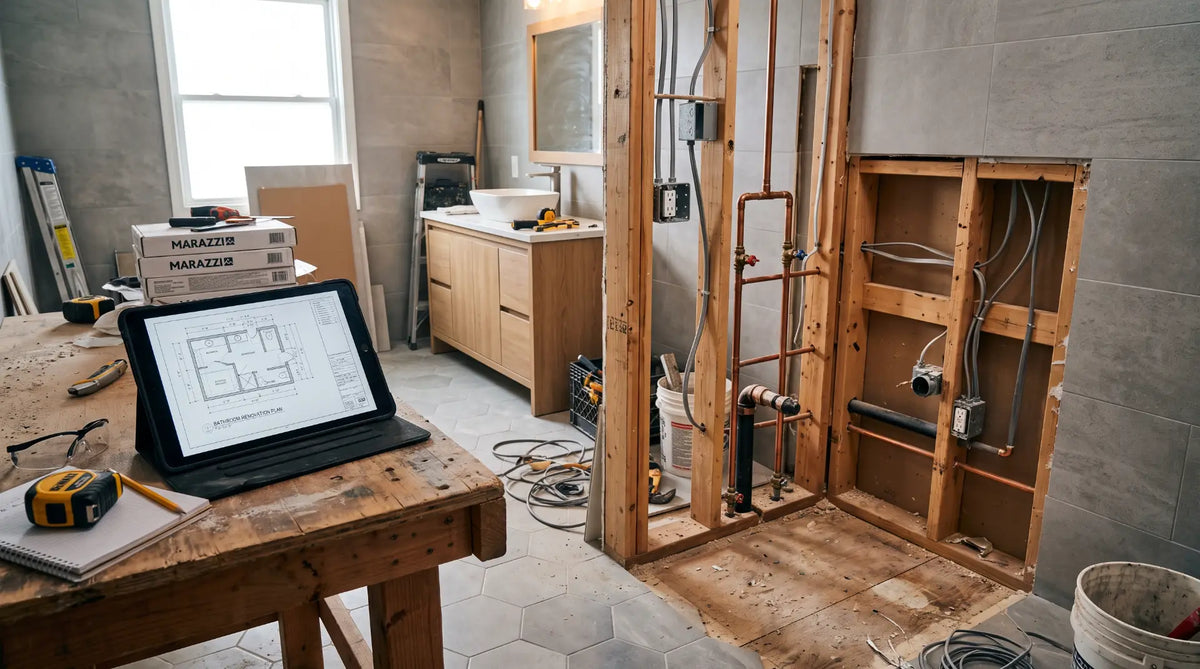
Rot, mold, outdated plumbing, asbestos, lead paint, and the code upgrades a renovation quietly triggers - what causes each hidden cost, roughly what it adds to your budget, and how to plan for it before demo day, not after.
Even homeowners who do everything right - setting a real ceiling, pricing fixtures first, building in a contingency fund - still come in over budget more often than they'd like. At Bathify, when we ask returning renovation customers what surprised them most about their project, the answer is almost never a product decision. It's something no one could see until a wall came down: a soft subfloor, an electrical panel that couldn't take one more circuit, floor tile that turned out to contain asbestos.
This guide covers those hidden costs specifically - what causes each one, roughly what it adds to a budget, and how to plan for it before it happens rather than after. If you haven't built your overall renovation number yet, start with Bathify's guide to budgeting for a bathroom renovation - this post picks up exactly where that one's contingency-fund section leaves off.
Read the categories in order if your home is older than 40 years - each one gets progressively more likely to affect you. If your home is newer, jump straight to Structural Surprises, Permits & Lead Times, and Scope Creep, since those apply regardless of a home's age.

Bathrooms are the single most moisture-exposed room in most American homes, and a wall or floor that's been quietly leaking - even slowly, even for years - stays invisible until the tile comes off. At Bathify, this is consistently the number one hidden cost our customers mention after the fact: what looked like a straightforward tile swap turned into subfloor replacement once a slow leak around an old tub spout or shower valve was uncovered.
Water-damaged plywood or framing around a tub, shower pan, or toilet flange has to be cut out and replaced before new flooring or tile can go down - there's no way to build over it safely.
Per the EPA's own guidance, a mold patch under roughly 10 square feet is generally manageable without a specialist, but larger or recurring mold problems call for professional remediation - and critically, fixing the mold without fixing the moisture source that caused it means the problem returns.
Before signing a contract, ask whether your quote includes an allowance for water-damaged subfloor or framing if it's found during demo. A contractor who's done this before will usually have a per-square-foot rate ready, rather than treating it as an open-ended surprise.

Homes with original galvanized steel supply lines or cast iron drain lines - common in anything built before the 1960s to 1970s - often look fine from the outside while corroding from the inside for decades. A renovation is frequently the first time anyone has actually opened that wall, and it's common for a plumber to recommend replacing degraded sections while everything is already exposed, since reopening a finished wall later costs far more than doing it now.
Replacing corroded supply or drain lines behind the specific wall you've already opened, without touching the rest of the home's plumbing.
Only relevant if your plumber identifies systemic corrosion beyond the bathroom - rare on a single-room renovation, but worth asking about directly if your home has its original galvanized or cast iron lines throughout.
At Bathify, since we ship the finished fixtures - faucets, toilets, showerheads - rather than the pipe behind the wall, this is a hidden cost that has nothing to do with product selection and everything to do with your home's plumbing age. It's worth asking your plumber directly, before demo day, what your supply and drain line material actually is.

Bathrooms carry some of the strictest electrical code requirements in the house because they combine water and power: GFCI protection at every outlet, adequate ventilation, and increasingly, a dedicated circuit for higher-draw fixtures like a heated towel rail or an in-mirror defogger. A home built before GFCI outlets became standard in the mid-1970s may need a full outlet upgrade just to pass a routine inspection - not because of anything new you're adding, but because the renovation triggers a code review of the existing circuit.
Installed cost per outlet, including the electrician's labor and inspection.
For a heated towel rail, heated floor mat, or in-mirror defogger, depending on how far the run is from your electrical panel.

Two federally regulated hazards specifically affect older homes, and both can add real cost to a renovation that has nothing to do with the fixtures you choose.
Common in original 9"x9" vinyl floor tile, tile mastic, and some older wall materials in homes built before the early 1980s. Per the EPA's guidance, intact asbestos-containing material that isn't being disturbed can often be safely left in place or covered, but any renovation that will disturb it should be inspected first and, if confirmed, handled by a certified abatement professional rather than pulled up as routine demolition.
Homes built before 1978 fall under the EPA's Renovation, Repair, and Painting (RRP) Rule, which requires any paid contractor disturbing more than six square feet of painted surface to be EPA lead-safe certified and follow specific containment and cleanup procedures.

Every fixture in a bathroom has a real weight, and a floor built to code for a lightweight fiberglass tub decades ago wasn't necessarily engineered for a cast iron soaking tub, a stone-resin freestanding tub, or a large-format porcelain tile floor. This rarely comes up on a straightforward like-for-like fixture swap, but it's a genuine consideration any time you're upgrading materials rather than just replacing them in kind.
Sistering joists or adding blocking beneath a heavier tub or a large-format tile floor, depending on span and access from below.
A floating vanity needs solid blocking between wall studs, not drywall alone, to safely carry its weight - a labor step that's separate from the vanity's own price and easiest to add while the wall is already open for other work.
At Bathify, freestanding tub product pages list empty and filled weight for exactly this reason - the Vanity Art Adonis 55" Acrylic Freestanding Bathtub weighs meaningfully less filled than a comparable cast iron tub, which matters if your contractor is evaluating whether the existing floor needs reinforcement. The same logic applies to any of our wall-mount vanities, including the Kube Bath Milano - confirm wall blocking with your contractor before ordering, not after delivery.
Three smaller hidden costs that add up quickly when they're not planned for in advance:
Varies significantly by municipality and the scope of plumbing or electrical work involved.
Custom tile, semi-custom vanities, or made-to-order finishes can push a timeline back significantly - and a delayed material doesn't just push the schedule, it delays labor you've already scheduled and put a deposit down for.
Hauling out the old tub, tile, and vanity - more if hazardous material disposal (see asbestos above) is involved.
The single most common self-inflicted hidden cost isn't hidden at all - it's a homeowner adding a heated floor, a shower niche, or a second sink mid-project because the wall is already open and the incremental cost feels small in the moment. Individually, none of these additions is unreasonable. Collectively, they're the most common reason a project that started at $18,000 finishes at $26,000.
If a "while we're in there" idea comes up mid-renovation, price it specifically against your remaining contingency fund, not against the overall project budget. If it would use more than half of what's left in reserve, treat it as a future project rather than an in-progress addition.
Not every hidden cost comes from behind a wall. Some of the most common - and most avoidable - come from ordering the wrong size, missing a rough-in dimension, or discovering a finish doesn't match once it's installed. At Bathify, "wrong measurement" is one of the most frequent reasons behind a return or a mid-renovation scramble, which is why our product pages are built the way they are:
Every vanity listing specifies cabinet depth, countertop overhang, and sink cutout position, so you can confirm clearance against your toilet and door swing before ordering - not after installation day. Collections are organized by exact size, including our 24" and under, 30" to 36", and 40" to 48" vanity collections, so you're comparing genuinely comparable options rather than guessing from a photo.
Our return policy also gives you a safety net if a fixture doesn't fit as expected once the wall is open and true measurements are visible - though confirming dimensions before ordering is always faster than a return and keeps your renovation timeline on track. And if you're matching finishes across categories - faucet, mirror, towel bar - our support team can confirm finish-family matches before you order, since "close enough" metal tones rarely look right side by side once installed.
A home inspector or contractor doing a real walkthrough - not just a sales estimate - is more likely to flag plumbing age, electrical panel capacity, and visible water staining before you sign a contract.
If your home was built before 1978, ask specifically whether asbestos and lead testing are included in the estimate - don't assume it's covered by default.
A contractor unwilling to break down labor, materials, permits, and a contingency allowance is harder to hold accountable when a "surprise" appears mid-project.
Our budgeting guide recommends 10-20 percent generally; for homes over 40 years old, budget toward the higher end of that range specifically because of the categories covered in this article.
See the section above on how Bathify's product pages are built to make this step faster and more reliable.
| Red Flag | What It Usually Means |
|---|---|
| Musty smell near the tub or shower that cleaning doesn't fix | Possible mold or moisture trapped behind tile or a shower pan |
| Soft or springy flooring near the toilet or tub | Likely subfloor damage from a slow, long-term leak |
| Discoloration or bubbling on the ceiling below the bathroom | Active or past leak that hasn't been fully addressed |
| A contractor who avoids specifics about plumbing or wiring age | May not have inspected thoroughly, or is avoiding a harder conversation about cost |
| A quote for a pre-1978 home that never mentions lead-safe certification | A compliance gap that could add cost - or legal risk - later |
$8,000 cosmetic refresh, 1965 home
Planned budget: $8,000, with a 15% contingency of roughly $1,200 held in reserve. During demo, the contractor found a rotted section of subfloor around the toilet flange (+$1,200) and a pinhole leak in an original galvanized supply line (+$650). Total surprise: $1,850 - slightly above the contingency, which is exactly why a 20% reserve is the safer target for a home this age rather than the standard 15%.
$24,000 mid-range remodel, 1948 home
Planned budget: $24,000, with a 20% contingency of roughly $4,000. Testing confirmed asbestos in the original 9"x9" floor tile, requiring professional abatement (+$2,400), and the electrician flagged knob-and-tube wiring that needed GFCI circuit upgrades to pass inspection (+$900). Total surprise: $3,300 - fully covered by the contingency because it was sized correctly for the home's age from the start.
Size your contingency to your home's age, not just your project's scope
Home built after 1990, straightforward layout: A standard 10-15% contingency is usually enough - most of the categories in this guide are unlikely to apply.
Home built 1978-1990: Budget a 15% contingency and ask specifically about electrical panel capacity and plumbing material before signing.
Home built before 1978: Budget 20% or more, and confirm lead-safe certification and asbestos testing are explicitly included in your contractor's estimate before you sign anything.
Any home with a known or suspected past leak: Get a moisture reading before finalizing your budget, not after demo begins.
Renovating an Older Home? Shop Bathify With Confidence
Every vanity, tub, and mirror listing includes the exact dimensions and specs you need to plan around a real, sometimes unpredictable, older-home renovation. Free shipping on orders over $50, shipped USA-wide.


