







Everything you need to know about choosing, installing, and upgrading bathtub accessories - organized by tub type, use case, and budget. From the first-time buyer to the luxury remodel.
A bathtub is one of the most personal fixtures in any home - it's where you decompress after a long day, where the weekly long soak happens, and for many homeowners, it's the statement piece of the entire bathroom. Yet most bathtubs sit underequipped. The right accessories don't just make a bath more comfortable - they make it safer, more organized, more luxurious, and in the case of faucets and drains, more functional in ways you notice every single day.
This guide covers every category of bathtub accessory available to homeowners in 2026. We've organized it by type - so whether you have a standard alcove tub, a freestanding soaker, a drop-in, or a whirlpool, you'll find exactly what applies to your setup - along with the buying criteria that separate a great purchase from a disappointing one.
According to Grand View Research, 62% of US homeowners now prioritize bathroom upgrades - and the trend driving most of that spending isn't full renovations. It's targeted accessory upgrades that deliver spa-like comfort for a fraction of remodel costs. The bathtub tray market alone reached $762 million in 2025. Freestanding tub accessories represent the fastest-growing sub-category as more homeowners invest in soaking tubs as wellness fixtures, not just bathing ones.
Not every bathtub accessory works with every tub. Before buying anything, identify your tub type - it determines which accessories can mount, which require floor-standing alternatives, and which are universal. Here's a quick breakdown of the four most common types in American homes.
Enclosed on three sides, open on one. The most common tub type in US homes - found in virtually all standard bathroom layouts. Almost all wall-mounted accessories are compatible.
Wall-mounted caddies, grab bars, and tub spouts work perfectly. Bath trays and caddies bridge the open side easily. Maximum accessory flexibility of all tub types.
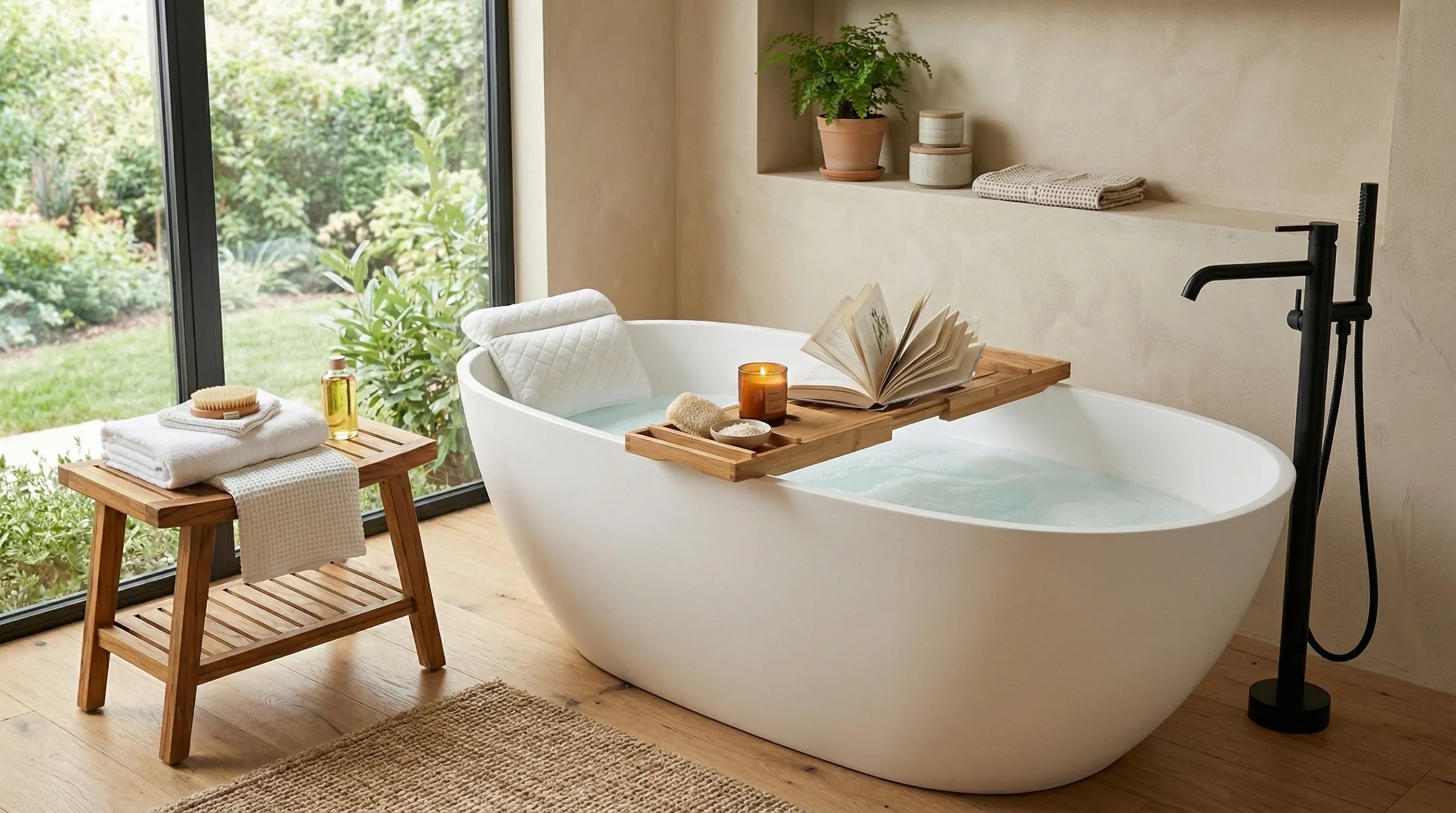
Stands alone, accessible from all sides. Fast-growing premium segment - the statement piece of modern luxury bathroom design. Wall mounting is often not possible.
Floor-standing faucets, freestanding caddies, and floor-mounted towel rails are the go-to accessories. Bath trays are ideal as no wall anchor is needed.
Set into a deck or surround with the rim visible above the surface. Popular in suburban new construction. The deck provides a natural surface for accessories.
Deck-mounted faucets are the standard. The surrounding deck doubles as a natural shelf for candles, trays, and bath products - making elaborate caddies optional.
Deep soaking or jet-equipped tubs. Typically freestanding or drop-in. Require accessories that accommodate the deeper basin and often the jet system surrounds.
Extended bath trays (to span the wider rim), waterproof pillows, and aromatherapy dispensers are most compatible. Grab bars require solid wall anchoring.
We've divided the accessories into four categories: Essential Hardware (the functional foundations of every tub), Comfort Upgrades (the accessories that transform a bath into an experience), Safety Accessories (often overlooked until they're needed), and Luxury Add-Ons (for the full spa-at-home upgrade). Every category deserves attention - but the order reflects priority for most homeowners.
These are the hardware pieces that make a bathtub work properly - faucets, drains, and overflow systems. They're also the pieces most homeowners never think to upgrade, which is why so many existing tubs still have builder-grade components from the year the house was built.

The bathtub faucet is both the most functional and most visually prominent hardware piece associated with the tub. A builder-grade tub spout delivers water, but little else - no temperature precision, often limited flow rate, and a chrome finish that rarely coordinates with the rest of the bathroom. An upgraded tub faucet changes the daily fill experience, the visual weight of the tub, and in the case of thermostatic systems, gives you precise temperature control so the water is exactly right every time.
- Freestanding floor-mount faucets are the premium choice for freestanding tubs - they stand independently beside the tub and are a major design statement in their own right. They require rough-in plumbing within reach of the tub location
- Wall-mount tub fillers are the most common and practical option for alcove and drop-in tubs - they protrude from the wall above the tub and pair cleanly with a hand shower diverter
- Thermostatic valves are worth the premium: they maintain set water temperature regardless of pressure fluctuations from other fixtures running simultaneously in the home
- Fill rate (GPM) matters for comfort: a 4 GPM filler takes nearly 15 minutes to fill a standard 60-gallon tub; a 6+ GPM model cuts that to under 10 minutes - a real daily-use difference

The bathtub drain and its matching overflow cover are among the most visible hardware pieces on the tub floor and wall - yet most homeowners never think to upgrade them when they replace faucets or refinish the tub. A mismatched drain (chrome drain against brushed nickel faucet hardware) is one of the most common design inconsistencies in otherwise well-designed bathrooms. An upgraded drain also offers better flow rates and often a pop-up or lift-turn mechanism that's noticeably more satisfying to use than the original.
- Always buy the drain and overflow cover as a matched set - finish calibrations vary by manufacturer; a drain and overflow from different brands rarely look identical even in the same "finish"
- Deep-soak overflow drain covers are a simple upgrade that allows the tub to fill 1–2 inches higher by blocking the standard overflow opening - great for soaking tubs
- Pop-up and toe-touch drains offer the cleanest look and the most satisfying operation; trip-lever designs are older technology but extremely reliable and easy to maintain
- Standard 1.5" drain openings are near-universal in US tubs - most replacement drains fit any standard tub without modification
This is where the bathtub goes from a fixture you use to a destination you look forward to. These accessories address the sensory quality of the bathing experience - comfort, organization, ambiance, and immersion. All of them are available without any installation work.

The bath tray is the single most purchased bathtub accessory in the US - and for good reason. It transforms a standard bath from a utilitarian soak into a curated ritual. A quality tray holds a book or tablet, a drink, skincare products, a candle, and anything else that makes 20 minutes in the tub genuinely restorative. The global bathtub tray market reached $762 million in 2025, with bamboo and teak options growing fastest as homeowners prioritize both aesthetics and eco-friendly materials.
- Teak is the material standard for bath trays: naturally water-resistant, antibacterial, and becomes more beautiful with use. Kiln-dried bamboo is the sustainable runner-up - it performs similarly and is typically 20-30% less expensive
- Adjustable telescoping arms are non-negotiable - standard US tubs range from 55 to 72 inches in width; a fixed-width tray will not fit most tubs and cannot be adjusted when you change tubs
- A wine glass or beverage holder slot is a surprisingly important feature - a glass balanced directly on the tray rim will tip the first time it's touched
- Book/tablet holders with page clips are more practical than simple raised rails - clips hold pages open without requiring a hand, which is the whole point of a bath tray

A bath pillow is one of those accessories that seems optional until you use one - and then feels indispensable. Without support, the porcelain or acrylic tub wall creates pressure on the neck, upper back, and head within minutes of reclining, which limits how long a bath can actually be enjoyed. A well-designed bath pillow with ergonomic contouring and secure suction-cup attachment eliminates this completely, turning a 10-minute tolerance into a genuine 30-minute soak.
- Memory foam conforms to the neck and shoulder anatomy better than fiberfill or gel inserts - it provides consistent support without compressing flat during a long soak
- Suction cup count and size matters: smaller pillows with 2–3 cups slide or detach in a warm bath; look for 4 large suction cups minimum for reliable adhesion on both flat and slightly curved tub walls
- Waterproof mesh or 3D mesh fabric outer covers allow water to pass through rather than saturate - this is both more comfortable and far more hygienic than solid fabric covers
- Machine-washable covers are the hygiene baseline - pillows that cannot be washed develop mildew along the suction cup channels within weeks

This is one of the most underappreciated bathtub accessories available - and one of the cheapest meaningful upgrades on this entire list. Standard bathtub overflow openings are positioned low on the tub wall to prevent flooding, which limits fill depth to approximately 14-16 inches. A suction-cup overflow drain cover seals over that opening temporarily, allowing the tub to fill 2-3 inches deeper. For anyone who soaks regularly, the difference in immersion is immediately noticeable.
- Universal suction-cup models fit most standard US overflow openings without modification - check the overflow opening diameter before ordering (most are 4–4.5 inches)
- Silicone covers create a more secure seal than hard plastic designs - they conform to slight surface irregularities around the overflow opening
- Safety reminder: always supervise the tub fill when using an overflow cover, and remove before leaving the bathroom - overflow protections exist for a reason
- This accessory is most impactful in older alcove tubs with low overflow positioning - newer deep-soak and soaking tubs typically have higher overflow placement already
Bathtub injuries are among the most common household accidents in the United States - the CDC estimates over 235,000 emergency bathroom injuries occur annually. The bathtub-specific hazards are slipping on wet surfaces and burns from imprecise water temperature control. Both are entirely preventable with the right accessories.

A grab bar is the single most important safety investment associated with a bathtub - not just for elderly family members, but for every household. Stepping into and out of a wet, slick tub is inherently unstable, and the risk is compounded when the tub is full and the bather is relaxed. A properly installed grab bar eliminates this risk entirely. The reason most homeowners don't have one is that older grab bar designs looked institutional; modern designs are indistinguishable from premium bathroom hardware.
- Wall stud mounting is non-negotiable for load-bearing grab bars - toggle anchors alone are insufficient for the dynamic lateral force of someone catching themselves mid-fall
- ADA-compliant grab bars (1.25–1.5 in. diameter, smooth finish, 1.5 in. clearance from wall) provide the best grip geometry for all hand sizes - don't deviate from this standard
- Angled (angled-mount) grab bars positioned on the tub wall at 45° provide both vertical pull (standing up) and horizontal support (stepping in/out) - more versatile than either purely vertical or horizontal orientations
- Suction-cup grab bars are not a safety product - they can release under load. Use wall-mounted bars for any genuine load-bearing safety application

The tub floor is the most hazardous surface in any home when wet - it's smooth, rounded, and frequently covered in soap residue. A non-slip tub mat addresses this directly. Unlike adhesive non-slip strips, which peel and harbor mold within months, a proper suction-cup mat maintains consistent grip, covers the full standing area, and can be removed after every use for cleaning and drying - which is critical for hygiene in a surface that sits in standing water.
- Full-coverage mats (matching your tub floor dimensions) provide more consistent traction than half-mats - the unsupported ends of a partial mat are themselves a trip hazard
- PVC-free TPE or natural rubber mats are the recommended material - PVC mats off-gas plasticizers in warm bath water, which is a legitimate chemical exposure concern for frequent bathers
- Drainage holes with a diameter of at least 5mm allow water to drain continuously rather than pool under the mat, which significantly reduces mold growth between uses
- Remove and hang the mat to dry after every bath - a mat that stays on the tub floor permanently will develop mold on the underside within 1–2 weeks regardless of material
These accessories move the bathtub from a functional piece into a full wellness fixture. None of them require structural changes to your bathroom - just a willingness to invest in the experience of the space you already have.

Stepping out of a warm bath into a cold towel is a jarring experience that immediately breaks the relaxation the bath created. A heated towel rail positioned within reach of the tub solves this so effectively that it's consistently the #1 bathroom accessory purchase homeowners report being glad they made. Plug-in electric models require no plumbing or electrical work beyond a standard outlet - they can be positioned anywhere in the bathroom and set on a timer to have towels warm precisely when you step out.
- Plug-in electric models are the most accessible - they work from any standard outlet, move if you rearrange the bathroom, and cost nothing to install
- Position the rail within arm's reach of the tub exit point - a towel warmer on the opposite wall requires crossing a wet bathroom floor while cold, which defeats the purpose
- Timer functions (15/30/60 min auto-off) eliminate any concern about leaving it running - start it at the beginning of your bath and the towels are at peak warmth when you finish
- Finish should match your tub faucet and other bathroom hardware - heated towel rails are now available in all standard bathroom finishes including matte black and brushed gold

The most effective luxury bath experience engages multiple senses simultaneously - which is why the highest-rated hotel bathtubs always have scent alongside warmth. An aromatherapy caddy or a well-chosen bath salt holder positioned on the tub or bath tray gives you control over the olfactory dimension of the bath, which is the fastest route to genuine relaxation (scent bypasses the cognitive brain and directly triggers the limbic system). It's also the easiest luxury upgrade to add: no installation, no tools, just placement.
- Ceramic or glass containers are the only appropriate materials for bath salt storage - salts are highly corrosive to metals and will pit stainless and brass surfaces within weeks
- Candle placement on a bath tray provides both scent and ambient lighting - flameless LED candles are a safer option that deliver the same visual warmth without fire risk in a humidity-rich environment
- Essential oil diffusers (ultrasonic mist style) work particularly well in enclosed bathrooms - the humidity of a hot bath amplifies the diffusion, requiring less product per session
- Eucalyptus and peppermint are stimulating; lavender and chamomile are sedating - choose based on whether the bath is intended as a morning energizer or an evening wind-down

A bath stool or teak side table beside a freestanding tub is one of those accessories that appears to be purely decorative but earns its place through daily utility. It holds the items that don't fit on the bath tray - a second towel, a robe, a tea cup, a stack of books - while also providing a practical step surface for getting in and out of deep or high-sided soaking tubs. In photographs and in person, a well-chosen stool alongside a freestanding tub is what gives the bathroom a "finished" quality that distinguishes it from a room with nice fixtures.
- Teak is the go-to material for any bath-adjacent furniture - it's inherently water-resistant, antibacterial, and one of the few woods that genuinely thrives in humid environments without swelling or degrading
- For freestanding tub setups: a stool at rim height (typically 16-20 in. for a soaking tub) provides a natural step assist that makes getting in and out of a deep tub significantly safer and more comfortable
- A stool with a lower shelf doubles storage capacity - the top surface holds display items (candles, a plant) while the shelf holds rolled towels, a magazine, or bathroom essentials
- Match the stool material to the bath tray if you have one - a teak stool alongside a teak caddy tray creates a cohesive spa aesthetic that's immediately recognizable
The bathtub is one of the most chemically demanding environments in the home - it's exposed to hot water, bath salts, essential oils, soap scum, and near-constant humidity. Material choice determines whether an accessory lasts one year or fifteen. Here's the definitive breakdown for every category.
| Material | Best used for | Lifespan (tub environment) | Avoid for |
|---|---|---|---|
| Teak wood | Bath trays, stools, shelving - any wet-zone wood item | 10-20+ years with occasional oiling | Nothing - it's the top choice for tub-adjacent wood |
| Kiln-dried bamboo | Trays, accessories, organizational items | 5-10 years (seal annually) | Direct prolonged submersion; sharp bath salts scratch surface |
| 304 Stainless steel | Faucet hardware, grab bars, drain covers | 15-20+ years | Prolonged contact with bath salts - may pit over time |
| Solid brass | Faucets, spouts, drain hardware | 20+ years with plated finish | Unfinished surfaces tarnish; requires gentle cleaning products |
| Ceramic / porcelain | Salt holders, soap dishes, candle risers | Indefinite (if not dropped) | Tub floor surface (breakage + injury risk) |
| Memory foam (waterproof) | Bath pillows | 2-4 years depending on use frequency | Prolonged submersion - degrades internal foam structure |
| TPE / natural rubber | Non-slip tub mats | 3-5 years | Strong bleach cleaners accelerate degradation |
| Acrylic | Cosmetic holders, display items | 2-4 years before yellowing / scratching | Bath trays or any structural accessory |
- Tub faucet upgraded - wall-mount, deck-mount, or floor-mount depending on tub type; finish matched to bathroom hardware; thermostatic valve recommended
- Drain and overflow cover matched - same finish as faucet; pop-up, toe-touch, or trip-lever style; bought as a set with overflow cover
- Bath caddy tray in place - teak or bamboo, adjustable telescoping arms, wine glass slot, book/tablet holder with page clips
- Bath pillow installed - memory foam with waterproof mesh cover, 4+ large suction cups, machine-washable cover
- Deep-soak overflow cover available - silicone or suction-cup style, fits standard overflow opening, used only with supervision
- Grab bar installed on tub wall - wall-stud mounted, ADA-compliant diameter, angled orientation for maximum entry/exit support
- Non-slip tub mat in use - full-coverage PVC-free material, 130+ suction cups, drainage holes, removed and hung to dry after each bath
- Heated towel rail positioned at tub-side - plug-in electric, 200+ BTU, timer function, finish matched to hardware
- Aromatherapy caddy or salt holder - ceramic or glass, positioned on bath tray, complements the intended bath experience (relax vs energize)
- Bath stool or side table beside freestanding tub - teak preferred, 16–18 in. height, lower shelf for storage, 200 lb capacity if used as step
Shop Premium Bathtub Accessories at Bathify
From freestanding tub faucets and drains to bath caddies, towel warmers, and safety grab bars - every accessory in this guide is available at Bathify. Free shipping on orders over $50, USA-wide.


