







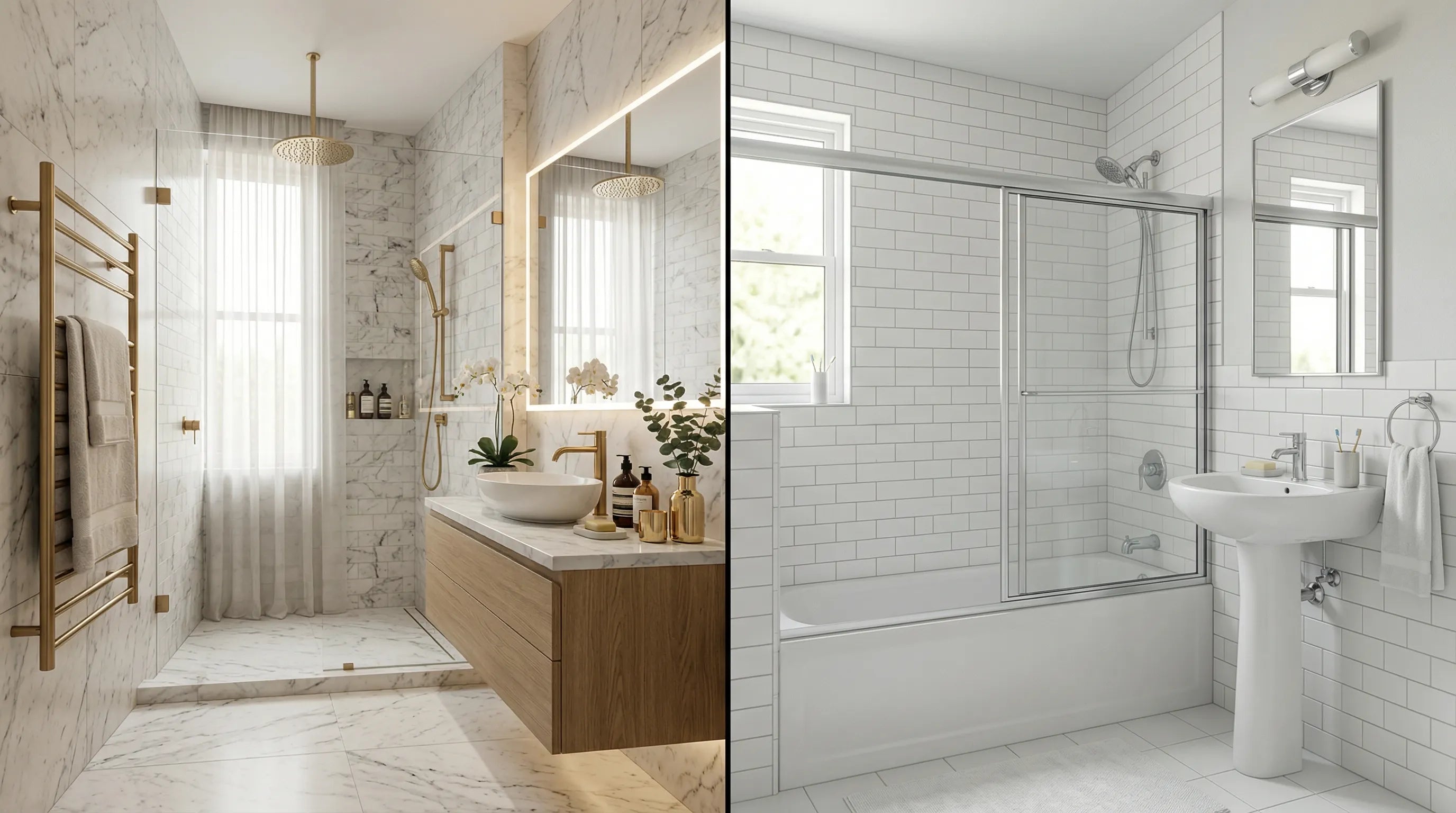
We cut through the marketing to give you an honest, category-by-category verdict: where spending more genuinely pays off - and where a budget pick does the exact same job for a fraction of the price.
Here's the honest truth about bathroom accessories: the price tag is often one of the worst predictors of quality. A $200 towel bar from a well-known brand can outlast three $60 versions from a big-box store. And a $35 soap dish is functionally identical to a $120 one - because ceramic is ceramic, regardless of the label on the box.
The difference is almost never about luxury vs. budget across the board. It's about knowing exactly which categories reward a higher investment with measurably better performance, durability, or daily experience - and which ones don't. This guide gives you that breakdown, category by category, with real price comparisons and honest verdicts based on materials, longevity, and practical impact.
According to the 2024 Cost vs. Value Report, mid-range bathroom remodels recoup approximately 74% of cost at resale - among the highest returns of any interior renovation. But the ROI drops sharply for upscale remodels, recovering only 45–50%. The sweet spot for value isn't all-budget or all-luxury - it's strategic: spend on the pieces where quality directly translates to performance or longevity, and save where it doesn't.
For each product category, we applied three questions to determine the verdict. If the answer to all three is "yes," it's worth spending more. If one or more is "no," budget often wins.
Question 1 - Does it have moving parts or mechanical components? Pumps, valves, hinges, and heating elements fail in cheap versions within 1–3 years. Premium engineering extends this to 10–15 years. Quality directly equals longevity here.
Question 2 - Does the material matter for performance? A cheap zinc towel bar rusts. A cheap shower caddy corrodes. A cheap soap pump breaks. When the material determines how the product functions over time, quality matters. When it's purely cosmetic, it often doesn't.
Question 3 - Does it affect daily experience in a noticeable way? A premium shower head delivers meaningfully better pressure and coverage every single day. A premium soap dish doesn't feel different from a budget one. If the daily experience difference is imperceptible, save.
These five categories reward a higher investment with noticeably better performance, dramatically longer lifespan, or a meaningfully better daily experience. Buying budget in these categories is a false economy - you'll replace them sooner and spend more in the long run.
The shower head is the single bathroom accessory where spending more delivers the most immediate and noticeable daily difference. Budget models use plastic nozzles that clog with mineral deposits within months, spray patterns that are uneven or weak, and ABS plastic bodies that degrade under UV and heat within 3-5 years. A quality solid-brass or stainless shower head with precision-engineered nozzles delivers consistent pressure, lasts 10-15+ years, and saves water through more efficient spray design.
- ABS plastic body - degrades in 3-5 years
- Plastic nozzles clog with hard water deposits
- Limited spray patterns, uneven coverage
- No WaterSense certification - higher water use
- Finish peels or discolors within 2 years
- Solid brass or stainless body - 15+ year lifespan
- Silicone nozzles - wipe clean, mineral-resistant
- 5–8 spray settings including rainfall and massage
- WaterSense certified - saves 2,700+ gal/year (EPA)
- PVD finish - scratch-resistant, 10x more durable than chrome plate
A $150 quality shower head used daily for 15 years costs $0.03 per shower. A $30 budget head replaced every 3-4 years costs more over the same period - plus the frustration of declining performance. The EPA's WaterSense data shows a quality head saves $70/year in water and energy. At that rate, a $120 shower head pays for itself in under 2 years. This is the clearest "spend more" case in the entire bathroom.
The towel bar is one of the most frequently touched surfaces in any bathroom - and the one most likely to fail dramatically if cheaply made. A budget towel bar uses zinc alloy or thin chrome-plated steel with mounting hardware rated for perhaps 10 lbs. When it fails - usually by pulling out of the wall - it takes tile or drywall with it, creating a repair that costs far more than the price difference between cheap and quality hardware. Premium towel bars use solid brass cores, genuine PVD or electroplated finishes, and mounting hardware rated for 40–60 lbs.
- Zinc alloy or hollow chrome-plated steel
- Finish chips, peels, or corrodes within 2-3 years
- Mounting hardware typically rated 10-15 lbs
- Wall failure risk - can pull tile or drywall out
- Replacement cost + wall repair often exceeds $100
- Solid brass or 304 stainless steel core
- PVD finish - 10x harder than standard chrome plate
- Mounting hardware rated 40-60 lbs minimum
- 15-25 year lifespan with no finish degradation
- Buy the full set (bar + ring + hook + toilet paper holder) for finish guarantee
A $90 towel bar set that lasts 20 years costs $4.50 per year. A $30 set replaced every 3 years costs $10 per year - plus potential wall repair costs. Beyond economics, the visual inconsistency of a corroded or replaced towel bar in an otherwise well-designed bathroom is a real quality signal to anyone who enters. Hardware sets are the place to buy quality once and stop thinking about it.
A bathtub faucet is a plumbing fixture that interacts with hot and cold water under pressure, multiple times a day, for decades. The internal cartridge is the critical component - it controls temperature mixing and prevents scalding. Budget faucets use plastic or low-grade ceramic cartridges that fail within 5-7 years; premium faucets use ceramic disc cartridges rated for 500,000+ cycles. The difference in daily function is immediately noticeable: a quality thermostatic faucet delivers the same water temperature within 1°F every time, regardless of what else is running in the house.
- Plastic or low-grade ceramic cartridge
- Temperature inconsistency when other fixtures run
- No thermostatic protection - scald risk
- Drip leaks develop within 5-7 years
- Limited finish options; chrome only at this price point
- Ceramic disc cartridge - 500,000+ cycle rating
- Thermostatic valve - locks temperature ±1°F
- Anti-scald protection built into the cartridge
- Solid brass body - 20+ year plumbing lifespan
- All major finishes available: chrome, matte black, brushed gold
A faucet replacement involves water shutoff, potential plumber fees, and in older homes, surprises behind the wall. Doing it once with a quality fitting is always cheaper than doing it twice with budget fittings. Thermostatic protection is also a genuine safety feature - particularly important in households with children or elderly family members. This is one of the clearest cases where the internal engineering justifies every dollar of the premium.
Heated towel rails are electrical appliances - and budget electrical appliances in a wet environment are a combination that fails early and sometimes dangerously. Budget models use low-grade heating elements that lose efficiency within 2–3 years, often fail to reach adequate temperature, and use resistive heating wire that degrades in the humidity of a bathroom environment. Quality models use stainless steel heating elements, proper thermal regulation, and are built to IEC safety standards for use in bathroom wet zones.
- Low-grade resistive heating wire
- Reaches inadequate temperature for full towel drying
- Heating element fails within 2–3 years in humid conditions
- Often lacks proper bathroom IP (ingress protection) rating
- No timer - constant-on or manual only
- Stainless steel heating element - 10–15 year lifespan
- 200–300 BTU output - fully dries thick bath towels
- IP44 or IP55 bathroom-rated for wet zone safety
- Built-in timer with auto-shutoff
- Available in all bathroom hardware finishes
A quality heated towel rail running $15–25/year in electricity costs for 12–15 years is a dramatically better investment than a cheap model that barely heats, fails within 3 years, and needs replacement. This is the most-loved daily accessory upgrade in our customer surveys - but only when the product is actually good enough to work properly. Don't buy budget here: a rail that doesn't truly warm a towel delivers none of the benefit and all of the cost.
This is the most used visual surface in the bathroom - you look at it every single morning. A budget mirror with uneven LED strips, poor color temperature rendering, or a dim reflective coating makes grooming harder and makes the room feel cheap. Quality LED mirrors use CRI 90+ LEDs (accurate skin-tone rendering), adjustable color temperature from 3,000K–6,000K, and anti-fog heating elements that keep the glass clear after a hot shower. The practical difference is noticed every single day.
- CRI 70–80 LEDs - poor color accuracy for grooming
- Fixed color temperature - usually harsh cool white only
- No anti-fog — fogs immediately after a hot shower
- Touch switch often fails within 1-2 years
- Cheap reflective backing - distortion at edges
- CRI 90+ LEDs - true skin-tone color accuracy
- Adjustable 3,000K–6,000K - warm for evening, daylight for makeup
- Anti-fog heating element built into glass
- Capacitive touch switch - rated 100,000+ activations
- 5-layer silver reflective coating - zero distortion
You use this mirror 365 days a year. Over 10 years, that's 3,650 interactions with it - more than almost any other surface in the home. A quality LED mirror at $250 divided across 10 years is $25 per year for accurate grooming lighting every single morning. The color rendering difference between a CRI 80 and CRI 90+ mirror is instantly visible when you apply makeup or shave. This is one purchase you notice immediately and appreciate daily.
These categories fail the "does quality actually change the experience?" test. The function is identical, the materials are the same, and the only difference is the brand markup. Save your money here and redirect it to the categories above.
A soap dish holds a bar of soap. The materials available at the $15-25 price point (ceramic, porcelain, stainless steel) are functionally identical to those at the $80-150 price point. Ceramic fired at the same temperature in different factories is the same product with a different brand label on the bottom. The only time this rule doesn't apply: if you need a specific finish to match a hardware set you've already purchased - and in that case, buy it from the same product line, not necessarily the most expensive version.
- Ceramic or stainless - same material as premium
- Drainage slots on most models
- Available in all standard finishes
- 5+ year lifespan (if not dropped)
- Same ceramic or stainless material
- Brand name and designer aesthetic
- Marginally more refined finish in some cases
- 5+ year lifespan (if not dropped)
A ceramic soap dish for $20 holds a soap bar identically to a $100 version. Spend the $80 difference on a quality towel bar or toward a better shower head instead. The caveat: buy from the same product line as your other hardware for finish matching, and choose a model with drainage slots so it doesn't become a puddle of soap scum.
A bathroom waste bin has one job: contain waste and prevent odor. Above $35-50, you are paying for aesthetics rather than meaningfully better function. The mechanism (step-open, sensor, or manual lid) is where quality can make a difference - but even here, a $40 step-open bin with a soft-close lid performs the same task as a $120 designer version. The bin is also replaced more often than hardware (every 5-8 years as aesthetics change), which makes long-term durability less important here than elsewhere.
- Step-open mechanism - same as premium
- Soft-close lid available at this price
- Matte and brushed finishes available
- 3–5L capacity - right for most bathrooms
- Same step-open mechanism
- More refined aesthetic and finish quality
- Brand name and designer provenance
- Marginally better pedal mechanism in some cases
Get a $35-45 step-open waste bin with a soft-close lid and a 35L capacity. That covers everything you need. The key specs to match: liner compatibility (standard 4-gallon bags), lid mechanism (step-open beats manual for hygiene), and a narrow footprint so it doesn't dominate floor space. Spend the difference on the shower head.
Bath mats outside the tub are replaced every 2-3 years regardless of quality, because washing degrades the non-slip backing over time. This makes paying a premium for longevity largely irrelevant - you're replacing it anyway. What does matter: the material spec (GSM rating for cotton mats, or thickness for memory foam), and the non-slip backing type. These specifications are available across all price points - you just have to know what to look for rather than relying on brand or price as a proxy for quality.
- 1,800+ GSM cotton - same spec as premium
- TPR suction backing available
- Machine washable at 60°F
- Replacement cycle: 2-3 years anyway
- Same GSM range as well-specified budget mats
- Better color range and weave aesthetics
- Certified organic cotton in some cases
- Still replaced every 2-3 years
Buy to spec, not to brand. Look for 1,800+ GSM for cotton mats, TPR or latex suction backing (not rubberized fabric, which curls at the edges), and machine-washable construction at 60°F. A $30 mat with the right specs outperforms a $100 mat with wrong specs. The exception: if you want organic cotton certification (GOTS), there is a legitimate price premium for genuine certification.
A toilet paper holder's only mechanical requirement is that it holds a roll securely and doesn't wobble when you pull paper from it. Budget models meet this requirement at $15–30 when properly installed. The one condition that changes this verdict: if you've bought premium towel bars and hardware, you must buy the toilet paper holder from the same product line - not because the quality difference matters, but because finish calibration is brand-specific and a mismatched finish at a glance is a design error that undermines everything else you've spent on the space.
- Spring-bar or post-arm mechanism - same function
- Zinc alloy or ABS core - adequate for light use
- Standard finishes available
- Works if not in the same sightline as premium hardware
- Solid brass or stainless core
- Calibrated finish to match same-line hardware precisely
- Heavier feel, more refined spring mechanism
- Essential if your towel bar is the same brand and collection
Save here unless your towel bar is from a premium product line. In that case, buy the toilet paper holder from the same collection - not because the function warrants it, but because finish consistency across hardware is one of the most noticeable design details in a bathroom. A $25 toilet paper holder in "matte black" from a different brand than your "matte black" towel bar will look noticeably different side by side.
These categories don't have a universal right answer - the value of spending more depends on your specific use case, household size, or renovation context.
For a primary bathroom used daily by multiple people: spend more. Solid wood or plywood-core vanities with dovetail drawer joints and solid brass hardware outlast MDF or particleboard versions by a decade or more in a humid environment. For a powder room used by guests 3-5 times per week: budget is fine. The environmental stress is minimal and the aesthetic expectations are lower. For rental properties: always choose mid-range, not budget - MDF vanities in rentals fail within 5 years and replacement costs more than the premium would have.
Primary bath: spend $400–$800 for solid wood or plywood-core construction. Powder room: $150–$350 is perfectly adequate. Rental property: $250–$450 mid-range — budget MDF becomes a liability within 3 years in a rental context.
Soap dispensers are the most visible countertop accessory, and the pump mechanism is the only component that actually matters for quality. Budget dispensers use plastic pump heads that fail within 1-2 years; quality dispensers use metal pump heads that last 5-10 years. However, the premium above mid-range (metal pump, ceramic or glass body, 300ml+ capacity) doesn't deliver further performance improvement - it's purely brand markup. Spend enough to get a metal pump; don't spend beyond that for brand recognition.
The $35–65 range is the sweet spot: ceramic or stainless body, metal pump head, 300ml+ capacity, refillable wide-mouth opening. A $15 plastic dispenser's pump will fail. A $120 designer dispenser's pump won't perform any better than a $50 one. Buy a matched set (liquid soap + lotion) in the same material and finish - the visual impact of consistency is the real upgrade here.
With shower caddies, the right question is not budget vs. luxury - it's material vs. material. A $25 aluminum tension caddy outlasts a $70 chrome-plated steel wall caddy in a humid shower environment, because aluminum doesn't corrode and chrome plating does. The price is almost irrelevant here; the material specification determines everything. Know what you're buying regardless of price: aluminium or 304 stainless steel are the only materials worth purchasing for anything that lives inside a shower.
Buy on material, not on price. A $30 aluminium tension caddy is a better purchase than a $80 chrome-plated steel wall mount. Ask one question before buying: is it aluminium, 304 stainless, or chrome/zinc plated? The last two corrode in shower environments regardless of price. Slotted base shelves are also non-negotiable - flat bases trap water and grow mold beneath products.
Your complete reference for every major bathroom accessory category - cut this out, save it, and use it next time you're shopping.
| Accessory category | Verdict | Budget range | Premium range | The one thing to look for |
|---|---|---|---|---|
| Shower head / system | Splurge | $20–$50 | $80–$300 | Solid brass body + WaterSense 2.0 GPM cert |
| Towel bar set | Splurge | $15–$40 | $60–$200 | Solid brass core + PVD finish + buy as full set |
| Bathtub faucet / filler | Splurge | $40–$120 | $200–$800 | Ceramic disc cartridge + thermostatic valve |
| Heated towel rail | Splurge | $30–$80 | $120–$400 | Stainless element + IP44+ rating + 200+ BTU |
| LED mirror / medicine cabinet | Splurge | $40–$100 | $150–$500 | CRI 90+ LEDs + adjustable colour temp + anti-fog |
| Soap dish | Save | $12–$30 | $60–$150 | Drainage slot + finish matches hardware set |
| Waste bin | Save | $20–$50 | $80–$200 | Step-open + soft-close lid + 3–5L capacity |
| Bath mat (outside tub) | Save | $18–$45 | $60–$150 | 1,800+ GSM + TPR backing + machine washable 60°F |
| Toilet paper holder | Save | $15–$40 | $40–$120 | Match to towel bar product line for finish accuracy |
| Vanity (primary bath) | Splurge | $150–$350 | $400–$800+ | Solid wood or plywood core — never MDF in primary bath |
| Soap dispenser | Mid-range | $15–$25 | $35–$65 sweet spot | Metal pump head + 300ml+ capacity + wide refill opening |
| Shower caddy | Buy by material | $25–$60 | $40–$120 | Aluminium or 304 SS only — price is irrelevant |
The fastest way to tell budget from quality isn't the price - it's the material spec in the product description. Here's a quick decoder for the most commonly listed materials and what they actually mean for longevity.
The resale data reinforces the strategy: mid-range investments that focus on functional upgrades and broad appeal consistently outperform luxury-only spending. The sweet spot isn't premium everywhere - it's strategic quality in the right places. A bathroom with a quality shower system, premium hardware set, and a well-specified LED mirror will look and perform as well as one with every designer fixture, at a fraction of the cost difference.
The most effective strategy for any bathroom: identify the two or three accessories with the highest daily touchpoint frequency (shower head, towel bar, mirror) and invest in quality there without compromise. For everything else - ask the three-question test. Does it have moving parts? Does the material change performance? Does it change daily experience noticeably? If the answer is no to all three, save your money and put it somewhere it actually works harder for you.
Shop Premium Bath Products at Bathify
Quality where it counts, smart pricing where it doesn't. Browse Bathify's full range of bathroom accessories - from shower systems and towel warmers to mirrors and vanities. Free shipping on orders over $50.


