







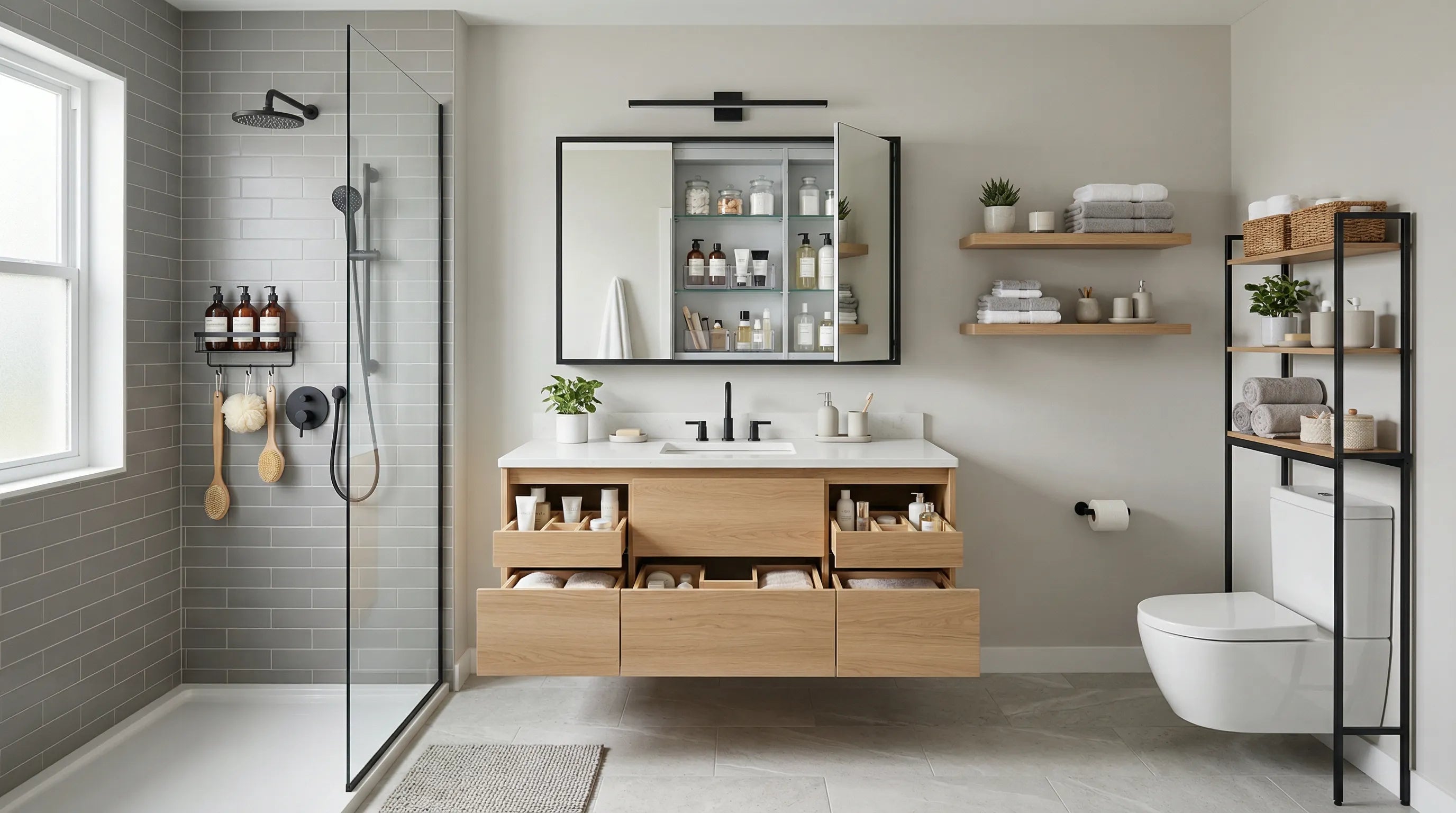
A room-by-room, zone-by-zone framework for picking the storage solutions that actually work - based on your bathroom size, layout, and how you use the space every day.
Most bathroom storage problems aren't actually storage problems. They're placement problems. The average American bathroom has 47 individual products competing for space across roughly 40 square feet - but most of those products are stored in the wrong zones, creating the feeling of constant clutter even in bathrooms with ample cabinet space.
This guide gives you a practical framework for choosing the right storage solutions for your specific bathroom. Not just a list of products to buy - but a clear decision process: how to assess what you actually need, which storage types work in which scenarios, and what to look for in each category so you invest in solutions that last.
A 2024 survey by the National Kitchen and Bath Association found that bathroom storage is the #1 cited reason for bathroom renovation — yet 71% of homeowners who added storage during a remodel reported that clutter returned within 6 months. The issue was never square footage. It was the wrong type of storage in the wrong zones. Getting the strategy right before buying the products is what this guide is about.
The single biggest storage mistake homeowners make is buying products before auditing the space. Twenty minutes of honest assessment will save you from purchasing three organizers that don't fit, returning them, and starting over.
Before choosing any storage solution, answer these four questions about your bathroom. Your answers will directly determine which product categories apply to you.
Before buying any storage product, spend 5 minutes measuring. Write down: the interior depth and width of the cabinet under your sink, the width and height of the wall space above your toilet, and the distance between your shower walls at the corners. Most storage products list dimensions in their specifications - matching these against your measurements eliminates 90% of returns.
Interior designers use a zone-based approach to bathroom organization because it solves the root cause of clutter: storing items where they're convenient to grab, not where it's convenient to put them away. Assign every product in your bathroom to one of these three zones before deciding what storage to buy.
Used every single day. Must be within arm's reach and immediately visible.
- Toothbrush, toothpaste, floss
- Face wash, moisturizer
- Soap dispenser
- Daily prescriptions
- Deodorant, razor
Used 2–5 times per week. Can be in a cabinet or drawer — doesn't need to be visible.
- Hair tools, styling products
- Makeup and grooming extras
- Cleaning sprays
- Nail care, tweezers
- Backup toiletries
Extras and seasonal items. Furthest from the mirror — top shelves, linen closet, under-sink back.
- Extra toilet paper rolls
- Backup shampoo/conditioner
- First aid supplies
- Seasonal items (sunscreen, etc.)
- Guest toiletries
Once you assign your products to zones, the storage decisions become obvious. Zone 1 products need open, visible storage on the counter or in a medicine cabinet. Zone 2 products go in drawers and closed cabinets. Zone 3 products go in linen towers, under-sink back shelves, or overhead storage. Fighting this logic - putting Zone 3 items in the front of the medicine cabinet, for example - is what creates the feeling that you never have enough space.
There are seven distinct categories of bathroom storage, each solving a specific problem. Most bathrooms need 3–4 of these, not all seven. The key is matching the solution to the actual gap in your bathroom - not buying everything and hoping it all fits.
![[Premium Quality Bathroom Products & Accessories Online]-Bathify](https://cdn.shopify.com/s/files/1/0633/9467/6967/products/A750-1.jpg?v=1648818315)
The medicine cabinet is the highest-efficiency storage upgrade available in a bathroom because it replaces a flat mirror - something that was already on the wall - with 12-18 cubic inches of organized, hidden storage. Modern medicine cabinets look identical to flat mirrors from the outside. If your bathroom has a flat mirror, switching to a cabinet version is the single best storage decision you can make.
- Replacing a flat mirror - zero additional wall space required, instant storage gain
- Zone 1 products: daily-use items that need to be within arm's reach of the sink
- Bathrooms where countertop clutter is the main problem
- Recessed version is ideal for new builds and full renovations where the wall can be opened up

The space directly above the toilet is the most consistently wasted storage zone in the average American bathroom. A freestanding over-toilet etagere or a wall-mounted cabinet in this zone adds 8–12 cubic feet of storage without occupying a single additional inch of floor space. For small bathrooms, this is often the most impactful single purchase available.
- Small bathrooms with limited wall space elsewhere — the toilet zone is often the only free vertical real estate
- Zone 3 backstock: extra toilet paper, backup toiletries, first aid supplies
- Renters: freestanding etageres require zero installation and move with you
- Bathrooms with no linen closet nearby — this becomes the linen overflow zone

The cabinet under the bathroom sink is statistically the most disorganized space in most homes. It has irregular dimensions due to plumbing, it's deep and dark, and items pushed to the back disappear for months. The right under-sink organizer turns this dead space into functional storage - doubling or even tripling usable capacity without adding anything to the room's footprint.
- Cleaning supplies and products that don't need to be visible but need to be accessible
- Bathrooms where the under-sink cabinet is currently a "black hole" of lost products
- Always measure: interior cabinet width, depth, and - critically - pipe location and clearance height before ordering
- Two-tier sliding organizers are the highest-impact option: they effectively double the usable depth of the cabinet

Floating shelves are the most versatile bathroom storage option — they work in every bathroom size, they're aesthetically flexible, and they go where no cabinet can. The key is their placement. Shelves installed at the wrong height or in the wrong zone create clutter displays, not storage solutions. Done right - above the toilet, flanking a mirror, or beside the vanity - they become a functional and design-forward part of the bathroom.
- Display storage: items you want visible, like rolled towels, candles, and glass apothecary jars
- Filling empty wall space that cabinets are too bulky for - narrow walls, beside windows, between fixtures
- Spa-style bathroom aesthetics - a trio of floating shelves above a towel bar creates an immediate premium look
- Not ideal for Zone 1 daily products - open shelves collect dust and require regular tidying

For bathrooms without a dedicated linen closet - which describes most bathrooms in apartments and older American homes - a linen cabinet or storage tower is the primary bulk-storage solution. It handles the Zone 3 volume problem: towel sets, backup supplies, seasonal items, and guest toiletries. The trade-off is floor footprint, which is why getting the right dimensions is critical before purchasing.
- Bathrooms with no linen closet - this becomes the primary towel and backstock storage solution
- Zone 3 bulk items that need to stay organized but don't need to be visible
- Slim tower formats (12–18 in. wide) work in tight corners without dominating the room visually
- Wall-mounted linen cabinets eliminate the floor footprint entirely - the premium choice for smaller bathrooms

The shower is one of the most product-dense zones in any bathroom - shampoo, conditioner, body wash, shaving gel, razors, and face wash all compete for a ledge that's typically less than 6 inches wide. Products balanced on the edge of a tub or shower floor are both a clutter problem and a safety hazard. A proper shower caddy or built-in niche shelf resolves both at once.
- Any shower with products currently sitting on the ledge or floor - a caddy is always safer and more organized
- Renters: tension-pole caddies require zero drilling and move with you
- New builds and full renovations: a recessed tile niche is the most polished, permanent solution - plan it before the tile goes up
- Multi-person households: look for caddies with adjustable shelf heights and separate zones per person

Having cabinets and drawers is not the same as having organized storage. An unorganized drawer is functionally no different from a pile on the countertop - you still spend 90 seconds searching for the nail clippers every morning. Drawer dividers and counter organizers are the final layer of the storage system: they impose order inside the spaces you've already created.
- Vanity drawers that have become "junk drawer" zones - a $15 divider set restores full usability
- Countertop organization: a vanity tray containing your Zone 1 essentials is the most elegant version of this solution
- Shared bathrooms: clear labeled containers give each person their own designated space in shared drawers
- Always buy after you've sorted your products into zones - organize what you're keeping, not everything
| Storage solution | Best bathroom size | Renter-friendly | Floor space used | Best zone coverage |
|---|---|---|---|---|
| Medicine cabinet mirror | Any size | ✓ Surface-mount | None | Zone 1 (daily) |
| Over-toilet etagere | Small to medium | ✓ Freestanding option | Minimal | Zone 2 + 3 |
| Under-sink organizer | Any size | ✓ No installation | None (uses existing) | Zone 2 + 3 |
| Floating shelves | Any size | ✗ Requires drilling | None | Zone 1–2 (display) |
| Linen cabinet / tower | Medium to large | ✓ Freestanding option | Moderate | Zone 3 (backstock) |
| Shower caddy / niche | Any size | ✓ Tension / adhesive | None | Shower zone |
| Drawer & counter organizers | Any size | ✓ No installation | None (uses existing) | Zone 1 (fine organization) |
Small bathrooms - under 50 square feet, which is most bathrooms in apartments and older homes - have a different optimization problem than large bathrooms. The goal isn't adding more storage. It's adding storage that doesn't make the room feel smaller. Every floor-based piece adds visual weight; every wall-mounted and vertical piece removes it.
Research in environmental psychology consistently shows that floor coverage - not total volume - is the primary driver of perceived room size. A small bathroom with completely clear floors will feel 30-40% larger than the same room with two freestanding storage units, even if the total storage capacity is identical. This is why wall-mounted and vertical storage solutions outperform freestanding units in small bathrooms even when they hold less.
- Replace flat mirror with medicine cabinet first - zero additional footprint, immediate storage gain, no change to room feel
- Use every inch above the toilet - a freestanding etagere adds 60+ inches of vertical storage in a zone that's otherwise completely empty
- Mount towel bars, hooks, and accessories on the wall, not on the vanity - keeping the countertop clear is the highest-impact visual trick in small bathroom design
- Choose a tension-pole shower caddy over a floor caddy - keeps the shower floor clear, which makes the shower enclosure feel larger
- A large single mirror beats multiple small accessories - a mirror that spans most of a wall visually doubles room depth at no extra cost compared to smaller pieces
For small bathrooms, the order of operations matters: clear the floor first, then add vertical storage, then organize interior spaces. Buying a linen tower before clearing the floor counter-intuitively makes the room feel more cramped, not more organized. Work from floor up, not from storage type outward.
The bathroom is a chemically aggressive environment: humidity regularly reaches 80-95% during and after showers, surfaces are exposed to cleaning chemicals, and products are touched with wet hands dozens of times per day. Material choice is not aesthetic preference - it's durability planning.
| Material | Best use | Lifespan in humid conditions | Avoid for |
|---|---|---|---|
| 304 Stainless steel | Shower caddies, towel bars, hardware | 15–20+ years | Nothing — best all-around |
| Solid brass | Towel bars, cabinet hardware, fixtures | 20+ years with care | Unfinished surfaces (tarnishes) |
| Aluminium | Shower caddies, lightweight shelving | 10–15 years | Heavy-load shelving |
| Ceramic / porcelain | Soap dishes, countertop organizers | Indefinite if not dropped | Shower zone (breakage risk) |
| Bamboo | Trays, shelves, countertop pieces | 5–8 years with sealing | Direct water exposure (warps) |
| Zinc alloy (die-cast) | Hardware, hooks, rings | 8–12 years | High-moisture shower zones |
| MDF / particleboard | Cabinet bodies (finished only) | 5–10 years | Any unsealed surfaces |
Find the Right Storage Solution at Bathify
From medicine cabinets and linen towers to shower niches and floating shelves - Bathify carries every storage solution in this guide, in premium finishes with free shipping on orders over $50.


