







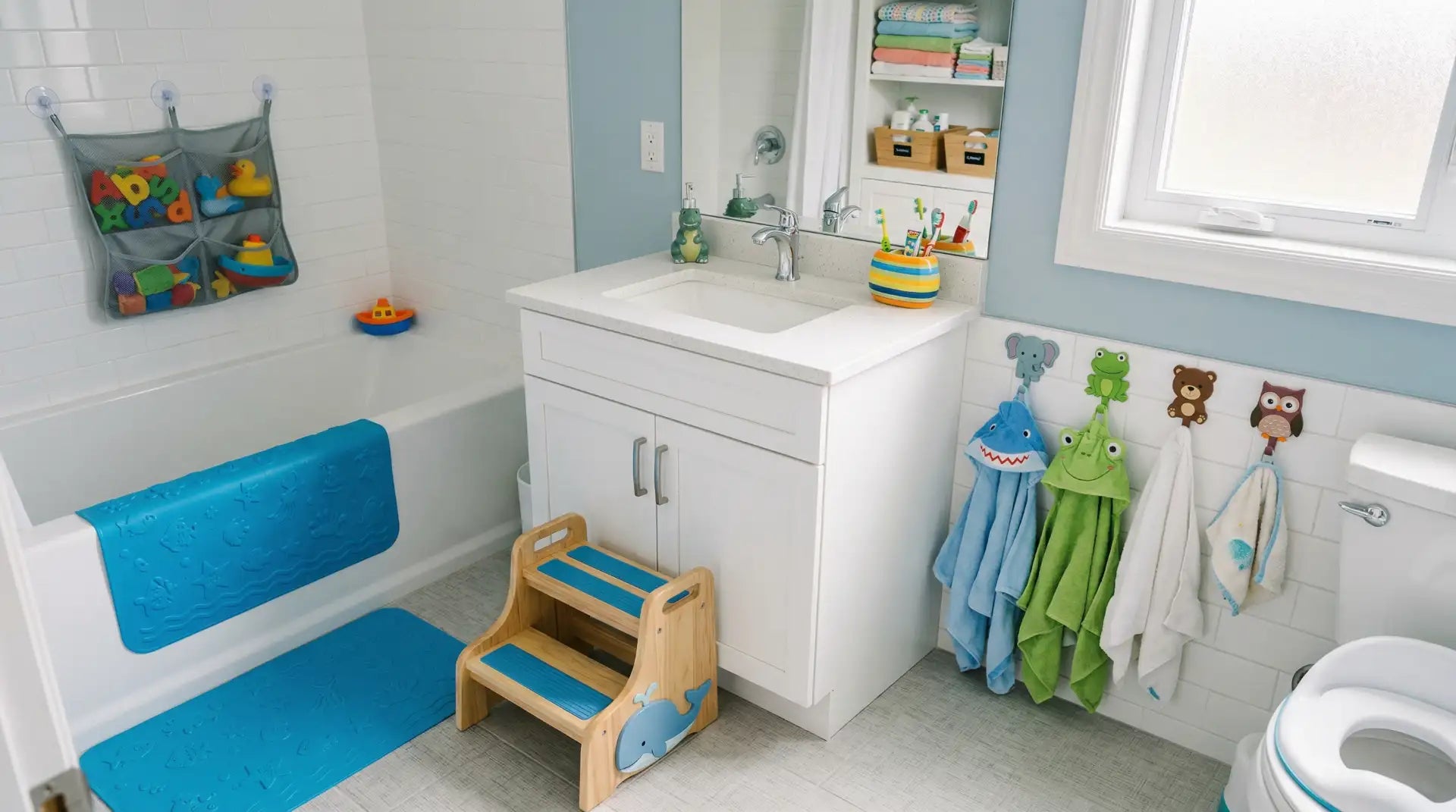
The right kids' bathroom accessories do three things simultaneously: keep children safe around water, make daily routines easier to stick to, and hold up to the kind of use only a child can deliver. Here's exactly what to buy - and why.
A kids' bathroom - or a shared bathroom used by both adults and children - has different requirements than an adult-only space in nearly every category. Safety comes before aesthetics, but it doesn't come at the expense of it. Slip resistance, non-toxic materials, reachable storage, and temperature protection aren't afterthoughts in a bathroom used by children: they're the foundation on which everything else is built. Get these right, and the fun, practical accessories that make kids actually want to brush their teeth and wash up every day can do their job.
This guide covers nine essential kids' bathroom accessories, organized by function: safety first, then hygiene habit support, then storage and organization. For each one, we've included age guidance, material safety information, and specific product features that distinguish a genuinely child-appropriate accessory from one that's merely marketed as such.
Safety accessories eliminate the most serious risks: slipping on wet surfaces, scalding from hot water, and falling from heights when reaching for things that aren't at child level. Habit accessories make the routines children need to build - tooth brushing, handwashing, independent bathing - easier to perform correctly and consistently. Organization accessories store kids' products where children can actually access them, which is both a convenience and an independence-building tool. All three categories matter, but the order of priority is fixed: a fun toothbrush holder means nothing if the bath mat isn't slip-resistant.
Kids' bathroom needs shift significantly as children develop. Understanding which stage your child is in helps you prioritize which accessories deliver the most value right now - rather than buying for a stage your child has outgrown or hasn't reached yet.
These accessories are organized by priority: safety-critical items first, habit-building tools second, and storage and organization accessories last. Within each category, the most universally needed items come before the age-specific ones.
These are not optional upgrades - they are the baseline for any bathroom used by children. The CDC identifies bathroom falls and hot water scalds as among the most common causes of preventable childhood injury. Each of these accessories directly addresses one of those risks.

Bathroom falls are the most frequent cause of non-fatal injuries in children, and the bathtub is the highest-risk surface in the room. A non-slip bath mat inside the tub is the single most impactful safety purchase for any bathroom used by children. You need two: one for the tub floor (which contacts wet skin directly and must have strong suction cups) and one for the bathroom floor outside the tub (where children step out onto a potentially wet surface). These are different products with different requirements - a mat designed for inside the tub is not the same as one designed for the bathroom floor.
- Choose TPE (thermoplastic elastomer) or natural rubber over PVC - PVC mats release phthalates in warm bath water, and children's skin contact in warm water increases chemical absorption compared to adults
- The suction cup grid should be dense - mats with large gaps between suction cups lose grip in the corners and edges where children most often step when getting in and out of the tub
- OEKO-TEX Standard 100 certified mats guarantee the material is free from harmful substances - especially important for a product in prolonged contact with a child's skin in warm water
- Drain the mat flat and allow it to air dry completely between uses - mats that stay suctioned to the tub retain moisture underneath, promoting mold growth on a surface that contacts children's bare feet

A bathtub spout sits at exactly the head height of a young child sitting or standing in the tub. When a child slips, falls, or simply leans in the wrong direction during bath time, the metal spout becomes a direct head injury risk. A tub spout cover - a soft silicone or foam sleeve that fits over the spout - eliminates this hazard entirely. It's one of the cheapest and most impactful child safety accessories available for the bathroom, and it installs in seconds. For bathrooms with a freestanding tub filler, a soft cover for the lower valve and spout handles serves the same function.
- Silicone covers are more durable and easier to clean than foam - foam covers absorb water and can develop mold inside the cover material where you can't see it
- Measure your spout width before purchasing - "universal fit" covers work for standard residential spouts (typically 3–4 inches), but oversized or decorative spouts may require a different size
- The cover should fit snugly without requiring adhesive - covers that rely on glue or tape either come loose in humid conditions or damage the spout finish when removed
- Replace the cover if the silicone shows any cracking, hardening, or discoloration - degraded silicone can become brittle enough to break on impact, which defeats the safety purpose

A step stool is the accessory that unlocks sink independence for young children - the ability to reach the faucet, wash their hands, brush their teeth, and see themselves in the mirror without being lifted. Without one, parents become a physical requirement for every sink-based routine, which is both impractical and counterproductive for building independence. But a poor quality step stool - one that rocks, slides, or has a slippery top surface - introduces a new fall risk rather than eliminating one. The step stool for a bathroom must be specifically designed for a wet-floor environment, not just a short household stool repurposed from another room.
- A wide base with a low center of gravity is the most important structural feature - stools that tip when a child leans forward to reach the faucet are the primary cause of step stool injuries
- Non-slip rubber feet (not plastic feet with rubber pads) on the base, and a textured or rubberized top surface - both are required. Many stools have one but not the other
- Measure the height from your floor to your sink basin before buying - the child's chest should be roughly at the rim of the sink when standing on the stool, not reaching up to it
- Two-step stools with a wide platform are safer than single-step stools for children under 4 - the two-step design gives the child something to hold as they step up, and the wider top platform allows them to reposition without stepping off
The American Dental Association reports that children are significantly more likely to brush for the full recommended two minutes when using a timer or a musical toothbrush - a measurable behavioral outcome from a single accessory. The right habit-supporting accessories don't just make routines more fun: they make children measurably better at them.

Giving a child their own dedicated toothbrush holder and rinse cup - distinct from the adults' accessories - creates a sense of ownership over the routine that reliably increases compliance. This is well-documented in child behavior research: children who have dedicated, personalized tools for a task are more likely to perform that task independently and correctly. The toothbrush holder and cup don't need to be novelty items covered in characters to achieve this - a simple, well-made set in the child's chosen color, placed at their height, is sufficient. What matters is that it belongs to them and is within their reach.
- BPA-free and phthalate-free materials are the minimum standard for any product a child puts near their mouth - look for these certifications explicitly, not just "food-safe" marketing language
- Drainage holes in the toothbrush holder base are more important for children's holders than adults' - kids don't rinse toothbrushes as thoroughly, so more water and toothpaste residue accumulates in the holder
- Silicone holders are the safest material for young children - they're unbreakable when dropped, easy to sanitize in the dishwasher, and free from the sharp edges that can form when plastic holders crack
- Let the child choose the color or design - this single act of ownership dramatically increases the likelihood they'll use it without being reminded

Handwashing compliance in children is one of the most impactful public health behaviors during school age - the CDC attributes regular handwashing with soap to significant reductions in respiratory and gastrointestinal illness in children. But compliance depends heavily on friction: if the soap dispenser requires more force than a child can generate, if it drips, or if it dispenses far more soap than needed (creating mess that discourages use), the behavior breaks down. A child-friendly soap dispenser addresses all three: a light-action pump, a no-drip nozzle, and a measured single-pump dose sized for a child's hands.
- Automatic sensor dispensers are the highest-compliance option for children under 5 - no pump force required means no barrier to use, and the measured dose prevents the "too much soap, too messy, I give up" pattern
- Look for a dispenser that works with foaming soap - foam dispensers use 5–7 times less soap per pump than liquid dispensers while producing the same lather, which means fewer refills and dramatically less countertop mess
- Place the dispenser at the step stool level - a soap dispenser at adult counter height that requires a child to reach up to pump it will be skipped consistently once adult supervision is removed
- Refillable dispensers with wide-mouth openings are easier for parents to refill without spilling - the same selection guidance from Bathify's eco-friendly bath products guide applies here

Towel hooks mounted at child height are one of the most effective and underused independence-building accessories in a kids' bathroom. When children can hang and retrieve their own towel without asking for help, towel-related after-bath routines become genuinely independent - and towels end up on hooks instead of the floor, which is itself a daily frustration for most parents of young children. The correct mounting height for child towel hooks is 36–40 inches from the floor for ages 3–6, and 42–48 inches for ages 7 and up. Standard adult towel bars are mounted at 48–54 inches - out of comfortable reach for children under 8.
- Install with wall anchors, not just drywall screws - children pull on towel hooks with their full weight when retrieving a towel, and a hook that pulls out of the wall is both a safety hazard and a frustration that ends the habit
- Double hooks (two prongs) or large single hooks with a deep throat allow a child-size towel to hang fully without falling - a small hook that only catches the corner loop of a towel drops it every time
- Stainless steel or coated metal hooks are significantly more durable than plastic - bathroom humidity causes plastic hooks to become brittle and crack within 1–2 years
- Add a row of child-height hooks in addition to adult towel bars, rather than replacing them - this keeps the bathroom functional for adults while adding independent access for children
Children's bathrooms accumulate products faster than adult bathrooms - bath toys, multiple hair care products, individual toothbrushes, and a rotating cast of bath-time accessories. Storage that's designed for how children actually interact with their bathroom (reaching from below, pulling things out quickly, rarely putting things back precisely) works significantly better than adult storage solutions applied to a child's space.

Bath toys stored in a pile in the tub corner, or left sitting in standing water, develop mold on their internal surfaces rapidly - a problem that is both a hygiene concern and largely invisible to parents until the toy is opened or squeezed near a child's face. A bath toy organizer that holds toys off the tub surface, allows air circulation, and drains completely is not just a storage convenience: it's a mold prevention tool. The best bath toy organizers are mesh bags or open-weave baskets that drain freely and allow toys to dry between baths. Solid containers that hold toys in an enclosed space - even with holes in the bottom - trap moisture.
- Mesh organizers are the only fully effective drainage solution - any solid-walled organizer, even with holes drilled in the bottom, retains moisture pockets that promote mold growth on toys stored inside
- Suction cup mounts must be rated for the total weight of a full organizer - an organizer that detaches from the tub wall mid-bath is a safety hazard and a mess simultaneously
- Machine-washable organizers are significantly more hygienic than hand-clean-only versions - an organizer that can be put in the washing machine weekly is an organizer that will actually be cleaned regularly
- Keep toy volume to what fits the organizer with room to breathe - an overstuffed mesh bag doesn't drain or dry effectively, which defeats the mold-prevention function of the design

Once children begin using the shower independently - typically around age 5–7 - they need their own designated storage for their shampoo, conditioner, and body wash. In a shared family shower, children's products that share a caddy with adults' products get mixed up, used incorrectly, and knocked off shelves. A dedicated child-height caddy for the shower - clearly their own, containing only their products - solves this and reinforces the same ownership principle that makes the toothbrush holder effective: when it belongs to them, they take care of it and use it correctly.
- Aluminum is the best material for a child's shower caddy - it's lighter than stainless steel (less dangerous if it falls), naturally rust-resistant, and significantly more durable than plastic alternatives
- Slotted shelves (not solid shelves) are essential - shampoo and conditioner bottles left on solid shelves collect water underneath and develop mold on their bases within weeks
- Avoid tension-pole shower caddies for children - they can be dislodged by a child leaning on them or pulling products off enthusiastically, creating a falling hazard in the shower
- A smaller caddy with two or three shelves is better than a large caddy half-filled - fewer products on each shelf means less reaching, less knocking things over, and a simpler shower routine

In shared bathrooms used by multiple children - or by children and adults together - the source of most daily friction is unclear ownership of products and space. A labeled counter organizer (or a caddy-per-person system where each child has their own basket or tray) eliminates this friction almost entirely. Each child's products live in their labeled section; what's in your section is yours; what's not in your section isn't yours to use. This is a simple organizational principle that works reliably for children from about age 5 upward, and it has the secondary benefit of making the shared counter genuinely organized rather than a rotating battlefield of personal care products.
- Individual caddies per child outperform shared organizers with labeled sections - a caddy can be moved, stored under the counter, or taken to a shared bathroom in another part of the house, while a fixed divided organizer only works in one location
- Clear acrylic or transparent plastic allows children (and parents) to see contents at a glance - opaque storage that requires opening to see what's inside is consistently used less reliably by children
- Durable, washable materials are essential - children's bathroom caddies receive more rough handling than adult accessories and need to survive being knocked off counters, dropped, and occasionally used as a toy container
- Keep each child's caddy to a maximum of 4–6 items - the more products in a caddy, the less likely it is to be put away properly after use. Simplicity is the organizing principle that works for children
Children's bathroom accessories are in prolonged contact with skin in a warm, humid environment - conditions that accelerate chemical off-gassing and absorption more than almost any other household setting. Material selection matters more here than in any other room of the house.
| Material | Safety for kids | Best used for | Notes |
|---|---|---|---|
| Silicone (food-grade) | Excellent | Toothbrush holders, bath mats, spout covers, soap dispensers | Non-toxic, BPA-free, dishwasher safe, unbreakable. Best overall material for kids' bath accessories |
| TPE (thermoplastic elastomer) | Excellent | Bath mats, step stool grips, non-slip surfaces | PVC alternative - no phthalates or dioxin production. OEKO-TEX certifiable. Preferred over PVC for all contact surfaces |
| Natural rubber | Good | Bath mats, suction surfaces | Naturally latex-derived - check for latex allergy in child before use. Biodegradable, no synthetic chemical concerns |
| Stainless steel (304 grade) | Excellent | Hooks, caddies, dispensers, toothbrush holders | Non-reactive, no coatings to chip, corrosion-resistant. Ideal for wet-environment hardware |
| BPA-free polypropylene | Acceptable | Storage caddies, cups, organizers (non-heated contact) | BPA-free certification required. Not recommended for warm water contact - use silicone or stainless for dispensers and rinse cups |
| PVC / vinyl | Avoid | - | Releases phthalates in warm water - particularly problematic for bath mats in prolonged skin contact. Choose TPE or silicone instead |
| Chrome-plated zinc (Zamak) | Avoid for mouthed items | Hardware only (hooks, bars) - not items near mouth | Chrome plating can chip with use. Fine for wall hardware but not appropriate for toothbrush holders, cups, or dispensers |
"BPA-free" is a necessary condition for kids' bathroom plastics, but it is not sufficient on its own. Many plastics that are genuinely BPA-free still contain BPS, BPF, or other bisphenol analogs with similar endocrine-disrupting properties that are less regulated and less tested. For accessories in direct warm-water contact with children's skin - bath mats, toothbrush holders, rinse cups - silicone, TPE, or stainless steel are meaningfully safer choices than any plastic, BPA-free or otherwise. "BPA-free" is a floor, not a ceiling.
The most effective kids' bathroom is one that allows children to complete their routines independently at their own height, with their own labeled products, without adult intervention - for the basics. Set it up once with the right accessories at the right heights, label what belongs to each child, and then step back. Children who can perform their bathroom routines independently, from hanging their towel to washing their hands to putting their toothbrush away, develop the habit faster and maintain it longer than children who need adult assistance for each step. The accessories are the scaffolding - independence is the outcome.
- Safety - bath mat (inside tub): TPE or natural rubber, dense suction cup grid, OEKO-TEX certified if possible. Full tub-floor coverage
- Safety - bath mat (outside tub): Separate mat for the bathroom floor where children step out wet. Non-slip rubber base, absorbent top surface
- Safety - tub spout cover: Soft silicone sleeve covering the tub spout. Toddler through age 7. Snug friction fit - no adhesive required
- Safety - step stool: Wide base, non-slip rubber feet and textured top surface. Sized to your sink height. Two-step model for children under 4
- Habit - toothbrush holder & cup: BPA-free or silicone. Drainage holes. Child-chosen color. Placed at child's reachable height
- Habit - soap dispenser: Automatic sensor or light-action pump. Foaming soap preferred. Placed at step stool level. Refillable
- Habit - towel hooks: Mounted at 36–40 inches (toddler/preschool) or 42–48 inches (school age). One hook per child. Secure wall anchor installation
- Storage - bath toy organizer: Mesh or open-weave - not solid. Fully draining. Machine washable. Suction cup mount weight-tested
- Storage - shower caddy: Aluminium or 304 stainless steel. Slotted shelves. Mounted at child shoulder height in shower. One per child in shared showers
- Storage - labeled organizer: Individual caddy per child for shared bathrooms. Clear or transparent. Maximum 4–6 items each. Child chooses color
Shop Kids' Bathroom Accessories at Bathify
From non-slip bath mats and step stools to soap dispensers, towel hooks, and shower caddies - every essential bathroom accessory is available at Bathify. Free shipping on orders over $50, USA-wide.


