







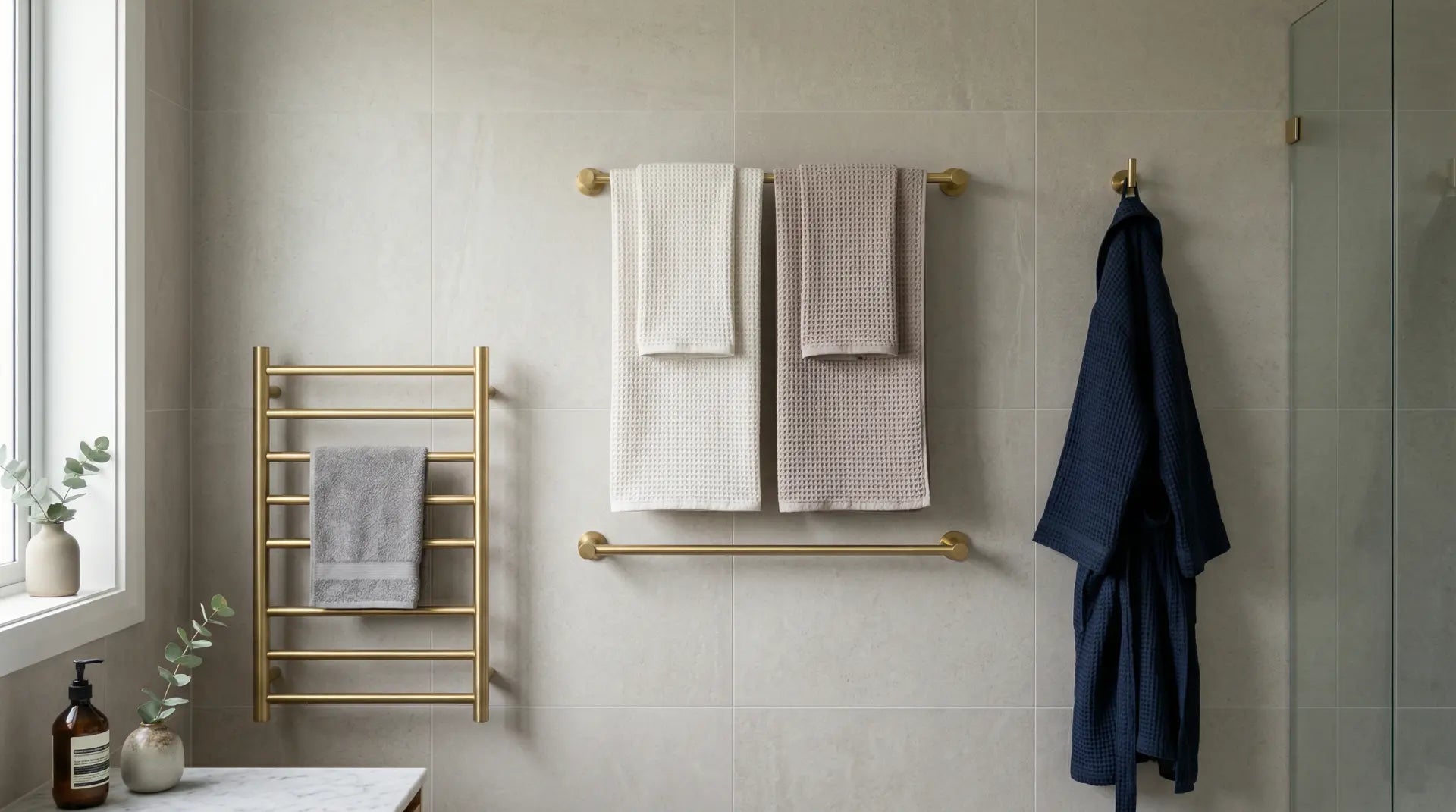
The towel bar is the most touched piece of hardware in your bathroom - and one of the most under-thought. This guide covers every towel accessory type, with exact mounting heights, finish-matching rules, and how to choose the right option for every space and use case.
Towel accessories are among the most frequently used fixtures in any bathroom - and among the most commonly installed incorrectly. A towel bar mounted two inches too low causes every towel to drag against the vanity or collect moisture from the floor. A hook where a bar should be means towels dry slowly and mildew between uses. And a chrome bar in a matte-black bathroom breaks the finish coordination that makes a bathroom feel designed rather than assembled.
This guide covers every category of towel accessory - bars, rings, hooks, and heated rails - with the specific heights, lengths, placement rules, and finish considerations that determine whether each piece works well in the space. Whether you're completing a new bathroom or upgrading one piece at a time, these are the numbers and decisions that matter.
The three most common towel accessory failures are easily preventable. Wrong mounting height (the bar is too close to the vanity, so towels bunch against the countertop). Wrong material (zinc alloy or thin chrome-plated steel corrodes within 2-3 years in bathroom humidity). Wrong type for the use case (a hook where a bar is needed means towels never fully open, stay damp, and develop mildew within days). This guide addresses all three - with the specific measurements, material specs, and type recommendations that prevent each issue before installation.
These are the industry-standard heights used by contractors, designers, and the National Kitchen and Bath Association (NKBA). They ensure towels are reachable without stretching, hang freely without touching the floor or countertop, and align visually with other bathroom fixtures. Use these as your starting point and adjust for your specific household height range and bathroom layout.
When mounting a towel bar above a vanity counter: the countertop typically sits at 32-36" from the floor. A bar at 48" gives only 12-16" of clearance above the counter - enough for a hand towel, but too low for a bath towel, which would bunch against the surface. For bath towel bars above a vanity, raise the bar to 52-54" from the floor. For bars above a toilet tank (which tops out at 30-32"), a minimum of 18" clearance between the tank and the bar prevents damp towels from absorbing moisture from the tank lid - placing the bar at 48-52" works for most toilet tank heights.
These are the six towel accessory types every well-equipped bathroom needs, ordered from most essential to the most impactful upgrade. Each one has a specific job - and choosing the wrong type for a use case causes the problems (slow drying, mildew, hard-to-reach placement) that make people assume towel accessories don't really matter.

The towel bar is the most important towel accessory in any bathroom because it's the only option that lets a bath towel hang fully open - maximizing the surface area exposed to air circulation and allowing the towel to dry properly between uses. A towel folded over a hook bunches at the fold, trapping moisture in the interior layers and creating the conditions for mildew and bacterial growth within 24-48 hours. For any towel used daily, a bar is the correct choice.
- Length: 24" minimum for a single standard bath towel (27" wide) folded once. For larger households or bath sheets (34-36" wide), choose a 30"-36" bar so the towel doesn't bunch on the returns
- Height: 48" from the finished floor to the center of the bar — this is the NKBA standard and ensures 18-20" of clearance below a folded bath towel. Adjust to 52"+ when mounting above a vanity countertop
- Placement: Within arm's reach of the shower or tub exit point. The goal is to reach the towel without stepping onto a cold floor or dripping across the room
- Double towel bars: Two parallel bars on the same brackets allow twice the hanging capacity in the same wall footprint - the front bar for daily use, the back bar for a second towel or spare. Ideal for couples sharing a bathroom
- Material is the most important spec: Solid brass core bars with PVD finish or 304 stainless steel last 15–25 years. Zinc alloy bars with thin chrome plating corrode, pit, and lose finish within 2-4 years regardless of price

The towel ring is the correct solution for a hand towel at the vanity - it takes minimal wall space, keeps the towel within arm's reach after handwashing, and reads as a designed, intentional detail rather than a provisional solution. A hand towel folded over a ring hangs in a looped position that dries acceptably for a towel used multiple times a day. The ring should be mounted on the wall adjacent to the sink (not directly above the faucet, where it would stay wet) at a height that's reached comfortably while standing at the basin.
- Height adjustment when above a protruding vanity: If the vanity countertop sits at 36", a ring at 44" gives only 8" of clearance - too little for a hand towel to hang freely. In this case, raise the ring to 50-54" or move it to an adjacent wall where there's no obstructing surface below
- Side-of-vanity mounting: When wall space beside the sink is tight, a ring mounted on the side panel of the vanity cabinet (using the same finish hardware) keeps it within reach and off a tile wall entirely
- Ring vs. small bar near sink: A ring suits a single hand towel in a single-use sink. A small 12"–18" bar next to the sink is better for a guest bathroom where a folded display towel is intended - it holds the towel flat and open, which is more presentable for guests
- Buy from the same collection as your faucet: Ring and faucet are in the same sightline. "Brushed nickel" from two different manufacturers can be visibly different shades - this is the most noticeable finish mismatch in any bathroom

Robe hooks serve a different function than towel bars - they hold robes, bags, and clothing temporarily, not for active drying. A hook on the back of the bathroom door is one of the highest-utility additions in any bathroom: it holds a bathrobe within reach of the shower, gives guests a place to hang their bag or clothing while using the bathroom, and clears the floor of items that would otherwise be deposited on the toilet lid or countertop. Double or triple robe hooks multiply this utility in a very small wall footprint.
- Back-of-door placement: Hooks on the back of the bathroom door are the most efficient use of space in any bathroom - the door surface is otherwise completely unused. Door-mounted hooks require no wall drilling and work in both rented and owned homes
- Height for family bathrooms: 70" works for adults; for shared family bathrooms, a second hook at 48-54" on the same wall serves children and shorter household members without requiring a full second installation
- Don't use hooks as primary towel drying: Hooks bunch towels at the fold, trapping moisture and significantly slowing drying time. This is fine for a bathrobe worn briefly and rehung, or a towel that's changing daily anyway - but for a bath towel used 2–3 times before washing, a bar is always preferable
- Double hooks maximize capacity without extra wall space: A double robe hook takes almost the same footprint as a single and holds two items - a robe and a towel, or two robes for a couple. In small bathrooms, always prefer double hooks over two singles
An over-door hook rack hangs over the top of any standard door and provides 4-8 hooks instantly, with no drilling, no wall anchors, and no damage to the door or wall. For renters, for immediate solutions before a renovation, and for family bathrooms where multiple people need multiple hang points, an over-door rack is often the fastest and most practical towel accessory upgrade available. Quality models use stainless steel hooks with rubber padding on the door-contact points to prevent scratching.
- Measure door thickness before purchasing - most over-door racks are designed for standard 1.375" doors; thicker doors (1.75"+) require racks with deeper hook channels
- Rubber or silicone padding on the door-contact points is non-negotiable - bare metal on a painted door surface causes finish damage within weeks
- Stainless steel or powder-coated steel hooks hold up in bathroom humidity; chrome-plated models corrode at the contact points within months
- Over-door racks work best on the back of the bathroom door - this keeps hooks within reach and completely out of the way when the door is open into the bathroom

Heated towel rails are consistently rated as the bathroom accessory purchase homeowners are most glad they made. The daily experience difference is immediate and tangible - stepping out of a warm shower into a pre-warmed towel is a qualitative shift that no other accessory delivers. But beyond comfort, a heated rail is also the most effective mildew-prevention tool for bath towels: a towel dried on a heated rail in 3-4 hours can be used 4-6 times before washing, versus 1-2 times for a cold-hook towel that takes 8-12 hours to dry. Fewer wash cycles means less detergent, less water, and towels that last years longer.
- Plug-in electric vs. hardwired: Plug-in models are the right choice for most homeowners - they work from any standard outlet, require no electrician, and can be repositioned if the bathroom layout changes. Hardwired models offer a cleaner look (no visible cord) but require an electrical rough-in and a licensed electrician for installation
- Hydronic models (water-heated): Connect to the home's hot water system for continuous heat without electricity - the most energy-efficient option for homes with a hydronic heating system already. Require plumber installation; not practical as a retrofit in most American homes
- Placement: Within arm's reach of the shower or tub exit point - the goal is to reach it before stepping onto the bath mat. Wall space beside the shower or between the shower and vanity is ideal
- Timer function: Set the rail to warm 20 minutes before your usual bathing time. Most quality plug-in models include a 15/30/60-minute auto-off timer - this eliminates any concern about forgetting to turn it off
- IP rating: IP44 is the minimum for bathroom zone 2 (within 60cm of the shower) - it means protection against water splashing from any direction. IP55 adds protection against water jets. Never install an unrated appliance in a bathroom wet zone
- Finish match: Heated towel rails are now available in every standard bathroom finish - chrome, matte black, brushed nickel, brushed gold. Match to your faucet and towel bar hardware for a cohesive hardware story
A freestanding towel rack stands on the floor and provides two to five bars of towel-hanging capacity without any wall contact. It's the correct solution for renters who can't drill walls, for bathrooms with limited or tiled walls where anchor placement is difficult, and for spaces where additional towel capacity is needed quickly without a renovation. Quality freestanding racks in stainless steel or black-powder-coated steel become a design element - particularly when placed beside a freestanding bathtub as a complementary floor-standing piece.
- Weighted base design is essential - a lightweight rack that tips when a wet towel is added is a fall hazard in a wet bathroom. Test for stability in the store or read weight specifications carefully for online orders
- 304 stainless steel or quality powder-coated finishes only - chrome-plated freestanding racks corrode at the base feet first, which is the point of constant floor contact and potential standing water exposure
- Bar spacing determines functionality: bars too close together prevent towels from hanging open and drying properly. Look for 4"+ of spacing between parallel bars on multi-bar racks
- Freestanding racks work particularly well beside a freestanding bathtub - they maintain the floor-level design language of a freestanding tub and provide towel access without requiring wall mounting near a potentially wet freestanding installation
The most common towel accessory mistake is using a hook where a bar is needed, or a ring where a bar is needed. Each accessory type has a specific use case it serves well - and specific cases where it fails. Use this table to decide the right type for every location in your bathroom.
| Accessory type | Best use case | Why it works here | Wrong use case | Why it fails there |
|---|---|---|---|---|
| Towel bar (24"–36") | Daily bath towel — shower or tub zone | Towel hangs fully open; maximum air exposure; dries fastest; looks designed | Small bathroom with no wall space | Requires 24"+ of clear wall; may conflict with door swing or other fixtures |
| Towel ring | Hand towel at the vanity sink | Takes minimal wall space; hand towels are short enough to dry in a loop; correct scale for a single hand towel | Full-size bath towel storage | A bath towel bunched through a ring never fully opens; dries slowly; looks untidy |
| Robe hook (single/double) | Bathrobe or pre-shower clothing; back of door | Robes are worn briefly then rehung; towels that change daily do fine on hooks; minimal wall footprint | Daily bath towel used 2-3 times before washing | Towel bunched at fold traps moisture; mildew develops within 24–48 hours in a folded wet towel |
| Over-door rack | Rental bathrooms; extra capacity; family bathrooms | No drilling; maximum hooks in one installation; back of door is wasted space otherwise | Primary daily bath towel in a permanent bathroom | Aesthetically casual; hooks don't dry towels as well as bars; fine for temporary or supplemental use |
| Heated towel rail | Primary bath towels in primary or guest bathroom | Warm towel every use; towels dry in 3-4 hours vs. 8-12; mildew eliminated; spa experience daily | Children's bathroom or high-humidity utility bathroom | Higher initial cost; overkill for rarely-used bathrooms; children's bathrooms may have safety considerations |
| Freestanding rack | Rental; additional capacity; beside a freestanding tub | No wall damage; moveable; provides multiple bars without permanent installation | Tight bathrooms where floor space is limited | Footprint takes floor space that may be needed for movement; risk of tipping in very tight layouts |
The single most impactful design rule for towel accessories: every metal finish in the same bathroom sightline must match. This means the towel bar, towel ring, robe hook, faucet, toilet paper holder, and shower hardware should all share the same finish - and ideally come from the same manufacturer's product line to guarantee finish calibration is identical.
Buy your complete hardware set from one manufacturer's collection in one finish. This is the most reliable way to guarantee finish consistency - because "brushed nickel" from Brand A and Brand B are rarely the same shade, undertone, or surface texture. Most major manufacturers (Moen, Delta, Kohler, Grohe, American Standard) offer coordinated 3-4 piece sets including towel bar, ring, robe hook, and toilet paper holder in matched finishes. Buying the set at once is also typically 15–25% less expensive than buying the pieces individually.
Towel accessories are in constant contact with a humid environment, damp towels, and cleaning products. Material choice determines whether a towel bar looks new after 15 years or corrodes, pits, and loses finish within 2-3 years. The core rule: solid brass or 304 stainless steel for anything structural; PVD finish over chrome plate wherever possible.
| Material | Typical lifespan | Finish durability | Verdict for towel bars |
|---|---|---|---|
| Solid brass | 20-30 years | PVD finish: 15–25 years; chrome plate: 8-12 years | Best choice - dense, corrosion-resistant, holds any finish quality |
| 304 stainless steel | 15-20+ years | Brushed stainless: indefinite; polished: shows scratches over time | Excellent for wet zones - lighter than brass, fully rust-proof |
| Zinc alloy (zamak) | 3-7 years | Chrome plate: 2-4 years before pitting or peeling | Acceptable for low-humidity zones; avoid near shower or tub |
| Hollow chrome-plated steel | 2-5 years | Chrome flakes or corrodes; particularly at bracket contact points | Avoid - the most commonly bought and most quickly regretted option |
| ABS plastic (some finishes) | 2-4 years | Yellows and degrades under UV and heat | Never appropriate for structural towel hardware |
| PVD coating (over any base) | 15-20+ years | 10× harder than chrome plate; scratch- and tarnish-resistant | Best finish option - worth paying premium, particularly for colored finishes |
- Towel bar (24"+ length): Mounted at 48" from the floor (bar center); within arm's reach of shower or tub exit; solid brass or 304 stainless core; PVD or quality chrome finish; stud-mounted or toggle anchors rated 40 lbs minimum
- Hand towel ring: Mounted at 42-44" from the floor; 4-6" to the side of the faucet (not directly above it); finish from the same manufacturer's collection as the faucet; hand towels only
- Robe hook (single or double): At 70-72" from the floor; on the back of the door or adjacent to the shower; double hook preferred for couples or family bathrooms; finish matched to all other hardware
- Finish consistency: All towel hardware from the same manufacturer's product collection in the same finish name - towel bar, ring, robe hook, and toilet paper holder as a coordinated set
- Material specification: Solid brass or 304 stainless core; PVD finish for maximum longevity; never zinc alloy or chrome-plated hollow steel for shower or tub zone accessories
- Heated towel rail (upgrade): Plug-in electric for flexibility; IP44+ safety rating; 200+ BTU output; stainless steel heating element; timer function for efficiency; within arm's reach of shower or tub exit
- Freestanding rack (if needed): 304 stainless or powder-coated steel; weighted base; 4"+ spacing between bars; positioned beside shower or tub, out of traffic path
- Double-check before drilling: Test placement with painter's tape; drape a towel at the intended height to confirm clearance from the floor, countertop, and adjacent fixtures; use a level on every piece
Shop Towel Accessories at Bathify
From coordinated towel bar sets and robe hooks to heated towel rails in every finish - Bathify has every towel accessory in this guide, matched to your faucet and hardware finish. Free shipping on orders over $50.


