







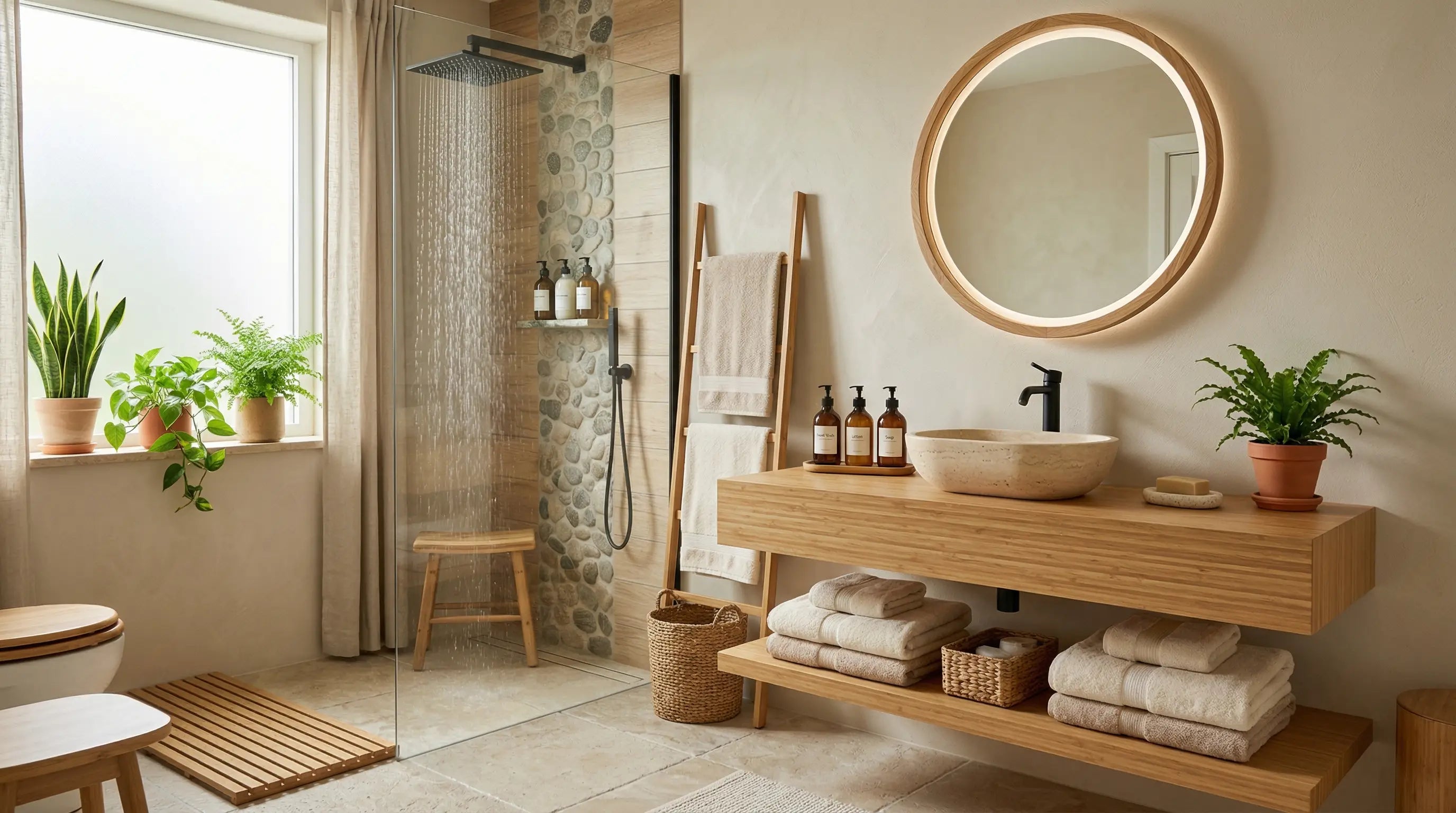
The bathroom is one of the most resource-intensive rooms in any home. Here are the products that reduce water, plastic, and energy use — without sacrificing quality, comfort, or aesthetics.
The bathroom is quietly one of the most resource-intensive rooms in any American home. It accounts for 17% of household water use, generates hundreds of single-use plastic containers per year through shampoo, conditioner, and personal care product packaging, and in most homes runs old, inefficient fixtures that waste water and energy every single day. The good news: the bathroom is also one of the easiest rooms to make meaningfully more sustainable - because a handful of hardware and product swaps address the majority of the environmental impact.
This guide covers the best eco-friendly bath products across every category - fixtures, accessories, materials, and consumables - with clear explanations of what each product actually saves and what certifications to look for. None of these swaps require compromising on quality or aesthetics. In fact, many of the most sustainable bath products available in 2026 are also the most premium-looking and longest-lasting.
According to the EPA, showers and faucets together account for nearly 40% of indoor home water use. The average American generates 220 kilograms of plastic waste per year - the highest per capita of any nation globally (OECD, 2019) - and a significant portion of that originates from bathroom product packaging. Meanwhile, the US plastic recycling rate has fallen to approximately 5% in 2026, meaning 95% of bathroom plastic packaging is headed to landfill. Bathroom-specific swaps - WaterSense fixtures, refillable dispensers, bamboo accessories - address all three environmental impact categories simultaneously.
Eco-friendly bathroom products address three distinct environmental categories. Understanding which category each product targets helps you prioritize where your spending delivers the most actual impact.
These products are organized by environmental impact category - water savings first (biggest impact), plastic reduction second, then materials and energy. Every product on this list is available today, performs comparably to or better than conventional alternatives, and delivers measurable environmental benefits.
Water-efficient bathroom fixtures offer the highest environmental return per dollar of any eco-friendly upgrade available. They also reduce your water bill and - because most hot water comes from fossil-fuel heating - reduce your home's carbon output simultaneously.

WaterSense is the EPA's voluntary certification program for water-efficient plumbing fixtures. A WaterSense-labeled shower head uses a maximum of 2.0 gallons per minute - compared to 2.5 GPM for the federal standard and 5+ GPM for pre-1990 fixtures. The EPA's own data confirms that replacing a standard shower head with a WaterSense model saves more than 2,700 gallons of water per household per year, and reduces water heating energy costs by an average of $70 annually.
- Look specifically for the WaterSense label - not just "water-saving" marketing language. WaterSense requires independent third-party testing; generic "eco mode" claims do not
- Modern WaterSense heads use air-infusion technology to maintain perceived pressure at lower flow rates - in blind tests, most users cannot distinguish 2.0 GPM WaterSense from 2.5 GPM standard
- If you live in California, Colorado, or New York City: local regulations already require 2.0 GPM or below - WaterSense compliance is mandatory in these states
- Silicone nozzles are the most sustainable material for the spray face — they resist hard water deposits, last longer, and can be cleaned by hand without chemicals

Bathroom faucets account for roughly 19% of indoor home water use - second only to toilets. A standard faucet runs at 2.2 GPM; a WaterSense-certified faucet runs at 1.5 GPM or less. The EPA estimates that replacing standard faucets and aerators with WaterSense models saves the average household $250 in water and electricity costs over the fixtures' lifetime. For the quickest and cheapest upgrade: add a WaterSense-certified aerator to your existing faucet. It screws onto the faucet tip in minutes and immediately reduces flow without replacing the faucet itself.
- If your existing faucet is in good condition: an aerator swap is the most sustainable option - it extends the life of the existing fixture rather than adding to landfill
- WaterSense faucets are now available in every finish category (matte black, brushed nickel, brushed gold, chrome) - no aesthetic compromise required
- Thermostatic faucets reduce water waste from "wait for warm water" behavior - one of the most wasteful but easily solved bathroom habits
- For bathroom sink faucets: choose solid brass construction for longevity - a well-made brass faucet lasts 20+ years, which is itself a significant sustainability benefit versus replacing cheap zinc faucets every 5 years

A bath uses 35–50 gallons of water on average - comparable to a 15–20 minute shower at standard flow rates. The efficiency comparison between bathing and showering depends heavily on shower duration and flow rate. What matters most for tub sustainability: an efficient tub filler (6+ GPM fill rate minimizes cold-water run time before filling), a well-insulated tub body (stone resin retains heat up to 30% longer than acrylic, reducing the need to top up with hot water), and a deep-soak overflow cover that allows a full, deep soak without refilling.
- Stone resin tubs retain heat significantly longer than acrylic - reducing the need to add hot water mid-soak, which is one of the biggest water waste behaviors in tub use
- A thermostatic tub filler eliminates the "run cold water until warm" waste - it delivers set temperature from the first second, saving 1–3 gallons every bath
- A deep-soak overflow cover allows the tub to fill 2–3 inches deeper, enabling a genuinely immersive soak with the same amount of water as a shallow fill to overflow level
- Acrylic tubs - which make up 52% of the market - are increasingly available in recycled or partially recycled resin formulations, reducing the virgin plastic content significantly
Plastic packaging from personal care products is the bathroom's most significant waste stream - and the easiest to eliminate. These accessory swaps remove the need for disposable plastic containers without changing your daily routine.

A set of refillable dispensers for liquid soap, shampoo, conditioner, and body wash eliminates 10-15 single-use plastic bottles per person per year - 40-60 bottles for a family of four. This is one of the most impactful plastic-reduction swaps available in any room of the home, and it happens to also be one of the best countertop upgrades you can make aesthetically. A matched set of ceramic or stainless steel dispensers replaces a collection of mismatched branded bottles that visual designers consistently cite as the most common source of bathroom clutter.
- Ceramic and stainless steel bodies are indefinitely reusable - the pump mechanism is the only component that wears, and a metal pump head lasts 5–10 years
- Wide-mouth refill openings eliminate spilling and frustration - narrow-neck dispensers that require a funnel discourage regular refilling
- Concentrate refill pods (available from many sustainable personal care brands) reduce shipping weight and packaging volume by 80-90% versus standard product bottles
- Buy as a complete matched set for both the aesthetic and environmental benefit - coordinated dispensers eliminate the need for branded plastic bottles on the counter entirely

The most common shower caddy is an ABS plastic or chrome-plated steel model that corrodes, discolors, or breaks within 18–24 months of shower humidity exposure. Replacing it every two years for a household lifetime of 30 years produces 15+ discarded caddies in landfill. A quality aluminium or 304 stainless steel caddy lasts 15–20+ years in the same environment - which means one purchase for the lifetime of the bathroom. This is the sustainability principle of "buy once, buy right" applied directly: the most eco-friendly product is often the most durable one.
- Aluminium is the most sustainable choice for shower caddies - it is infinitely recyclable, naturally corrosion-resistant, and far lighter than stainless steel
- 304 stainless steel (not 201 or 202 grade) is the alternative to aluminium - look for "304 grade" or "18/8 stainless" in the product specifications
- Slotted or wire shelving bases are essential - they allow water to drain freely rather than pooling, which extends the caddy's life and prevents mold
- When a caddy reaches end of life: aluminium is one of the most efficiently recycled materials - it can be curbside recycled in most US municipalities
These products replace conventional materials (plastic, chrome-plated zinc, synthetic rubber) with renewable, biodegradable, or indefinitely durable alternatives - without any functional compromise.

Bamboo is technically a grass, not a wood - it grows to harvest size in 3–5 years versus 20–60 years for hardwood, requires no pesticides or artificial irrigation in most growing environments, and sequesters carbon at a higher rate than equivalent timber. In bathroom applications - bath trays, soap dishes, counter organizers, towel rings - bamboo performs comparably to hardwood at lower cost and with a fraction of the environmental footprint. Kiln-dried and properly sealed bamboo is also naturally antimicrobial, which is a genuine functional benefit in a humid bathroom environment.
- FSC-certified bamboo ensures the product comes from responsibly managed sources - look for the FSC logo on packaging or product listing
- Kiln-dried bamboo is more dimensionally stable than air-dried - it's less likely to warp or crack in bathroom humidity when properly sealed
- Avoid bamboo products with heavy lacquer or plastic coating - they compromise biodegradability at end of life and can contain VOCs
- Apply food-safe mineral oil or bamboo oil once or twice a year to extend product life significantly and maintain the natural finish

Conventional cotton is one of the most pesticide-intensive crops in the world - it uses approximately 6% of all agricultural pesticides globally despite occupying only 2.5% of cropland. GOTS-certified organic cotton uses no synthetic pesticides or fertilizers, 88% less water in cultivation, and 62% less energy to produce. For bath towels - which are in direct daily contact with skin for the lifetime of the product - the difference between certified organic and conventional is both environmental and personal health-relevant. GOTS-certified towels also maintain softness through significantly more wash cycles than conventional cotton equivalents.
- GOTS certification is the gold standard - it covers the entire supply chain from farm to finished textile, not just the raw material
- OEKO-TEX Standard 100 is a valid alternative - it certifies that the finished product is free from harmful chemicals, even if the cotton isn't certified organic at source
- Turkish cotton (Aegean long-staple cotton) is naturally more durable and quick-drying than standard short-staple cotton - it gets softer with each wash rather than harder
- Wash at 60°C (140°F) for the first 2–3 washes to set the fibers, then 40°C - hot washing repeatedly shortens towel lifespan and increases energy use

Most standard bath mats are made from PVC (polyvinyl chloride) - one of the most environmentally problematic plastics in production and disposal. PVC manufacturing produces dioxin, a persistent toxic compound, and PVC products release plasticizers (phthalates) into warm water during use. For a product that sits in your bath or shower floor and contacts skin daily, the chemistry of the material matters beyond just aesthetics. TPE (thermoplastic elastomer) and natural rubber are functional equivalents to PVC that avoid these production and use-phase chemical concerns, and are more readily recyclable at end of life.
- Look for "PVC-free," "TPE," or "natural rubber" in the product specifications - marketing terms like "eco mat" or "green mat" mean nothing without material specification
- OEKO-TEX Standard 100 certified bath mats guarantee no harmful chemical content regardless of base material
- Teak wood bath mats are the premium zero-chemistry option - no rubber backing, no suction cups, and no synthetic materials at all. They require drying after each use but last 10–20+ years
- At end of life: TPE can be recycled through specialty rubber/plastic programs; natural rubber is biodegradable; teak is compostable or can be repurposed

Most bathrooms still use incandescent or halogen lighting for vanity illumination - fixtures that convert only 5-10% of electrical energy to visible light, wasting the rest as heat. Replacing bathroom lighting with LED reduces energy consumption by up to 75% and produces better quality light in the process. An LED mirror with built-in front or backlight provides CRI 90+ illumination at the vanity - the most important grooming surface in the home - while using a fraction of the electricity of separate incandescent vanity bulbs. LED bulbs also last 15,000–25,000 hours versus 1,000-2,000 hours for incandescent, which dramatically reduces both replacement frequency and waste.
- ENERGY STAR certified LED mirrors use at least 75% less energy than incandescent equivalents and are independently verified for performance claims
- Dimmable LED mirrors allow you to reduce brightness to 20–30% for low-demand tasks like evening bathing - this cuts energy use proportionally and extends LED lifespan
- Anti-fog heated glass eliminates the need to run extra hot water or waste time waiting for steam to clear - an indirect water and energy saving
- At end of life: LED components should be taken to an electronics recycling facility - they contain small amounts of materials that are valuable to recover and should not go to landfill
Greenwashing is rampant in the bathroom product category. "Natural," "eco-friendly," and "sustainable" are unregulated marketing terms that any brand can use without verification. These certifications are third-party verified and mean something specific.
Terms like "natural," "eco-friendly," "green," "sustainable," and "biodegradable" are not regulated and require no verification. Any brand can print them on any product. Always look for a named third-party certification (WaterSense, GOTS, FSC, OEKO-TEX, ENERGY STAR) before treating an environmental claim as meaningful. If a product's sustainability claims don't reference a specific certification, treat them as marketing language only.
| Current product | Sustainable swap | Difficulty | Impact | Annual saving |
|---|---|---|---|---|
| Single-use plastic pump bottles | Ceramic or SS refillable dispensers | Easy | Plastic: High | 10–15 bottles/person/yr |
| Plastic or chrome-plated shower caddy | Aluminium or 304 SS caddy | Easy | Material: High | 1 caddy every 15–20 yrs vs every 2 |
| PVC bath mat | TPE, natural rubber, or teak mat | Easy | Chemical: Medium | Reduced chemical exposure daily |
| Incandescent/halogen vanity lighting | LED mirror or LED vanity bulbs | Easy–Medium | Energy: High | $40–80/yr in electricity |
| Standard shower head (2.5 GPM) | WaterSense certified (2.0 GPM) | Easy (15 min) | Water: Very High | 2,700 gal + $70/yr |
| Conventional cotton towels | GOTS organic or OEKO-TEX certified | Easy (at next purchase) | Chemical + water: Medium | 88% less water in production |
| Plastic/lacquered wood accessories | FSC-certified bamboo accessories | Easy | Material: Medium | Biodegradable end-of-life |
| Standard sink faucet (2.2 GPM) | WaterSense faucet or aerator (1.5 GPM) | Medium (DIY or plumber) | Water: Medium-High | $250 over faucet lifetime (EPA) |
- Water — shower: WaterSense certified shower head (2.0 GPM or less, EPA label). Replaces 2,700+ gallons and $70/year
- Water — faucet: WaterSense faucet or aerator (1.5 GPM). Quick aerator swap available for under $10
- Plastic — dispensers: Ceramic or stainless refillable dispenser set for soap, shampoo, conditioner, body wash. Metal pump heads only
- Material — caddy: Aluminium or 304 stainless steel shower caddy with slotted base. One purchase for 15–20 years
- Material — bath mat: TPE, natural rubber, or teak bath mat. Certified PVC-free for tub floor use
- Material — accessories: FSC-certified bamboo for bath tray, soap dish, and countertop organizers
- Textiles — towels: GOTS-certified organic or OEKO-TEX Standard 100 cotton. Turkish long-staple cotton is the performance-plus-sustainability choice
- Energy — lighting: LED mirror (CRI 90+, ENERGY STAR eligible, adjustable color temperature). Replaces incandescent vanity lighting
- Bathing — tub: Stone resin tub for heat retention (less hot water top-up) and thermostatic tub filler (no cold water waste)
Shop Sustainable Bath Products at Bathify
From WaterSense-certified shower systems to refillable dispensers and LED mirrors - every eco-friendly upgrade in this guide is available at Bathify. Free shipping on orders over $50, USA-wide.


