







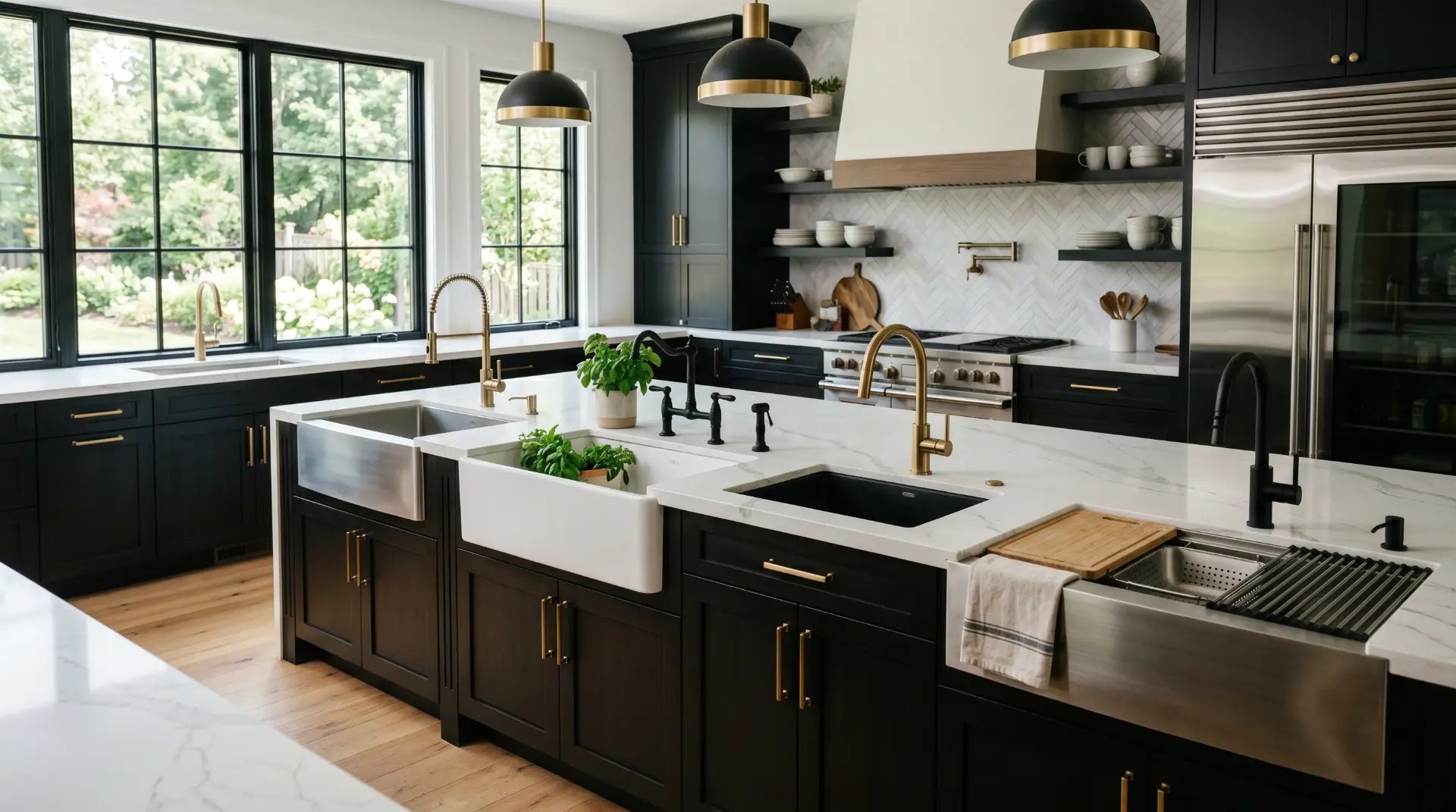
Every kitchen sink on this list was evaluated on six objective criteria - material grade, basin depth, gauge (stainless), noise management, installation compatibility, and daily-use maintenance. Eight picks, zero sponsored placements. Ranked by the use case each sink actually wins.
Most "best kitchen sinks" lists rank by Amazon review count or affiliate payout. This one does neither. We evaluated every sink below on the specifications that determine whether it performs well in three years - not just unboxing day. A kitchen sink in a busy American household absorbs roughly 8 to 12 uses per day. Over a ten-year lifespan that's 40,000 uses before performance degradation, denting, or finish failure becomes visible. The right sink at year one and year ten is the same sink. That's the standard we ranked against.
Each pick below is assigned to the use case it genuinely wins - not "best overall" applied to everything. If your kitchen fits the use case, the pick is yours. Every sink listed ships free to the continental US from Bathify.
Every sink spec in this guide assumes you know your base cabinet interior width and your countertop material. A standard American base cabinet is 36 inches wide with an interior of 34 to 35 inches - your sink body must be at least 2 inches narrower than the interior on each side. Farmhouse sinks require cabinet modification. Undermount sinks require stone or solid-surface countertops. These aren't optional - they're the structural constraints that determine whether any sink on this list actually works in your kitchen. Our complete Kitchen Sink Buying Guide covers every measurement in detail.
Every sink was scored on the six specifications that govern real-world performance over a 10-year residential lifespan. Brand recognition and price-point positioning were not criteria. A $350 16-gauge stainless sink that scores well on all six outranks a $700 name-brand sink that scores poorly on gauge disclosure or noise dampening.

The 16-gauge stainless steel undermount single bowl earns the top ranking on this list for the same reason it dominates professional kitchen installations and the vast majority of properly specified American kitchen renovations: it is the format that gets every fundamental right simultaneously. Sixteen-gauge steel - 1.5mm thickness - is rigid enough to resist denting from heavy cast iron cookware, solid enough to feel substantial underhand, and stiff enough that the basin doesn't flex when you apply pressure to the walls or floor during scrubbing. Eighteen-gauge steel, which accounts for the majority of stainless sinks sold at box retailers under $200, flexes perceptibly and dents at impact points within one to two years of daily heavy use.
The 9 to 10-inch basin depth is the specification that separates functional from inadequate in a primary kitchen sink. A full-size sheet pan lays flat in a 10-inch basin. A 16-quart stockpot fits upright under the faucet arc without tilting. Produce rinsing, pot soaking, and basin cleaning all happen without the user compensating for insufficient depth. Below 8 inches, every large-item task requires awkward maneuvering that the kitchen layout wasn't designed for. The undermount installation - against a stone or quartz countertop - delivers the cleanest possible surface transition: no rim, no debris catch point, and the ability to sweep crumbs directly from counter into sink with one motion.
Sound dampening on quality 16-gauge sinks combines two systems: a spray-on undercoating that covers 70 to 80% of the exterior basin surface, and rubber isolation pads at the four mounting points. Together, these reduce the impact noise - the hollow metallic ring when a spoon or pot drops into the basin - by 40 to 60% compared to an undampened sink of the same gauge. For the spec-conscious buyer: both dampening systems should be present. A sink with only pads and no undercoating, or only undercoating and no pads, is delivering partial performance.
Shop Undermount Kitchen Sinks at Bathify →
The fireclay farmhouse sink is the kitchen fixture with the clearest gap between what it looks like in a photograph and what it delivers in daily use. The photograph captures the visual: a wide, bright white basin with a clean apron front that transforms the kitchen's focal point. What the photograph doesn't show - but daily use confirms - is that the 9 to 10-inch basin depth of a typical 33-inch farmhouse sink accommodates large-item kitchen tasks with a comfort and ease that a standard 8-inch undermount simply doesn't match. The deep basin creates room to fill a full stockpot without tilting it, to wash an oversized roasting pan without water spraying over the rim, and to stack dishes for soaking without the pile immediately reaching above the waterline.
Fireclay's vitreous enamel glaze - produced by firing ceramic clay at 1,800°F or above - is the surface hardness that no other kitchen sink material replicates. It is non-porous, which means it doesn't harbor bacteria in surface micro-cracks the way cast iron enamel eventually does. It resists staining from coffee, wine, and acidic food at a level that stainless and granite composite match only with perfect maintenance and prompt rinsing. And unlike cast iron enamel, fireclay glaze doesn't yellow over time - the white finish on a fireclay sink at year fifteen is visually identical to year one. For households where the kitchen sink is a permanent design element rather than a replaceable commodity, fireclay is the correct material specification.
The weight - 100 to 180 lbs depending on size - is the specification that requires planning, not an inconvenience to overlook. Every fireclay farmhouse installation requires cabinet reinforcement and front rail modification before the sink arrives. Attempting to install a 150-lb fireclay sink into a standard unmodified base cabinet results in cabinet failure, countertop cracking, or both. Budget $200 to $500 for cabinet modification labor in addition to the sink purchase. This is not optional and it is not something that can be corrected after installation.
Shop Farmhouse Sinks at Bathify →
Granite composite is the sink material that has made the most ground against stainless steel in American kitchen renovations since 2021, and the reason is visible from across the room: a matte black granite composite sink against white quartz countertops with matte black faucet hardware is the design combination that defines contemporary American kitchen aesthetics in the first half of this decade. No other sink material delivers that visual with comparable durability at the same price point.
Eighty percent granite powder bound with acrylic resin produces a material that is harder and more scratch-resistant than stainless steel, handles heat up to 536°F without cracking or discoloration - so a pot from the stove goes directly into the basin without a trivet - and generates none of the impact noise that stainless requires dampening pads to address. It is naturally quiet. It is naturally heat-resistant. And in dark finishes - black and charcoal - it is the most forgiving surface finish of any kitchen sink material: water spots, minor food residue, and light surface marks are visually absorbed by the dark matte surface in a way that no light-colored or reflective material can manage.
The one maintenance nuance worth stating clearly: granite composite sinks in white and light gray are substantially higher maintenance than their dark-finish equivalents. Hard water mineral deposits - the white chalky buildup around the drain that forms in areas with high calcium content in municipal water - are nearly invisible on a black or charcoal surface and starkly visible on white. If your water is hard and you want granite composite, specify dark. The visual logic reinforces the maintenance logic perfectly.
Shop Granite Composite Sinks at Bathify →
The workstation sink is the most significant functional upgrade in the American kitchen sink market since the farmhouse sink became mainstream. The defining feature is the integrated ledge system - a built-in rail along the basin perimeter that accepts a set of sliding accessories: a sink-width cutting board, a perforated colander, a wire drying rack, and in some configurations a flat cover plate that turns the entire basin into a prep surface. The result is a sink that functions as an extension of the countertop during prep - you prep on the cutting board directly above the basin, slide it aside, rinse into the basin below, drain in the rack to the side, all without repositioning anything off the sink perimeter.
The flat basin floor - as opposed to the sloped floor used in standard undermount sinks - maximizes the working space available. Every square inch of the basin floor is level and usable. The combination of flat floor, 9 to 10-inch depth, and full-width ledge means the workstation sink accommodates more simultaneous tasks than any other sink format. For households that cook seriously - prepping multiple ingredients, using the sink as a landing zone for produce, herbs, and rinsed items during active cooking - the workstation format changes the kitchen workflow in a way that is immediately apparent on first use and impossible to go back from.
One critical purchase note: accessory compatibility in workstation sinks is brand-specific. The cutting board, colander, and drying rack are manufactured to the exact internal width of the specific sink model. Verify that the accessories you want are included in the purchase or separately available from the same manufacturer for the specific sink model you're ordering. Mixing accessories from different brands rarely works because the ledge rail dimensions and spacing vary between manufacturers.
Shop Workstation-Style Sinks at Bathify →
The double bowl recommendation comes with a prerequisite that most kitchen sink guides sidestep: the double bowl is the correct specification for households that hand-wash the majority of their dishes regularly, without a dishwasher as the primary dish-cleaning mechanism. For households with a dishwasher in daily use, the split bowl's only functional advantage - separating washing from rinsing - disappears, and the center divider becomes a obstacle that prevents large items from lying flat in the basin. For dishwasher households, a single bowl is the correct choice. This recommendation is for the rest.
Among double bowl configurations, the 60/40 offset split is substantially more practical than the equal 50/50 split. In a 33-inch double bowl with equal split, each bowl is approximately 14 to 15 inches wide - neither wide enough to comfortably wash a large pot nor small enough to feel intentionally sized for a secondary task. The 60/40 split gives a larger bowl of approximately 18 to 20 inches - wide enough to wash a full-size Dutch oven - and a smaller bowl of approximately 11 to 12 inches that serves cleanly as a dedicated rinse station, a space for a dish rack, or a produce preparation area. The 60/40 split is simply more useful than the 50/50 because it acknowledges that the two bowls serve two different functions rather than pretending they're interchangeable.
Shop Double Bowl Sinks at Bathify →
The compact kitchen sink is the category most often treated as the lesser version of a standard-size sink - a compromise you make when you can't fit a 33-inch bowl. The framing is wrong. A well-specified 25 to 30-inch single bowl undermount in 16-gauge stainless with a 9-inch basin depth is not a compromised sink. It is the correctly proportioned sink for a kitchen where the base cabinet is 30 to 33 inches wide. Installing an oversized sink into an undersized cabinet sacrifices counter space on both sides of the basin, creates structural clearance issues with the mounting clips, and produces a visually awkward proportion where the basin occupies the entire visible counter width with no breathing room.
The 9-inch basin depth specification matters in compact sinks for the same reason it matters in standard sinks: a 30-inch wide basin with only a 7-inch depth is shallow enough that filling a tall pot under a standard pull-down arc produces regular splash. A 9-inch depth keeps water confined where it belongs. The tight-radius corner specification - right-angle or near-right-angle interior corners rather than rounded corners - maximizes the usable basin floor area in a compact footprint, giving you more working space per square inch of exterior sink dimension than a wide-radius alternative.
Shop Compact Undermount Sinks at Bathify →
The top-mount drop-in sink is the correct specification for any kitchen with a laminate countertop - which accounts for a substantial share of American kitchens, particularly in rentals, starter homes, and homes where the last renovation preceded the shift to stone countertops. Laminate cannot support an undermount installation: the exposed particle board at the cutout edge absorbs moisture and fails under the combination of water and sink weight. A top-mount sink solves this by carrying its own weight through the rim that sits on the counter surface, with the laminate never exposed to standing water at the cutout edge.
The material and gauge specifications don't change with mount type. A quality top-mount sink should still be 16-gauge stainless, still have a 9-inch basin depth, and still have full spray-on undercoating with rubber isolation pads. The only functional tradeoff versus undermount is the visible rim - a ledge at the perimeter where debris, water, and soap residue accumulate and require regular wiping. The silicone seal between rim and countertop requires inspection annually and replacement every 3 to 5 years. These are real maintenance considerations, not deal-breakers, and they are the honest price of the installation simplicity and countertop compatibility that a drop-in provides.
Shop Top-Mount Kitchen Sinks at Bathify →
The honest assessment of the under-$250 kitchen sink market: 16-gauge stainless in a quality undermount configuration is not available at this price point. What is available is 18-gauge stainless - thinner, more prone to visible denting after 12 to 18 months of heavy daily use, louder without adequate dampening - that is entirely acceptable for the use cases it serves: rental properties, secondary prep sinks in large kitchens, guest house kitchens, and any kitchen where the sink sees light-to-moderate daily use without heavy cookware impact.
The specifications to confirm at this price point are the same as at any price, just with different expected outcomes. Gauge should be stated explicitly as 18 - not "heavy gauge" or "commercial grade." Sound dampening should be present in some form, even if only rubber pads rather than full undercoating. Basin depth should be at minimum 8 inches - under this threshold, a budget sink compounds its durability limitations with a shallow basin that splashes. And the drain should be centered or rear-positioned - not front-positioned, which creates plumbing clearance issues in standard base cabinets.
| Pick | Material | Mount | Basin Depth | Price | Best For | Shop |
|---|---|---|---|---|---|---|
| #1 - 16-ga Stainless Undermount | 16-gauge stainless | Undermount | 9-10" | $350-550 | Most kitchens - the universal winner | Shop → |
| #2 - Fireclay Farmhouse | Fireclay | Apron-front | 9-10" | $500-900 | Design-forward kitchens, deep basin users | Shop → |
| #3 - Granite Composite | Granite composite | Undermount / top-mount | 9-10" | $300-600 | Dark hardware kitchens, heat-intensive use | Shop → |
| #4 - Workstation Stainless | 16-gauge stainless | Undermount | 9-10" flat floor | $600-1,000 | Serious cooking kitchens, integrated prep | Shop → |
| #5 - 60/40 Double Bowl | 16-gauge stainless | Undermount | 9" (large bowl) | $350-550 | Hand-wash households, no dishwasher | Shop → |
| #6 - Compact 25-30" Undermount | 16-gauge stainless | Undermount | 9" | $280-450 | Galley kitchens, smaller homes, 30-33" cabinets | Shop → |
| #7 - Top-Mount Drop-In | 16-gauge stainless | Top-mount | 9" | $250-450 | Laminate countertops, DIY replacements | Shop → |
| #8 - Budget Under $250 | 18-gauge stainless | Either | 8-9" | Under $250 | Rentals, secondary sinks, light-use kitchens | Shop → |
The product listing for any kitchen sink should answer six questions before you add it to cart. If any of these six is missing or vague, treat it as a quality flag and verify with the seller before purchasing.
| Spec to Check | What Good Looks Like | Red Flag Wording | Why It Matters |
|---|---|---|---|
| Gauge (stainless) | "16-gauge" stated explicitly | "Heavy gauge," "commercial grade," gauge not stated | 16-gauge resists denting; 18-gauge dents under daily heavy use |
| Basin depth | 9" or deeper for primary kitchens | "Deep basin" without a number; anything under 8" | Under 8" splash is uncontrolled for most faucet heights |
| Sound dampening | Spray-on undercoating + rubber pads both listed | "Sound-deadening pads" only (no undercoating) | Both systems together reduce impact noise 40-60%; pads alone is partial |
| Mount type | Stated as undermount, top-mount, or apron-front with countertop requirements | "Dual mount" without installation notes on countertop requirements | Mount type determines whether the sink is compatible with your countertop |
| Body dimensions vs. basin dimensions | Both stated - e.g. "33" overall, 31.5" basin interior" | Single measurement that could mean either overall or interior | Basin interior determines cabinet cutout size and what fits in the sink |
| Warranty | Lifetime or 10+ year - explicitly stated | "Limited warranty" without duration; under 5 years | Warranty duration is the manufacturer's confidence signal in the product's lifespan |
The single fastest way to separate quality kitchen sinks from marketing-dressed budget sinks: look for gauge disclosure, basin depth in inches, and warranty duration - all stated as explicit numbers. A listing that provides all three as hard numbers is demonstrating specification confidence. A listing that provides none as explicit numbers - using only "heavy duty," "deep basin," and "limited warranty" - is hiding behind vague language because the specific numbers don't support the price point being asked. This applies across stainless steel at every price tier from $150 to $900. The numbers either show up or they don't.
For most American primary kitchens: 16-gauge stainless undermount, single bowl, 9-10" basin, with full sound dampening. For design-first renovations: fireclay farmhouse.
The 16-gauge stainless steel undermount single bowl at $350 to $550 covers the needs of the majority of American primary kitchens - it is durable enough to absorb 10+ years of daily heavy use without denting, deep enough for large-item tasks, clean enough visually against any countertop material, and available in enough size variations to fit virtually any base cabinet configuration. It is the default correct answer.
For the kitchen where the sink is the design centerpiece - an open-plan layout where the sink is visible from the living space, a renovation where the fireclay farmhouse sink is the feature that signals the entire renovation's intent - the fireclay farmhouse is the correct upgrade. The cabinet modification cost and weight planning are real, but they are one-time requirements for a sink that will look identical at year fifteen as it did on installation day.
The granite composite earns its place in any kitchen where the color and finish are driving the decision - particularly matte black or charcoal in contemporary kitchens with dark hardware. The workstation earns its place in any kitchen where the cook is serious enough to use a prep station actively. Don't buy either if the reason is appearance alone - both demand daily use of their defining features to justify the price premium over the standard 16-gauge undermount.
Shop kitchen sinks at Bathify - free shipping across the USA
Browse farmhouse, undermount, granite composite, and top-mount kitchen sinks - all with free shipping on orders over $50 to the continental US.


