







1-Piece vs 2-Piece Toilet: Real Differences Explained
The choice between a one-piece and two-piece toilet affects your cleaning routine, your installation budget, your long-term repair costs, and how the bathroom looks. This guide cuts through the marketing to explain what actually differs - and which type is right for your bathroom in 2026.
Most toilet buying guides spend half their word count on GPF ratings and bowl shapes, then leave the 1-piece vs 2-piece question as a single bullet point: "1-piece is easier to clean; 2-piece is cheaper." That's accurate but useless if you're deciding between a TOTO Supreme II and a TOTO Drake II - two excellent toilets that look roughly similar in product photos and flush essentially the same way, but involve meaningfully different cleaning routines, different installation considerations, and different long-term cost profiles.
This guide covers the real differences - not the theoretical ones. It uses actual products sold at Bathify to give you US price context, and it explains the practical outcomes of each choice: what happens on a Tuesday morning when you clean the bathroom, what happens three years in when a seal starts to fail, and what happens when you try to sell a home with a toilet that a buyer perceives as outdated.
Answer these before comparing products: (1) What is your cleaning tolerance - do you clean the bathroom weekly, or will the toilet go two to three weeks between cleanings? If the latter, the tank-to-bowl gap on a 2-piece toilet will collect mold and scale in ways that become genuinely difficult to address. (2) What is your budget ceiling, including installation? If your total budget is under $400 including a plumber, a 2-piece is the more practical choice. If your budget is $600 or more and you're installing in a visible primary bathroom, the 1-piece case gets much stronger. Our Complete Toilet Buying Guide covers the broader purchase decision; this guide focuses entirely on the type comparison.
If cleaning matters more than cost, choose 1-piece. If cost matters more than cleaning, choose 2-piece. Both flush identically.
The 1-piece toilet wins on cleaning, aesthetics, and leak risk. The 2-piece toilet wins on upfront cost, shipping safety, and parts availability for repairs. Flush performance - GPF rating, bowl size, flush technology - is independent of whether the toilet is 1-piece or 2-piece. A TOTO Drake II 2-piece with Tornado Flush at 1.28 GPF flushes as effectively as a TOTO Supreme II 1-piece at the same GPF rating. The type decision affects everything except the flush.
For primary bathrooms that will be shown or sold: 1-piece. For secondary bathrooms or guest baths on tighter budgets: 2-piece with a quality tank-to-bowl seal. For any bathroom where Washlet+ integration is planned: confirm the toilet is Washlet+-ready regardless of type - both exist in Washlet+-compatible versions at Bathify.
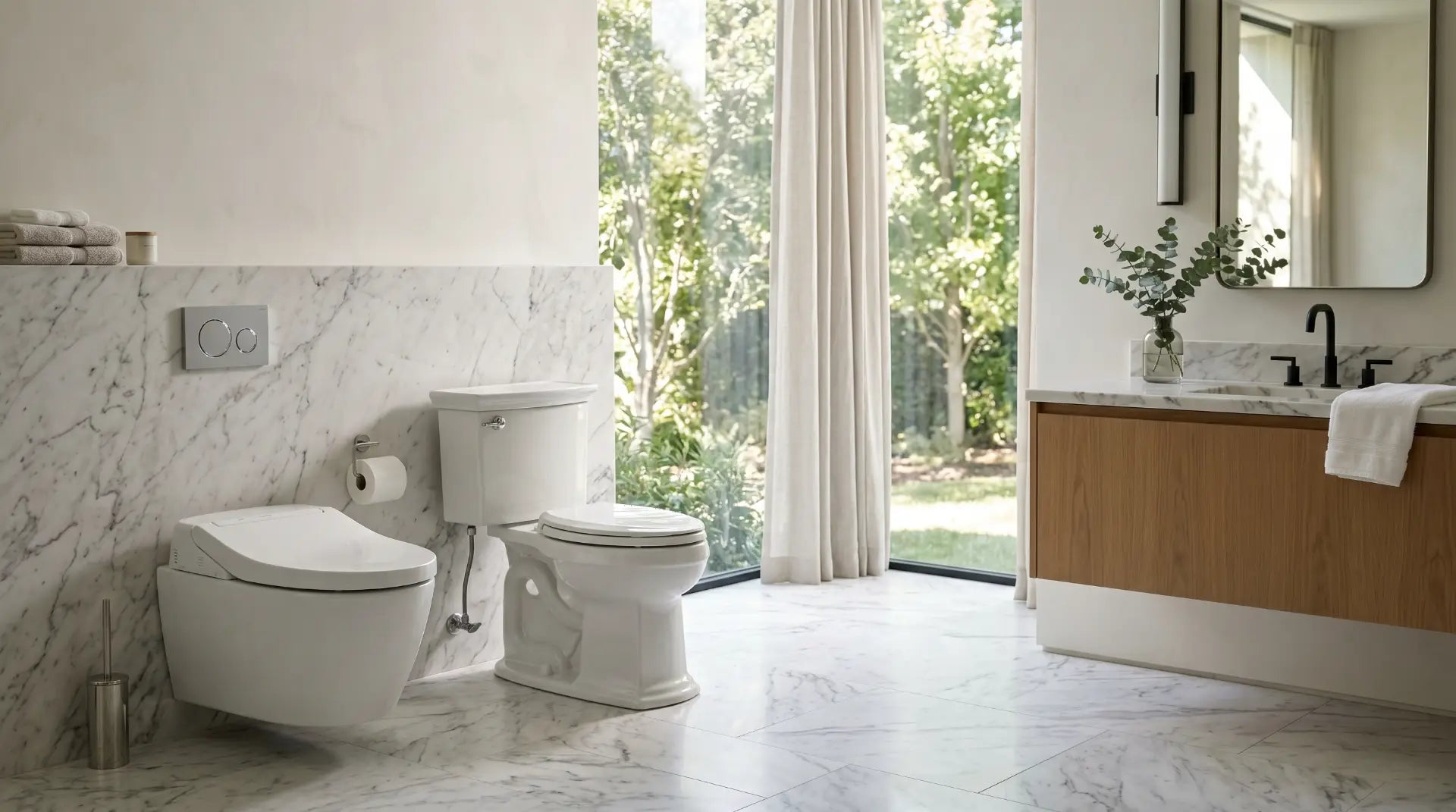
A 1-piece toilet is manufactured as a single kiln-fired ceramic unit - the tank and bowl are formed together and fired as one piece. They cannot be separated without breaking the toilet. The visual result is a smooth, uninterrupted profile from the back of the tank to the front of the bowl, with no seam, no gap, and no joint between them.
A 2-piece toilet has a tank and bowl manufactured separately. They are shipped in separate boxes, and during installation, the tank is placed on the bowl and secured with bolts through the tank base into the bowl collar. A rubber gasket creates a watertight seal between the two pieces at the water fill point. The visible result is a horizontal seam where the tank meets the bowl - that junction is both the visual dividing line and the mechanical connection point that requires maintenance over time.

At comparable quality tiers, 1-piece toilets cost $100 to $300 more than 2-piece equivalents. At Bathify, the TOTO Drake II 2-piece elongated toilet at 1.28 GPF retails around $725, while the TOTO Supreme II 1-piece at the same GPF rating and comparable features comes in at a higher price point. Both use Tornado Flush and CEFIONTECT - the price difference is the manufacturing cost of the single-unit ceramic body. Shipping a single large fragile piece intact is more complex and expensive than shipping a tank and bowl separately, which is another factor in the price gap.
Installation cost is roughly equivalent for most plumbers, though some charge a small premium for 1-piece toilets because of their weight - a typical 1-piece is 10 to 20 lbs heavier than its 2-piece equivalent, which affects maneuvering in tight bathrooms. In a standard bathroom with accessible rough-in, installation of either type by a licensed plumber in most US cities (Houston, Phoenix, Chicago, Atlanta, Seattle) runs $150 to $300 in labor, including wax ring and supply line.
Long-term cost is where the 2-piece can become more expensive in practice. The tank-to-bowl gasket and bolts are a failure point that the 1-piece eliminates entirely. A leaking tank-to-bowl seal on a 2-piece toilet costs $15 to $40 in parts and 30 minutes of repair time if you do it yourself - or $100 to $200 if you call a plumber. Most quality 2-piece toilets won't need this repair for 10+ years, but it is a cost the 1-piece never incurs. The 2-piece also requires periodic tightening of tank-to-bowl bolts to prevent wobble and micro-leaks.

This is the category where the 1-piece toilet has the clearest practical advantage. The seam between tank and bowl on a 2-piece toilet is one of the most difficult surfaces to clean in a bathroom - it is a horizontal crevice at the back of the toilet, typically around 2 to 3 inches deep and only accessible at awkward angles. Dust, hair, moisture, and hard water minerals accumulate in this gap constantly. In bathrooms with high humidity - any bathroom without strong ventilation - mold establishes itself in this crevice within months of installation and becomes progressively harder to remove as it colonizes the grout-like texture of the underside of the tank base.
A 1-piece toilet has no such gap. The smooth, uninterrupted curve from tank body to bowl base is wipeable in a single pass. Cleaning a quality 1-piece toilet with CEFIONTECT glaze (which TOTO applies to the Supreme II, UltraMax II, and Promenade II at Bathify) takes genuinely less time and effort than cleaning a 2-piece equivalent - not marginally less, but substantially less. In a primary bathroom cleaned weekly by a homeowner who cares about the result, the difference compounds meaningfully over the years.
The bowl cleaning experience is identical between the two types - flush technology and glaze quality determine that, not the type. CEFIONTECT's ultra-smooth ionic glaze minimizes waste adhesion in both 1-piece and 2-piece TOTO toilets. The difference is entirely in the external surfaces.

2-piece toilets have a meaningful shipping and installation advantage. Because the tank and bowl ship in separate boxes, the risk of transit damage to either piece is significantly lower - a cracked tank doesn't ruin the bowl, and vice versa. 1-piece toilets ship as a single large box; a crack in any part of the unit requires returning and replacing the entire toilet. At Bathify, toilet orders over $50 ship free to the continental US, but damage-related replacements for 1-piece units are more logistically complex.
For DIY installation, 2-piece toilets are the more manageable choice. The bowl can be set on the wax ring and secured before the tank is attached - working in two lighter steps. A 1-piece toilet must be maneuvered and set as a single unit, which in a tight bathroom with limited floor space can require two people or a professional. The average 1-piece weighs 90 to 120 lbs depending on the model; the equivalent 2-piece splits this into a 60-70 lb bowl and a 25-35 lb tank.
Rough-in requirements are the same for both types - standard US rough-in is 12 inches from the wall to the center of the floor drain, and both 1-piece and 2-piece toilets are manufactured to this standard (with 10-inch and 14-inch rough-in options available in both types for older homes). Confirm your rough-in before purchasing any toilet regardless of type.
Measure your rough-in before ordering: To measure rough-in, measure from the wall (not the baseboard) to the center of the toilet floor bolts (the bolt caps at the base of the current toilet). Standard 12-inch rough-in fits the vast majority of US homes built after 1990. Older homes, particularly pre-1970 construction in cities like Chicago, Boston, or New York, may have 10-inch or 14-inch rough-ins that require specific toilet models. Both 1-piece and 2-piece toilets are available in non-standard rough-in sizes at Bathify.

The ceramic body of both toilet types is essentially identical in durability - vitreous china is vitreous china, and a quality toilet from TOTO, Kohler, or American Standard will last 25 to 50 years under normal use regardless of whether it's 1-piece or 2-piece. The durability difference is entirely in the mechanical connection between tank and bowl on 2-piece models.
The tank-to-bowl gasket on a 2-piece toilet is a compressed rubber seal that maintains a watertight connection between the tank water outlet and the bowl fill point. Over time - typically 10 to 25 years, depending on water chemistry and installation quality - this gasket compresses, hardens, and eventually cracks, allowing slow water seepage between the tank and bowl. This is not a catastrophic failure; it typically appears as intermittent moisture on the outside of the joint, or a slight pooling of water at the base of the tank. But it is a repair that the 1-piece toilet eliminates by design.
In high-mineral-content water markets - Phoenix, Las Vegas, Dallas, Denver - the tank-to-bowl gasket degrades faster due to calcium and magnesium deposits infiltrating the seal. 2-piece toilet owners in these markets should inspect the tank-to-bowl junction annually and replace the gasket proactively if moisture is detected. 1-piece toilet owners in these markets have one fewer maintenance item on their list.

The visual difference between 1-piece and 2-piece toilets is meaningful in contemporary and minimalist bathrooms, and essentially irrelevant in traditional or transitional bathrooms. In a modern bathroom designed around clean lines, frameless glass shower enclosures, floating vanities, and minimal ornamentation, the seamless silhouette of a 1-piece toilet reads as intentionally designed - it looks like it belongs to the same design language as the rest of the space. A 2-piece toilet in the same bathroom reads as functional rather than designed.
In a traditional bathroom with subway tile, beadboard paneling, pedestal sinks, or chrome fixtures, the visual distinction between 1-piece and 2-piece matters far less. The profile difference between a TOTO Drake II 2-piece and a TOTO Promenade II 1-piece in a classic white-tiled bathroom is largely invisible to most observers. The type decision in traditional bathrooms can be made purely on cost and maintenance grounds without visual penalty.
For bathrooms with Washlet+ bidet seat integration - where the bidet seat's power cord and water supply line are concealed within the toilet's channel system - the 1-piece form factor produces the cleanest visual result. TOTO's Washlet+-compatible 1-piece toilets (UltraMax II, Supreme II, Promenade II) are specifically designed so the bidet seat integration reads as a single unified appliance rather than a toilet with accessories attached.

When internal tank components fail - fill valve, flapper, flush handle, trip lever - the repair process is identical for both toilet types. These are universal or brand-specific parts available at Home Depot, Lowe's, or directly from TOTO and Kohler, and the repair requires no toilet disassembly. Running toilets, slow fills, and phantom flushes are almost always internal tank components, and they're fixed the same way regardless of toilet type.
Where the 2-piece toilet has a clear advantage: if the tank cracks or is damaged, only the tank needs to be replaced. A cracked tank on a 2-piece TOTO Drake II means ordering a replacement tank - a manageable repair. A cracked tank on a 1-piece TOTO Supreme II means replacing the entire toilet, because the tank and bowl are one ceramic unit that cannot be separated. A cracked bowl on either type requires full replacement, so the 2-piece's advantage is specific to tank damage.
In practice, toilet tank cracks are uncommon under normal use - they typically result from physical impact (dropping something heavy on the tank) or freeze damage (a toilet in an unheated space that freezes). If your bathroom is at any risk of the latter, a 2-piece's replaceability advantage is worth weighing more seriously.
| Factor | 1-Piece Toilet | 2-Piece Toilet | Winner |
|---|---|---|---|
| Upfront Cost | $100-$300 higher at equivalent quality | Lower - the more affordable entry point | 2-Piece |
| Installation Ease | Heavier single unit; may need 2 people | Lighter components; easier to maneuver | 2-Piece |
| Exterior Cleaning | No tank-to-bowl gap; one smooth surface to wipe | Crevice between tank and bowl accumulates mold | 1-Piece |
| Bowl Cleaning | Determined by glaze (CEFIONTECT, etc.) - identical | Determined by glaze - identical to 1-piece | Tie |
| Leak Risk | No tank-to-bowl gasket - zero leak risk at that joint | Tank-to-bowl gasket can fail after 10-25 years | 1-Piece |
| Flush Performance | Determined by flush system (1.28 GPF, Tornado, etc.) | Identical - not affected by toilet type | Tie |
| Tank Repairability | Cracked tank = replace entire toilet | Cracked tank = replace tank only | 2-Piece |
| Internal Parts Repair | Fill valve, flapper, handle - identical process | Identical repair process as 1-piece | Tie |
| Aesthetics (Modern Bath) | Seamless profile - reads as designed | Visible tank-bowl seam - functional look | 1-Piece |
| Washlet+ Integration | Cleaner cord concealment in Washlet+-ready models | Compatible - cord concealment less seamless | 1-Piece |
| Shipping Safety | Single large box - higher transit damage risk | Two separate boxes - lower per-piece risk | 2-Piece |
| Long-Term Maintenance | No tank-to-bowl seal to replace | Periodic gasket inspection; bolt tightening | 1-Piece |
You are renovating a primary bathroom in a modern or minimalist style, and the visual profile of the toilet matters to the design. You clean the bathroom weekly or less frequently and don't want to deal with tank-to-bowl gap cleaning. You are planning to add a Washlet+ bidet seat and want clean cord and line concealment. Your budget is $600 or more for the toilet itself (before installation). You are in a high-humidity bathroom without strong ventilation, where the tank-to-bowl crevice on a 2-piece toilet would become a persistent mold problem.
At Bathify, strong 1-piece options include the TOTO Supreme II (Washlet+-ready, CEFIONTECT, Tornado Flush, Universal Height), the TOTO UltraMax II (industry-leading 1G flush at 1.0 GPF), and the TOTO Promenade II (1.28 GPF, elegant traditional profile compatible with transitional bathrooms).
Your budget is under $600 for the toilet and you want to maximize quality within that constraint. You are replacing a toilet in a secondary bathroom, guest bath, or rental property where long-term aesthetics are not the priority. You prefer DIY installation and want to work with lighter components. You are buying for a vacation home or any property with risk of freeze damage, where individual tank replaceability has real value. Your bathroom style is traditional or transitional and the type distinction has no visual impact.
At Bathify, the TOTO Drake II 2-piece (Tornado Flush, CEFIONTECT, Universal Height, 1.28 GPF) is one of the best-value toilets in the US market at its price point - it delivers TOTO's flush technology in the 2-piece format that most US homeowners find familiar and budget-appropriate.
If your primary concern is flush power, water efficiency, or clog resistance, the 1-piece vs 2-piece decision does not affect any of these. Choose your GPF rating (1.28 GPF is the federal standard; 1.0 GPF is available in water-restricted areas like California) and your flush technology (Tornado Flush for TOTO, Class Five for Kohler) first. Then choose the type based on budget and cleaning preference. Browse 1-piece toilets and 2-piece toilets at Bathify to compare options at your budget level.
1-Piece for modern bathrooms and low-maintenance households. 2-Piece for budget-conscious renovations and secondary bathrooms.
The 1-piece toilet wins in every category that affects the long-term bathroom experience: cleaning, aesthetics in modern spaces, leak risk, and Washlet+ integration quality. It loses on upfront cost, installation ease, and tank repairability. For a primary bathroom in a home where you plan to live for 10 or more years, the $100-$300 premium over a 2-piece is a one-time cost that pays back through reduced cleaning time and eliminated tank-to-bowl maintenance.
Choose 1-piece if: you have a modern or minimalist primary bathroom, you value easier cleaning over lower upfront cost, or you're adding a Washlet+ bidet seat and want clean cord routing.
Choose 2-piece if: you need to keep the toilet cost under $500-$600, you're replacing in a secondary or guest bathroom, you prefer DIY-friendly installation, or you're in a situation where tank-only replacement has real value (vacation homes, rentals, cold-weather properties).
In both cases: prioritize flush technology and glaze quality over the type decision. A TOTO Drake II 2-piece with Tornado Flush and CEFIONTECT will outperform a no-name 1-piece toilet in every practical dimension. The type is the final decision, not the first one. Browse the full toilet collection at Bathify - including 1-piece, 2-piece, wall-mount, and Washlet+ combinations - with free shipping across the USA.


