







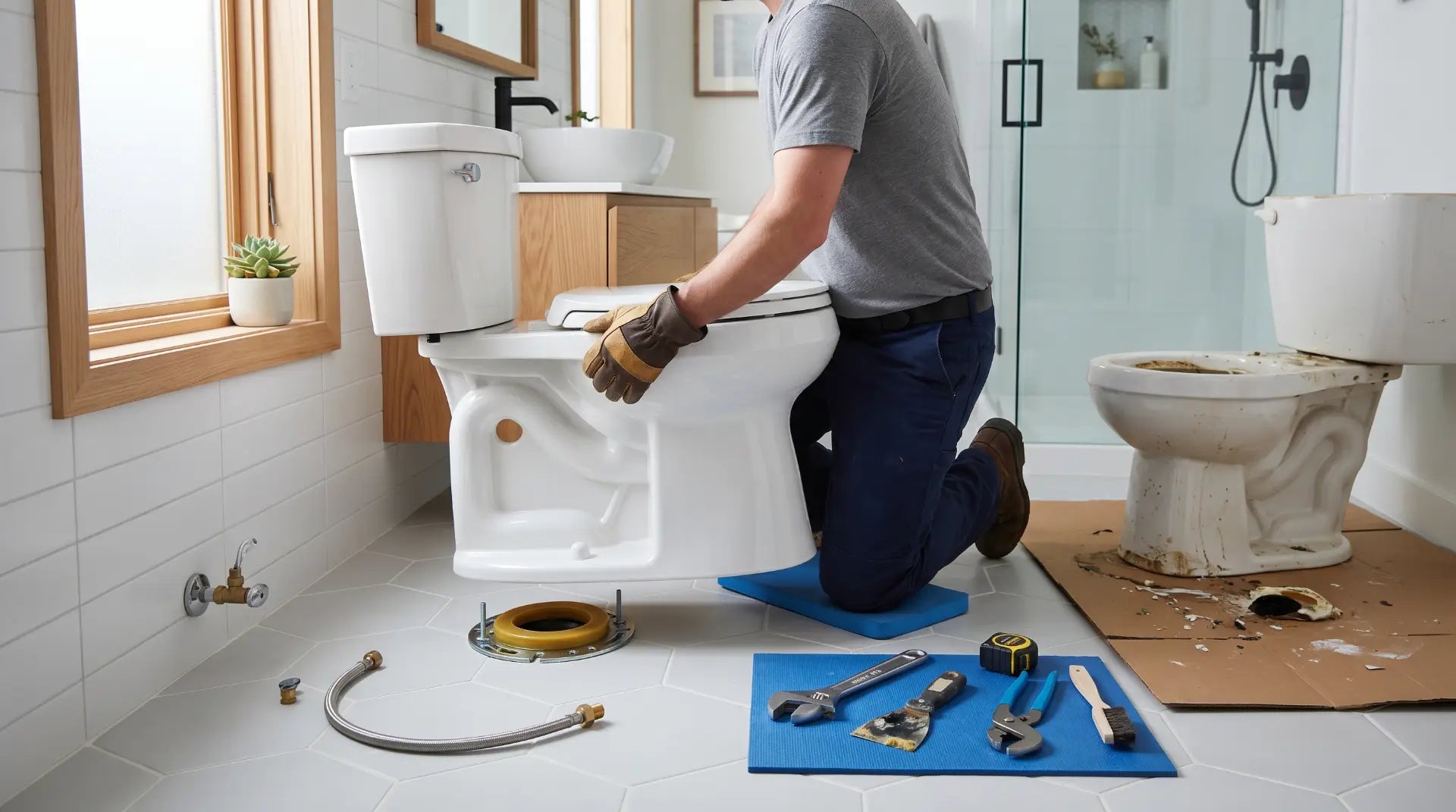
A full toilet replacement costs $150-$400 in labor when you hire a plumber. This guide walks you through every step - from shutting off the water to the final leak test - so you can do it yourself in 1-3 hours with basic tools.
Replacing a toilet is one of the most rewarding DIY plumbing projects a homeowner can tackle - partly because the savings are substantial ($150-$400 in avoided labor costs), and partly because the process is genuinely straightforward once you understand each step. The entire job involves no pipe cutting, no soldering, and no specialized plumbing knowledge. Every connection is mechanical: bolts, nuts, a rubber supply line, and a wax ring. If you can turn a wrench and lift 60-120 lbs (or have one person to help), you can replace a toilet.
What most online guides miss are the steps that actually cause problems: measuring the rough-in before ordering the new toilet, inspecting the flange before installing rather than after discovering a leak, understanding why you must never reuse an old wax ring, and knowing the specific differences in procedure for 1-piece versus 2-piece toilets. This guide covers all of them - with enough detail to handle the complications that commonly arise in US homes, including corroded bolt caps, older flanges, hard-to-close shutoff valves, and the disposal logistics for an old toilet.
If you're replacing a toilet because the current one is running constantly or leaking at the base, those specific repairs are covered in separate guides in this series. This guide covers a complete toilet removal and replacement - taking the old toilet entirely out and installing a new one in its place.
Don't remove the old toilet and then go buy the new one. The floor drain (flange) must be covered while you shop, and the bathroom will be out of service. Buy and have the new toilet on-site before starting. Confirm the rough-in measurement (see Phase 1 and the "Before You Buy" section below) matches the new toilet's rough-in spec. For TOTO, Swiss Madison, and most brands at Bathify, the standard rough-in is 12 inches - but always verify before purchasing.
Toilet replacement is rated a beginner-to-intermediate DIY project. The process itself is straightforward; the complications come from the condition of existing components - particularly corroded bolts, damaged flanges, and stuck shutoff valves in older US homes. Here's an honest picture of what to expect:
| Factor | Best Case | Realistic Average | Complications Add |
|---|---|---|---|
| Time (2-piece toilet) | 60-90 minutes | 90-150 minutes | 30-60 min for corroded bolts, flange damage, or stubborn shutoff valve |
| Time (1-piece toilet) | 90-120 minutes | 120-180 minutes | 20-30 min for single-unit weight management; requires a helper |
| Physical difficulty | Light lifting, kneeling | Moderate - toilet is 60-100 lbs | 1-piece toilets average 90-120 lbs - always use a helper |
| Tools needed | Wrench, putty knife, sponge | Wrench, putty knife, sponge, hacksaw | Hacksaw for corroded bolts; flange repair kit for damaged flanges |
| Parts cost | $20-$40 (wax ring + bolts + line) | $30-$80 | $15-$40 for flange repair kit; $15-$40 for shutoff valve replacement |
| Plumber needed? | No - straightforward swap | No - handle complications yourself | Yes: broken main shutoff, cracked floor drain pipe, concrete subfloor flange damage |
Gather everything before you start. Running to Home Depot mid-job with the toilet disconnected wastes time and leaves an open floor drain. Here's exactly what you need:
| Part | Notes | Cost | Where to Buy |
|---|---|---|---|
| Wax ring | Always buy new. Standard or "extra thick" wax ring for flanges that sit slightly below floor level. Wax-free silicone alternative (Fernco Wax-Free) is easier to install and reusable for adjustments. | $5-$15 | Home Depot, Lowe's, Amazon |
| Closet bolt set (toilet bolts) | Usually sold as a pair with nuts and washers. Stainless steel bolts resist corrosion better than zinc. Standard size fits all US residential flanges. | $4-$10 | Home Depot, Lowe's |
| Water supply line | 12"-20" braided stainless steel flexible hose. Measure the distance from your shutoff valve to the toilet tank inlet - buy slightly longer than needed. Never reuse the old line if it's rubber or kinked. | $8-$18 | Home Depot, Lowe's, Amazon |
| Toilet-to-floor caulk | White 100% silicone or siliconized latex caulk. Caulk the front and sides of the toilet base only - not the back - so a future leak at the wax ring can be detected rather than pooling invisibly under the toilet. | $6-$12 | Home Depot, Lowe's |
| Flange repair kit (if needed) | A steel repair ring that clamps over a cracked or low flange. Most US flanges don't need this, but inspect before assuming. Oatey and Sioux Chief make the most common repair rings. | $10-$25 | Home Depot, Lowe's |
| Bolt caps / base cover set | Usually included with new toilet. If not, buy a universal cover set at hardware stores. Match color to toilet. | $3-$8 | Home Depot, Lowe's |
Buying the wrong toilet is a costly mistake. These three measurements take five minutes and ensure your new toilet fits perfectly before it's delivered.
The rough-in is the distance from the finished wall behind the toilet to the center of the floor drain (the flange bolt holes). Measure from the wall - not from the baseboard - to the center of one of the two floor bolts at the toilet base. Standard US rough-in is 12 inches, which fits the vast majority of toilets sold in the US including all TOTO, Swiss Madison, and American Standard models at Bathify. Pre-1970 homes in the Northeast and Midwest sometimes have a 10-inch or 14-inch rough-in. Buying a 12-inch rough-in toilet for a 10-inch space means the tank will hit the wall; buying it for a 14-inch space means a 2-inch gap behind the tank that's hard to conceal.
Measure from the finished wall to any obstacle directly in front of where the toilet will sit (opposite wall, door swing arc, vanity corner). A standard elongated toilet requires at least 21 inches of clearance in front of the bowl rim per current IPC code. A round or compact elongated toilet reduces this requirement slightly. For very tight powder rooms and half-baths, this measurement determines which bowl shape you can install. See our separate elongated vs. round toilet bowl guide for the full space analysis.
Standard toilets have a seat height of 15-17 inches - historically the norm in US homes. Comfort height (ADA height) toilets have a seat height of 17-19 inches and are now the majority of sales for primary bathrooms because they're easier for adults to sit and rise from. Before buying, confirm which height your household prefers. If you have seniors or anyone with limited mobility in the home, comfort height is the clear recommendation. All TOTO and Swiss Madison models at Bathify are available in both height configurations.

The toilet shutoff valve is the oval-shaped handle on a chrome or braided supply line behind and below the toilet tank - usually at floor level or low on the wall. Turn it clockwise until it stops. This cuts water flow to the toilet only, without affecting the rest of the house. If the valve is stuck and won't turn, apply penetrating oil (WD-40 or PB Blaster) to the stem, wait 5 minutes, and try again. Do not force a stuck shutoff valve - you risk breaking it and being unable to shut off the water at all, at which point you'll need to close the main house shutoff.
- Close the shutoff valve - turn clockwise until fully closed. Confirm by trying to flush; the tank should not refill.
- Flush the toilet - hold the handle down until the tank is fully empty. This drains 90-95% of the tank water.
- Remove remaining tank water - use a sponge and bucket to soak up what's left in the tank. Wring out into the bucket. Get it as dry as possible - every ounce left in the tank is dead weight you'll be carrying when you lift it.
- Remove bowl water - use the sponge to remove water from the toilet bowl. Alternatively, pour a bucket of water rapidly into the bowl to force a siphon flush, then sponge up the remainder. A dry bowl prevents spills when tilting the toilet during removal.
- Verify shutoff is working - after draining, confirm the tank does not refill at all. If water slowly trickles back into the tank, the shutoff valve is not fully sealing. In that case, proceed but work quickly, or close the main house shutoff before continuing.

For a 2-piece toilet, always remove the tank before the bowl. A toilet tank full of water weighs 30-40 lbs on top of a 60-80 lb bowl - that's awkward at best and dangerous at worst. Separating them makes each piece manageable for one person. For a 1-piece toilet, skip to Phase 3 - the tank and bowl are a single unit.
- Disconnect the water supply line - place a small bucket or towel under the connection. Use an adjustable wrench to unscrew the supply line from the bottom of the tank (the threaded metal or plastic inlet on the underside of the tank). Turn counterclockwise. Some water will drip out - expect it. Set the supply line aside; you'll replace it with a new one.
- Remove the tank lid - lift straight up and set on a towel away from the work area. Toilet lids are ceramic and crack easily if bumped.
- Disconnect the tank from the bowl - inside the tank at the bottom, you'll see 2-3 rubber-sealed bolts (tank bolts) that pass through the tank bottom and thread into the bowl. Reach underneath the tank and hold the nut with your fingers or pliers while turning the bolt head inside the tank with a screwdriver counterclockwise. Remove all bolts.
- Lift the tank off the bowl - grip the tank from below with both hands. Lift straight up. The tank is now separate from the bowl. Set it in the bathtub or on towels on the floor.
Stubborn tank bolts: If the tank bolt nuts are corroded and won't turn, spray with penetrating oil and wait 5 minutes. If they still won't budge, cut them off with a hacksaw or oscillating tool (cut the bolt below the nut). The bolts are sacrificial - they're replaced with the new toilet installation anyway.

The toilet bowl is bolted to the floor through two floor bolts (closet bolts) that pass through the toilet base into slots in the flange. Plastic caps cover the bolt nuts at the front sides of the toilet base. These bolts and the wax ring beneath the bowl are the only things holding the toilet to the floor.
- Pry off the bolt caps - use a flathead screwdriver or utility knife to pop off the plastic bolt caps at each side of the toilet base. Some snap off; others are caulked and need the utility knife to cut the caulk bead first.
- Cut base caulk - if the toilet base is caulked to the floor (common in remodeled bathrooms), score around the entire caulk bead with a utility knife before trying to lift. Attempting to lift before cutting will tear the flooring.
- Unscrew the floor bolt nuts - use an adjustable wrench to unscrew the nuts from both floor bolts counterclockwise. If the bolts spin (common with older zinc or corroded bolts), grip the bolt with locking pliers above the nut while turning the nut. If the bolt is so corroded it won't release, cut it with a hacksaw flush with the nut - you'll replace these bolts anyway.
- Rock the bowl gently side to side - grip the bowl at the sides and rock it left and right. This breaks the wax ring seal between the toilet base and the flange. Don't lift yet - just rock until you feel the seal give. It usually takes 3-5 rocks.
- Lift the bowl straight up - once the seal is broken, lift the bowl straight up off the flange bolts. If you have a helper, use them now. Set the bowl on old towels or cardboard immediately - upright if possible, on its side if the bathroom is very tight. Wax residue on the bottom will smear if placed face-down on tile.
- Stuff a rag in the open floor drain - immediately after lifting the bowl, stuff a rag or old towel into the open flange drain. Sewer gas comes up through this opening. The rag blocks the smell while you work and prevents accidentally dropping tools down the drain.
Wax drip protection: Before lifting the bowl, lay old towels or cardboard in a path from the toilet to wherever you're setting the old toilet down (hallway, garage, outside). The wax ring residue on the bowl's underside smears on floors and is difficult to remove from grout. Having a clear, protected path means you can move quickly and keep your floors clean.

The flange is the flat ring of PVC, ABS, or cast iron bolted to the floor that the toilet sits on. Its two bolt slots hold the closet bolts, and the toilet's wax ring seals against it. A damaged, cracked, or incorrectly positioned flange is the root cause of most toilet leaks at the base - and the mistake most DIYers make is discovering the flange is damaged after the new toilet is already installed.
- Remove the drain rag and inspect with a light - use a flashlight or phone light to examine the flange from above. Look at the flat ring surface and the bolt slots on each side.
- Check the flange is at the right height - the top of the flange should be flush with or up to ¼" above the finished floor. If the flange sits more than ¼" below the floor surface (common after tile installation), a standard wax ring won't create a full seal. Use a double-thick wax ring or a wax-free silicone seal (like the Fernco WRSF-4) that adjusts to different heights.
- Check for cracks in the flange ring - run your finger around the full ring. A cracked flange means the wax ring can't seal properly. Minor cracks on non-weight-bearing sections can be bridged with a steel repair ring ($10-$25 at Home Depot - Oatey brand is most common). A severely cracked or fully broken flange requires replacing the flange entirely - a plumber job if the drain pipe is PVC set in concrete.
- Check the bolt slots - the two elongated slots on opposite sides of the flange hold the closet bolts. They should be intact and clear of debris. If the slot edges are chipped away, the bolts won't be held securely - use a repair ring with its own bolt slots to restore this.
- Scrape off all old wax - use a putty knife to scrape every trace of old wax from the flange surface and the surrounding floor. The new wax ring needs a clean, flat surface to seal properly. Wipe up residue with paper towels. The surface should be completely clean before the next step.
| Flange Condition | Diagnosis | Solution | DIY or Pro? |
|---|---|---|---|
| Intact, flush with floor, slots clear | Perfect - proceed normally | Standard wax ring | DIY |
| Flange sits ¼"-½" below floor level | Floor was raised (new tile, hardwood over old floor) | Extra-thick wax ring or wax-free seal | DIY |
| One or both bolt slots damaged/chipped | Age or overtightening damage | Steel flange repair ring + new bolts | DIY |
| Minor crack in PVC ring (not through) | Age, impact, or freeze damage | Steel repair ring over existing flange | DIY |
| Full break - flange in pieces | Severe damage or impact | Full flange replacement | DIY if PVC glue joint; Pro if concrete |
| Flange sits >½" below floor | Major remodel raised the floor significantly | Flange extender + wax-free seal | Caution - verify extension height |

With a clean, inspected flange, you're ready to prepare it for the new toilet. These two steps - setting the bolts and placing the wax ring - are simple but must be done correctly. A cocked bolt or off-center wax ring causes installation headaches that are hard to fix without starting over.
- Insert new closet bolts into the flange slots - slide the head of each bolt into the slot on each side of the flange. Position them so they point straight up and align with each other across the diameter of the flange. The heads should sit flat in the slot - if they spin, the slot is damaged (see Phase 4 table). Many installers use a small piece of plumber's putty or the plastic retainer that comes in bolt sets to hold the bolts upright while positioning the toilet.
- Verify bolt alignment - both bolts should be equidistant from the center of the flange and aligned with each other. This is critical: if one bolt is closer to the wall than the other, the toilet will sit crooked. Use a tape measure or eyeball from directly above.
- Position the wax ring - the wax ring can be placed on the flange or on the toilet's horn (the outlet on the bottom of the bowl). Placing it on the flange is more common and easier to keep centered. Press it gently to seat it - don't deform or compress it. If the room is cold (below 60°F), warm the wax ring between your hands for a minute - cold wax doesn't seat as effectively.
- Remove the drain rag only when you're ready to set the toilet - have your new toilet in position and ready to lower. You don't want the drain open any longer than necessary.

Lowering the toilet onto the flange is the most critical moment in the installation. The wax ring - once compressed - cannot be repositioned without starting with a new wax ring. The goal is to lower the bowl perfectly centered over the flange with the two bolt holes in the base aligned with the two bolts sticking up from the flange, then press straight down to compress the wax ring into a full seal. Do this as a single controlled motion.
- Tip the bowl slightly to see the underside - look at the bottom of the new bowl. You'll see the horn (the outlet pipe) in the center, and two bolt holes symmetrically placed on either side. Identify these visually so you know what you're aligning.
- Position yourself and a helper (if using one) - if using a helper, each person takes one side of the bowl. If solo, grip the front and back rim. Have the flange directly below you, bolts pointing straight up.
- Straddle the flange and align the bolt holes - lower the bowl until the bolt holes are directly above the upward-pointing flange bolts. Look through the bolt holes from above to confirm alignment. Take your time here - this alignment is everything.
- Lower straight down in a single controlled motion - once aligned, lower the bowl straight down without twisting or rocking. The bolts will pass through the bolt holes and the horn will push into the wax ring. Keep pressing down until the toilet base is flat on the floor on all sides.
- Press down firmly to compress the wax ring - sit on the toilet (with the lid off the tank area) and press down. Your body weight compresses the wax ring into a full seal. Rock gently side to side once to ensure full compression - but do not rock aggressively or you may break the seal before bolting.

With the toilet seated on the wax ring, it needs to be bolted down securely enough to not move, but not so tightly that you crack the ceramic base - the #1 overtightening mistake in DIY toilet installation. Ceramic toilets crack at the bolt bosses (the reinforced areas around the bolt holes) when bolts are overtightened. The rule is: hand-tight plus ¼ turn, alternating sides.
- Slide on the washers and hand-thread the nuts - place a plastic washer (usually included with the bolt set) over each bolt, then a metal washer, then thread the nut by hand clockwise onto each bolt. Don't use a wrench yet.
- Check for wobble - with nuts hand-threaded, rock the toilet side to side gently. If it wobbles, the floor is uneven. Slide plastic toilet shims (available at hardware stores for $2-$4) under the base on the low side until the toilet sits flat and solid without rocking. Cut off the protruding shim with a utility knife after bolting.
- Tighten nuts alternately - wrench only a quarter-turn at a time - use an adjustable wrench to tighten each nut a quarter-turn, then switch to the other side. Alternate back and forth, gradually tightening both sides evenly. Stop when the toilet feels firm and doesn't move - not when the wrench feels like it won't go further. Typical final torque is 15-25 ft-lbs - snug, not strained.
- Cut the bolts to length - the floor bolts will protrude above the nuts by 1-3 inches. Use a hacksaw or bolt cutter to cut them flush with the top of the nut. Cut slowly - sudden hacksaw movements can crack porcelain.
- Install the bolt caps - press the plastic bolt caps over the nuts. They typically snap into a plastic base that sits on the floor. Fill any gap between the cap base and floor with a small amount of plumber's putty or silicone caulk to keep them in place.
- Caulk the toilet base (front and sides only) - apply a bead of white silicone or siliconized latex caulk along the front and sides of the toilet base where it meets the floor. Do not caulk the back - leaving the back uncaulked allows any future wax ring leak to drain visibly to the floor rather than pooling invisibly under the toilet. Smooth the caulk with a wet finger and wipe excess with a damp cloth.

For a 2-piece toilet, you'll install the tank onto the bowl before reconnecting water. The tank connects to the bowl via 2-3 tank bolts that pass through rubber gaskets to form a watertight seal between tank and bowl. These gaskets are typically pre-installed on new toilets - verify they're in place before mounting.
- Install the flush valve and fill valve if not pre-installed - most new toilets come with the flush valve (flapper) pre-installed in the tank. The fill valve may be separate. Follow the manufacturer's instructions in the box - typically involves threading the fill valve into the tank bottom from inside and securing the locknut from underneath. TOTO Drake II and Swiss Madison models at Bathify come with hardware pre-installed.
- Place the tank gasket on the flush valve outlet - this large rubber donut gasket seals the tank-to-bowl connection. It sits around the flush valve outlet (the large opening at the tank bottom). If your new toilet didn't include one, buy a universal tank-to-bowl gasket ($4-$8 at Home Depot).
- Lower the tank onto the bowl - lift the tank and align the tank bolt holes with the holes in the tank ledge at the back of the bowl. Lower straight down. The flush valve outlet should seat into the bowl's water inlet.
- Hand-thread the tank bolts from inside the tank - reach inside the tank, find the bolt heads, and thread washers and nuts onto the bolts from underneath. Hand-tighten alternately until snug - same alternating technique as the floor bolts. Do not overtighten; the tank is ceramic and will crack.
- Connect the new water supply line - thread the supply line's female end onto the fill valve inlet under the tank (hand-tight then a quarter-turn with pliers). Connect the other end to the shutoff valve (same way). Do not overtighten - hand-tight plus a quarter-turn is correct for braided stainless supply lines.

Before putting tools away, running through a complete leak and function test takes 10 minutes and can prevent discovering a problem days or weeks later when water has already damaged the subfloor.
- Open the shutoff valve slowly - turn the shutoff valve counterclockwise (open) slowly - not all at once. Let the tank fill gradually. Watch the supply line connections at the shutoff valve and at the tank inlet for any drips as water pressure comes up.
- Check all connections while tank fills - get down with a flashlight and visually inspect: (a) supply line connection at shutoff valve, (b) supply line connection at tank inlet, (c) tank-to-bowl gasket connection (look for wetness at the tank-bowl joint), (d) floor around the toilet base (look for any water seeping from under the base).
- Check tank water level - the tank water should fill to approximately 1 inch below the overflow tube top and then stop. If it keeps running, adjust the fill valve float down (usually a clip or twist on the fill valve body). See our running toilet repair guide if the toilet won't stop running after installation.
- Perform the first flush - flush the toilet and watch: (a) the toilet flushes cleanly without gurgling or partial flushes, (b) the tank refills completely and stops within 60-90 seconds, (c) the bowl refills to the correct water level, (d) no water appears at the base during or after the flush.
- Flush 3-5 more times - check the base and all connections after each flush. The wax ring fully seats after a few flushes. If water appears at the base after multiple flushes, the wax ring is not sealed - see the troubleshooting section below.
- Install the toilet seat - most new toilets come with the seat in the box. Attach the seat hinge posts to the two holes at the back of the bowl. Plastic cap-top bolts tighten from underneath, or bolt-down style hinges use a wrench from above. Check the seat manufacturer's instructions.
- Replace the tank lid - set it back in place. Done.
A 1-piece toilet like the TOTO UltraMax II or Swiss Madison Sublime II has the tank and bowl fused as a single ceramic unit. The installation procedure follows the same phases above, but with these important differences:
The primary challenge with 1-piece toilets is the single-unit weight. 90-130 lbs of ceramic is awkward to maneuver into a bathroom, position over a flange, and lower with precision. Always use at least one helper. When lowering onto the flange, one person guides the toilet down while the other confirms bolt hole alignment from the side. Once set, the installation procedure - bolting, leveling, supply line, and testing - is identical to a 2-piece.
1-piece delivery planning: If you're having a 1-piece toilet delivered, confirm the delivery team will bring it to the bathroom - not just to the front door. Most freight deliveries leave the box on the porch. A 120 lb toilet in a box requires two people to carry to the bathroom. Factor this into your planning, particularly in homes with stairs.
Wall-hung toilets - such as Swiss Madison Concorde wall-hung models available at Bathify - use a completely different installation system from floor-mounted toilets. The toilet bowl mounts to a steel carrier frame embedded in the wall, and the tank is concealed inside the wall. Replacing a wall-hung toilet involves removing the actuator plate, accessing the carrier's tank, disconnecting the bowl mounting bolts, removing the bowl, and installing the new bowl.
The wall-hung replacement process does not involve wax rings, floor flanges, or floor bolts. The bowl mounts on two horizontal bolts extending from the carrier frame at the wall. Leak points are the bowl-to-carrier connection (sealed with a rubber gasket) and the flush pipe connection from the carrier to the bowl. Because the carrier frame and in-wall tank are the most expensive and complex components, most wall-hung toilet replacements involve only the bowl - not the carrier or in-wall tank. For a full wall-hung installation guide including carrier installation, see our wall-mount toilet guide.
| Problem | Likely Cause | Fix |
|---|---|---|
| Water at the base after flushing | Wax ring not fully sealed - toilet was rocked after setting, or set at an angle | Remove toilet, clean flange, install new wax ring, reset. No shortcut - the ring must be replaced. |
| Toilet wobbles or rocks | Uneven floor, undertightened bolts, or shims needed | Insert plastic toilet shims under the low side, then retighten bolts alternately to snug |
| Drip at supply line connection | Connection under-tightened or missing rubber washer inside line fitting | Turn off water, check that the rubber washer is inside the supply line fitting, retighten ¼ turn |
| Tank keeps running after fill | Fill valve float set too high, or flapper not seating correctly | Adjust fill valve float down; check flapper chain has ½" of slack. See running toilet repair guide |
| Weak flush / incomplete bowl clear | Water level in tank too low, or flapper closes too fast | Raise tank water level by adjusting fill valve float up; check flapper chain length |
| Drip at tank-bowl joint | Tank-to-bowl gasket misaligned or tank bolts undertightened | Remove tank, reseat gasket centered on flush valve outlet, reinstall tank and tighten bolts alternately |
| Gurgling sound during flush | Venting problem in drain stack, not related to toilet installation | Check other drains in the bathroom - if all gurgle, the vent stack needs clearing. Plumber job. |
| Sewer smell after installation | Wax ring leak (small) or rag left in drain (check first) | Confirm no rag in drain. If smell persists, check for wax ring leak - you may need to remove and reset |
Ceramic toilets are heavy, bulky, and not accepted in standard curbside trash pickup in most US municipalities. Here are your realistic disposal options:
| Situation | Why It Needs a Pro | Typical Cost |
|---|---|---|
| Shutoff valve won't close and is stuck or broken | Requires closing main house shutoff and replacing valve - simple but needs main shutoff access | $100-$250 |
| Flange is completely broken and set in concrete | Chipping concrete and resetting a flange requires specialized tools and skills | $200-$500 |
| Drain pipe is cracked below the flange | Any drain pipe damage below the floor requires opening the floor or crawlspace | $300-$800+ |
| Wall-hung carrier frame installation (new install) | In-wall carrier must be anchored to wall framing - requires opening the wall | $500-$1,500 labor |
| Gurgling or slow draining throughout bathroom | Vent stack blockage - not related to toilet, needs drain cleaning or vent access | $150-$400 |
| Standard 2-piece toilet - no complications | All steps in this guide are DIY-appropriate for homeowners with basic tools | DIY - $20-$80 in parts |
A toilet replacement is a genuine DIY project. With this guide, the right parts, and 2-3 hours, most US homeowners can do it successfully and save $150-$400 in labor.
The steps are mechanical and logical: shut off the water, drain, remove the tank (on 2-piece toilets), unbolt the bowl, inspect and clean the flange, install new bolts and wax ring, lower the new toilet straight down, bolt and level, reconnect water, and test thoroughly. None of these steps require specialized plumbing knowledge - they require patience, the right tools, and following the sequence correctly.
The two most common DIY failures - a leaking wax ring and overtightened bolts cracking the porcelain - are both avoidable by following the guidance in this guide: set the toilet in a single straight-down motion without rocking, and tighten bolts to "firm but not strained" by alternating sides. The flange inspection step, which most competing guides skip, is the other critical intervention that prevents discovering problems after the new toilet is already installed.
If you're replacing a toilet because the current one is aging past 15 years, running constantly, or simply inefficient (pre-2000 toilets flush 3.5-5 gallons per flush versus today's 1.28 GPF WaterSense standard), browse Bathify's full toilet collection to find TOTO Drake II, Swiss Madison Sublime II, and other WaterSense-certified models. Free shipping on orders over $50 to the continental US. Once it arrives, this guide has everything you need to install it yourself.


