







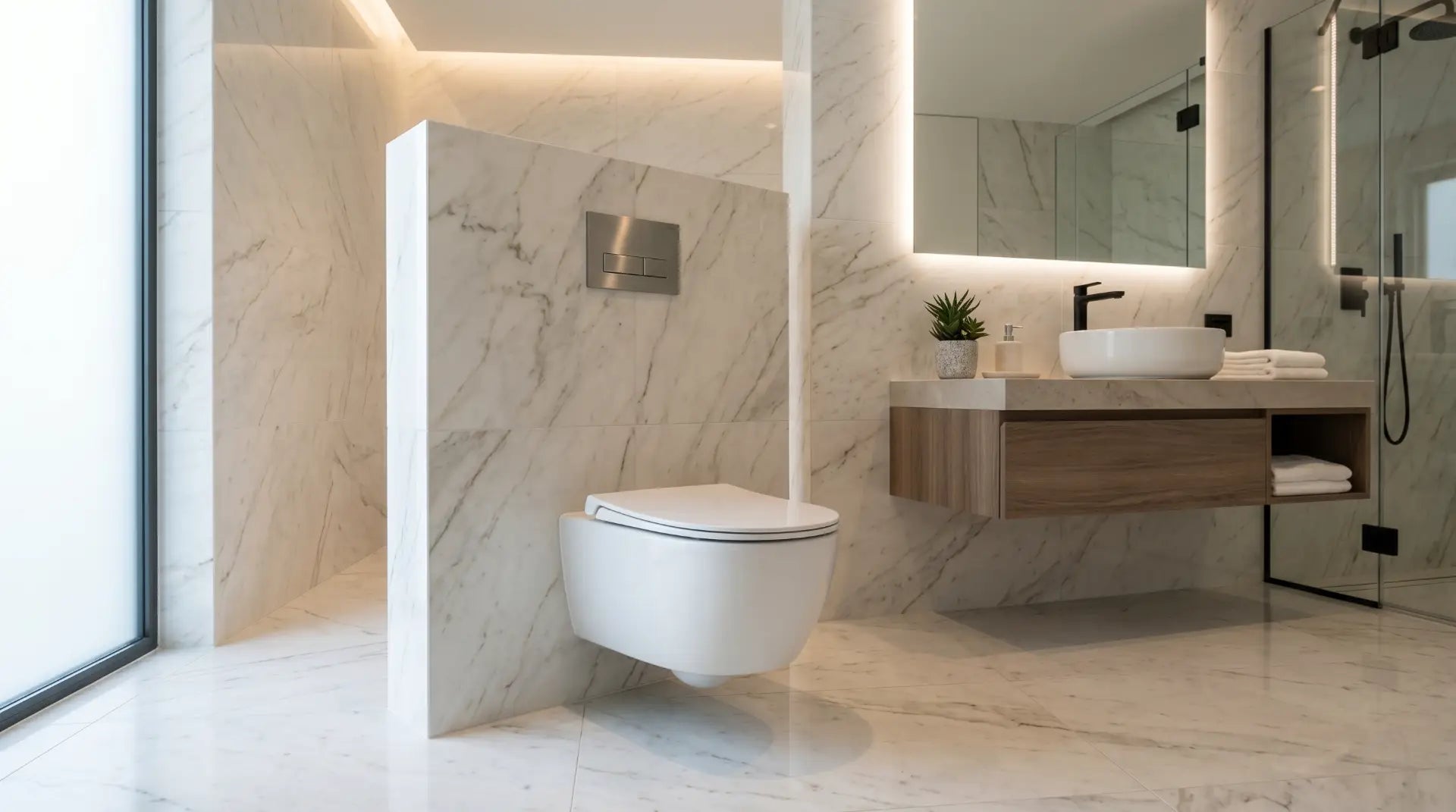
Wall hung toilets look stunning. They float off the floor, clean easier underneath, and save real space in tight bathrooms. But the installation cost is genuinely higher - and the in-wall carrier system changes everything about what happens when something needs repair. Here's the honest answer.
The wall-mount toilet question gets answered wrong in most buying guides - either dismissed as "too expensive and complicated" without engaging with why someone would want one, or promoted as the inevitable future of bathroom design without acknowledging the very real practical trade-offs. The truth is more nuanced: a wall-hung toilet is one of the most aesthetically impactful changes you can make to a bathroom, it cleans easier than any floor-mount design, and it genuinely frees floor space. It also costs more to install, creates access challenges when the in-wall tank needs service, and is a harder project to reverse than almost any other bathroom fixture choice.
This guide covers the wall mount toilet decision honestly - what the installation actually costs in the US market in 2026, what the carrier system involves, what happens when parts fail, which bathrooms benefit most, and which situations should stick with a floor-mount toilet and put the cost difference toward a better flushing system. It also covers the specific wall-hung toilets available at Bathify so you can see real product and price context, not theoretical numbers.
Is the wall you're mounting on a load-bearing wall, or can it accommodate a 4-inch stud bay (minimum depth for a standard in-wall carrier system)? This is the structural question that determines whether a wall-mount toilet is even feasible in your specific bathroom. A licensed contractor or plumber can assess this in a single site visit. If your wall can't accommodate the carrier and you'd need a full build-out - constructing a new false wall in front of an existing one - add $400-$900 to the installation cost estimate before you start comparing toilet bowls. Our Complete Toilet Buying Guide covers all toilet types in context; this guide focuses entirely on the wall-mount decision.
Yes - if your bathroom is small, modern, and you're doing a full renovation. No - if you're doing a simple toilet swap or your wall can't support a carrier.
A wall-mount toilet is worth the extra installation cost when three conditions are true: you're already opening the wall (during a full bathroom gut-renovation), the bathroom is under 60 square feet where floor space matters, and the aesthetic of a floating toilet fits the design direction you're going. When these three align, the $700-$2,000 installation premium is justified by the design impact, the cleaning advantage, and the adjustable height flexibility.
It is not worth it as a standalone toilet swap in an otherwise untouched bathroom. You'd be spending $700-$2,000 in extra labor on top of the toilet cost just to open and retile a wall - for a bathroom that isn't changing in any other way. In that scenario, a premium 1-piece floor-mount toilet with great flush technology (TOTO Supreme II, UltraMax II) delivers 90% of the visual upgrade at a fraction of the total project cost.
Every wall-hung toilet installation has three separate components that must be purchased and installed - and this is where most buyers get surprised mid-project.
The in-wall carrier frame is a steel frame that mounts inside the wall cavity, typically to the floor and to studs. It supports the full weight of the toilet and the user - engineered to hold 500 lbs or more - and contains the water tank, flush valve, and supply connection. The carrier frame is the most structurally critical component and must be installed level and plumb before any wall finish goes on. Swiss Madison carriers, Geberit carriers (widely used with premium European bowls), and TOTO's proprietary in-wall tank units are the carrier systems most commonly sold in the US market. The carrier requires a minimum wall depth of 4 inches - the standard 2×4 stud bay (3.5 inches actual) is slightly short, which is why a ½-inch furring or a 2×6 framed wall is typically used in new installations.
The wall-hung toilet bowl mounts to bolts protruding from the carrier frame. The bowl hangs at whatever height the carrier was set to - typically adjustable between 15 and 19 inches from finished floor to rim, which is the adjustment range on both Swiss Madison and TOTO wall-hung bowls sold at Bathify. The bowl is supported entirely by the carrier, not by the floor, so the floor can be tiled continuously underneath without interruption.
The actuator flush plate is the wall-mounted button or panel that activates the concealed flush valve. It's the only visible part of the tank system - and it's also the access point for servicing the tank internals. Quality actuator plates (Geberit, Swiss Madison) include a removable panel for access; lower-quality systems require breaking the tile to service the tank.
The wall-mount toilet question is really a total project cost question - not just a toilet price question. Here's what the full cost looks like in 2026 for a US bathroom renovation, based on typical contractor and plumber rates in major markets (New York, Los Angeles, Chicago, Houston, Atlanta, Seattle).
Compare this to a complete floor-mount toilet replacement with a premium 1-piece TOTO or Swiss Madison (toilet $600-$900 + plumber $200-$350 = $800-$1,250 total). The wall-mount premium is real - typically $700 to $2,500 more for an equivalent bathroom upgrade. That premium is justified in a full gut renovation where the wall is already open. It is hard to justify for a standalone toilet swap in a bathroom that isn't otherwise being renovated.
Time your wall-mount install for your full bathroom renovation: The installation cost difference drops significantly if you're already opening walls for other work - shower retiling, vanity replacement, plumbing rough-in updates. When a contractor is already on site with the walls open, adding a wall-mount carrier rough-in adds $300-$500 in incremental labor rather than $1,000+ as a standalone project. If you're planning a full bathroom renovation in the next 12-18 months, buy the carrier and bowl now and wait. If you're only replacing the toilet, buy a floor-mount.

The floor underneath a wall-hung toilet is completely uninterrupted. No bowl base, no floor bolts, no caulk line collecting mold along the base of the toilet. You can mop under the toilet in a single pass - the same as mopping any other part of the floor. This sounds minor until you've spent five minutes scrubbing the grout lines around the base of a floor-mount toilet and realized the design fundamentally prevents you from cleaning that area properly.
In bathrooms with heated tile floors, continuous underfloor heating, or polished large-format tile where visible interruptions read as a design failure, the wall-hung toilet's clean floor line is a genuine aesthetic and functional win. It's the primary reason interior designers default to wall-hung toilets in high-specification primary bathrooms - the visual result on the floor is simply better and cleaner than any floor-mount alternative.

A wall-hung toilet's footprint is the bowl only - the tank is behind the wall. In a small bathroom where you're working with 50 square feet or less, reclaiming 6-9 inches of depth in front of the toilet (the space the tank would occupy) is a meaningful spatial difference. It can be the margin that allows a door to swing freely, allows a comfortable turning radius, or allows a slightly larger vanity to fit in the remaining space.
The benefit is most pronounced in powder rooms, apartment bathrooms, and secondary bathrooms in older US homes where the original bathroom dimensions assumed a more compact fixture footprint than modern toilets typically have. In bathrooms over 80 square feet, the space benefit is essentially invisible in everyday use - the room is large enough that the tank's footprint is not a constraint.

Wall-hung toilets are the only toilet category where the rim height is set at installation to match the household's users - not a factory default. The carrier frame's height is adjustable during rough-in, and most systems allow a range of 15 to 19 inches from the finished floor to the rim. Standard floor-mount toilets are fixed at 14-15 inches (standard) or 16-18 inches (comfort/ADA height), with no adjustment possible.
For households with taller adults, elderly users, or mobility considerations, setting a wall-hung toilet at exactly the right ergonomic height - not an approximation - is a genuine quality-of-life advantage that no floor-mount toilet can replicate. For households that include children and adults with significantly different ergonomic needs, the range covers both ends: 15 inches is child-accessible; 19 inches meets ADA requirements and suits taller users comfortably.

The floating bowl against a clean tile wall is the single most recognizable visual element of a high-specification modern bathroom. It reads as intentional design - not just a fixture replacement - and elevates the perceived quality of the entire space. In primary bathrooms in homes above $600K in markets like Seattle, Denver, Austin, and South Florida, a wall-hung toilet has become an expected feature in any renovation that's positioning the bathroom as a premium space.
The Swiss Madison Concorde's square bowl profile in matte white or matte black, set against large-format tile with no visible base or floor bolts, is one of the strongest single visual statements available in bathroom design at its price point. For bathrooms where design quality and eventual resale impact matter, the visual return on a wall-mount installation is genuine and measurable.

A wall-hung toilet is one of the most difficult bathroom fixtures to reverse. The carrier frame is anchored to studs and the floor inside the wall. The supply line runs inside the wall cavity. The wall is tiled over the entire installation. Switching back to a floor-mount toilet after a wall-hung installation means: removing the actuator plate, cutting open the tile, removing the carrier, reframing or patching the wall, replumbing the supply line to a floor connection, and retiling. This is a $1,500-$3,000+ demolition and reconstruction project.
This irreversibility matters in several scenarios: if you're planning to sell the home within five years and are uncertain whether the wall-hung toilet will appeal to buyers; if you're renovating a rental property where tenant preferences and property management access requirements matter; or if you have any uncertainty about the quality of the installation (a carrier improperly anchored or set at the wrong height cannot be adjusted without opening the wall).

Most wall-hung toilet bowls at Bathify are sold bowl-only. The in-wall carrier frame and the actuator flush plate are separate purchases that must be confirmed compatible with the bowl you chose. This is not complex once you understand the system - Swiss Madison bowls are designed to work with Swiss Madison carriers; TOTO's NEOREST WX1 uses TOTO's proprietary in-wall tank unit - but it catches many buyers off guard when they see the bowl price and realize the carrier and actuator add another $350-$800 to the fixture cost before labor even begins.
When budgeting a wall-mount toilet project at Bathify, price all three components explicitly: the bowl listing page, the compatible carrier system, and the actuator plate. Some bundles exist (Swiss Madison's Concorde bundle includes bowl + carrier + actuator in a single SKU at a better combined price), but most listings are component-by-component.

The in-wall carrier tank fills through a supply line inside the wall cavity. Because the tank is in the wall rather than sitting on a porcelain base on the floor, its fill sound transmits differently - some users describe the fill refill as louder or more resonant than a standard tank toilet, particularly in bathrooms with drywall-finished walls (rather than tile directly over concrete). In bathrooms where noise between floors or rooms is already a concern - apartments, bedrooms adjacent to bathrooms - this is worth factoring into the decision.
Quality carrier systems (Geberit, in particular) are designed with noise-dampening components that significantly reduce fill noise. Budget carrier systems may not include these, and the difference is audible. If noise is a concern, specify a Geberit carrier and budget accordingly - Geberit carriers typically run $400-$700 but are considered the quietest and most reliable in-wall tank systems in the US market.
This is the category most wall-mount toilet marketing omits and most buyers discover only after installation. Here's the honest picture.
| Component | Common Failure | Access Method | DIY Feasible? | Cost to Repair |
|---|---|---|---|---|
| Flush valve / fill valve | Running toilet, slow fill | Remove actuator plate - access panel behind it | Yes (with panel) | $30-$80 parts + 30 min |
| Actuator flush plate | Button stuck, won't flush | Pull plate off wall - no tile removal | Yes | $60-$150 replacement plate |
| Supply line (in-wall) | Slow leak inside wall | Remove actuator plate or open access panel | Usually accessible | $50-$150 parts + plumber |
| Carrier frame anchor | Toilet wobble / shifting | Must open tiled wall | No - tile removal required | $800-$2,500 tile + labor |
| In-wall tank body | Crack (rare - freeze risk) | Must open tiled wall | No - major renovation | $1,500-$3,500+ |
| Bowl | Crack (impact damage) | Unmount bowl from carrier bolts | Yes - bowl-only replacement | $200-$600 bowl + plumber |
A wall-hung toilet makes sense - both financially and practically - in the following situations:
A wall-hung toilet is the wrong choice in these situations - even if you love the look:
The alternative to a wall-mount if you want the aesthetic: A skirted 1-piece toilet (like the TOTO Promenade II or TOTO UltraMax II) hides the trapway and floor bolts behind a smooth ceramic skirt, giving a much cleaner floor-line than a standard exposed-trapway toilet. It doesn't float off the floor, but it eliminates the bowl base gap that collects grime and reads as a significantly more premium fixture at $600-$900 - without the $1,500+ installation overhead of a wall-mount. For bathrooms where the wall-mount premium is hard to justify, a skirted 1-piece is the gap-filler that delivers most of the visual upgrade.
Bathify carries wall-hung toilet bowls at multiple price points. Here's what's available and who each is right for.
The Swiss Madison Ivy is an elongated wall-hung bowl at Bathify's lowest price point in this category - $196.99 for the bowl. It pairs with a Swiss Madison in-wall carrier (sold separately) and a Swiss Madison actuator plate. The Ivy's elongated profile is the most traditional-looking of the Swiss Madison wall-hung line, making it the most compatible with transitional bathrooms that want the wall-mount function without a severely square or avant-garde bowl shape. Dual flush 0.8/1.6 GPF. As with all Swiss Madison wall-hung bowls, the carrier and actuator must be priced separately - budget $350-$550 in additional fixture cost before labor.
The Swiss Madison Concorde is the most visually distinctive option in Bathify's wall-hung toilet range - a square bowl design that reads as aggressively contemporary in the best possible way. Available in glossy white, matte black, and glossy white with black hardware. Dual flush 0.8/1.6 GPF, soft-close quick-release seat, scratch-resistant ceramic. For bathrooms going for a sharp modern or industrial aesthetic, the Concorde's square bowl is the product - there's no floor-mount toilet that replicates this visual. Bathify also carries the Concorde bundle in some configurations, which includes the bowl, in-wall carrier, and actuator at a combined price - check the bundle listing for current pricing, which typically saves $80-$150 versus buying components separately.
The TOTO NEOREST WX1 at Bathify is the top-tier wall-hung option - a wall-hung toilet with integrated bidet seat, EWATER+ self-cleaning technology, CEFIONTECT ceramic glaze, and TOTO's 3D Tornado Flush at 0.8/1.2 GPF. The bowl unit alone is $3,153.99; the NEOREST in-wall tank unit and top unit are sold separately at additional cost. This is not a renovation-budget product - it's the flagship for primary bathrooms where the wall-hung form factor is meeting TOTO's highest-tier technology. For homeowners building or renovating a primary bathroom in the $800K+ home range, the NEOREST WX1 wall-hung is the answer to "what's the best wall-hung toilet available."
| Factor | Wall-Mount Toilet | Floor-Mount Toilet (1-Piece) | Winner |
|---|---|---|---|
| Total Install Cost | $1,500-$4,000+ (bowl + carrier + labor + tile) | $750-$1,300 (toilet + plumber) | Floor-Mount |
| Floor Cleaning | Floor completely clear - mop straight through | Base and floor bolts require cleaning around | Wall-Mount |
| Space Saving | 6-9" of depth freed (tank behind wall) | Tank occupies 8-12" of depth behind bowl | Wall-Mount |
| Height Adjustability | 15-19" range set at install - infinitely adjustable within range | Fixed at standard (14-15") or comfort height (16-18") | Wall-Mount |
| Aesthetics (Modern Bath) | Floating bowl - strongest design statement in the category | Skirted 1-piece approaches but doesn't match the floating effect | Wall-Mount |
| Flush Performance | Dual flush standard; excellent with quality carrier valve | 1.28 GPF or better; Tornado Flush, Class Five available | Tie |
| Common Repairs (fill valve, etc.) | Accessible via actuator plate panel on quality systems | Fully accessible - lift tank lid, standard DIY | Floor-Mount (simpler) |
| Structural Repairs | Carrier anchor failure = wall demolition | Floor flange repair is localized, straightforward | Floor-Mount |
| DIY Install | Not recommended - requires licensed plumber for carrier rough-in | DIY-feasible for experienced homeowners | Floor-Mount |
| Reversibility | Very difficult - requires wall demolition and retiling | Standard toilet swap - 2-4 hours, no wall work | Floor-Mount |
| Resale Appeal | Strong positive in modern/luxury market segment | Universal appeal - no buyer polarization | Depends on market |
| Best Use Case | Full gut-renovation, small bathroom, modern design | Any bathroom - the universal solution | Depends on situation |
Worth it in a full renovation with the right bathroom. Not worth it as a standalone swap.
The wall mount toilet pros genuinely outweigh the cons in the right context - a complete primary bathroom renovation, a small bathroom where floor space is a real constraint, and a modern design direction where the floating bowl is integral to the aesthetic. In these conditions, the installation premium is a one-time cost that pays back across years of easier cleaning, better visual quality, and the height customization that no floor-mount toilet offers.
Outside this context - a standalone toilet replacement, a bathroom staying otherwise untouched, a traditional or transitional design, a rental property - the floor-mount wins by a wide margin. A premium 1-piece skirted toilet (TOTO UltraMax II, Supreme II, or Promenade II) with an excellent flush system delivers most of the visual upgrade and all of the flush-performance upgrade at a total project cost of $750-$1,300. The wall-mount's specific advantages - the floating floor line, the 6-9" of saved depth, the adjustable height - simply don't materialize unless the bathroom conditions justify them.
If you're doing a full renovation: strongly consider wall-mount, especially in primary bathrooms under 60 sq ft. Price the three components (bowl + carrier + actuator) at Bathify, get one contractor quote for the rough-in, and compare that total against a premium 1-piece floor-mount at the same fixture quality level.
If you're only replacing the toilet: buy a skirted 1-piece floor-mount. You'll get a dramatically better toilet than what you're replacing, spend 60-70% less on the total project, and avoid a wall demolition you'll regret if anything ever needs service. Browse Bathify's 1-piece toilet collection and wall-mount toilet collection side by side to make the comparison concrete.


