







The bowl shape decision is the one most buyers get wrong - not because it's complicated, but because nobody explains the real trade-offs. This guide covers dimensions, comfort, space requirements, price differences, and exactly which households should choose each shape.
The bowl shape question - elongated vs round - is asked by nearly every homeowner buying a new toilet, and answered badly by nearly every guide. Most articles reduce it to "elongated = more comfortable, round = saves space" and leave you to figure out the nuance yourself. The nuance is what actually matters: how much space elongated really takes versus round in your specific bathroom, whether the comfort difference is meaningful for your household, and when the compact elongated option makes both arguments irrelevant.
The stakes are real. A toilet installed with a bowl shape that doesn't match the room feels wrong every day. An elongated bowl in a powder room or small half-bath can reduce the maneuvering clearance to the point of discomfort. A round bowl in a master bath that two adults use daily is a comfort compromise that's immediately noticeable. Neither mistake is catastrophic, but both are avoidable - and this guide gives you the framework to avoid them.
What follows is a head-to-head comparison across seven real-world criteria: comfort, space and clearance, cleaning, aesthetics, cost, ADA and senior suitability, and family/multi-user households. Each round ends with a verdict. The summary table and final recommendation tie everything together for each room type.
Before comparing bowl shapes, measure the rough-in distance (center of the drain to the finished wall behind the toilet - standard US is 12", some older homes are 10" or 14") and the available room depth from the wall to any obstacle in front of the toilet. A 12" rough-in elongated toilet at 18.5" bowl length projects to about 28-30" total from the wall (including tank). A round bowl projects 26-28". In rooms under 60" deep, those 2 inches can meaningfully affect the comfort of the space or even clearance compliance.
Choose elongated for most bathrooms. Choose round only when room depth is genuinely tight - typically powder rooms, half-baths, or bathrooms under 60" deep with obstacles directly in front of the toilet.
If your bathroom has adequate depth (60" or more from the wall behind the toilet to any obstacle or door swing in front of it), an elongated bowl is the better long-term choice in almost every scenario: more comfortable for adults, easier to clean, better resale compatibility, and available in a wider range of models and styles at Bathify and major US retailers. The comfort difference is real and noticeable daily. The price premium is modest - typically $20-$80 more for equivalent round and elongated models in the same product line.
If your bathroom is genuinely space-constrained - a powder room, a tight half-bath, or an older apartment bathroom where the toilet is close to a door swing or opposite wall - round is the right call, or consider a compact elongated (see the dedicated section below) which offers a middle-ground most buyers don't know exists.
The core measurement difference is in front-to-back bowl length - the distance from the front rim of the bowl to the back of the tank or seat mounting holes. Elongated bowls measure approximately 18.5 inches front-to-back. Round bowls measure approximately 16.5 inches. The 2-inch difference is consistent across virtually all manufacturers and price points - whether you're buying a $300 two-piece from Swiss Madison or a $900 TOTO UltraMax II.
What that 2 inches means in practice depends entirely on the room. In a large primary bathroom with 72" of depth from the wall to the door, 2 inches is completely imperceptible. In a 48"-deep powder room where code minimums are already tight, 2 inches is the difference between feeling uncomfortably cramped and having normal maneuvering room. Use the table below to understand the total footprint of each shape:
| Measurement | Elongated Bowl | Round Bowl | Difference |
|---|---|---|---|
| Bowl length (front-to-back) | ~18.5 inches | ~16.5 inches | 2 inches |
| Bowl width | ~14-14.5 inches | ~14-14.5 inches | Identical |
| Total depth (bowl + tank from wall) | ~28-30 inches | ~26-28 inches | 2 inches |
| Seat hole spacing (mounting) | Standard - 5.5" center-to-center | Standard - 5.5" center-to-center | Identical |
| Rough-in distance (typical US) | 12" (also 10" and 14" available) | 12" (also 10" and 14" available) | Identical |
| Code minimum front clearance | 21" minimum (15" per old code, 21" current IPC/UPC) | 21" minimum (same) | Identical requirement |
| Side clearance from centerline | 15" each side (18" recommended) | 15" each side (18" recommended) | Identical |
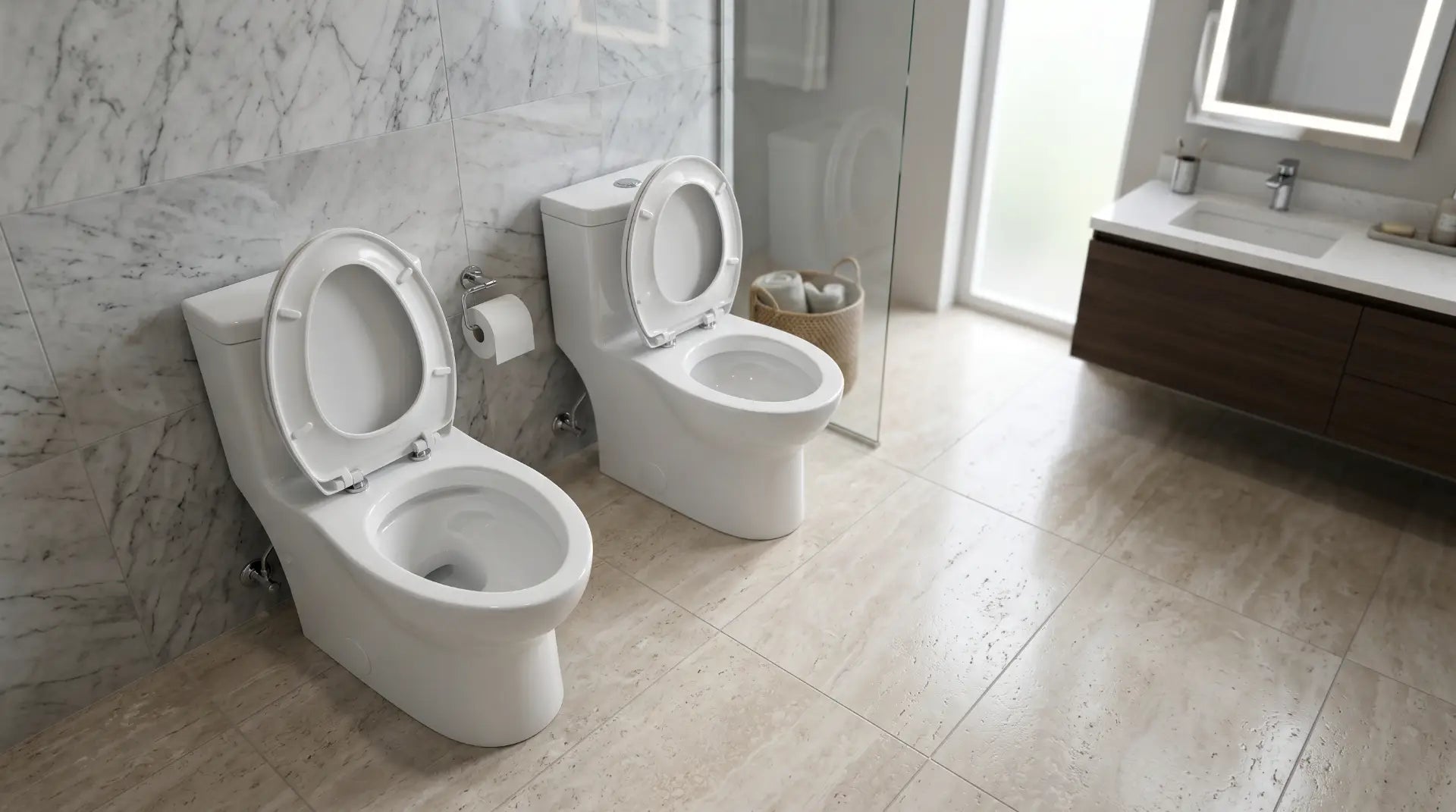
From above, an elongated bowl is clearly oval - stretched forward, with the seat's front edge extending further into the room than a round bowl in the same mounting position. The shape is visually similar to an egg with the narrow end at the back. A round bowl, viewed from above, is distinctly more circular - compact, with the front edge of the seat noticeably closer to the tank. Side by side in the same brand and color, the difference is immediately apparent even to untrained eyes.
From a seated perspective, the elongated bowl provides more surface area forward of the body's center of mass. This means the thighs are more fully supported for most adults, the natural seating posture feels less perched, and there's more margin for positioning without contacting the bowl's sides or front rim. The round bowl feels more compact underfoot - adequate for most adults, noticeably more comfortable for children, and genuinely constraining for taller adults with longer inseams who use the toilet daily.

The comfort difference between elongated and round toilet bowls is real, consistent, and noticed by most adults who use both shapes regularly. An elongated bowl's 18.5" bowl length provides more front-to-back seating surface than a 16.5" round bowl - effectively 2 additional inches of support surface for the thighs. For adults averaging 5'6" to 6'2" in height, this translates to a noticeably more supported and natural seated position. The body's weight distributes more evenly across the elongated seat, reducing the pressure points that a compact round seat concentrates at the back of the thighs.
For men specifically, the elongated shape reduces the likelihood of contact between the front of the body and the bowl rim during seated use - a small but consistently cited comfort advantage. For women, the wider forward surface provides more stable and comfortable positioning during extended use. For people over 60, the additional surface area often makes sitting and rising noticeably easier when combined with a comfort-height bowl (ADA height of 17"-19" seat height), which is available in elongated across all major brands at Bathify including TOTO, Swiss Madison, and American Standard.
Round bowls are not uncomfortable - they are the standard most US adults used for decades, and the majority of people using them daily don't describe them as painful or problematic. The comparison only stings when someone switches from elongated to round; going the other direction always feels like an upgrade. The comfort verdict for elongated is clear, though the magnitude depends heavily on the height and build of the primary users.

The 2-inch space advantage of round over elongated is the most cited reason homeowners choose round bowls - and also the most frequently overstated reason. In the vast majority of US bathrooms, 2 inches of extra projection makes zero practical difference to the feel or function of the room. A full bathroom (typically 60" × 96" or larger), a master bath, a guest bath, or any bathroom with a toilet in its own alcove has clearances that render 2 inches irrelevant.
Where the 2 inches genuinely matters: powder rooms and half-baths that are under 44" wide, small apartment bathrooms where the toilet sits directly across from a door or vanity corner, or tight bathrooms in pre-1970 US homes where actual room depth from the back wall is under 60". In these scenarios, a round bowl can be the difference between meeting the International Plumbing Code's 21" minimum front clearance and falling below it. Some older powder rooms in New York, Chicago, San Francisco, and Boston townhouses have been found with as little as 40"-45" of total depth - a space where round is the only compliant choice and elongated makes the room genuinely unusable.
The practical test: measure your room's depth from the wall behind the toilet location. Subtract 28" (minimum elongated total projection). If less than 21" remains, elongated is not code-compliant and may feel severely cramped. If 21"-30" remains, it fits but is tight. If more than 30" remains, round's space advantage is theoretical rather than practical.

Elongated bowls have a slight cleaning and hygiene edge over round bowls, primarily because their larger surface area better contains splashing during use and provides more surface area for water to coat during flushing - reducing the likelihood of deposits accumulating at the waterline. For men using the toilet standing, the elongated shape's wider forward opening is more forgiving of aim variation, which reduces exterior bowl cleaning frequency in real-world households.
The cleaning difference between shapes is, however, far less significant than the difference between glaze quality and flushing technology. A round bowl on a TOTO toilet with CEFIONTECT nano-glaze (which Bathify stocks across the Drake and Supreme lines) will stay cleaner with less effort than an elongated bowl on a lower-quality toilet with a standard glaze and a weak flush. When comparing equivalent quality levels - same manufacturer, same glaze technology, same flush system - elongated gets a marginal cleaning edge for the reasons above, but it's not the deciding factor for most households.
Glaze matters more than shape: If cleaning is your primary concern, prioritize a toilet with an advanced surface coating - TOTO's CEFIONTECT, American Standard's EverClean, or Kohler's CleanCoat - over bowl shape. These nano-glazes create an ion barrier that actively repels particles. A round bowl with CEFIONTECT will clean faster and stay cleaner longer than a standard-glaze elongated bowl from a budget brand. Browse TOTO's CEFIONTECT models at Bathify.

Elongated bowls are the visual standard in modern and contemporary American bathrooms. The oval shape reads as sleek and proportional in most bathroom layouts - it aligns naturally with the horizontal emphasis of vanities, mirrors, and floor tile patterns. In a master bath with large-format tile, a frameless shower, and a floating vanity, a round toilet can visually appear disproportionately compact. Elongated is the design-neutral default that pairs seamlessly with any style from modern minimalist to transitional.
Round bowls, on the other hand, genuinely suit traditional and classic bathroom designs - particularly those featuring pedestal sinks, hex tile floors, chrome hardware, and wainscoting. In a farmhouse, Craftsman, or Victorian-style bathroom, the round bowl's classic proportions feel authentic rather than dated. If you're furnishing a historically detailed space, round may actually be the stronger design choice.
From a resale perspective, elongated is the safer default for the US market. Buyer expectations in primary bathrooms have shifted firmly toward elongated as the standard, and listing a master bathroom with a round toilet can now read as dated in real estate photography - particularly in markets like Seattle, San Francisco, New York, and the major Sunbelt metros where renovated bathrooms are a selling point. In traditional-style homes in the Southeast and Midwest, the resale impact is neutral to positive for round in the right design context.

Elongated toilets typically cost $20-$80 more than equivalent round models within the same product line. At the entry level - two-piece toilets in the $250-$400 range - this premium is consistently in the $20-$40 range. At the mid tier ($400-$700), the gap is typically $30-$60. At the premium tier (TOTO Drake II, UltraMax II, Swiss Madison Sublime), the round and elongated versions of the same model are often $40-$80 apart. The price difference is real but modest relative to the total purchase decision - it rarely exceeds 10-15% of the toilet's cost.
Toilet seats are slightly cheaper for round than elongated by approximately $5-$20 per seat - a consideration for households replacing seats regularly or buying bidet seats. Standard toilet seats at Home Depot and Lowe's run $15-$40 for round and $18-$55 for elongated at equivalent quality. Bidet toilet seats - which Bathify stocks across the TOTO and other brands - have a similar small price differential. Over 10-15 years of ownership, the toilet seat cost difference between shapes is unlikely to exceed $40-$80 total, which does not change the economics meaningfully.
Installation cost is identical for both shapes. A toilet replacement costs $150-$400 in labor whether the new toilet is round or elongated (same rough-in, same supply line, same wax ring, same procedure). The shape of the bowl has no bearing on the installation process or time.

For seniors, people with limited mobility, post-surgical recovery, or any household designing for aging-in-place, the combination of an elongated bowl and comfort-height (ADA height, 17"-19" seat height) is the recommended configuration in virtually every accessibility guide. The elongated shape provides more seating surface to support the transfer process - the act of sitting down onto and rising from the toilet - because more of the seat's forward surface area contacts the thighs during the motion.
ADA compliance for commercial and public installations specifically requires elongated bowl configurations in accessible stalls. While residential bathrooms are not required to meet ADA standards, the same biomechanical logic applies: elongated + comfort height = the most accessible residential toilet configuration. For households where someone uses the toilet with a grab bar or raised toilet seat, elongated also accommodates the addition of those accessories more naturally than round, since the front clearance is greater for seat attachment hardware.
One caveat: for wheelchair users performing side-transfer from a wheelchair, the bowl shape matters less than the side clearance space (18" minimum recommended from toilet centerline to the nearest side wall). In that specific context, the shape is secondary to the room layout. But for ambulatory seniors who simply need a more forgiving sitting surface, elongated + comfort height is the clear recommendation. Browse TOTO's ADA-compliant comfort-height models at Bathify, including the Drake II and UltraMax II in universal height (ADA) configurations.

Toddlers and young children (ages 2-6) tend to find round bowls more manageable because the smaller seat surface area means less risk of slipping forward or feeling unstable. On an elongated bowl, very young children often need a reducer seat insert to feel secure. If a bathroom is specifically a children's bathroom or a shared bathroom where toddler potty training is a current priority, round is genuinely the more practical shape.
For households with children over age 7 sharing a bathroom with adults, compact elongated is often the ideal middle ground - enough length to support adults comfortably, without the full 18.5" projection that can feel large to younger kids. The TOTO Drake II in compact elongated configuration (see the compact elongated section below) is among the most popular family-bathroom choices in the US market for exactly this reason.
For households with elderly grandparents, the calculus shifts back toward elongated + comfort height, especially if there is a primary toilet shared with younger adults who also want comfort. Multi-generational households navigating both toddlers and seniors in the same space often fare best with elongated + comfort height on the primary toilet (optimized for the adults who use it most) plus a separate round or compact elongated in a secondary bathroom near the children's rooms.
Elongated wins 5 of 7 rounds. Round wins only the space round - and only when room depth is genuinely constrained. One round (families/kids) was a context-dependent draw.
Between the standard 18.5" elongated and the 16.5" round bowl, there is a third bowl shape that resolves the tension between the two: the compact elongated. Compact elongated bowls - sometimes called "compact" or "short projection" elongated - measure approximately 17"-17.5" front-to-back. They retain the oval shape and greater sitting comfort of a standard elongated bowl while reducing the projection to something close to a round bowl's footprint.
TOTO popularized the compact elongated configuration in the US market through its Drake II line, which is available in both standard elongated and compact elongated versions. The compact elongated Drake II sits at 17.25" bowl length - saving nearly 1.25" versus standard elongated while remaining noticeably more comfortable than a round bowl. It's now the most common toilet shape recommendation for family bathrooms, guest baths, and smaller primary bathrooms where standard elongated would feel large but round would feel like a comfort compromise.
| Bowl Type | Front-to-Back Length | Total Projection from Wall | Best For |
|---|---|---|---|
| Round | ~16.5 inches | ~26-27 inches | Powder rooms, tight half-baths, kids' baths, spaces under 60" deep |
| Compact Elongated | ~17-17.5 inches | ~27-28 inches | Family baths, smaller primary baths, any room where standard elongated is close to limits |
| Standard Elongated | ~18.5 inches | ~28-30 inches | Master baths, guest baths, larger primary baths, any room over 60" deep |
The right bowl shape depends on the specific bathroom, not a single universal answer. Here's the breakdown by room type for US homes:
- Master bathroom or primary household toilet - adults use it daily and comfort matters
- Guest bathroom where adult visitors are the primary users
- Room depth is 60" or more from back wall to any front obstacle
- Designing for a modern, contemporary, or transitional aesthetic
- Seniors or limited-mobility users - pair with comfort height (ADA)
- Installing a bidet seat - elongated seats and bidet seats have a wider selection
- Planning for resale value - elongated is now the US buyer expectation for primary baths
- Powder room or half-bath with less than 60" total room depth
- Small apartment bathroom where toilet is close to door swing or wall
- Children's bathroom where toddler potty training is ongoing
- Traditional or farmhouse-style bathroom where round suits the design
- Budget is very tight and the $20-$80 saving is meaningful
- Replacing a round bowl in an older toilet rough-in setup (some pre-1980 framing makes elongated awkward)
| Category | Elongated | Round | Better Choice |
|---|---|---|---|
| Bowl length | ~18.5 inches | ~16.5 inches | Depends on room |
| Comfort for adults | More sitting surface, better leg support | Functional but more compact seated feel | Elongated |
| Comfort for children | Can feel large for toddlers without reducer | More stable and accessible for young kids | Round |
| Space efficiency | Projects 2" further into room | Saves 2" of front projection | Round (tight rooms) |
| Ease of cleaning | Larger surface area - marginal advantage | Slightly less surface area but still functional | Elongated (marginal) |
| Modern aesthetics | Oval shape - contemporary, sleek | Circular - traditional, classic | Depends on style |
| Purchase price | $20-$80 more at equivalent quality | Slightly less expensive | Round (budget) |
| ADA / senior use | More supportive - especially with comfort height | Functional but less surface area for transfers | Elongated |
| Toilet seat selection | Wider bidet seat selection, slightly more expensive seats | Universal seat availability, slightly cheaper | Elongated (selection) |
| Installation cost | Identical to round | Identical to elongated | Tie |
| Resale appeal (US primary baths) | Preferred by buyers in most major markets | Neutral to positive in traditional-style homes | Elongated |
| Best room type | Master bath, guest bath, primary toilet | Powder room, half-bath, tight apartments | Context-dependent |
Elongated for most rooms. Round only when space is genuinely tight. Compact elongated when you're on the fence.
The elongated vs round toilet bowl debate has a clear answer for most US homeowners: elongated is the better choice for primary bathrooms, master baths, guest baths, and any room where adults use the toilet regularly and the room depth allows it. The comfort advantage is real, the aesthetic fits modern US design standards, the resale value is better, and the $20-$80 price premium is modest relative to the purchase.
Choose elongated if your room depth from the back wall to any obstacle is 60" or more, adults use the toilet daily, you're designing for a contemporary or transitional aesthetic, or you're planning for resale value in a US market. TOTO Drake II, TOTO UltraMax II, Swiss Madison Sublime II, and Swiss Madison Monaco in elongated are the most searched models at Bathify for good reason - they represent the US standard for quality, water efficiency, and bowl shape at $350-$900.
Choose round if your bathroom is a powder room or half-bath under 60" deep, you're outfitting a dedicated children's bathroom, your design is explicitly traditional or farmhouse-style, or you're replacing a round bowl in a very tight pre-existing space where the constraint is structural. Round bowls in the same product lines - TOTO Drake, Swiss Madison Sublime II round - are excellent toilets; the shape is not a quality indicator.
Consider compact elongated if you're on the fence - specifically the TOTO Drake II compact elongated or any model labeled "compact elongated" or "short projection." At 17-17.5" bowl length, compact elongated splits the difference practically and is often the right answer for family bathrooms, smaller primary baths, and any room where you want elongated comfort without standard elongated projection. Browse Bathify's full toilet collection to filter by bowl shape and find the right model for your specific bathroom.


