







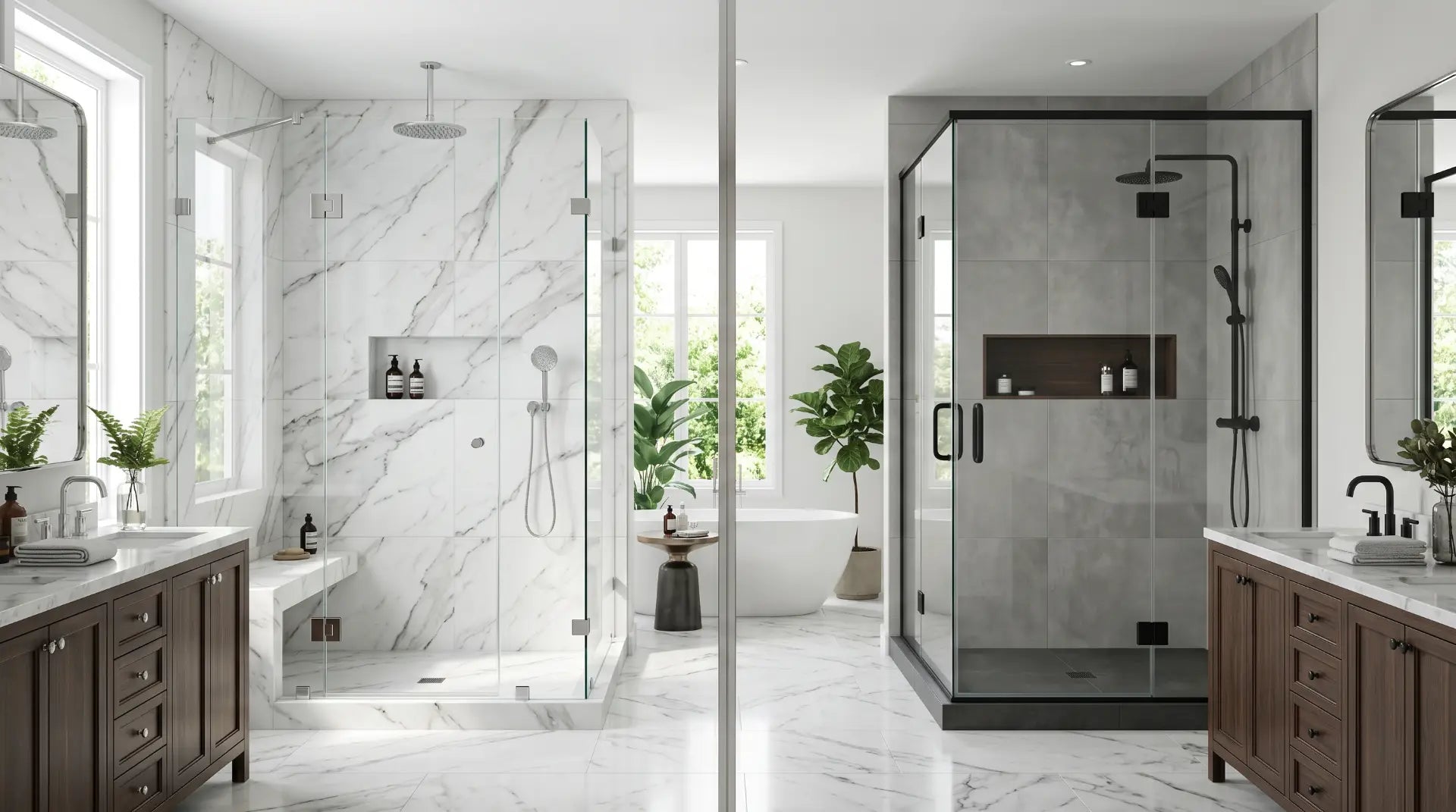
The shower door is the single most visible decision in a shower remodel - and the price gap between frameless and semi-frameless can exceed $1,500 for the same opening. This guide compares both across the 7 factors that actually matter: cost, looks, glass strength, leaks, cleaning, installation tolerances, and resale value - so you buy the right door the first time.
Walk into any newly remodeled American bathroom and the shower door tells you the budget before anything else does. A frameless glass enclosure - thick panels, no metal surround, hardware reduced to a few polished hinges - reads as custom and high-end at a glance. A semi-frameless door - slim metal around the structural perimeter, clean glass on the door panel itself - reads as modern and finished, at a noticeably lower price. Both are enormous upgrades over the fully framed sliding doors and curtain rods of the 1990s. The question is which one is the right buy for your bathroom, budget, and walls.
The honest answer is that neither door is universally better. Frameless wins on aesthetics, glass quality, cleaning, and resale presentation. Semi-frameless wins on price, water containment, forgiveness on imperfect walls, and speed of installation. The marketing around frameless doors tends to bury the second list - and the contractors quoting semi-frameless tend to bury the first. This guide puts both lists side by side, with real US pricing, so the decision becomes a calculation instead of a guess.
It also covers the two things most comparison articles skip: why frameless doors are designed to have small gaps (and what that means for water on your floor), and why the condition of your walls - not your taste - sometimes makes the decision for you.
Hold a 4-foot level vertically against both walls of the shower opening. If either wall is out of plumb by more than about 1/4 inch over the height of the door, a standard frameless door will show a visible tapered gap along that edge - and the fix is custom-cut, out-of-square glass at a meaningful upcharge. Semi-frameless and framed systems hide up to roughly 1/2 inch of wall irregularity inside their adjustable wall jambs. In older homes (pre-1980s especially), this single 2-minute check decides the comparison before price ever enters it. Tile bumps, bowed studs, and out-of-level curbs matter for the same reason - frameless glass is cut dead straight, and it does not bend to meet a wavy wall.
Buy frameless if this is a primary bathroom you'll keep for 10+ years or a remodel where resale presentation matters. Buy semi-frameless if budget, water containment, or imperfect walls are in play - it delivers most of the look for roughly half to two-thirds of the cost.
Frameless doors use thick 3/8-1/2 inch self-supporting tempered glass with no perimeter metal - the premium, custom-measured option at $1,000-$3,000+ installed. Semi-frameless doors keep slim framing around the enclosure's structural edges but leave the door panel's glass edges exposed, using 1/4 inch glass at $700-$1,600 installed. The frameless door looks better, cleans easier, and presents better at sale. The semi-frameless door seals better, installs on imperfect walls without custom glass, and frees up $500-$1,500 of budget for the part of the shower you actually feel every day - the shower system itself.
Read the 7-factor breakdown below to see exactly where each door wins - and the scenario table to match the right door to your specific bathroom.
Shower doors sit on a three-step ladder, and you can't compare the top two steps properly without seeing all three. Each step removes metal, thickens the glass, and raises the price:
| Type | What Defines It | Glass Thickness | Typical Installed Cost (US) | Best For |
|---|---|---|---|---|
| Framed | Aluminum framing surrounds every edge of every panel, including the door. The frame is structural - the thin glass depends on it. Usually sold as off-the-shelf kits with sliding (bypass) or hinged doors. | 3/16"-1/4" (4-6mm) | $300-$900 | Rentals, flips, strict budgets, tub-shower combos |
| Semi-Frameless | Metal framing remains around the structural perimeter of the enclosure (wall jambs, header or sill), but the door panel itself has exposed, polished glass edges with no metal around them. The hybrid step. | 1/4" (6mm), some 5/16" (8mm) | $700-$1,600 | Most secondary baths, value-focused remodels, imperfect walls |
| Frameless | No perimeter framing at all. Thick tempered glass is self-supporting, mounted with heavy-duty hinges, glass clips, or a minimal U-channel. Custom-measured to the opening in most installations. | 3/8"-1/2" (10-12mm) | $1,000-$3,000+ (custom corner/oversized: $3,000-$5,000+) | Primary bath remodels, resale-focused renovations, showcase showers |
Two clarifications that prevent most buyer confusion. First, "semi-frameless" does not mean half the panels are framed and half aren't - it means the structure is framed while the door's glass edges are clean. From across the room, a good semi-frameless enclosure looks remarkably close to frameless; up close, you see the slim metal along the walls and top. Second, "frameless" does not mean hardware-free - every frameless door still has visible hinges or pivots, a handle, and often small wall clips or a low-profile channel securing the fixed panel. The difference is that hardware on a frameless door is jewelry; the frame on the other two types is structure.
The cost gap comes from three places, and only one of them is the glass. First, material: 3/8-1/2 inch tempered glass costs significantly more per square foot than 1/4 inch, and frameless hardware - solid-brass hinges rated to carry an 80-100 lb panel for decades - costs far more than the aluminum extrusions and rollers of a semi-frameless kit. Second, measurement: most frameless enclosures are custom-templated to your exact opening, with the fabricator measuring plumb, level, and square at multiple points before cutting; semi-frameless doors are predominantly standard-size kits with built-in adjustability. Third, labor: hanging heavy custom glass with millimeter-level tolerances is specialist work, usually a dedicated glass company rather than a general handyman.
Realistic 2026 US numbers for a standard 48-60 inch alcove opening:
- Semi-frameless kit, DIY install: $500-$1,000 for the door, $0 labor. The genuine budget path to a modern glass look.
- Semi-frameless, professionally installed: $700-$1,600 all-in. Most installs complete in 2-4 hours.
- Frameless single door + inline panel, professionally installed: $1,200-$2,400 all-in for standard clear glass and chrome or brushed nickel hardware.
- Frameless custom (90° corner, neo-angle, oversized, low-iron glass, premium finishes): $3,000-$5,000+. Every deviation from a standard rectangle adds fabrication cost.
Price the whole shower, not just the door: A common remodel mistake is spending the entire fixture budget on frameless glass and then re-installing a builder-grade shower valve behind it. A semi-frameless door plus a quality thermostatic shower system usually costs about the same as a frameless door plus a basic mixer - and the first combination is the one you'll feel every single morning.

A frameless enclosure is visually closer to "no enclosure" than to a framed door. With no metal interrupting the sightline, the shower reads as part of the room rather than a box inside it - which is why frameless glass makes small bathrooms feel measurably larger and why designers specify it almost by default in higher-end remodels. If you've invested in tile work, a niche, or a statement shower system, frameless glass is a display case; any frame, however slim, is a picture frame drawn around part of the view.
Semi-frameless is the strong middle ground, and it's closed much of the gap over the last decade. Modern semi-frameless designs use narrow profiles in finishes that match current hardware trends - matte black semi-frameless enclosures in particular have turned the frame into a deliberate design element rather than a compromise, echoing the black-grid industrial look. Where semi-frameless visibly loses is up close: the wall jambs and header are evident at arm's length, and the 1/4 inch glass has a slightly less substantial presence than 1/2 inch panels.
One honest design note in semi-frameless's favor: if your bathroom style is intentionally framed - black-trim industrial, transitional with mixed metals - a matte black semi-frameless door can be the better aesthetic choice, not the cheaper one. Frameless wins the minimalist and spa looks; it doesn't automatically win every look.

Frameless doors use 3/8 inch (10mm) or 1/2 inch (12mm) tempered glass because the glass must support itself - there's no frame doing structural work. The byproduct of that engineering requirement is the tactile quality buyers notice immediately: a frameless door swings with a solid, vault-like heft, doesn't flex or rattle, and closes with a damped, substantial sound. Semi-frameless doors use 1/4 inch (6mm) glass that leans on the frame for rigidity; it's perfectly safe and durable, but a sliding semi-frameless panel can exhibit slight flex and rattle in daily use, especially as rollers and guides wear.
On safety, the two are equals, and this matters more than thickness: every shower door legally sold in the US must use safety glazing - tempered or laminated glass meeting the federal CPSC 16 CFR 1201 standard (look for the etched safety label in a corner of the glass). Tempered glass of any thickness breaks into small granular pebbles rather than dagger shards. Spontaneous breakage - usually from microscopic nickel-sulfide inclusions or edge damage during handling - is rare and can occur with either door type; buying from a reputable fabricator and never letting hard objects strike the exposed glass edges keeps the already-low risk low.
- Longevity of the glass: Tempered glass itself doesn't wear out - a quality glass panel is a 20+ year component on either door type.
- Longevity of what holds it: This is where they diverge. Frameless brass hinges typically need nothing beyond an occasional set-screw check. Semi-frameless moving parts - rollers, guides, vinyl seals - are wear items with a 5-10 year service life, though replacements are cheap ($10-$40) and DIY-friendly.
- The weight caveat: That premium 80-100 lb frameless panel hangs its entire load on 2-3 hinges anchored into your wall. Hardware quality and anchoring into solid blocking (not just tile and drywall anchors) determine whether a frameless door is a lifetime door - covered in Factor 6.

This is the most under-disclosed fact in the shower door market: a frameless door is splash-resistant, not watertight. Because thick glass panels can't ride inside sealed channels the way framed glass does, frameless enclosures are engineered with small deliberate clearances - typically 1/8 to 3/16 inch at the hinge side, the strike side, and under the door (managed by a clear polycarbonate sweep). Direct, sustained spray at those gaps will push water through. Droplets on the floor near the hinge gap after a shower are normal frameless behavior, not an installation defect - a fact buried in most manufacturers' fine print and a recurring surprise in owner reviews.
Semi-frameless doors seal meaningfully better. The framed structural perimeter closes the wall and top/bottom edges completely, and vinyl seals on the door edges close most of the rest. A properly installed semi-frameless enclosure keeps water containment close to fully-framed levels - which is why it remains the practical choice for kids' bathrooms, high-traffic family baths, and any shower where the spray pattern can't be controlled.
How to make a frameless door behave - 3 rules that prevent 95% of complaints:
- Aim the water at the walls, not the door. Fixed shower heads should point toward tiled walls or the back of the enclosure. If you're pairing the door with a new system, this is worth planning at the same time - our rain head vs handheld comparison covers spray patterns and placement in detail. Ceiling-mounted rain heads that fall straight down are the most frameless-friendly configuration of all.
- Hinge the door away from the spray. The hinge-side gap is the most leak-prone point. Configure the door so the hinge side is the far side from the shower head.
- Keep the sweep and seals fresh. The bottom sweep and any clear edge seals are $10-$25 parts that harden over 3-5 years. Replacing them restores the door to day-one containment in 10 minutes.

Ask anyone who has owned a framed or semi-frameless slider for a decade what they'd change, and the answer is rarely the look - it's the track. Metal channels and frame profiles are where shower grime lives: soap scum films the extrusions, hard water scales the rollers, and the bottom track of a sliding door collects standing water that breeds mildew in corners no brush quite reaches. Semi-frameless designs reduce this dramatically versus fully framed (the door panel itself wipes clean like frameless glass), but the perimeter framing and any header/sill channels remain cleaning work - typically a monthly detail job with an old toothbrush.
A frameless enclosure is glass, hinges, and a handle. The entire surface squeegees in 20 seconds, there is nowhere for water to pool, and the small amount of hardware wipes clean. Over a 15-year ownership window, this is the difference between hundreds of track-scrubbing sessions and none - a quality-of-life gap that owners consistently rank above the aesthetic gap.
The maintenance routine that keeps either door looking new:
- Daily (20 seconds): Squeegee the glass after the last shower. This single habit prevents ~90% of hard-water spotting and soap scum buildup - and matters most in hard-water markets like Phoenix, Las Vegas, Dallas, and Southern California.
- Weekly (2 minutes): Spray a 50/50 white vinegar and water mix, let it sit 5 minutes, rinse, squeegee. Dissolves mineral film before it etches. (Skip vinegar on natural stone surrounds - use a stone-safe cleaner instead.)
- At purchase: Order factory hydrophobic coating (ShowerGuard, EnduroShield, Diamon-Fusion or similar, typically $100-$300) or apply a DIY glass sealant. Coated glass sheets water off instead of spotting and roughly halves cleaning effort for years.
- Every 3-5 years: Replace vinyl sweeps/seals (both types) and check rollers and guides (semi-frameless sliders). $10-$40 in parts, DIY.

Frameless glass is cut perfectly straight, and it meets your wall exactly as your wall is. If the wall leans 3/8 inch out of plumb over the door height - completely common in homes built before modern framing tolerances, and not rare in new construction either - a standard rectangular frameless panel will show a wedge-shaped gap that no caulk can hide. The fixes are custom out-of-square glass (fabricated to match the wall's lean, at an upcharge) or corrective wall work before measuring. Frameless installs also demand a level curb, flat tile at the mounting points, and - critically - hinge anchoring into solid structure. A 90 lb door cantilevered on hinges anchored only into tile and drywall will sag within years; proper installs hit wood blocking or studs, which is why frameless should be planned before the walls close up in a full remodel.
Semi-frameless systems are engineered for real-world walls. Their wall jambs include built-in adjustment - typically absorbing up to about 1/2 inch of out-of-plumb per side - and the frame distributes the (much lighter) load across the full mounting rail rather than concentrating it on hinge points. This is why a semi-frameless door can be confidently installed on 1970s walls in an afternoon, while a frameless door on the same opening needs a template visit, a 1-2 week fabrication wait, and a specialist crew.
Real estate agents consistently flag the primary bathroom as a make-or-break room in showings, and the shower enclosure is its most photographed element. A frameless enclosure photographs as open space and reads as a recent, premium renovation; buyers don't itemize "1/2 inch glass with brass hinges," they register updated. In mid-market and upper-market homes - and in any market where competing renovated listings feature frameless glass - a framed or dated enclosure can make an otherwise solid bathroom feel like a future project to buyers, which is exactly the impression that costs money at the negotiating table.
The honest caveats: no one should expect a shower door to "return" its cost in isolation - it contributes to the overall bathroom remodel's value, where midrange bathroom remodels historically recoup roughly 65-75% of cost at resale per industry cost-vs-value studies. And the resale logic is price-tier dependent. In starter homes, rentals, and lower-priced markets, a clean modern semi-frameless enclosure presents as fully updated, and the $1,000+ frameless premium is unlikely to move the sale price at all. Spend to the neighborhood, not to the brochure.
Selling within 2 years? If the existing enclosure is structurally fine but dated, a deep restoration (descaling the glass, re-caulking, replacing sweeps, polishing or painting hardware) plus a modern shower trim swap often delivers most of the showing-day impact of a new door for under $300. Save the frameless investment for a bathroom you'll actually live with.
| Factor | Semi-Frameless | Frameless | Edge |
|---|---|---|---|
| Installed cost (standard alcove) | $700-$1,600 | $1,000-$3,000+ ($3,000-$5,000+ custom) | Semi-Frameless |
| Glass thickness | 1/4" (6mm), frame-supported | 3/8"-1/2" (10-12mm), self-supporting | Frameless |
| Look & sightlines | Slim perimeter metal visible; door glass clean | Uninterrupted glass; showcase aesthetic | Frameless |
| Water containment | Near-watertight with seals and frame channels | Designed gaps (1/8"-3/16"); splash-resistant only | Semi-Frameless |
| Cleaning effort | Door wipes clean; perimeter frame needs detail work | Squeegee-only; no tracks or channels | Frameless |
| Wall tolerance | Adjustable jambs absorb ~1/2" out-of-plumb | ~1/4" max; beyond that, custom-cut glass | Semi-Frameless |
| Installation | Same-week, 2-4 hrs, DIY-possible | Template + 1-3 wk fabrication, specialist crew | Semi-Frameless |
| Long-term hardware | Rollers/guides/seals wear in 5-10 yrs (cheap to replace) | Brass hinges effectively lifetime with occasional adjustment | Frameless |
| Resale presentation | Reads as updated in most price tiers | Reads as premium renovation; strongest in mid/upper tiers | Frameless |
| Safety glazing | Tempered, CPSC 16 CFR 1201 | Tempered, CPSC 16 CFR 1201 | Tie |
Score it and the pattern is clear: frameless wins everything you see and feel - aesthetics, glass quality, daily cleaning, resale impression. Semi-frameless wins everything practical - price, water containment, tolerance for real walls, speed. That's why the right answer depends on the bathroom, not on a universal ranking.
Find the row that describes your project - this table resolves the decision for the large majority of buyers:
If you landed on different rows for the same bathroom - say, a primary bath remodel (frameless) in an older house with leaning walls (semi-frameless) - the tiebreaker is whether walls are opening up. In a full gut remodel, correct the walls and add hinge blocking while they're open, then buy frameless. In a door-swap-only project, the walls you have decide: beyond ~1/4 inch out of plumb, semi-frameless is the engineering-correct answer, not the consolation prize.
Once you've picked frameless or semi-frameless, four spec decisions determine how the door actually looks, works, and ages. Get these right and either door type performs at its best:
Clear is the default and the right call for most showers - it maximizes light and shows the tile. Note that standard clear glass has a faint green tint (from iron content) that becomes visible at 1/2 inch thickness; low-iron glass (often sold as Starphire or HD glass, typically a 10-20% upcharge) removes the green cast and is worth it next to white tile or marble. Frosted, rain-textured, and fluted glass trade some light for privacy and also hide water spots far better - a practical pick for shared bathrooms and hard-water regions. Whatever you choose, confirm the tempered safety-glazing etch mark in a corner of every panel.
Hinged/pivot doors (the frameless standard) give the widest opening and the cleanest look; building practice requires shower doors to open outward (or both ways) so a person can never be trapped inside, which means you need clear swing space in front of the shower - typically plan for the door width plus a couple of inches. Sliding/bypass doors (the semi-frameless strength) need zero swing clearance, making them the answer for tub combos and tight floor plans; frameless "barn-style" sliders with exposed top rollers split the difference, offering thick glass with no swing - at frameless pricing. As a rule of thumb, keep hinged door panels in the 22-36 inch width range: the IRC requires at least a 22-inch clear shower opening, and panels much beyond 36 inches get heavy enough to strain standard hinges.
Chrome and brushed nickel remain the volume leaders; matte black and brushed gold are the trend finishes commanding upcharges. The rule from Factor 2 bears repeating because it's the most common error: match the door hardware to the shower trim, towel bars, and faucet finish already in the room - one metal family per bathroom. On frameless doors specifically, pay for solid-brass hinges over zinc-alloy; the hinge is the entire structural system and the worst place to economize. On semi-frameless sliders, look for stainless or anodized-aluminum top tracks and serviceable (replaceable) roller assemblies.
Factory-applied hydrophobic coatings (ShowerGuard and EnduroShield are the common names, usually $100-$300 per enclosure) bond to the glass and make water sheet off rather than dry into mineral spots. In hard-water markets, this is the single highest-value add-on for either door type - it roughly halves cleaning effort for the life of the coating. DIY-applied sealants cost $15-$30 and work meaningfully, but need reapplication every 6-12 months.
Semi-frameless: genuinely DIY-able for a capable homeowner. Kits ship with adjustable wall jambs, pre-drilled hardware, and instructions written for non-professionals. The required skills are accurate measuring, drilling into tile (use a carbide or diamond bit, painter's tape over the mark, low speed, no hammer mode), keeping the jambs plumb, and a clean caulk line. Budget 3-5 hours for a first-timer and recruit a second pair of hands for holding panels. The two failure points to respect: measure the opening at top, middle, and bottom (openings are rarely identical at all three), and caulk per the manufacturer's diagram - sealing weep holes or the wrong channel edges traps water inside the frame.
Frameless: hire the specialist. This is not gatekeeping - it's physics and economics. The panels weigh 80-100 lbs each and chip or shatter if an edge taps tile during handling; the hinges must anchor into solid blocking; the tolerances are millimeter-level; and a mis-measured custom panel is a non-returnable several-hundred-dollar mistake. Professional frameless installation typically adds $300-$600 to the glass cost, includes the template measurement (transferring measurement liability to the installer), and usually carries workmanship warranty on top of the glass warranty. The exception: experienced DIYers installing a standard-size frameless kit (some big-box frameless kits use 3/8 inch glass in stock sizes) on known-plumb walls with accessible blocking - possible, but a two-person job with zero margin for error.
| Task | Skill Level | Time | Typical Labor Cost If Hired | DIY? |
|---|---|---|---|---|
| Semi-frameless kit install | Confident DIY (drill into tile, level, caulk) | 3-5 hrs first time | $200-$500 | Yes |
| Frameless custom enclosure | Specialist glazing crew | Template visit + 3-5 hr install | $300-$600 (often bundled with glass) | Hire it out |
| Frameless stock-size kit | Experienced DIY, 2 people, plumb walls | 4-6 hrs | $250-$500 | Either |
| Sweep/seal/roller replacement (any door) | Basic | 10-30 min | - | Yes |
Frameless for the primary bath you'll keep and the remodel you'll sell. Semi-frameless for everything else - and for any wall a level says isn't straight.
If this is the bathroom you use every morning for the next decade, or the renovation that will headline your listing photos, buy frameless: the 3/8-1/2 inch glass, uninterrupted sightlines, squeegee-only cleaning, and lifetime-grade hinges are exactly the kind of premium that compounds with daily use. Accept its two honest trade-offs going in - it costs $500-$1,500+ more installed, and it is splash-resistant rather than watertight, with small designed gaps that demand sensible showerhead placement.
If the project is a secondary bath, a rental, a tub combo, a sub-$1,000 door budget, or a house whose walls fail the 2-minute level test - buy a quality semi-frameless door without hesitation or apology. It contains water better, installs the same week on the walls you actually have, and delivers most of the modern glass look at 50-70% of the cost. Then put the difference where it changes every shower you take: the system behind the glass. A semi-frameless door paired with a thermostatic shower system beats a frameless door paired with a builder-grade valve in daily experience, every single time.
Whichever door you choose, spec it once and spec it right: matched hardware finish, tempered safety-glazing etch confirmed, hydrophobic coating in hard-water markets, and - for frameless - hinge blocking planned before the walls close. Browse Bathify's shower systems collection to complete the enclosure from the inside out. Free shipping on orders over $50 to the continental US.


