







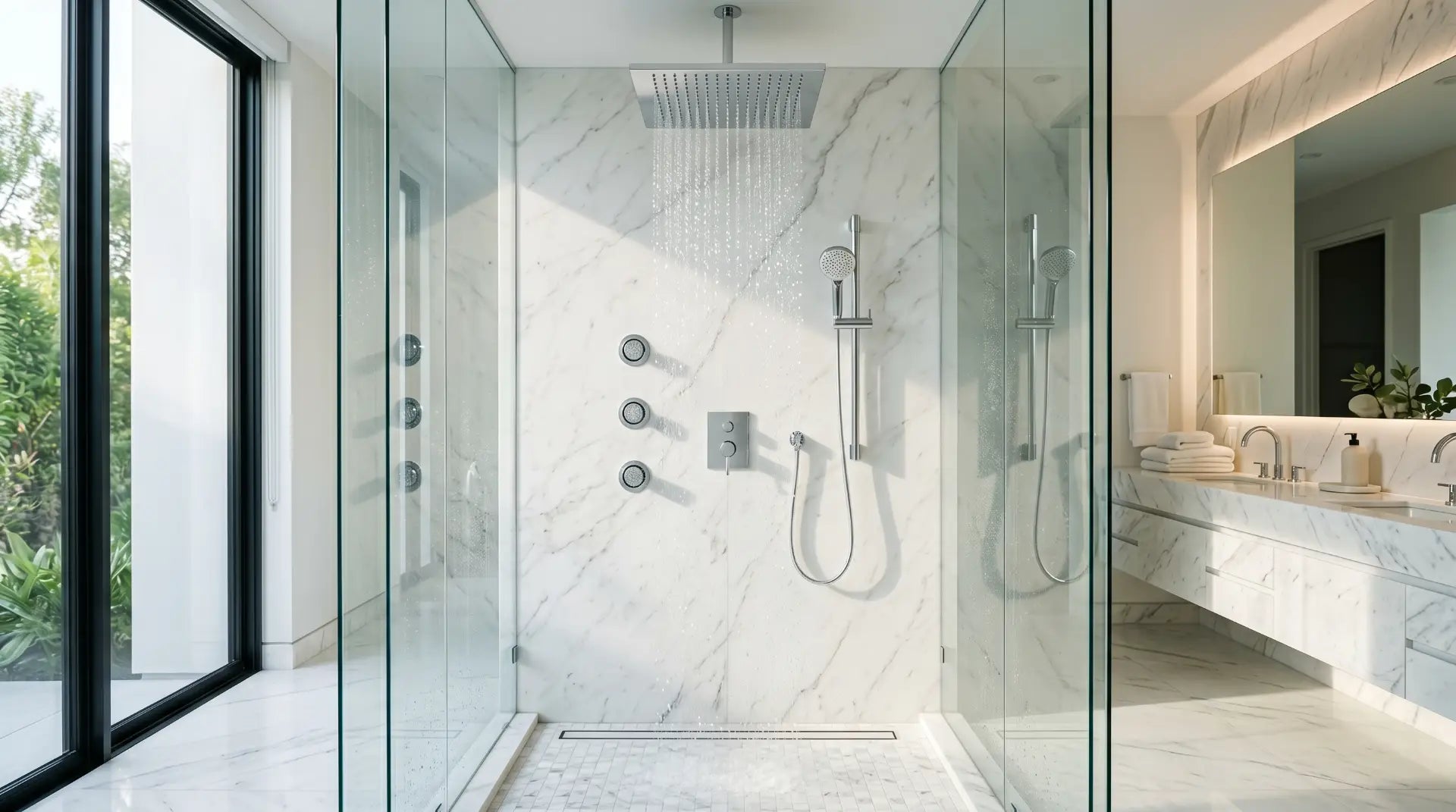
Every shower system type explained - from a single rain head upgrade to a full thermostatic multi-outlet spa configuration - with the plumbing requirements, pressure math, finish guidance, and specific product picks that make every decision clear before you spend a dollar.
A shower systems buying guide for 2026 needs to answer a question that most guides fail to ask: what is your water supply actually capable of delivering? Before the design conversation, before the valve type, before the rain head diameter - the GPM available at your shower location determines which system configurations will work and which ones will disappoint regardless of how much you spend on the fixtures. This guide starts with that constraint and builds the decision framework from there.
The shower upgrade market in the US spans an enormous range - from a $75 rain head that threads onto your existing shower arm in 10 minutes, to a $3,000+ KubeBath multi-outlet thermostatic system requiring new in-wall rough-in, an electrician for LED lighting, and a week of contractor work. Both are legitimate choices; they serve completely different bathrooms, budgets, and renovation scopes. The buying mistake happens when someone applies the logic of one tier to a decision in another - buying a multi-outlet panel without the water pressure to support it, or installing a ceiling rain head in a shower where the ceiling height makes it impractical.
This guide covers every shower system type available in the US market, with the technical reality behind each one - including the content gaps most competitors skip: the GPM math that determines simultaneous outlet viability, the real difference between pressure-balancing and thermostatic valves beyond "one is more expensive," the finish durability chart for shower environments specifically, and why a $359 KubeBath Aqua Piazza 20" rain head at Bathify delivers a noticeably better experience than a $45 big-box rain head despite looking similar in product photos.
Buy a $10 water pressure gauge at any hardware store, thread it onto a hose bib or laundry faucet, and check your home's static pressure. Target range for a full shower system is 45-80 PSI. Under 35 PSI and you'll struggle to run a single good rain head with satisfying volume. Over 80 PSI and you need a pressure reducer before adding multiple outlets. This 5-minute test eliminates the most expensive shower system mistake in the market.
For most US homeowners doing a master bath upgrade: a 12"-20" rain head + handheld combo on a thermostatic valve is the best value-to-experience ratio available. For renovation budgets under $500: a quality rain head replacement. For full spa systems: plan the plumbing before choosing fixtures.
The shower systems market divides cleanly into three upgrade paths. Path 1: a rain head swap - no plumbing change, $150-$400 in parts, done in a weekend. Path 2: a complete shower system (rain head + valve + handheld, sometimes body jets) requiring a licensed plumber and rough-in work - $400-$1,500 in fixtures plus $600-$1,500 in labor. Path 3: a shower panel - a freestanding wall-mount unit that connects to your existing supply without in-wall rough-in, making it the closest thing to a full multi-outlet system without a plumber.
Which path is right depends on what your existing plumbing allows, what your bathroom's water pressure supports, and what scope of disruption you're willing to accept. The sections below walk through every component in detail - starting with the six system types, then the valves, then the pressure math that determines what's possible in your specific home.
Every shower system falls into one of six configurations. Understanding what each type is - and isn't - before looking at any specific product eliminates most buying mistakes.

A large-format overhead shower head - typically 8"-20"+ in diameter - installed on either a wall arm extension or a ceiling arm. Delivers a wide, drenching spray that simulates natural rainfall. The defining characteristic is area coverage, not pressure. Rain heads work best at low-to-medium flow that spreads evenly across the face - not at high pressure that would concentrate streams. The single-head configuration connects to your existing valve: no new rough-in required if you're keeping the valve.
Best for: Master bath upgrades, open-plan walk-in showers, anyone wanting spa feel without a plumber. Budget: $150-$1,200 depending on size and construction quality.

A complete shower system including a rain head, a diverter valve (usually pressure-balancing), and a separate handheld sprayer on a slide bar or hook. The diverter routes water to either outlet - or on better systems, to both simultaneously (requiring adequate pressure). This is the most common "shower system" format sold in the US and the upgrade that delivers the biggest daily quality-of-life improvement per dollar. The KubeBath Aqua Rondo system at Bathify fits this configuration.
Best for: Most primary bathrooms. Complete system in a box - valve, rain head, handheld, slide bar. Budget: $300-$800 complete.

A tall vertical panel (typically 36"-60" high, 8"-14" wide) that mounts to the shower wall and connects to your existing hot/cold supply connections. Contains an integrated rain head (top), body jets (mid-panel), and a handheld sprayer - all in one self-contained unit. The critical advantage: the entire panel connects to your existing two-supply hookup with no new in-wall rough-in. The diverter is built into the panel. True multi-outlet experience achievable without tearing open walls.
Best for: Rental properties, homes where wall opening is not feasible, anyone wanting multi-outlet without plumber scope. Budget: $200-$1,500.

The full spa-level configuration: a thermostatic valve controls water temperature independently from volume; individual volume controls activate each outlet independently (rain head, handheld, body jets, or a secondary rain head). Enables running multiple outlets simultaneously while maintaining precise temperature control. Requires dedicated in-wall rough-in for each outlet, a thermostatic valve rated for the number of outlets, and adequate home water pressure/volume to support the load. KubeBath's Aqua Piazza 40" Dual Rain Head system at $1,290.99 fits this tier.
Best for: Master bath full remodels, larger shower enclosures (48" × 48"+), homeowners doing full plumbing rough-in anyway. Budget: $800-$3,000+ fixtures; $600-$1,500 additional labor.

A large-format rain head (typically 12"-24") mounted flush with or recessed into the ceiling directly above the shower position. Requires plumbing supply run through the ceiling or a long ceiling arm from the wall - either way, more installation scope than a wall-arm rain head. The payoff: a truly immersive overhead rainfall experience that wall-mount arms never fully replicate, because gravity-fed water falls straight down rather than angled from a wall arm. Best combined with a thermostatic valve and handheld outlet.
Best for: New-build master baths, full remodels where ceiling work is already open. Budget: $400-$1,500 head alone; labor varies significantly by ceiling construction.

The most accessible shower upgrade: remove the existing shower head by hand or with a wrench, wrap the shower arm threads with Teflon tape, and thread on the new rain head. Keeps your existing valve and supply plumbing entirely unchanged. The ceiling for this configuration is your existing water pressure and the ½" NPT fitting on your current shower arm - if the rain head is too large/heavy for the arm, you'll need a new arm too (simple $20-$60 part, same DIY scope).
Best for: Budget-first upgrades, rental properties, homeowners who want to test rain head experience before committing to a full system. Budget: $75-$400 for the head alone.
Rain shower heads deliver their signature experience through area coverage - water spread across a large face at moderate flow - not through pressure. This is the single most important thing to understand about rain heads before buying one. If you set expectations for high-pressure pulsating massage, a rain head will disappoint. If you set expectations for a warm, enveloping overhead downpour that evenly saturates the body, a properly sized rain head in a well-designed shower is unmatched.
At 6"-8" diameter, most "rain heads" produce a focused wide spray that's noticeably different from a standard head but doesn't produce immersive rainfall coverage. You can feel exactly where the spray zone ends. At 10"-12", coverage improves meaningfully - the full torso gets wet simultaneously for most adults. At 16"-20" and above, the experience changes qualitatively: water surrounds the entire body at once, with the outer edges of the spray face delivering gentle coverage while the center provides denser flow. The KubeBath Aqua Piazza 20" Super Slim Square Rain Head at $359.99 at Bathify sits in the sweet spot - 20 inches is large enough for genuine immersive coverage at standard US residential water pressure.
Wall-mount rain heads use an extension arm (typically 10"-20" long) that extends horizontally from the wall supply and then angles down - the head sits above and in front of the user. The experience is excellent with a quality arm, though the water always arrives at a slight angle rather than truly vertical. Ceiling-mount rain heads connect to a ceiling supply and deliver water straight down - the most immersive configuration. Ceiling mount requires either a dedicated supply rough-in through the ceiling or a very long S-curve arm extending from a high wall-mount position. For new construction or full remodels where the ceiling is already open, ceiling mount is the better choice; for existing shower retrofits, wall-arm mount is far more practical.
Budget rain heads under $100 almost universally use ABS plastic internal waterways, which are functionally adequate but develop calcium buildup faster than brass and are more prone to nozzle deterioration over time. Quality rain heads like KubeBath's Aqua Piazza use solid brass waterway construction - the same material standard as premium faucets. Solid brass handles mineral-rich water (hard water is common in Phoenix, Las Vegas, Denver, Dallas, and Los Angeles) significantly better, and silicone nozzle tips on the spray face - which KubeBath uses - allow calcium deposits to be wiped away with a finger rather than soaked in vinegar or replaced.
For hard water markets (Phoenix, Las Vegas, Denver, LA, Dallas): Silicone nozzle tips on rain shower faces are not a premium feature - they're a maintenance requirement. Every shower head nozzle eventually clogs from mineral deposits in hard water. Silicone tips (rubber spray holes that deform slightly under water pressure) shed deposits when you rub them with your thumb during the shower. Ceramic or fixed plastic nozzles require soaking the head in white vinegar every 3-6 months to maintain flow quality. This single spec difference justifies significant price premiums in hard water regions.
Shower panels are the most misunderstood product category in the shower systems market. The marketing presents them as "full spa systems" - rain head, body jets, handheld, and sometimes waterfall, all in one sleek unit - without clearly explaining the critical limitation: they connect to a standard two-supply (hot/cold) connection, which means the total flow available to all outlets combined is whatever your existing single shower supply delivers. At 2.0 GPM (the federal limit for a single head), distributing that flow across a rain head, three body jets, and a handheld simultaneously produces minimal pressure from each individual outlet.
The diverter valve built into most shower panels directs flow to one outlet at a time - so when you're using the rain head, you get full flow to the rain head; when you switch to body jets, full flow goes to the jets. In sequential-use mode rather than simultaneous mode, panels perform exactly as described. The rain head at the top typically delivers a reasonable overhead experience; the body jets in sequential mode provide actual pressure. The practical reality of most homeowners' use patterns - not running all outlets simultaneously - means shower panels work well as marketed if you understand this limitation.
The panel mounts to the shower wall and connects to your existing hot and cold supply shutoffs - the same connections your current shower valve uses. A plumber's involvement for panel installation is optional (it's within DIY scope for homeowners comfortable with basic plumbing) and typically costs $150-$300 if hired, versus $600-$1,500 for a full in-wall system rough-in. For renters, homes with tile that can't be opened, or bathrooms where budget doesn't support full system scope, shower panels are the practical path to a multi-outlet configuration.
Handheld shower heads are consistently the most underappreciated component in shower system buying decisions - they're treated as a secondary add-on, yet in daily household use they're often the most-used outlet in the system. Bathing children, washing pets, rinsing hair while standing, cleaning the shower itself, and directed rinsing for injuries or post-surgery all become dramatically easier with a quality handheld than a fixed head alone.
A complete rain head + handheld system - the configuration the KubeBath Aqua Rondo system at Bathify represents - covers virtually every showering need that exists in a household with adults, children, and seniors. The rain head provides the immersive daily shower experience; the handheld provides the directed utility that a fixed head can never replicate. The combination costs no more in plumbing scope than a standalone rain head and delivers a fundamentally more functional shower.
Hose quality matters more than buyers expect: a cheap braided hose kinks, tangles, and develops leaks at the connections within 2-3 years. KubeBath's systems use double-interlocked stainless steel hoses - the same construction as premium plumbing connectors - that resist kinking and maintain flexibility through thousands of uses. The slide bar mounting allows height adjustment for users of different heights, making the system genuinely accessible for everyone in the household from children to tall adults.
Body jets - the horizontal spray nozzles mounted at torso height on shower walls, designed to deliver a massage-like experience to the back and shoulders - require more plumbing infrastructure than any other shower component. Each body jet needs its own supply line run from the rough-in valve. A typical configuration of 6-8 body jets at 0.25-0.5 GPM each consumes 1.5-4 GPM of additional water flow simultaneously - which, combined with an overhead rain head, can push total system demand to 4-6 GPM or more. The standard residential hot water heater produces 10-12 gallons per minute maximum, and the supply pipes to most US showers are ¾" or ½" runs that throttle flow before it even reaches the valve.
The honest assessment: body jets as a primary shower feature work excellently in well-designed systems with adequate supply plumbing - the KubeBath Aqua Piazza system at Bathify demonstrates this - but require a realistic conversation with a plumber about your home's actual supply capacity before committing. In a 1950s ranch house with ½" galvanized supply pipes running across 40 feet of basement ceiling, 6 body jets running simultaneously may produce 0.2 PSI of outlet pressure at each nozzle - enough to make a sound but not enough to feel. In a new build or a home with dedicated ¾" PEX supply to the shower, body jets work exactly as designed.
The valve is the heart of any shower system. It's hidden in the wall, it controls water temperature and flow, and the wrong valve choice limits what the system can do regardless of how much you spend on the heads. Most homeowners underinvest in the valve and overinvest in the visible fixtures - a mistake that produces either safety problems (scalding from pressure-balance failures) or functional limitations (inability to run multiple outlets simultaneously) that no fixture upgrade can fix.
A pressure-balancing valve mechanically maintains the ratio of hot to cold water regardless of supply pressure fluctuations - so when someone flushes a toilet elsewhere in the house (dropping cold supply pressure), the valve automatically reduces hot water volume proportionally to maintain the same hot/cold ratio and prevent scalding. This is the safety function. What it does not do: maintain a specific temperature. If the incoming hot water temperature changes (as it does with distance from the water heater, or as the heater's thermostat cycles), the outlet temperature changes too.
Pressure-balancing valves control both temperature (via the ratio of hot to cold) and total flow with a single handle. They typically support one or two outlets via a built-in diverter. They're the right valve for: single-outlet systems (standalone rain head or rain head + handheld), budget-constrained systems, and any shower where multiple simultaneous outlets are not required. Virtually every pre-2000 US home with a single shower handle has a pressure-balancing valve already installed - and for a standard rain head swap, no valve change is needed at all.
A thermostatic valve maintains a user-set temperature precisely and independently of supply pressure fluctuations - it continuously measures the outlet water temperature and adjusts the hot/cold mixing in real time to hold the target temperature exactly. The temperature control is separate from the volume controls, meaning you can set temperature once (say, 104°F) and it stays there. Individual volume controls then activate each outlet independently, and the temperature holds regardless of which outlets are running or what's happening elsewhere in the plumbing.
This independent control architecture is what enables true multi-outlet simultaneous operation: you can run the ceiling rain head + handheld + body jets simultaneously, each at its own set volume, all at the same temperature. Thermostatic valves are more expensive ($200-$600 for the valve alone vs. $50-$200 for a pressure-balancing valve) and require in-wall installation by a plumber. They're the right choice for: any system with 3+ outlets, master bath full remodels, households where consistent temperature matters (families with young children or elderly users), and any configuration where simultaneous outlet operation is desired.
| Feature | Pressure-Balancing | Thermostatic |
|---|---|---|
| Temperature consistency | Maintains ratio (not exact temp) | Maintains exact target temperature |
| Scald protection | Yes - code minimum | Yes - more precise |
| Simultaneous outlets | 1-2 max (diverter switches) | 2-6+ (independent volume controls) |
| Controls | Single handle (temp + volume) | Separate temp + individual volume controls |
| Valve cost | $50-$200 | $200-$600+ |
| Installation | Standard - most plumbers · Some DIY capable | Licensed plumber required |
| Best for | Simple systems: 1 rain head or rain + handheld | Multi-outlet systems: 3+ outlets, full spa configurations |
| Hot water wait time | Varies by distance from heater | Faster response - thermostat pre-mixes hot water |
GPM - gallons per minute - is the flow rate specification on every shower head and system component. The federal maximum for shower heads sold in the US is 2.0 GPM (established by EPAct 1992, enforced by federal law). California, Colorado, and New York cap at 1.8-2.0 GPM depending on product type. WaterSense-certified shower heads are rated at 2.0 GPM or less. This ceiling is the same for all shower heads: the $45 hardware store head and the $400 KubeBath head both operate within it. What differs is how they distribute that 2.0 GPM - the quality of the spray face, nozzle design, and air entrainment technology that makes 2.0 GPM feel like more or less water depending on execution.
Every outlet in a shower system draws from the same supply. A rain head rated at 2.0 GPM + a handheld at 1.8 GPM = 3.8 GPM total demand when running simultaneously. Your home's shower supply pipe (typically ½" copper or ¾" PEX) has a maximum flow capacity of roughly 3-5 GPM at normal residential pressure. Add body jets and you can easily exceed the supply pipe's practical capacity - which produces the scenario where every outlet runs at partial volume simultaneously, and the combined experience is worse than a single good head alone.
| Home Pressure (PSI) | Single Rain Head | Rain + Handheld | 3 Outlets | 4+ Outlets |
|---|---|---|---|---|
| 30-40 PSI (Low) | Marginal - upgrade pressure first | Not recommended | Not viable | Not viable |
| 40-55 PSI (Moderate) | Works well | Works - sequential | With pressure-boost | Not reliable |
| 55-70 PSI (Standard) | Excellent | Excellent - can run simultaneously | Works well | Possible with good valve |
| 70-80 PSI (High) | Best experience | Best experience | Works excellently | Good with thermostatic valve |
| 80+ PSI (Very High) | Install pressure reducer first | Install pressure reducer first | Install pressure reducer first | Install pressure reducer first |
Shower environments are uniquely demanding on fixture finishes - daily water exposure, soap residue, shampoo chemicals, hard water minerals, and steam cycling create conditions that degrade finishes faster than any other residential application. The finish that looks identical to a kitchen faucet in product photos may perform very differently over 5-10 years when subjected to daily shower conditions.
| Finish | Shower Durability | Hard Water Behavior | Cleaning Ease | Best For |
|---|---|---|---|---|
| Chrome (polished) | Excellent - the benchmark standard | Shows spots but wipes clean easily | Very easy - smooth surface | Any shower; universal match; most affordable |
| Matte Black | Good with quality PVD coating | Shows white deposits prominently - requires frequent wiping in hard water areas | Moderate - spots show on dark flat surface | Modern and contemporary; soft water markets or frequent cleaners |
| Brushed Nickel | Very good - texture hides minor deposits | Better than chrome - texture conceals water spots | Easy - textured surface forgives deposits | Most popular US finish; transitional and contemporary styles |
| Brushed Gold / PVD Gold | Excellent with PVD; poor with lacquer | Shows deposits readily - daily wiping required in hard water | Moderate - spots very visible on gold | Luxury master baths; low-hard-water markets |
| Oil Rubbed Bronze | Variable - depends on coating type | Living finish - develops patina including deposits | Difficult - cleaning agents strip living finishes | Traditional and rustic baths; low-maintenance expectations |
| Stainless Steel (brushed) | Excellent - resists corrosion natively | Hides deposits well; easy to clean | Easy - wipe clean | Industrial and contemporary styles; excellent longevity |
PVD (Physical Vapor Deposition) coating is the finish technology that determines long-term durability on all colored finishes (matte black, brushed gold, brushed bronze). PVD-coated finishes are harder than traditional lacquer-over-brass, more scratch-resistant, and significantly more resistant to the chemical exposure of shower environments. KubeBath uses durable chrome finish on the Aqua Piazza line. When evaluating any colored finish, confirm PVD coating - it's the difference between a finish that looks the same after 10 years and one that bubbles, flakes, or oxidizes within 3-5 years in a daily-use shower.
Bathify carries KubeBath's full Aqua Piazza and Aqua Rondo shower system lineup - German-engineered solid brass construction, silicone calcium-release nozzle tips, and clean geometric proportions in both lines. Here are the key configurations:
The master bath is where shower system investment pays the highest daily return - it's the primary use toilet, used by adults who'll notice and appreciate quality differences, and where design intent matters for resale value. The right configuration for most master baths is: a 12"-20" rain head as the primary outlet, a handheld for utility and flexibility, and a thermostatic valve if budget allows (or a quality pressure-balancing valve if not). Chrome, brushed nickel, or brushed gold finishes work well here. KubeBath's Aqua Piazza and Aqua Rondo lines at Bathify are designed for exactly this application - German-engineered quality at a price point accessible to a remodel budget without contractor-grade system scope.
Guest bathrooms see less daily use from dedicated users who know the system - which means usability simplicity matters more here than feature richness. A single high-quality rain head on a clean arm, in chrome (the most universally understood and easiest to clean finish), provides a premium guest experience without the complexity of a multi-outlet system. Add a basic handheld if the shower also sees family use for children or pets. No thermostatic valve needed here - pressure-balancing is appropriate and significantly reduces system cost.
For dedicated children's bathrooms, a handheld is not optional - it's essential. A fixed rain head alone makes hair-washing for young children unnecessarily difficult. A combination of a modest fixed head plus a quality handheld on a slide bar (adjustable from 36" to 72" height) serves children through multiple growth stages. Chrome or brushed nickel finish. Pressure-balancing valve with scald protection (a standard code requirement for all new installations, but worth confirming on older existing valves that may predate the 1993 federal scald-protection mandate).
| System Type | Outlets | New Rough-In? | Valve Type | Pressure Needed | Best For | Approx Fixture Cost |
|---|---|---|---|---|---|---|
| Single rain head swap | 1 | No | Existing valve | 45+ PSI | Quick upgrade, any bathroom | $75-$400 |
| Rain head + handheld (diverter) | 2 (sequential) | No | Pressure-balance | 45+ PSI | Master & guest bath upgrade | $300-$800 |
| Shower panel | 3-5 (sequential) | No | Built-in diverter | 50+ PSI | Multi-outlet without rough-in | $200-$1,200 |
| Thermostatic multi-outlet | 2-6 (simultaneous) | Yes | Thermostatic | 55+ PSI | Full master bath spa system | $800-$3,000+ |
| Ceiling rain head | 1-2 | Yes (ceiling) | Any | 50+ PSI | New build / full remodel | $400-$1,500 head |
| Rain + handheld + body jets | 3-8 | Yes (jets) | Thermostatic required | 65+ PSI recommended | Full spa remodel with plumber | $1,200-$4,000+ |
Check your pressure. Match the system to your scope. Invest most in the valve and the rain head - they determine the daily experience.
The shower systems buying decision simplifies to three questions answered in order: What is my water pressure? What scope of disruption am I willing to accept (no plumber, plumber optional, or full rough-in)? What is my fixture budget? Every other decision - system type, valve choice, head size, outlet count - flows from those three answers.
If your pressure is 55+ PSI and you're open to a plumber: a complete KubeBath Aqua Rondo or Aqua Piazza system with a thermostatic valve delivers a master bath experience that holds up daily for 15-20 years. The valve investment is the place to spend - a quality thermostatic valve with independent temperature and volume controls changes the daily shower experience more than any fixture decision. Browse KubeBath's complete systems at Bathify.
If you want a meaningful upgrade without a plumber: the KubeBath Aqua Piazza 20" Super Slim Square Rain Head at $359.99 at Bathify is the single best-value shower upgrade available - a solid brass, German-engineered, 20-inch rain head that transforms an existing shower in 30 minutes. Pair it with any quality handheld on your existing valve for a complete experience that outperforms most full systems at the entry tier.
If you want multi-outlet without wall work: a quality shower panel is the path. Verify your incoming pressure exceeds 50 PSI, choose a panel with solid brass internal connections (not plastic), and plan to use outlets sequentially rather than simultaneously for the best individual outlet experience.
The hardware for every configuration in this guide - KubeBath Aqua Piazza, Aqua Rondo, and the full shower faucets collection - ships free to the continental US on orders over $50 from Bathify's shower collection.


