







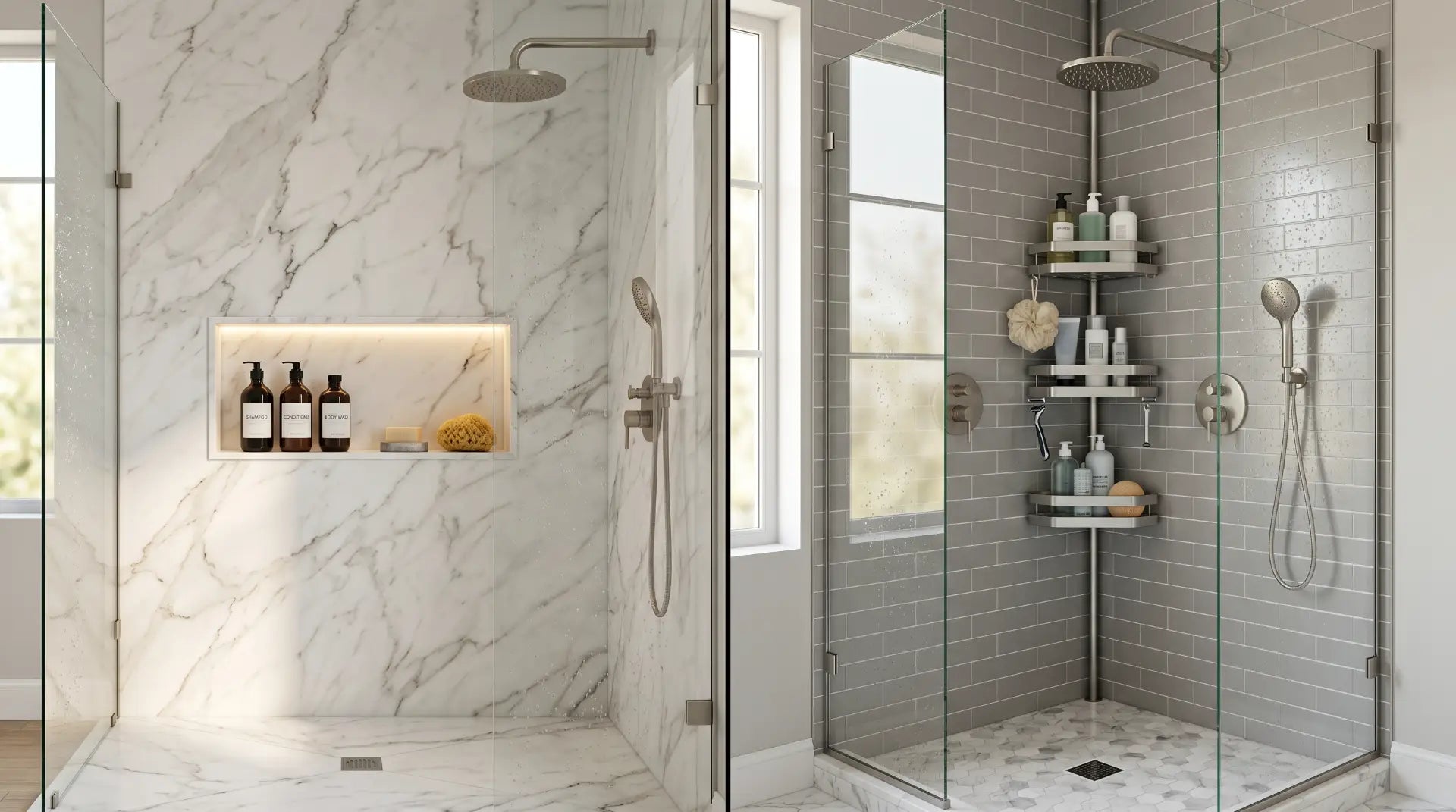
A corner caddy costs around $20 and goes up in five minutes. A recessed shower niche costs more and has to be built into the wall - but it lasts the life of your bathroom, never rusts, and adds resale value. This guide breaks down the real long-term math so you pick the right one for your situation, not just the cheapest one today.
Every shower needs somewhere to put the shampoo. The question is whether you build that storage into the wall once and forget about it, or hang something inside the shower that you'll clean around - and eventually replace. That's the real choice behind "shower niche vs corner caddy," and the right answer depends far more on your timeline and situation than on which option looks nicer in a showroom photo.
A recessed shower niche is a permanent, built-in cubby set into the wall during construction or tiling. A corner caddy is any shelf, pole, or basket added inside the finished shower. On the surface, the caddy looks like the obvious winner - it's a fraction of the price and you can install it this afternoon. But "long-term" changes the math. Over ten years, the cheap caddy you replace three or four times can cost as much as the niche, while the niche keeps adding value and never rusts onto your tile.
This guide compares both options across the seven factors that actually matter over time - cost, installation, durability, mold and cleaning, capacity, aesthetics and resale, and flexibility - then gives you a decision matrix so you can match the choice to your exact situation. If you're planning a full shower project, start with our complete shower systems buying guide; this article zooms in on the storage decision specifically.
Are you tiling or remodeling the shower anytime soon - or is the shower already finished and staying that way? If a tile project is on the table, a niche is nearly always worth building in while the wall is open; the marginal cost is small and you'll never get a cheaper chance. If the shower is finished and you're not touching it, a quality wall-mounted or corner caddy is the sensible, low-disruption choice. Everything below refines that starting point.
For long-term value, a recessed shower niche wins: it never rusts, never falls, needs no replacing, and adds resale appeal. A corner caddy wins for renters, tight budgets, and finished showers - but plan to replace budget models every 1-3 years.
Choose a shower niche if you're already tiling or remodeling, you own the home, and you want a clean, permanent, mold-resistant solution that pays back over time. Choose a corner caddy if you rent, the shower is already finished, you need storage immediately, or you want flexibility to move and reconfigure it. The two aren't really competitors so much as answers to different timelines - and for many homeowners, the smartest move is one niche plus one well-chosen caddy.
Read the full breakdown below, or jump to the decision matrix to match the choice to your situation in 30 seconds.
Here's how the two options stack up across the factors most people care about. We dig into each row in detail further down.
| Factor | Recessed Shower Niche | Corner Caddy | Long-Term Edge |
|---|---|---|---|
| Upfront cost | $150-$500 installed (during tiling) | $15-$60 | Caddy (today) |
| 10-year cost | One-time; no replacement | $60-$240 (3-4 replacements) | Niche |
| Installation | Built into wall; needs the wall open | Minutes; any finished shower | Caddy |
| Lifespan | 20+ years (life of the tile) | 1-10 years by material/mount | Niche |
| Mold & cleaning | Drains well; few contact points | More crevices, feet, suction gaps | Niche |
| Capacity | Generous; sized to your needs | Limited by shelf size | Niche |
| Looks & resale | Built-in, high-end appeal | Functional, visibly added-on | Niche |
| Flexibility | Fixed once built | Move, reconfigure, take with you | Caddy |
| Best for | Owners remodeling or building | Renters & finished showers | Depends |
A shower niche - also called a recessed niche, shower cubby, or shampoo niche - is a small storage compartment set into the wall of the shower, flush with the surrounding tile. Instead of adding something into the shower, you carve out a pocket in the wall and finish it to match. The result is built-in storage that takes up zero usable shower space and reads as part of the original design.
Niches are installed during construction or a tile renovation, when the wall is opened up. A waterproof prefab niche box (or a site-built frame) is set between the wall studs, waterproofed, then tiled over so it integrates seamlessly. The bottom shelf is - or should be - sloped slightly forward so water drains out instead of pooling. Many homeowners add a niche as part of choosing between a walk-in shower versus an enclosure, since both involve finishing the walls anyway.
A corner caddy is any add-on storage unit placed inside an existing shower - typically tucked into a corner to stay out of the way. Unlike a niche, it sits proud of the wall and can be installed in a finished shower in minutes. The catch is that all that convenience rides on how it attaches and what it's made of, and those two things decide how long it lasts. There are four common types, and they're not equal:
| Caddy Type | How It Mounts | Typical Lifespan | Best / Worst For |
|---|---|---|---|
| Tension pole | Wedges floor-to-ceiling by spring tension | 2-5 years | Lots of storage, no drilling / can slip over time |
| Hanging (over showerhead) | Hooks over the shower arm | 1-4 years | Renters, zero install / crowds the showerhead, sways |
| Suction cup | Sticks to tile or glass by vacuum | Months-2 years | Temporary, removable / loses grip, drops contents |
| Drilled / adhesive wall-mount | Screws or strong adhesive into wall | 5-10+ years | Near-permanent, sturdy / leaves holes or residue |
When people complain that "shower caddies always rust and fall," they're almost always describing a cheap chrome-plated tension pole or a suction-cup model. A drilled or adhesive stainless steel shelf is a genuinely different product - it can rival a niche for durability while keeping the flexibility a niche can't offer. Browse Bathify's glass & metal shower shelves if you want the long-lasting end of the caddy spectrum.
If you're caddy-shopping for the long haul, skip suction cups entirely and ignore "chrome-plated" (which is plated steel that rusts once it chips). Look for solid stainless steel, anodized aluminum, or coated brass, and choose a drilled or adhesive mount. That single decision is the difference between replacing it every year and keeping it for a decade.

On day one, it isn't close. A corner caddy runs $15-$60, while a recessed niche typically adds $150-$500 to a tile job - and far more if you're cutting into a finished wall as a standalone project. If your only metric is "cheapest right now," the caddy wins every time.
The picture changes over ten years. A niche is a one-time cost: once it's tiled in, you never spend another dollar on it. A budget caddy is a recurring cost - most get replaced every one to three years as the plating rusts, the suction fails, or the pole loosens. Three or four replacements later, you've quietly spent $60-$240, plus the small annoyance of re-shopping each time. A high-end drilled stainless caddy narrows that gap by lasting longer, but it also costs more upfront, moving it closer to niche territory.

This is the caddy's home turf. A hanging or tension caddy goes up in five minutes with no tools. Even a drilled wall-mount is a 30-minute job. There's no demolition, no waterproofing, no waiting for grout to cure - and no risk to the shower's water seal.
A niche is the opposite: it's a build-it-in-while-the-wall-is-open job. During new construction or a tile remodel, adding one is straightforward and cheap. Retrofitting one into a finished shower means opening the wall, checking for studs and plumbing lines, re-waterproofing, and re-tiling - work that really belongs to a tile professional. If you're already managing a shower install, our step-by-step shower system installation guide walks through the wall-open stages where a niche slots in naturally.

A niche has no moving parts and nothing to corrode. It's tile, mortar, and waterproofing - the same materials as the wall around it - so it lasts as long as the shower does, commonly 20 years or more. The only real failure mode is poor waterproofing during the build, which is a workmanship issue, not a wear issue.
Caddies live or die by material and mount. A suction model may last only months before grip fades; a chrome-plated steel pole rusts within a year or two of the plating chipping; a hanging caddy slowly fatigues at the hook. At the other end, a solid stainless or anodized aluminum unit that's drilled or adhered to the wall can run five to ten years or more. So the caddy's lifespan isn't one number - it's a spectrum from "months" to "a decade," entirely dependent on what you buy.

This factor surprises people. A niche, done correctly, is the easier of the two to keep clean. With a slightly forward-sloped bottom shelf, sealed grout, and decent bathroom ventilation, water drains out instead of pooling, and there are very few crevices for grime to hide. You wipe a smooth tiled surface - that's it.
A caddy introduces more mold-prone geometry: rubber feet that trap water against the floor, suction cups that hold a damp ring of moisture, metal-to-tile contact points, and mesh or wire shelving that collects soap scum in every gap. None of it is a dealbreaker, but it's more surface area and more crevices to scrub, every week, for the life of the caddy.

Because a niche is custom-built, you decide its size, shelf count, and placement. A common setup is one chest-height niche for everyday bottles plus a lower niche around shin height for foot-shaving or kids' supplies. For a busy family bathroom, you can size the niche to swallow tall pump bottles that tip over on a narrow caddy shelf.
A caddy is capped by its dimensions, but it does offer one organizational advantage: tiers. A tall tension pole or hanging caddy stacks several shelves vertically in a footprint a single niche can't match, which is genuinely useful in households with a lot of products. So the niche wins on flexibility and fit-to-need, while a multi-tier caddy can hold more total items in less wall area.

A recessed niche is a design feature. Tiled to match (or contrasted as an accent), it looks intentional and high-end, and buyers and agents read built-in storage as a sign of a quality build. It pairs cleanly with modern glass, like the look you get from frameless or semi-frameless shower doors, because there's nothing hanging inside the enclosure to interrupt the sightline.
A caddy, however tidy, always reads as an add-on - something placed in the shower rather than part of it. That's perfectly fine for daily living, but it doesn't move the needle on resale the way a built-in niche can. In a staged or photographed bathroom, a clean niche looks custom; a caddy looks like a fix.

A niche is permanent by design - which is its strength and its only real weakness. Once it's tiled in, its size and position are fixed forever. If your needs change, the niche doesn't. And if you rent, building one usually isn't an option at all.
A caddy is the opposite: reposition it, swap it for a bigger one, add a second, or pack it in a box when you move. For renters, students, and anyone in a temporary space, a no-drill hanging or tension caddy is often the only practical answer - it asks no permission and leaves no holes. That flexibility is exactly why caddies remain the default for millions of finished bathrooms.
The headline price hides the real story. Here's a realistic ten-year cost for each option, including replacements. Caddy figures assume budget-to-mid models replaced as they fail; the niche assumes a prefab unit installed during a tile job.
| Option | Upfront | Replacements (10 yr) | 10-Year Total | Notes |
|---|---|---|---|---|
| Suction / hanging caddy | $15-$30 | 4-8 units | $90-$240 | Shortest lifespan; replaced most often |
| Tension pole caddy | $30-$60 | 2-4 units | $90-$240 | More capacity; can slip over time |
| Drilled stainless shelf | $40-$90 | 0-1 unit | $40-$180 | Best-value caddy long-term |
| Recessed niche (during reno) | $150-$500 | None | $150-$500 | One-time; adds resale value |
| Recessed niche (retrofit) | $300-$800 | None | $300-$800 | Demolition + re-tile; pro job |
The pattern is clear. If you're tiling anyway, the niche's ten-year cost lands right in the range of repeatedly replacing budget caddies - except you also gain durability, easier cleaning, and resale appeal. But a single well-chosen drilled stainless shelf is the quiet value champion of the caddy world, often beating everything on pure cost while still lasting years.
Find the row that fits your situation and follow the recommendation. Most people land cleanly in one of these.
For many homeowners, the best answer isn't one or the other - it's both. Build a niche for your everyday essentials (the shampoo, conditioner, and body wash you reach for daily), then add a small caddy or corner shelf for the overflow: razors, a loofah, the kids' rotating cast of bottles. The niche handles the permanent core; the caddy absorbs whatever changes over time.
This combination gives you the niche's clean, built-in look as the foundation and the caddy's flexibility as a release valve, so you're never re-tiling a wall just because the family added a new product. It's the setup we'd recommend to most owners doing a full shower build - pair it with the right fixtures from our shower systems guide and you've covered storage for the life of the bathroom.
Get the placement and build details right the first time, because there's no easy redo. A few rules of thumb that hold up well:
- Height: set the bottom of the main niche around 36-48 inches off the floor - roughly chest height - so bottles are easy to reach without bending.
- Slope: insist on a bottom shelf tilted slightly forward (toward the shower) so water drains out instead of pooling. This is the single biggest factor in keeping a niche clean.
- Placement: position it on the wall opposite or beside the showerhead, not directly in the main spray, and avoid exterior walls in cold climates to sidestep insulation and condensation issues.
- Sizing: measure your tallest pump bottles and add clearance; consider a second, lower niche for foot care or kids' items.
- Waterproofing: this is non-negotiable and the one thing worth paying a pro for - a leaking niche behind tile is an expensive, hidden problem.
Material and mount type matter far more than price or looks. To get years instead of months:
- Material: choose solid stainless steel, anodized aluminum, or coated brass. Avoid "chrome-plated" steel - it's plating over rust-prone metal.
- Mount: prefer drilled or strong adhesive wall-mounts for permanence; reserve suction and hanging styles for renters and short-term needs.
- Drainage: look for open or slotted shelves that let water run off rather than solid trays that pool it.
- Capacity: if you have a lot of products, a tall multi-tier unit beats a single shelf for sheer volume.
- Finish match: match the caddy finish to your shower hardware for a more intentional, less "added-on" look.
You'll find durable, drainage-friendly options across Bathify's glass & metal shelves and broader bathroom storage collections, plus matching soap dishes and holders to round out the setup.
If you're tiling or remodeling, build the niche - it's the better long-term answer on durability, cleaning, and resale. If your shower is finished or you rent, a quality drilled caddy is the smart, low-disruption pick.
The "shower niche vs corner caddy" debate really comes down to timing. With the wall open, a recessed niche is one of the highest-value small upgrades you can make: it lasts 20+ years, never rusts onto your tile, stays cleaner than any add-on, and quietly signals a quality build to future buyers - all for a ten-year cost that often matches what you'd otherwise spend replacing budget caddies anyway.
But the caddy earns its place. For renters, finished showers, tight budgets, or anyone who values flexibility, a well-chosen stainless or aluminum caddy on a drilled mount is durable, affordable, and instant. And for owners doing a full build, the strongest setup is both - a niche for the essentials and a caddy for the overflow. Choose based on whether your wall is open, not on the sticker price alone.
Planning the storage as part of a bigger shower project? Browse shower niches, shower shelves, and the full showers collection at Bathify. Free shipping on all orders over $50 to the continental US.
Costs and lifespans in this guide are general planning estimates for US homes and vary by product, local labor rates, water conditions, and installation quality. Price your specific project and confirm product specs before purchasing.


