







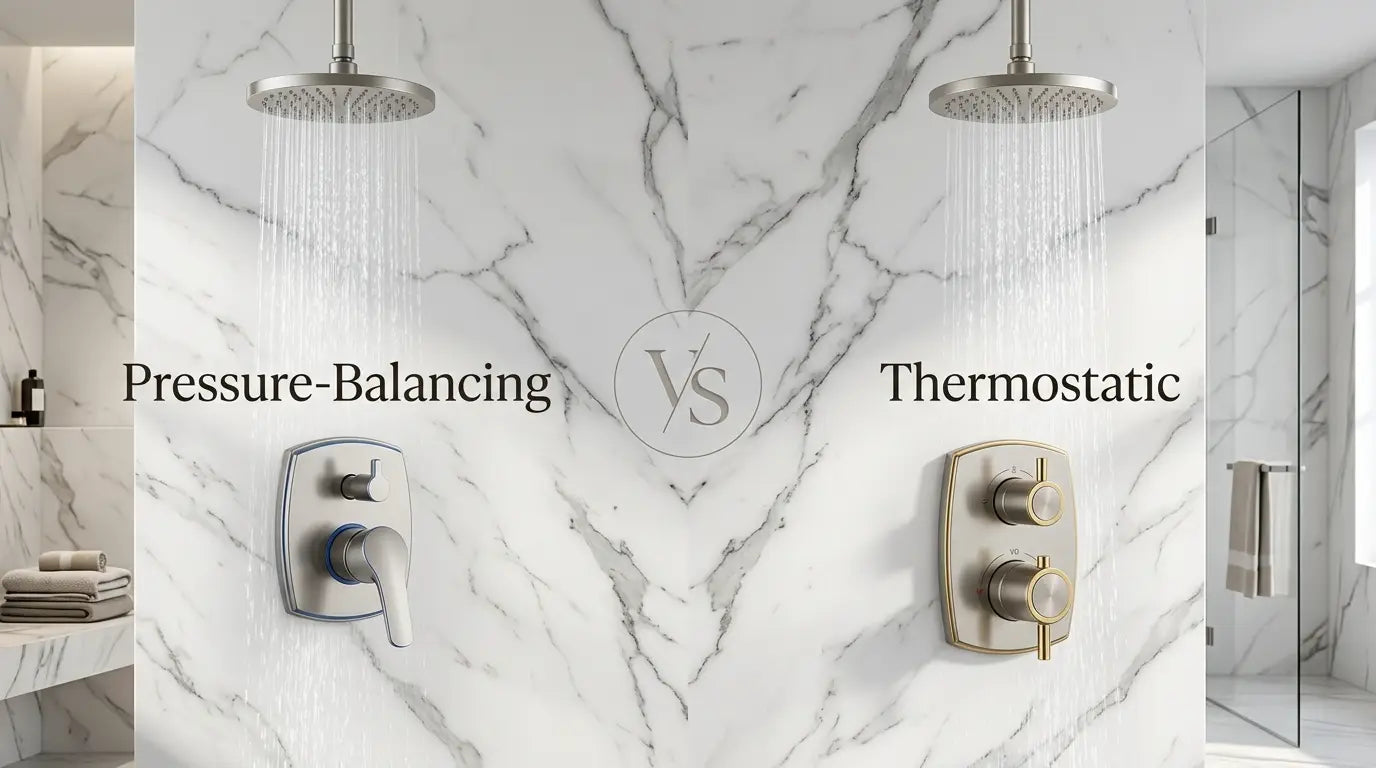
How to Choose the Right Shower Valve: Pressure vs Thermostatic
The shower valve is the most important fixture you'll never see - and the wrong choice costs you comfort, safety, and money for years. Here's exactly how to pick the right one for your home.
Every shower renovation in America starts the same way: someone picks a rain head, chooses a finish, maybe splurges on a handheld. The valve - the unit buried in the wall that actually controls water temperature and flow - gets almost no attention until it causes a problem. That's a mistake that costs homeowners comfort, safety, and money for the life of the bathroom.
The shower valve determines whether your water temperature holds steady when someone flushes a toilet two rooms away. It determines whether your kids can shower safely without a scald risk. It determines whether your multi-outlet system (rain head + body jets + hand shower) can all be controlled independently, or whether it's all-on or all-off. No amount of premium tile or designer hardware fixes a valve that's wrong for the application.
This guide covers the two valve types that handle over 99% of US residential shower installations - pressure-balancing and thermostatic - with a direct, honest comparison across cost, safety, installation, and long-term ownership. By the end, you'll know exactly which type to specify for your renovation and which products at Bathify deliver the best value for each.
US plumbing codes (IPC and most state amendments) require ASSE 1016-certified anti-scald protection in every residential shower. A pressure-balancing valve satisfies this requirement. A thermostatic valve exceeds it. The question isn't which valve is legal - both are - it's which valve delivers the experience your household actually needs for the next 15-20 years.

A pressure-balancing valve contains a diaphragm or spool-style piston that responds to the relative pressure between the hot and cold supply lines. When someone flushes a toilet and cold pressure drops, the piston shifts to reduce hot water flow proportionally - keeping the hot-to-cold ratio stable. The result: the temperature won't spike dangerously, though it will drift slightly if pressure changes are sustained. This is a purely mechanical, reactive system with no set-point memory.
A thermostatic valve works differently. It contains a wax-filled cartridge (or, in premium digital systems, an electronic sensor) that expands and contracts with water temperature. This element physically moves a mixing port to maintain the exact temperature you've dialed in, reacting to actual temperature rather than just pressure ratios. If cold water temperature drops in winter (common in northern US climates like Chicago or Minneapolis), the thermostatic cartridge adjusts automatically. A pressure-balancing valve cannot compensate for inlet temperature changes - only pressure changes.

Both valve types satisfy ASSE 1016 scald protection requirements, but the way they deliver safety is meaningfully different. A pressure-balancing valve prevents the worst-case scenario - a sudden scalding spike when a toilet flushes - but it doesn't lock in a set temperature. Every morning, you turn the handle and wait for the water to get to the right temperature by feel. If your hot water heater is set to 140°F (common for legionella prevention), a pressure-balancing valve alone won't cap the maximum output temperature in your shower.
A thermostatic valve solves this problem completely. You set the maximum temperature - typically 105-110°F for a family bathroom - and the valve cannot deliver water hotter than that set point, regardless of how the supply conditions change. For households with young children, elderly family members, or anyone with reduced temperature sensitivity, this is the only valve that provides genuine protection rather than just compliance. The CPSC estimates that over 2,000 Americans require emergency room treatment for scald burns from tap water each year - and the majority involve children under five.
Pressure-balancing valve rough-ins start around $50-$150 for major brands like Delta MultiChoice or Moen Posi-Temp. Add a trim kit (handle, plate, cartridge) at $80-$350, and a total DIY cost is $130-$500 for a complete single-function shower setup. Plumber installation for the rough-in runs $150-$350 in most US markets. The price of simplicity is also a long-term advantage: cartridge replacements for pressure-balancing valves are typically $20-$60 and widely available at Home Depot and Lowe's.
Thermostatic valve systems cost significantly more. Rough-in valve bodies run $200-$600 for quality options, and separate volume control valves (one per outlet) add $80-$250 each. A full thermostatic system for a rain head + hand shower setup typically lands at $600-$1,500 in parts before installation. Plumber labor for a multi-outlet thermostatic system in cities like Dallas, Denver, or Seattle typically runs $400-$900. Cartridge replacements are also more expensive at $40-$120 per cartridge.
| Cost Category | Pressure-Balancing | Thermostatic | Advantage |
|---|---|---|---|
| Rough-in valve | $50-$150 | $200-$600 | Pressure-Bal. |
| Trim kit | $80-$350 | $150-$500+ | Pressure-Bal. |
| Per extra outlet | N/A (1-function) | $80-$250 per volume control | Pressure-Bal. |
| Plumber rough-in | $150-$350 | $400-$900 | Pressure-Bal. |
| Cartridge replacement | $20-$60 | $40-$120 | Pressure-Bal. |
| Trim upgrade later | Easy (MultiChoice compatible) | Brand-specific | Pressure-Bal. |
Delta MultiChoice advantage: Delta's MultiChoice Universal rough-in valve, available at Bathify, accepts interchangeable trim kits - meaning you can install the rough-in now and upgrade the trim to a monitor, 14-series, or 17-series later without opening the wall again. It's the most future-proof budget option in the US market.

The rough-in valve - the part that goes inside the wall - requires a licensed plumber in most US states, regardless of valve type. This involves cutting open the shower wall, positioning the valve body to the correct depth and height, connecting supply lines, and soldering copper or crimping PEX. It also typically requires a permit in jurisdictions that follow the International Plumbing Code - which includes most US cities and counties. The complexity of this work is roughly similar for both valve types, though thermostatic systems often require more space in the wall cavity due to larger valve bodies and multiple volume control ports.
Where the difference matters is trim replacement. Replacing the cartridge, handle, and face plate - the trim - is a legitimate DIY task for both valve types, no permit required in most jurisdictions, and no wall opening needed. Pressure-balancing trim kits are universally available at Home Depot, Lowe's, Wayfair, and Bathify, with cartridges priced at $20-$60. Thermostatic trim replacements are more brand-specific and must match the exact rough-in body already in the wall - making brand selection at rough-in more consequential.

A pressure-balancing valve is fundamentally a single-function device: one handle controls one outlet (or multiple outlets simultaneously with a diverter). If you want a rain head and a hand shower, you can add a diverter - but you can only use one at a time, and there's no independent volume control. This is perfectly fine for straightforward showers, but it limits the spa-style flexibility that most premium shower upgrades are designed around.
A thermostatic system is built for multi-outlet control from the ground up. One thermostatic valve body sets and holds the temperature for the entire system. Separate volume control valves - one per outlet - let you run the rain head alone, the hand shower alone, both together, or add body jets independently. The temperature stays locked regardless of which combination of outlets is open. This is the correct architecture for any shower with more than two outlets, and it's what makes shower systems from KubeBath and TOTO function as designed.
The KubeBath Aqua Rondo 3-Way Rough-In Valve available at Bathify is a good example of a thermostatic-compatible valve built for multi-outlet control - solid brass waterway, durable chrome finish, and a 3-way diverter that handles rail shower, rain head, and hand shower independently within one cohesive system.
Pressure-balancing cartridges are among the most standardized components in US plumbing. A Moen Posi-Temp cartridge (1222 or 1225) or Delta Monitor cartridge (RP46074) will be on the shelf at your local Home Depot in Phoenix, Chicago, or Atlanta - no special order required. The average lifespan before a cartridge needs replacing is 8-15 years, and the replacement itself is a 30-minute DIY job. The simplicity of the single-cartridge mechanism means there's very little to go wrong.
Thermostatic cartridges are more complex, more sensitive to water quality, and more expensive to replace. In cities with hard water - Las Vegas, Phoenix, Dallas, and much of the Southwestern US - mineral buildup can shorten thermostatic cartridge life to 4-8 years without a water softener or filter. The thermostatic wax element itself can drift over time, requiring recalibration or replacement to maintain accurate temperature holding. Premium brands like TOTO engineer their cartridges for longevity, but the maintenance reality is more demanding than a pressure-balancing valve.
Easy lifespan test: Check your shower heads and faucet aerators for white mineral deposits. If you have visible calcium buildup after 6-12 months, you have hard water that will accelerate thermostatic cartridge wear. Factor a water treatment solution into your renovation budget if you're installing a thermostatic system.
This is the round that actually decides the purchase. Both valve types are well-made, code-compliant, and will last decades with reasonable maintenance. The question is which one matches your specific household and renovation goals.
- Single shower head, no body jets
- Renovation budget under $2,000 for shower fixtures
- Guest bathroom or secondary bath with light use
- Rental property or fix-and-flip project
- Replacing an existing single-function valve like-for-like
- Soft to moderate water quality (under 7 GPG hardness)
- Rain head + hand shower, or any body jets
- Primary bathroom, used daily by multiple people
- Household includes children under 12 or elderly users
- Shower system investment over $1,500 in fixtures
- Luxury renovation where daily experience matters
- Hot water heater set above 120°F for sanitation
2 draws (How It Works, Best For) not counted. Wins reflect category-specific advantages - not overall superiority.
| Factor | Pressure-Balancing | Thermostatic | Better Choice |
|---|---|---|---|
| How it works | Balances hot/cold pressure ratio | Senses & locks actual temperature | Context |
| Temperature accuracy | Approximate - varies by pressure | ±2°F - locks set point exactly | Thermostatic |
| Scald protection | Code minimum (ASSE 1016) | Max-temp stop + code compliant | Thermostatic |
| Rough-in cost | $50-$150 | $200-$600 | Pressure-Bal. |
| Total system cost | $200-$700 installed | $700-$2,500+ installed | Pressure-Bal. |
| Multi-outlet support | Limited (diverter only) | Full independent control | Thermostatic |
| DIY trim swap | Easy, wide availability | Brand-specific | Pressure-Bal. |
| Cartridge lifespan | 8-15 years | 4-12 years (water quality dependent) | Pressure-Bal. |
| Cartridge cost | $20-$60 | $40-$120 | Pressure-Bal. |
| Hard water tolerance | Good | Moderate (filter recommended) | Pressure-Bal. |
| Warm-up time | Standard (wait for temp) | Faster (can pre-set temperature) | Thermostatic |
| Design flexibility | Standard single-handle look | Separate temp + volume controls | Thermostatic |
| Code compliance | ASSE 1016 ✓ | ASSE 1016 ✓ | Both |
Bathify carries a curated lineup of pressure-balancing and thermostatic valves from Delta, TOTO, and KubeBath - all with free shipping on orders over $50 and a 30-day return policy. Here are the key options by category.
Delta's MultiChoice Universal rough-in is the most practical pressure-balancing valve in the US market - and one of the most genuinely useful products in bathroom plumbing. Install the rough-in body once, and you can swap the trim kit to any Delta 14-series, 17-series, or Monitor style without reopening the wall. This means a basic setup today can be upgraded to a rain-head trim kit or a tub/shower combo later with a $150 trim purchase rather than a full plumber visit.
Shop: Delta MultiChoice Universal Valve · Delta MultiChoice High Flow Valve
The KubeBath Aqua Rondo 3-Way Rough-In Shower Valve is built on German engineering principles, featuring a solid brass waterway, a chrome-finished decorative cover plate, and a 3-way diverter that handles rail shower, rain head, and hand shower independently. The ceramic cartridge construction and solid brass body are specified for longevity - this isn't a spec-to-price valve. It pairs directly with KubeBath's complete Aqua Rondo shower system lineup for a coherent, professional installation.
TOTO's Round Volume Control Valve Shower Trim pairs with their TBN01104U volume control valve body to deliver fine-grained flow control in thermostatic multi-outlet systems. Solid brass construction with corrosion-resistant chrome plating, a 10mm ultra-thin escutcheon for a clean minimalist profile, and a handle knob design that prioritizes usability without visual noise. TOTO's approach to shower systems emphasizes the integration of every component - valve, trim, head - into a unified experience rather than a collection of parts.
Both valves are excellent - the right one depends entirely on your shower setup and household
The pressure-balancing valve wins on cost, simplicity, and maintenance accessibility. If you're renovating a guest bathroom, running a single shower head, or working with a renovation budget under $1,500, a Delta MultiChoice or Moen Posi-Temp pressure-balancing system is the correct, code-compliant, and durable choice. It's what professional plumbers install in millions of US homes every year - for good reason.
Choose pressure-balancing if: you have a single shower outlet, a budget-focused renovation, a rental property, a guest bathroom, or soft to moderate water quality.
Choose thermostatic if: your shower has more than one outlet (rain head, hand shower, body jets), you have children or elderly family members, your hot water heater runs above 120°F, or you want consistent spa-quality temperature every morning without adjusting.
In either case: invest in the rough-in valve that gives you upgrade flexibility. Delta's MultiChoice Universal system is the best pressure-balancing pick for that reason. If thermostatic, specify solid brass - KubeBath and TOTO deliver the build quality that justifies the investment over a 15-20-year horizon.
Shop Shower Valves & Systems at Bathify
Browse pressure-balancing and thermostatic shower valves from Delta, KubeBath, and TOTO - shipped across the USA. Free shipping on orders over $50.


