







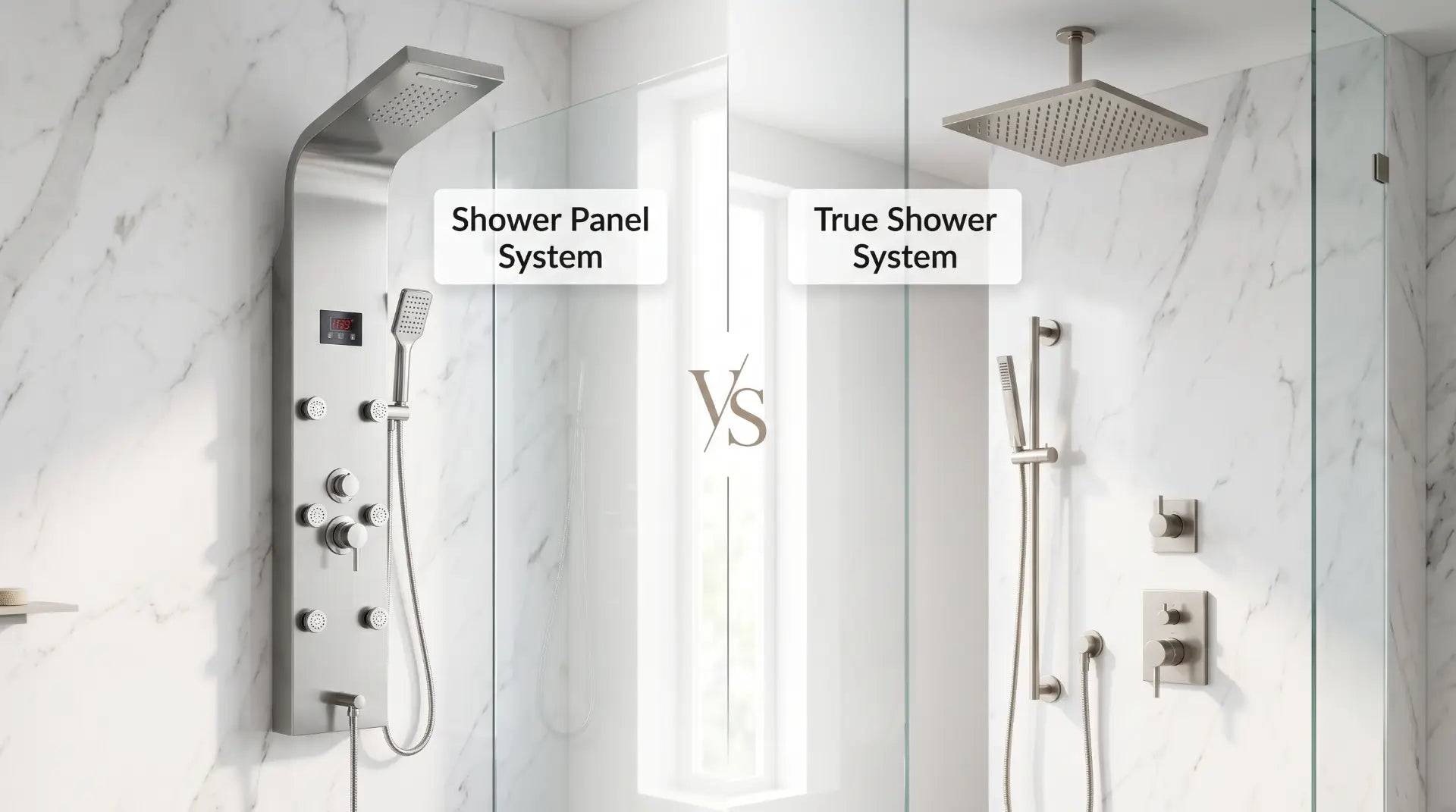
All-in-one shower towers promise a spa experience for under $300. We break down what they actually deliver, where they fail, and what holds up better long-term.
A shower panel system - sometimes called a shower tower, shower column, or shower panel set - is a single pre-assembled unit that bundles a rain shower head, several body jets, a handheld sprayer, and often an LED temperature display into one wall-mounted stainless steel or ABS plastic column. The entire unit connects to a single water supply line, which is the core of its appeal: instead of running separate plumbing for a rain head, hand shower, and body jets, you connect one panel and get all three functions in one box.
This guide gives you the honest version most retailer listings won't: what these systems actually deliver in a real American bathroom, where the marketing photos diverge from daily use, and when a traditional multi-function shower system - built from separately plumbed, individually replaceable components - is the smarter long-term investment. We'll also show you what that better alternative looks like in practice, with real products from Bathify.
Shower panel systems and true shower systems are not different price tiers of the same product - they're built on fundamentally different architecture. A panel routes every function through one shared internal manifold and one valve. A true shower system gives each function (rain head, hand shower, body jets) its own dedicated line off a central rough-in valve. That single design difference explains almost every durability and pressure complaint in this category.

Most shower panel systems in the US market are constructed from 201 or 304 stainless steel exteriors over plastic (typically ABS) internal piping and valve bodies. The 304-grade panels hold up reasonably well to surface corrosion, but the internal plastic components - the part you can't see - are where the real compromise lives. Plastic valve seats and internal channels are more prone to warping under sustained hot water exposure and degrade faster than the metal cartridges used in true shower systems.
A true multi-function shower system, like those from Riobel, KubeBath, or Vado available at Bathify, uses solid brass construction throughout the waterway - valve body, rough-in, and shower arm. Brass resists corrosion, holds finish plating (chrome, brushed nickel, matte black) significantly longer, and doesn't degrade under sustained heat exposure the way plastic internals do. This is the single biggest quality difference between the two categories, and it's almost never disclosed clearly in panel system product listings.

This is where panel system marketing photos diverge most sharply from daily reality. Standard US residential water pressure runs 40-60 PSI. A shower panel system splits that single pressure source across the rain head, 4-6 body jets, and a handheld sprayer - all drawing from the same internal manifold simultaneously. Running multiple functions at once means each one receives meaningfully less flow than running it alone, which is why body jet pressure in review videos almost always looks weaker in person than in the listing photos.
A true shower system avoids this by giving each function - rain head, hand shower, body jets - its own dedicated supply line from the rough-in valve, with independent volume controls. You can run the rain head at full pressure while the hand shower is off, or run both simultaneously without either one suffering a dramatic pressure drop, because each line is sized and routed independently rather than sharing one constrained channel.
Shower panel systems win decisively on upfront price - most range from $100-$400, with budget stainless steel options under $150 widely available through big-box retailers and marketplaces. Installation is often DIY-friendly since the unit connects to a single existing shower supply line, avoiding the plumber labor cost that comes with rough-in work.
The lifetime cost picture inverts that advantage. Because panel systems fail as a single unit - a clogged jet, a stuck diverter, or a leaking internal seal often means the whole tower needs replacing, since individual parts are rarely sold separately - many homeowners replace their panel system every 2-4 years. At $100-$400 per replacement, that's $50-$200 per year in ongoing cost. A true shower system with a quality rough-in valve and brass components costs more upfront ($300-$900 installed) but lasts 15-20 years with only occasional cartridge replacement ($20-$60 every 8-15 years) - a fraction of the per-year cost over the life of the bathroom.
| Cost Factor | Shower Panel System | True Shower System | Better Long-Term |
|---|---|---|---|
| Upfront unit cost | $100-$400 | $300-$900 installed | Panel |
| Installation | Often DIY, single connection | Plumber rough-in required | Panel |
| Typical lifespan | 2-5 years | 15-20+ years | Shower System |
| Repair if one part fails | Often full replacement | Replace single component | Shower System |
| Cost per year of ownership | $50-$200/year | $15-$60/year | Shower System |
This is the panel system's clearest, most legitimate advantage. Most units mount directly onto the existing shower wall and connect to the existing shower arm or supply line with basic plumbing fittings - no wall opening, no rough-in valve replacement, and in most cases no permit required. A handy homeowner can install most panel systems in an afternoon with basic tools, which is precisely why they're popular in rental properties and quick-turnaround renovations.
A true shower system requires a rough-in valve installed inside the wall - meaning the wall must be opened (if not already open during a renovation), supply lines positioned and connected, and in most US jurisdictions, a permit and licensed plumber for that portion of the work. Once the rough-in is set, trim installation (the visible handles, heads, and plates) is a more accessible DIY task - but the rough-in itself is not a weekend project for most homeowners.
Renting or temporary housing? A shower panel system is the more sensible choice precisely because of this installation advantage - you can remove it and take it with you, or revert to the original shower head, without modifying the building's plumbing. This is the strongest legitimate use case for the category.
The single biggest structural weakness of shower panel systems is that they fail as one unit. Because the rain head, body jets, handheld, and internal valve are all integrated into one sealed column, a failure in any single component - a stuck diverter, a cracked internal seal, a jammed body jet - often can't be repaired without disassembling the entire panel, and replacement parts for the internal manifold are rarely sold separately from the full unit. Most homeowners simply buy a new panel rather than attempt a repair.
A true shower system is built from independently replaceable components by design. If the hand shower cartridge wears out, you replace a $20-$40 part. If the diverter sticks, that's a separate, serviceable component. If you want to upgrade the trim finish years later, the rough-in valve stays in the wall and only the visible trim changes. This modularity is the core durability advantage - not because brass parts individually never fail, but because failure doesn't require replacing the entire system.
Body jets are the single most common complaint point on shower panel systems, and the reason is straightforward: the small nozzle openings on body jets are highly susceptible to mineral scale buildup, especially in hard water regions across the US Southwest, Texas, and parts of the Midwest. Within 12-24 months, many users report one or more jets weakening or stopping entirely due to internal scale accumulation that's difficult to clean without disassembling the unit - and many panel systems aren't designed for easy internal access.
Quality shower systems with body jets, like the KubeBath Aqua Piazza set available at Bathify, use silicone-tipped nozzles specifically engineered for easy calcium removal - you simply rub the silicone tips to break loose mineral deposits, a maintenance task that takes seconds rather than requiring disassembly. This single design detail is a meaningful long-term maintenance advantage in any US region with moderate to hard water.
The honest answer is that shower panel systems serve a real, legitimate niche - they're just a smaller niche than the marketing suggests. This is the round that should actually drive your purchase decision.
- You're renting and can't modify wall plumbing
- This is a short-term housing situation (1-3 years)
- Your renovation budget is under $300 for the shower fixture
- You want to test multi-function showering before committing
- The bathroom sees light, occasional use (guest bath)
- DIY installation with zero plumber cost is the priority
- This is a primary bathroom used daily, long-term
- You're already renovating and the wall will be opened
- You want repairable, upgradeable components
- Strong, consistent water pressure matters to you
- You're investing in resale value or a forever home
- You want body jets that hold up without 1-year replacement
2 draws (Cost time-horizon dependent, Best For use-case dependent) not counted. Wins reflect category-specific advantages, not a blanket recommendation.
| Factor | Shower Panel System | True Shower System | Better Choice |
|---|---|---|---|
| Construction | Stamped stainless / ABS internals | Solid brass throughout | Shower System |
| Water connection | Single shared line | Dedicated rough-in valve | Different design |
| Multi-function pressure | Drops when running multiple jets | Independent volume per outlet | Shower System |
| Upfront cost | $100-$400 | $300-$900 installed | Panel |
| Lifespan | 2-5 years typical | 15-20+ years | Shower System |
| Installation | DIY, no wall opening | Licensed plumber, permit likely | Panel |
| Repairability | Often full unit replacement | Individual component swap | Shower System |
| Body jet clogging | Common within 1-2 years | Less common with silicone tips | Shower System |
| Renter-friendly | Yes - fully removable | No - permanent plumbing change | Panel |
| Resale value impact | Minimal to none | Genuine fixture upgrade | Shower System |
Bathify doesn't carry the all-in-one panel category for a reason - the durability tradeoffs above are exactly why. Instead, the shower faucet collection focuses on true multi-function shower systems with solid brass construction, independently plumbed outlets, and finishes that actually hold up. Here are the standout options for anyone choosing the long-term path.

The Riobel Paradox Square system delivers the multi-function promise that panel systems advertise but rarely sustain. A square-form rain head, hand shower on a rail, and tub spout each connect through Riobel's solid brass valve architecture, with the contemporary squared geometry giving the whole setup a deliberate, design-forward look rather than the generic tower aesthetic of panel systems. Riobel backs the brand with a strong reputation for finish durability across chrome, brushed nickel, and matte black options.

The KubeBath Aqua Piazza set is the direct answer to panel-system jet clogging complaints. Built on German engineering principles with a super-slim solid brass one-piece shower head construction (eliminating seam leaks entirely) and silicone tips on both the rain shower and handheld specifically engineered for easy calcium buildup removal - exactly the maintenance advantage that panel systems lack. The valve installs with a threaded 1/2" MIP connection, meaning no messy soldering required during rough-in.

The Vado Round Shower Kit packages a complete 3-function bath and shower faucet - rain head shower, hand shower with rail, bath spout, valve, and diverter - into one coordinated purchase, simplifying the buying decision without sacrificing the architectural advantage of a true shower system. The ceramic cartridge and solid brass body construction are built for longevity, and the round, minimalist design suits a modern-style bathroom without the busy, industrial look common to panel towers.
Worth it for renters and short-term use - not worth it for a permanent renovation
Shower panel systems aren't a scam, and they aren't poorly designed for what they're built to do. The category genuinely solves a real problem: getting multi-function showering without opening a wall. But that convenience comes from a shared-valve, sealed-unit architecture that trades long-term durability and repairability for installation simplicity - and most listings don't make that tradeoff clear before you buy.
Choose a shower panel system if: you're renting, this is a temporary housing situation, your budget is under $300, or you want to test multi-function showering before committing to a renovation.
Choose a true shower system if: this is your primary bathroom, you're already renovating and the wall will be open, you want components that can be repaired individually rather than replaced as a unit, or you're investing in a home you plan to stay in for 5+ years.
In either case: check your home's water pressure and hardness before buying anything with body jets - both factors meaningfully affect performance and maintenance regardless of which category you choose.
Shop True Multi-Function Shower Systems at Bathify
Solid brass shower systems from Riobel, KubeBath, and Vado - built to outlast the panel-tower category. Shipped across the USA. Free shipping on orders over $50.


