







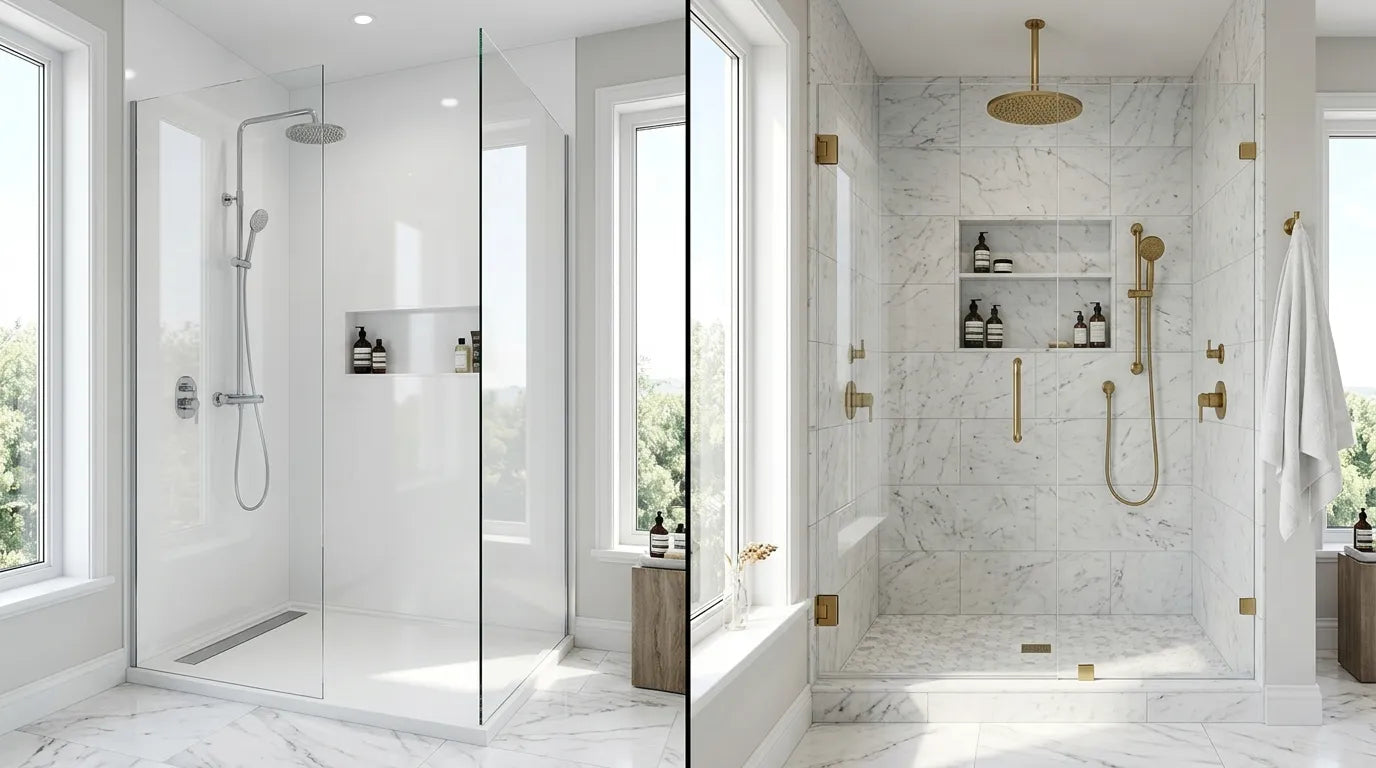
Grout scrubbing vs seam caulking, $400 installs vs $4,000 tile work - here's the honest 2026 breakdown every US homeowner needs before picking a shower wall material.
The acrylic vs tile debate starts with a fundamental design difference most guides gloss over. Acrylic shower walls - sometimes called acrylic surrounds or shower kits - are prefabricated panels of vacuum-formed acrylic (a rigid thermoplastic) that mount directly to studs or over existing drywall in a series of interlocking sections. The seams between panels are sealed with caulk, and the entire wall surface is one continuous non-porous material. No grout, no individual tile installation, no waiting for thin-set to cure.
Tile shower walls are built from individual ceramic or porcelain tiles - and increasingly, large-format tiles - set in thin-set adhesive over a cement board or tile-ready shower wall substrate, then grouted at the joints. The tile surface itself is nearly impervious to water; the grout joints between tiles are not. That distinction - impervious tile, porous grout - is the central fact that drives almost every maintenance difference in this comparison.
"Easier to maintain" isn't one thing - it's daily cleaning time, monthly deep-clean effort, periodic resealing frequency, and repair costs when something eventually fails. This guide scores each category separately so you can weight the factors that actually matter for your household's lifestyle and cleaning habits.

For day-to-day and weekly cleaning, acrylic wins without much debate. The non-porous surface means soap scum and mineral deposits sit on top of the material rather than penetrating it - a weekly spray with a mild bathroom cleaner and a soft microfiber cloth covers most of the maintenance. There are no texture variations or recessed joints to trap residue, so the cleaning motion is the same across the entire wall surface.
Tile walls require the same wipe-down on the tile face, plus grout lines - and the grout is where cleaning effort compounds. Soap residue and mineral deposits accumulate in the recessed joints, and in hard water cities like Phoenix, Las Vegas, Dallas, and Denver, mineral scale in grout lines can become visible within weeks and requires more than a simple wipe to remove. Weekly scrubbing with a stiff-bristled brush or a grout-specific cleaner is standard maintenance in hard water homes with tile walls.

This is the round where acrylic's structural advantage is most concrete. Acrylic itself is non-porous - mold and mildew have no surface material to colonize. The only areas of concern are the caulk seams between panels, which can fail over time and allow moisture infiltration behind the panel system. Maintained caulk seams (typically recaulked every 2-5 years depending on use) keep this risk negligible.
Grout is porous by nature, and in a wet shower environment, unsealed or aged grout is essentially a food source for mold. In humid climates like Miami, New Orleans, Houston, and Seattle, black mold in tile grout is one of the most common bathroom maintenance complaints. Professionally installed tile with epoxy grout significantly reduces porosity (epoxy grout is nearly impervious and is the professional recommendation for wet areas), but adds $200-$600 to installation cost and requires a skilled installer. Standard cement grout needs sealing every 12-24 months in wet areas, and that schedule is one that many homeowners let slip, leading to accelerating mold problems.
Specify epoxy grout at installation. If you choose tile, ask your installer to use epoxy grout rather than standard cement grout in the shower wet zone. The upcharge is real ($200-$600 more) but eliminates most of the ongoing sealing and mold-management obligation that makes tile more maintenance-intensive than acrylic in the first decade of ownership.
Acrylic wins decisively on upfront cost. A standard three-piece acrylic alcove kit runs $200-$500 for materials, with premium kits like the Vanity Art Kaelen 60" 4-Piece Direct-to-Stud kit reaching $600-$800. DIY installation is genuinely feasible for most homeowners since there's no thin-set, no grout, and no special tools - just panel adhesive, caulk, and basic carpentry. Professional installation adds $150-$400. Total installed cost: $400-$1,200 for most US homes.
Tile installation is a skilled trade in the US, and the labor costs reflect that. Material alone for a quality ceramic or porcelain tile runs $400-$1,500+ depending on tile size and format; professional installation adds $800-$3,000+ in most US markets, with higher rates in coastal cities and New York. A typical tile shower wall project lands at $1,500-$5,000, with high-end large-format tile work pushing $6,000-$10,000 in premium renovations. However, properly maintained tile with epoxy grout lasts 30-50 years with no need for full wall replacement, while acrylic surrounds typically need full replacement at 10-20 years - bringing lifetime costs much closer than the upfront gap suggests.
| Cost Category | Acrylic | Tile | Winner |
|---|---|---|---|
| Materials | $200-$800 | $400-$1,500+ | Acrylic |
| Installation labor | $150-$400 (or DIY) | $800-$3,000+ | Acrylic |
| Total installed | $400-$1,200 | $1,500-$5,000+ | Acrylic |
| Annual maintenance cost | ~$10-$30 (caulk, cleaners) | ~$30-$100 (grout sealer, cleaners) | Acrylic |
| Major repair (10-15 yrs) | Full replacement $400-$1,200 | Regrout only $300-$800 | Tile |
| Lifespan | 10-20 years | 30-50+ years | Tile |
| Cost per year of ownership | $30-$80/yr | $40-$100/yr | Similar |

Tile is simply more durable material. Fired ceramic and porcelain are among the hardest common building materials - they don't scratch under normal use, don't yellow with age or UV exposure, and don't crack unless subjected to impact or structural movement in the underlying wall. A well-installed tile shower in a well-built home in Austin or Charlotte genuinely can look identical at 25 years as at installation, with only grout showing age.
Acrylic weaknesses accumulate over years of use. The surface is susceptible to fine scratches from abrasive cleaners (a common mistake) or even textured sponges over years of use - and scratched acrylic traps soap residue and becomes progressively harder to keep looking clean. UV exposure through bathroom windows can cause gradual yellowing, particularly in white or off-white panels, which is irreversible without replacement. Seam caulk that fails (typically after 5-8 years of daily use) allows moisture behind the panels and can cause wall damage that requires complete panel removal to fix properly.

Tile wins this round by a wide margin. The US tile market in 2026 encompasses thousands of ceramic, porcelain, natural stone, and glass tile options across every format from 2"×2" mosaic to 48"×96" large-format slabs - in virtually any color, texture, pattern, or finish imaginable. Accent strips, herringbone patterns, contrasting grout colors, in-wall niches, and custom layouts are all possible with tile in ways that are simply unavailable in prefabricated acrylic.
Acrylic surrounds come in a limited set of colors and finishes - predominantly white, off-white, bone, and gray - with some premium kits offering embossed tile-look patterns designed to mimic the appearance of real tile. The mimicry has improved, but a close-up look at even the best tile-look acrylic panel doesn't replicate the depth, variation, or tactile quality of real ceramic or porcelain tile. For a primary bathroom in a mid-range to premium home, acrylic's design ceiling is a real limitation.

Tile walls are the natural home of the recessed shower niche - an opening cut between wall studs, waterproofed, and tiled to match the surrounding walls. This is one of the most sought-after features in US bathroom renovations and is straightforward to include during any tile installation. The niche sits flush with the wall plane, keeps the shower floor clear, and when tiled to match the surrounding wall, looks completely integrated.
Acrylic panel systems generally cannot accommodate a cut-in recessed niche without compromising the panel's waterproofing integrity - and cutting through an acrylic panel is likely to void the manufacturer's warranty. Some premium kits include a molded-in niche as part of the panel design, like the integrated wall-to-wall niche in the Vanity Art Kaelen direct-to-stud kit. For separate storage, a surface-mounted stainless steel shower niche from Bathify's collection - like the Nina 12"×24" or the Noah 24"×12" - is a clean, durable, and practical solution that works beautifully on acrylic walls without requiring any wall penetration.
Real estate agents and home appraisers across US markets consistently identify tile showers as a positive selling point and acrylic surrounds as a builder-grade or budget finish - language that affects both buyer perception and appraisal value. In major markets like Boston, Chicago, Los Angeles, Miami, and New York, a primary bathroom with custom tile work is a tangible feature; the same bathroom with acrylic walls is viewed as needing eventual renovation.
The exception is entry-level and rental markets, where a clean, undamaged acrylic surround is perfectly acceptable - buyers and renters in this segment prioritize function over finish, and an acrylic wall in good condition is preferable to cracked or moldy tile. For investor-owned rentals, the lower maintenance cost and simpler replacement of acrylic also makes it the more practical long-term choice between tenant turnover cycles.
Round 3 split (acrylic wins upfront/maintenance cost, tile wins lifetime). Wins reflect category-specific advantages - not a blanket recommendation.
This is the chart most competitor guides don't include - the real time investment per material, per task, per frequency.
| Factor | Acrylic | Tile | Winner |
|---|---|---|---|
| Daily cleaning effort | Low - wipe non-porous surface | Moderate - tile + grout lines | Acrylic |
| Mold resistance | High - no porous grout | Moderate - grout is porous | Acrylic |
| Upfront cost | $400-$1,200 installed | $1,500-$5,000+ installed | Acrylic |
| DIY installation | Yes - genuinely feasible | Skilled trade required | Acrylic |
| Lifespan | 10-20 years | 30-50+ years | Tile |
| Scratch resistance | Low - avoid abrasives | High - fired ceramic/porcelain | Tile |
| Design flexibility | Limited (colors, patterns) | Virtually unlimited | Tile |
| Niche compatibility | Limited (surface mount or built-in) | Fully custom recessed niches | Tile |
| Resale value | Builder-grade perception | Premium finish - positive signal | Tile |
| Sealing requirement | Recaulk seams every 2-5 yrs | Reseal grout every 1-2 yrs | Acrylic |
| Repair if damaged | Often full panel replacement | Replace individual tiles or regrout | Tile |
| UV/yellowing resistance | Low - white panels can yellow | High - fired materials don't yellow | Tile |
| Rental/budget suitability | High | Moderate (over-investment risk) | Acrylic |
- Renovation budget is under $1,500 for shower walls
- This is a rental property or secondary/guest bathroom
- You want DIY installation to save $400-$800 in labor
- Minimizing weekly cleaning time is the top priority
- You live in a hard water area and hate grout scrubbing
- You're flipping or staging a home for a quick sale
- This is your primary bathroom used daily by the household
- You want a custom look that no prefab panel can replicate
- You're investing in a forever home or high-resale market
- You want a recessed niche fully integrated into the wall
- You'll specify epoxy grout to minimize ongoing maintenance
- Long-term cost per year (not upfront) is what you're optimizing
Whether you go acrylic or tile, the shower fixtures and storage you pair with your walls are what complete the space. Here's what Bathify carries that's relevant to both material choices.

The Vanity Art Kaelen kit addresses the two biggest acrylic surround objections at once: the bland look and the lack of storage. The wall panels feature a mosaic tile pattern for visual texture, and the kit includes a built-in wall-to-wall integrated niche for toiletry storage - solving the primary functional limitation of acrylic without requiring any surface cutting. The direct-to-stud design installs in one day, and the seamless panel-to-panel joints reduce caulk seam maintenance compared to multi-panel kits with more junction points.

The Nina solves the acrylic wall's niche problem cleanly. Calibre-16 stainless steel with a cooked paint finish ensures genuine moisture resistance - not chrome-plated steel that rusts or plastic that degrades - and the two-compartment shelf design gives you organized storage for products of different heights. The surface-mount installation works on acrylic panels without any wall penetration, preserving the panel's waterproofing integrity. It also works beautifully as an accent niche on tile walls when you want storage in a location that wasn't planned for during rough-in.
Shop: Nina 12"×24" Shower Niche at Bathify · Noah 24"×12" Shower Niche · Nicola 12"×12" Square Niche

Your shower valve and fixtures mount to the valve rough-in behind the wall, not to the wall surface material itself - meaning a premium multi-function system from Riobel or KubeBath works identically whether your walls are tile or acrylic. The Riobel Riu 3-Way System (T/P coaxial thermostatic valve with rain head and hand shower rail) pairs with any finish wall material, making it a smart investment independent of your wall decision.
Shop: Riobel Riu 3-Way System at Bathify · Riobel Riu 2-Way System · All Shower Faucets
Acrylic is easier to maintain. Tile is a better long-term investment. Neither answer is wrong.
If "easier to maintain" is measured in weekly cleaning time and monthly cleaning effort - acrylic wins. No grout lines, no sealing schedule, a single non-porous surface that wipes clean. The ongoing maintenance obligation of an acrylic wall is genuinely less than tile in every week of the year.
If "easier to maintain" includes the full picture - resale, lifespan, repair costs when something fails, and design flexibility over 20 years - tile wins. Properly installed tile with epoxy grout, maintained with basic care, outperforms acrylic in every long-term ownership metric except upfront cost and installation simplicity.
Choose acrylic if: your renovation budget is under $1,500, this is a rental or secondary bathroom, you want a DIY project, or minimizing weekly cleaning time is your top priority.
Choose tile if: this is your primary bathroom, you're investing in a home you'll live in long-term, you want a custom look or integrated niche, or you're optimizing for resale value in a mid-range or above market.
In either case: pair your wall choice with a quality stainless steel niche for storage and a solid brass shower system - both work equally well on acrylic or tile, and both outperform the wall material choice in terms of long-term satisfaction with the shower experience.
Complete Your Shower with Fixtures Built to Last
Shower niches, multi-function systems, and solid brass faucets from Riobel, KubeBath, and Vanity Art - compatible with both acrylic and tile walls. Shipped across the USA. Free shipping on orders over $50.


