







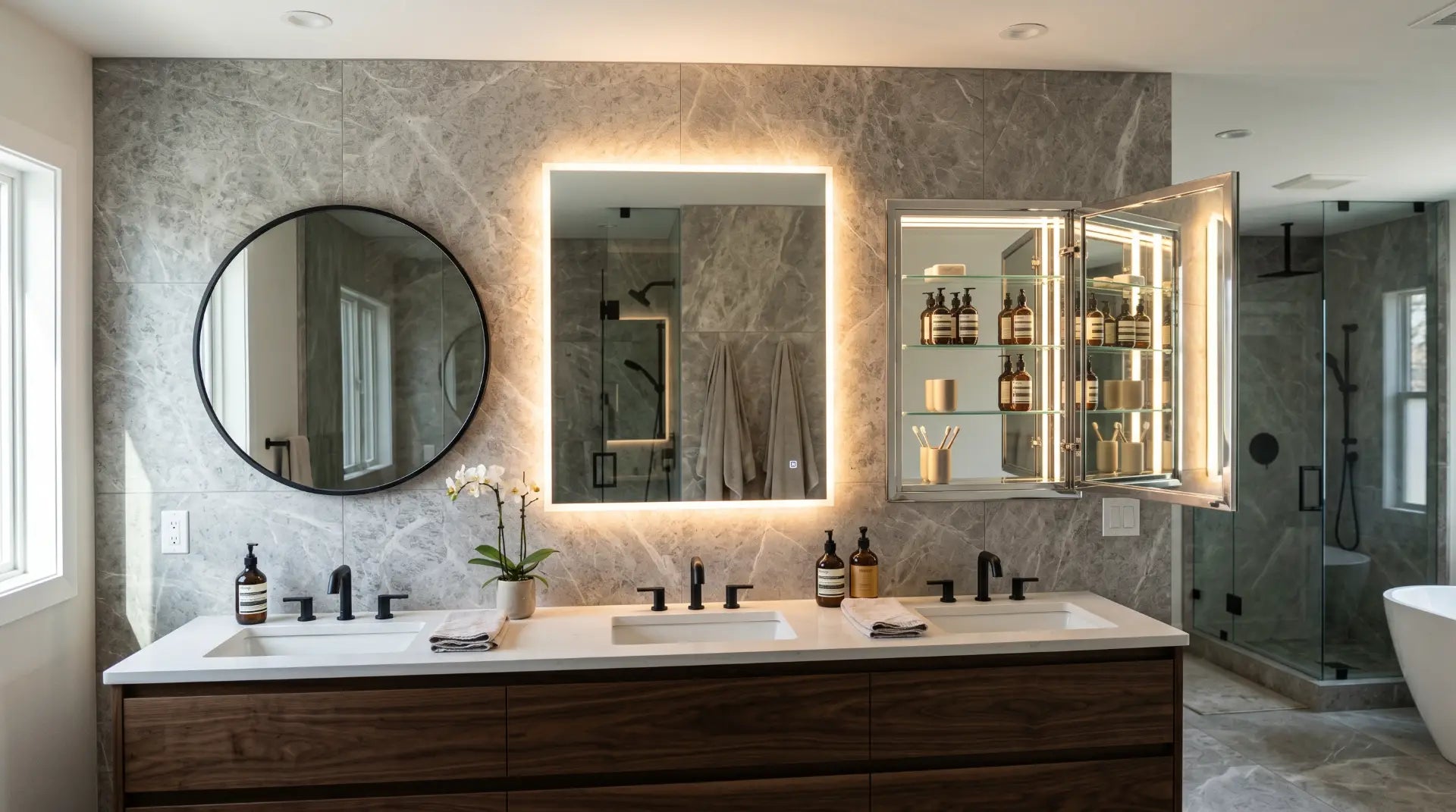
Six mirror types, one decision. This guide covers every bathroom mirror category - how each one works, what it costs, the sizing rules that actually matter, and the picks worth buying from Bathify right now.
The bathroom vanity gets all the attention in renovation planning - sink material, finish, drawer count. The mirror gets chosen last, often from whatever matches the vanity spec or fits the budget leftover. This is backwards. The mirror is the largest single visual element on the bathroom wall, the primary lighting reference for every grooming task the bathroom is designed for, and in the case of a medicine cabinet, the storage anchor for the entire vanity zone. It's also one of the highest-impact, lowest-cost upgrades you can make to an existing bathroom without touching the plumbing.
This guide covers every bathroom mirror category available in the US market in 2026 - LED, framed, frameless, medicine cabinets (recessed and surface-mount), anti-fog, smart mirrors, and magnification mirrors - with honest assessments of what each type actually delivers, who each one is right for, and what the real purchase decision looks like once the marketing language is stripped away.
If you already know your mirror type, jump directly to that section via the table of contents above. If you're starting from scratch and unsure which category to buy, read the Six Types overview first, then use the sizing rules and comparison table to land on a specific product. The FAQ at the bottom covers the six most-searched questions with direct answers.
Every bathroom mirror on the US market falls into one of six functional categories. Understanding the category first prevents the most common mistake: choosing based on aesthetics before confirming the functional match to the bathroom's actual needs.
Frameless mirrors with integrated LED strips - backlit (halo around perimeter) or front-lit (edge-facing your face). Include touch sensors, dimming, and anti-fog heating in most mid-range models. Replace the need for a separate vanity light bar.
Traditional mirrors with a decorative frame in a finish matching bathroom hardware. No built-in lighting - requires a separate vanity bar or sconce setup. Best for transitional and traditional style bathrooms.
Clean glass with polished or beveled edges, no frame. Works in modern and minimalist bathrooms without competing with other finishes. Standard frameless mirrors do not include lighting - a separate light source is required.
A mirror door on a storage cabinet - recessed into the wall for flush installation or surface-mounted. The best choice for bathrooms with limited vanity countertop space. Many current models include interior LED lighting and USB charging.
Not a standalone category - anti-fog is a feature built into LED mirrors and medicine cabinets. A resistive heating element behind the glass keeps the surface above the dew point during and after showers. Standard on most LED mirrors above $150.
LED mirrors with additional tech integrations - Bluetooth speakers, built-in clocks or weather displays, voice assistant compatibility. Highest price category ($300-$1,500+). Features are genuinely useful for some users and unnecessary overhead for most.
LED bathroom mirrors have become the default choice for primary bathroom renovations in the US market, and for practical reasons beyond aesthetics. They eliminate the separate vanity light bar or sconce - consolidating task lighting directly into the mirror - and consistently deliver the 80+ CRI lighting needed for accurate grooming. A $150 LED mirror with touch sensor, anti-fog, and adjustable brightness replaces a $40-$80 mirror plus a $60-$150 light bar, often with better task lighting placement than a bar mounted several inches above the mirror face.
The key purchasing decision within the LED mirror category is lighting position: backlit or front-lit. Most LED mirrors sold in the US are backlit - LEDs behind the mirror glass create a halo glow around the perimeter, projecting light backward onto the wall rather than forward onto your face. This is beautiful for ambiance but underwhelming for task lighting. Front-lit or edge-lit designs with LEDs along the mirror's face edge deliver meaningfully better illumination for makeup, shaving, and skincare because the light source is directed toward you rather than away from you.
Look for CRI 90+. Color Rendering Index measures how accurately a light source renders color compared to natural daylight (CRI 100). CRI 90+ is the minimum for grooming accuracy - it's what ensures your makeup looks the same under natural outdoor light as it does at your mirror. Most quality LED mirrors specify CRI; skip any that don't disclose it. For detailed guidance on color temperature, read the bathroom lighting color temperature guide.
The framed vs frameless decision is primarily aesthetic, with one functional note: framed mirrors require finish coordination with your bathroom hardware, while frameless mirrors are finish-neutral and work in virtually any bathroom without creating a coordination challenge.
Framed mirrors in metal finishes - matte black, brushed nickel, brushed gold - are the natural choice for transitional and traditional bathrooms where the frame becomes part of the room's hardware story, echoing the faucet finish and cabinet pulls. The frame adds visual weight that can feel heavy in a small bathroom but grounding in a larger one. For detailed guidance on matching mirror frames to vanity finishes, see our vanity and mirror matching guide.
Frameless mirrors eliminate the coordination obligation entirely. In modern and minimalist bathrooms - particularly those with floating vanities, minimal hardware, and clean-line design - a frameless LED mirror is the 2026 default that works regardless of the specific finish palette. A frameless mirror also tends to read larger than a framed mirror of the same dimensions because the glass extends fully to the edge with no visual border reducing the perceived size.
A frameless LED mirror is the one bathroom mirror choice that doesn't require a finish decision. You don't need to match it to the faucet, the hardware pulls, or the light fixture. For anyone uncertain about hardware finish coordination - or planning to update their bathroom hardware later - a frameless LED mirror is the lowest-risk, highest-flexibility choice. It's why frameless LED models dominate new construction and renovation projects in 2026.
A medicine cabinet combines the mirror with concealed storage - typically 4-5 inches of wall depth with adjustable glass shelves - eliminating the cluttered countertop of a bathroom without dedicated storage. In 2026, most mid-range and premium medicine cabinets include interior LED lighting, a 3x magnifying mirror on the interior door, and USB charging ports, making them a genuinely multi-functional investment rather than simply a storage box with a mirror door.
The recessed vs surface-mount decision is primarily practical, not aesthetic. A recessed medicine cabinet sits inside the wall cavity between studs, with its face flush to the finished wall - the most elegant installation, with no projection into the bathroom. This requires wall cutting, stud verification (must confirm no plumbing or electrical in the cavity), and is best done during a renovation when the wall is already being modified. A surface-mount cabinet mounts directly to the finished wall, projects 4-6 inches into the room, and requires only standard wall anchors - the right choice for existing bathrooms where you want storage without a renovation.
Interior lighting matters more than you expect. A medicine cabinet with interior LED lighting lets you see the contents clearly at any hour without relying on the main bathroom light - a practical quality-of-life detail that becomes obvious after the first few early-morning uses. The ICO Bath Jackson series at Bathify includes interior lighting, a 3x magnifying mirror, and USB ports, making it one of the most fully-featured options in its price range.
Anti-fog is a feature, not a mirror category - it's built into LED mirrors and medicine cabinets, not sold as a standalone product type. The mechanism is a thin low-voltage resistive heating pad embedded behind the mirror glass that warms the surface just above the ambient dew point during and after a shower, preventing condensation from forming. Unlike anti-fog sprays (which require reapplication every few weeks and leave a film that can affect reflection clarity), the heating element is a permanent, maintenance-free solution.
In the US market, anti-fog heating is standard equipment on most LED mirrors priced above $150 and on nearly all LED medicine cabinets. The element connects to the bathroom wiring circuit, typically through the touch sensor or a dedicated switch. Energy consumption is minimal - a typical 24×36 anti-fog heating pad draws 30-60 watts, comparable to a single incandescent bulb. For an in-depth guide to anti-fog technology and the best options in each price range, see our anti-fog bathroom mirrors guide.
Smart mirrors are LED mirrors with added technology integrations - Bluetooth speakers, built-in clocks or weather overlays, voice assistant compatibility (Amazon Alexa, Google Assistant), or touchscreen displays. They occupy the premium end of the market ($300-$1,500+) and are genuinely useful for a specific user profile: the person who wants to check the time, weather, or news during a morning routine without reaching for a phone. For the majority of bathroom users, the core functionality of a quality LED mirror - accurate lighting, anti-fog, touch dimming - delivers 95% of the daily-use value at a fraction of the cost.
The one smart mirror feature that stands apart from gimmick territory: Bluetooth speakers. A bathroom-safe Bluetooth speaker integrated into the mirror surface is a genuinely daily-use feature for people who listen to music or podcasts during morning routines, eliminating a separate Bluetooth speaker sitting on the vanity countertop. For a detailed breakdown of which smart mirror features are worth the premium, see our smart mirrors guide.
Magnification mirrors - standalone tabletop or wall-mount mirrors with 3x, 5x, or 10x magnification - serve a specific task-lighting and precision-work function that a standard bathroom mirror cannot provide: close-up skincare application, contact lens insertion, precision shaving, and makeup detail work. They're not a replacement for the primary bathroom mirror; they're a supplement to it.
Wall-mounted magnification mirrors on pivot arms are the most practical configuration - they extend when needed and fold flush against the wall when not in use. The most useful magnification level for most users is 5x; 10x is useful for skincare detail work but distorting at conversation distance. Many LED medicine cabinets, including the ICO Bath Jackson series at Bathify, include a 3x magnifying mirror on the interior door, giving you basic magnification without a separate purchase. Bathify also carries dedicated magnification mirrors in the mirror collection.
More bathroom mirrors are bought in the wrong size than any other wrong attribute. Too small and the mirror looks like an afterthought above a large vanity; too large and it crowds out the light fixtures or reads as disproportionate against the ceiling. These are the US-standard sizing rules used by interior designers - not rough guidelines, but the proportional ratios that produce the correct result consistently.
Height rule: Bottom of mirror should sit 4-6 inches above the faucet or backsplash. Top of mirror should land 2-3 inches below any overhead light fixture or the ceiling, whichever is lower. For 8-foot ceilings with a standard vanity height, this typically produces a mirror between 30-36 inches tall.
Sconce exception: If you're using side-mounted sconces instead of a bar light above the mirror, reduce mirror width to 60-70% of the vanity width to leave adequate horizontal clearance for the sconce placement. A 48-inch vanity with side sconces typically takes a 28-32 inch mirror rather than a 40-44 inch one. For complete lighting and mirror sizing guidance together, see our guide on how big your bathroom mirror should be.
Color temperature - measured in Kelvin - is the single most important specification on an LED bathroom mirror for grooming accuracy, and the one most homeowners overlook. Buying the wrong color temperature means your makeup, skin tone, and product colors look different at your mirror than they do in outdoor or office daylight - which leads to over-application of makeup, incorrect skincare product use, and a generally unflattering experience in the mirror every morning.
| Color Temp | Appearance | Best For | Grooming Accuracy |
|---|---|---|---|
| 2700K (Warm White) | Soft, yellow-white glow - incandescent look | Relaxing ambiance, traditional bathrooms, powder rooms | Good - flattering but slightly warm-shifts skin tone |
| 3000K (Warm-Neutral) | Slightly cooler than 2700K, still warm | Primary bathrooms - best all-around grooming balance | Very Good - accurate and flattering simultaneously |
| 4000K (Neutral White) | Clean, balanced - the "office light" temperature | Professional makeup application, true-color grooming | Excellent - professional standard for makeup accuracy |
| 5000-5500K (Daylight) | Cool, crisp - close to natural outdoor light | Detail skincare work, clinical precision tasks | High accuracy, unflattering - shows every flaw starkly |
| 6500K (Cool Daylight) | Blue-tinted, very cool | Not recommended for primary bathrooms | Over-emphasizes shadows, harsh on skin |
For complete guidance on choosing the right light fixtures to pair with your mirror, see our bathroom light fixtures buying guide.
Shape is a design decision, not a functional one - both round and rectangular mirrors reflect equally well. The relevant rule is that mirror shape should echo the dominant geometry of the bathroom's other design elements. Rectangular mirrors suit modern and contemporary bathrooms with clean lines, geometric tile patterns, and angular vanity profiles. Round or oval mirrors suit transitional and soft-modern bathrooms, particularly those with arched elements, curved faucet profiles, or organic material choices like wood vanity tops.
A round mirror has one practical limitation: its height and width are the same, which can make it feel undersized on wide vanities if sized for correct width. A 30-inch round mirror that's proportionally correct in width above a 36-inch vanity is also only 30 inches tall - which may feel short against an 8-foot ceiling. On single-sink vanities up to 36 inches wide, round mirrors work beautifully. On wider vanities, rectangular or oval shapes are generally more proportional. For a deeper comparison, see our round vs rectangle bathroom mirror guide.
| Feature | LED Mirror | Framed | Frameless | Medicine Cabinet | Smart Mirror |
|---|---|---|---|---|---|
| Built-in lighting | Yes | No | No | Optional | Yes |
| Anti-fog | Most models | No | No | Some models | Most |
| Built-in storage | No | No | No | Yes | No |
| Finish coordination needed | No (frameless) | Yes | No | No (frameless) | No |
| Separate light fixture required | No | Yes | Yes | Optional | No |
| DIY install feasibility | Moderate (wiring needed) | Easy | Easy | Moderate-Hard (recessed) | Moderate (wiring needed) |
| Typical price range | $100-$500 | $40-$300 | $40-$250 | $150-$800+ | $300-$1,500+ |
| Best bathroom type | Primary bath, any size | Traditional / transitional | Modern / minimalist | Any - storage priority | Primary bath, tech users |
Bathify carries LED mirrors, LED medicine cabinets, rectangle mirrors, round mirrors, and magnification mirrors from Vanity Art, ICO Bath, and KubeBath. These are the standout options across each category.

The Alder is the cleanest all-round LED mirror in Bathify's collection for a primary bathroom. The 4000K LED strip - the professional grooming standard - produces natural, even brightness without harsh shadows. Rounded corners on the frameless design soften the look without the commitment of a full round mirror, making it genuinely versatile across modern and transitional style bathrooms. Touch sensor for on/off and lighting adjustment, distortion-free surface, mounts vertically or horizontally.

5500K daylight-balanced LED strip for the highest color accuracy - the choice for makeup artists and detail-focused grooming routines. Up to 50,000 hours of LED lifespan, 80% less energy than traditional lighting. Tempered, shatter-resistant, corrosion-proof glass with all mounting hardware included. On/off switch built in, vertical or horizontal orientation.

The Lumi's square format is uncommon in the US market - most LED mirrors default to rectangle - making it the standout choice for bathrooms with square tile patterns or geometric design themes. 5500K daylight LED integrated strip, frameless minimalist design, touch sensor control. Compact 28-inch square fits perfectly on single-sink vanities up to 36 inches wide.

The Jackson is the most fully-featured medicine cabinet in Bathify's lineup - and one of the most genuinely practical bathroom investments for any home with limited countertop storage. Integrated interior lighting throughout the cabinet (not just the door), glass shelves, 3x magnifying mirror inside the door, 12V USB charging ports, dimmable touch-activated controls with adjustable color temperature, and a 5-year warranty. Copper-free glass with safety film backing. Can be surface-mounted or recessed. Available in two widths: 24"×36" and 30"×36".
Shop: Jackson 24"×36" at Bathify → · Jackson 30"×36" at Bathify →

The Numi's dual-door horizontal sliding mechanism is the standout design feature - both doors slide rather than swing, allowing simultaneous access to the mirror and cabinet interior without blocking the vanity space. Two adjustable tempered glass shelves, LED strip lighting, frameless 25"×26" profile, rock switch for lighting control. Suited for smaller bathrooms where a swinging cabinet door creates clearance issues with the toilet or adjacent wall.
![[Premium Quality Bathroom Products & Accessories Online]-Bathify](https://cdn.shopify.com/s/files/1/0633/9467/6967/products/A750-2.jpg?v=1648818315)
The Kube cabinet mirrors every surface - exterior door, edges, and interior door - creating a visually expansive effect in smaller bathrooms that a single-face mirror cannot replicate. Two tempered glass shelves inside. Surface-mount or recessed installation. For powder rooms and small bathrooms where expanding visual depth is the priority, the all-mirror construction makes this the right pick.
Match the mirror type to the bathroom's actual needs - then size it correctly
Primary bathroom, daily use: LED mirror (4000K for grooming accuracy) or LED medicine cabinet if storage is needed. Frameless design eliminates finish coordination. Ensure anti-fog is included if the mirror is close to the shower zone.
Limited countertop storage: LED medicine cabinet - the ICO Bath Jackson covers every practical feature (interior lighting, 3x magnification, USB charging, adjustable color temp) with both surface-mount and recessed options. Size to fit between studs for recessed; surface-mount if renovating an existing bathroom.
Traditional or transitional bathroom: Framed mirror in a finish matching your dominant hardware (faucet and cabinet pulls). Or a frameless LED mirror - which works across all styles and eliminates the finish decision entirely.
Small bathroom or powder room: An oversized frameless LED mirror (at or slightly above the vanity width) visually expands the space more than any other single change. The all-mirrored Kube cabinet amplifies this effect with reflected depth from all surfaces.
Double sink vanity (60"+): Two individual mirrors rather than one wide mirror - one per sink, sized to 60-70% of each sink zone's width. Matching LED mirrors in the same model create a cohesive paired look.
Shop Bathroom Mirrors at Bathify
LED mirrors, medicine cabinets, rectangle and round mirrors - from Vanity Art, ICO Bath, and KubeBath. Free shipping on orders over $50. Shipped across the USA.


