







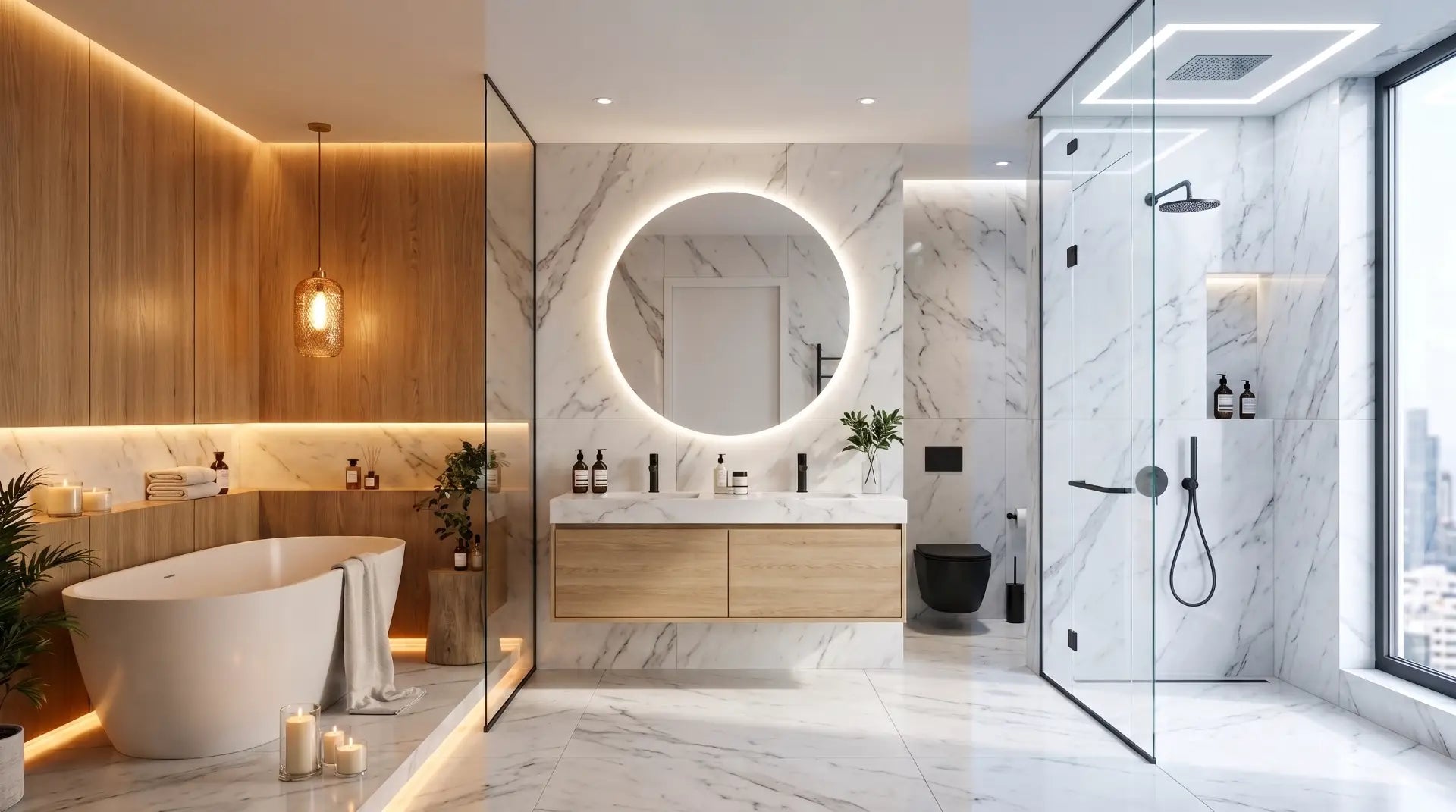
The Kelvin number on your bulb box determines whether your bathroom feels like a spa, a surgeon's office, or something in between. Here's exactly what each temperature does - and which zone of your bathroom actually needs it.
- What Is Color Temperature (and What Does Kelvin Actually Mean)?
- 2700K - Warm White: The Spa Feel
- 4000K - Neutral White: The Workhorse
- 6500K - Daylight: When (and When Not) to Use It
- Full Comparison: 2700K vs 4000K vs 6500K at a Glance
- Zone-by-Zone Guide: What Temperature Goes Where
- CRI: The Factor More Important Than Kelvin
- Makeup & Grooming Lighting: The Real Science
- How to Layer Color Temperatures Like a Pro
- Final Verdict
- Frequently Asked Questions
You pick the right vanity. You install a mirror you love. Then the wrong light makes everything look flat, orange, or like a hospital hallway - and suddenly none of your choices feel right. Bathroom lighting color temperature is the invisible variable that controls how every other element in your bathroom actually reads to the human eye.
The Kelvin number (K) printed on a bulb box tells you the color of the light - not how bright it is. Lower numbers like 2700K produce warm, amber-tinted light. Higher numbers like 6500K produce a crisp, blue-white light closer to overcast daylight. Most bathrooms need more than one temperature in different zones, and most guides never tell you where each one goes - or why.
This guide fixes that. We'll break down exactly what 2700K, 4000K, and 6500K look like in a bathroom, which zone each one belongs in, and the one technical metric (CRI) that matters more than Kelvin in nearly every situation. By the end, you'll know exactly what to buy, where to put it, and why.
Kelvin (K) tells you the color of light. Lumens tell you the brightness. A 2700K bulb and a 4000K bulb can both output 800 lumens - they'll look and feel completely different in your bathroom, but neither is brighter than the other. If your bathroom feels dim, increase lumens. If it feels too yellow or too blue, change the Kelvin. These are two separate dials.

At 2700K, light has that familiar incandescent warmth - amber-toned, soft, and inherently relaxing. It's what most living rooms and bedrooms run on, and it translates beautifully to specific zones of your bathroom. When you see a luxury hotel bathroom with warm, glowing light over the soaking tub, that's almost certainly 2700K at work.
The appeal of 2700K is emotional as much as functional. Warm light slows your nervous system down - which is exactly what you want during an evening soak or a late-night bathroom visit. It flatters skin tones by adding warmth and minimizing the appearance of blemishes, which is why spa designers and hotel interior architects reach for it consistently.
The limitation is task accuracy. Under 2700K light, warm tones in your makeup appear amplified while cooler tones are downplayed. You may apply foundation that looks perfect in the bathroom mirror and find it reads differently the moment you step into natural daylight. For any grooming task that requires color accuracy - matching your foundation, checking your shave, or seeing your true skin tone - 2700K is the wrong tool.
Always put your 2700K fixtures on a dedicated dimmer switch. A 2700K recessed light at full brightness over the tub can still feel too bright for a relaxing soak. On a dimmer, you can pull it back to 30-40% output for a true candlelit feel - and still have full brightness available for cleaning.

4000K is the industry standard for bathroom task lighting in the US - and for good reason. At this temperature, light is clean and white with no strong warm or cool cast. Colors appear accurate. White tiles look truly white. Skin tones render naturally without the flattering-but-inaccurate warmth of 2700K or the clinical blue push of 6500K.
For vanity mirrors, shaving, makeup application, and general bathroom grooming, the 3500K-4000K range is what most lighting designers specify in professional projects. It's the sweet spot where color accuracy is high enough for meaningful task work, but the tone stays comfortable enough that you don't feel like you're in a hospital corridor. In bathrooms with cool tile palettes - white subway tile, gray stone, or pale grout - 4000K looks particularly polished because it doesn't fight the palette the way warm light does.
One thing competitors consistently get wrong: they present 4000K as "harsh" or "clinical." That reputation mostly comes from old, low-CRI fluorescent fixtures running at 4000K - not from quality LED fixtures. A modern 4000K LED vanity light with CRI 90+ from brands like Kichler, Progress Lighting, or Hunter looks clean and crisp, not harsh. The Kelvin is not the problem - the CRI was.

At 6500K, light takes on a distinct blue-white quality that mimics overcast outdoor daylight at noon. It's the highest common temperature in residential LED bulbs and produces the closest approximation to natural sunlight that a light fixture can deliver. On paper, that sounds perfect for color accuracy - and for one very specific use case, it genuinely is.
Professional makeup artists and beauty content creators who shoot video or photography in bathrooms sometimes spec 5000K-6500K specifically because it previews exactly how makeup will appear under outdoor natural light. If your primary concern is that what you see in the mirror is what you'll see outside, 6500K delivers on that promise.
For everyday residential use in a US bathroom, however, 6500K is almost universally too much. The blue-white cast is noticeable and unflattering on most skin tones. It makes grout lines look dingy, warm wood tones look greenish, and the overall experience reads as clinical rather than comfortable. Interior designers consistently avoid 6500K in residential bathrooms - not because they don't understand color accuracy, but because livability matters as much as precision. The exception is laundry rooms and garages: 6500K is excellent there.
| Criteria | 2700K Warm White | 4000K Neutral White | 6500K Daylight |
|---|---|---|---|
| Light color appearance | Amber / golden yellow | Clean neutral white | Blue-white / daylight |
| Skin tone rendering | Flattering, warmer | Natural, accurate | Cool, can look pale/washed |
| Makeup accuracy | Poor - misleading warm cast | Good - close to daylight | Best - closest to outdoor |
| Bathroom mood | Spa, cozy, relaxing | Clean, functional, polished | Clinical, high-visibility |
| Tile palette match | Warm tones (cream, beige, wood) | Neutral & cool (white, gray, stone) | Ultra-cool / white only |
| Best bathroom zone | Tub, shower, nightlight | Vanity mirror, ceiling | Dedicated studio setup only |
| Recommended CRI | 80+ (relaxation), 90+ (task) | 90+ always | 90-95+ for accuracy |
| Residential livability | High | High | Low |
| Color accuracy for tasks | Low | High | Highest |
The single biggest mistake US homeowners make in bathroom lighting isn't choosing the wrong Kelvin - it's treating the bathroom as one undifferentiated room that needs one temperature. A well-lit bathroom has three distinct lighting zones, each with its own purpose and its own ideal Kelvin range.
Each zone needs its own switch or dimmer: If your vanity lights and tub lights are on the same circuit, you can't use them differently. When renovating, run a separate circuit to each zone. If you're working with an existing bathroom, smart bulbs from brands like Philips Hue, LIFX, or Lutron Caséta let you control zones independently without rewiring.
Most lighting guides spend 95% of their word count on Kelvin and bury CRI in a footnote. That's backwards. In a bathroom - where you're making color-critical decisions every morning - CRI matters more than Kelvin in most situations.
CRI stands for Color Rendering Index. It measures how accurately a light source reveals the true colors of objects compared to natural sunlight, on a scale from 0 to 100. A CRI of 100 means perfect accuracy - the light shows colors exactly as they'd appear in direct sunlight. Most residential LED fixtures land between CRI 80 and CRI 95.
Here's the practical impact: two bulbs can both be rated 4000K but have entirely different CRI scores. The CRI 80 version will make your skin tone look slightly washed out and your lipstick shade look different from how it appears outdoors. The CRI 90 version shows everything accurately. The 4000K number is the same on both - but the lighting experience is completely different.
| CRI Range | What It Means | Best For | Suitable for Bathroom? |
|---|---|---|---|
| CRI 70-79 | Colors are noticeably distorted; skin tones look dull | Warehouses, storage areas | No |
| CRI 80-89 | Acceptable color rendering; slight distortion in some hues | General living areas, hallways | Ambient only |
| CRI 90-94 | Excellent accuracy; colors appear very close to natural | Vanity, makeup, grooming | Yes - recommended |
| CRI 95-100 | Near-perfect; used in photography studios and medical settings | Professional makeup, color work | Yes - premium choice |
At Home Depot, Lowe's, and Wayfair, CRI is listed on the product specification sheet - often abbreviated as "Ra" or "CRI" followed by a number. Budget fixture brands frequently publish CRI 80 but market the fixture as "bright" and "natural." Don't confuse lumens (brightness) with CRI (accuracy). A 90 CRI fixture with 1,600 lumens at 3500K will outperform a 70 CRI fixture at 2,400 lumens for makeup every single time.
The most common bathroom lighting complaint in the US is some version of this: makeup that looks perfect at home looks wrong the moment you walk outside. This problem has a technical cause, and it's almost always fixable without a full renovation.
When you apply makeup under 2700K warm light, warm tones in the light amplify warm tones in your foundation and blush. The result looks balanced under that light. Step into natural daylight (which sits around 5000K-6500K), and the warm light was essentially fooling you - your foundation is now reading differently, your blush appears heavier, and your highlight looks flat.
The fix is narrowing the gap between your bathroom light and natural daylight without going all the way to 6500K (which most people find too harsh to live under). A 3500K-4000K fixture with CRI 90+ gets you close enough to daylight accuracy that what you see in the mirror closely resembles what you'll see outside. Professional makeup artists who train their clients' bathroom lighting consistently land in the 4000K-5000K range with CRI 90+.

The most common placement mistake is a single fixture directly overhead the mirror. This creates downward shadows under your eyes, nose, and chin - making you look tired and making accurate makeup application impossible regardless of your Kelvin choice. The professional standard is side-mounted sconces at eye level (60-65 inches from the floor), which cross-illuminate your face evenly from both sides with no shadows.
If you can't do side sconces, the next best option is a long horizontal bar that spans most of the mirror width. A single puck overhead is always a last resort. For bathrooms in cities like New York, Chicago, or San Francisco where space is limited, a backlit LED mirror with integrated vanity lighting achieves the same even coverage as sconces within the mirror's footprint. See our full guide on backlit vs. front-lit bathroom mirrors for how the placement translates across mirror types.
Target 2,000-2,400 lumens for the vanity zone specifically, on top of whatever ambient ceiling lighting you have. This is brighter than most homeowners default to - but the increased output is what allows you to see detail accurately during grooming without straining.

The fastest-growing segment of bathroom lighting in 2025-2026 is tunable white (also called color-selectable or CCT-adjustable) fixtures. These let you shift the Kelvin value of a single light using a switch, app, or dimmer - so your vanity light runs at 4000K while you apply makeup in the morning, then shifts to 2700K in the evening for a relaxing atmosphere.
Brands like Feit Electric, Lutron, and Philips Hue all sell tunable white options in the $40-$200 range that work in standard bathroom fixture sockets. For homeowners who want one fixture to handle multiple zones across the day, CCT-adjustable bulbs eliminate the need to wire separate circuits. If you're replacing a vanity fixture in a single-circuit bathroom, this is the most flexible upgrade available for under $100.
Professional lighting designers don't pick one Kelvin value for an entire bathroom - they layer temperatures across zones, put each zone on its own dimmer, and design for how the room is used at different times of day. Here's how to do the same thing without a designer's budget.
| Layer | Fixture Type | Kelvin | CRI | Control |
|---|---|---|---|---|
| Vanity task | Side sconces or horizontal bar at mirror | 3500K-4000K | 90+ | Dedicated dimmer |
| Ambient fill | Recessed ceiling cans or flush-mount | 3000K-3500K | 80-90 | Separate dimmer |
| Tub/shower | Wet-rated recessed can | 2700K-3000K | 80+ | Dimmer (required for wet zones) |
| Night light | Toe-kick LED strip or plug-in nightlight | 2200K-2700K | Any | Motion sensor or timer |
The Kelvin Scale - Bathroom Zones
Warmer temperatures (left) suit relaxation zones. Cooler temperatures (right) suit task zones. The 3500K-4000K range is the sweet spot for most US bathroom vanity setups.
If your bathroom has only one circuit, go tunable white at the vanity: A color-selectable LED fixture from Feit Electric or Philips Hue lets you set 4000K in the morning for makeup and switch to 2700K in the evening for a relaxing atmosphere - all without touching the wiring. It's the most cost-effective way to layer temperatures in a single-zone bathroom renovation.
3500K-4000K at the vanity. 2700K at the tub. Never 6500K in a living bathroom.
Bathroom lighting color temperature isn't a one-size answer - it's a zone-by-zone decision. The system that works in the vast majority of US bathrooms: neutral white (3500K-4000K with CRI 90+) at the vanity for accurate task lighting, and warm white (2700K-3000K) over the tub or shower for ambiance and relaxation.
Choose 2700K if: you're lighting a soaking tub, shower, or a nightlight circuit; your bathroom has warm wood tones or cream/beige tile; or you want a spa-like atmosphere for evening use. Pair it with a dimmer and CRI 80+ minimum.
Choose 3500K-4000K if: you're lighting a vanity mirror, installing general ceiling fill light, or need accurate color for makeup and grooming. This is the right choice for over 90% of US bathroom vanity setups. Use CRI 90+ without exception.
Choose 6500K if: you have a dedicated professional makeup studio setup, shoot video or photography in your bathroom, or need the absolute highest color accuracy for matching cosmetic shades. It's not a living-bathroom temperature - spec it carefully and isolate it to the task zone only.
In every case: Put each zone on its own dimmer switch. Confirm CRI 90+ before purchasing any vanity fixture. And if your current bathroom has only one circuit, a tunable white LED fixture is the single best upgrade you can make for under $100.
Shop Bathroom Lighting at Bathify
Browse vanity lights, LED mirrors, and bathroom fixtures - shipped across the US. Free shipping on orders over $50.


