







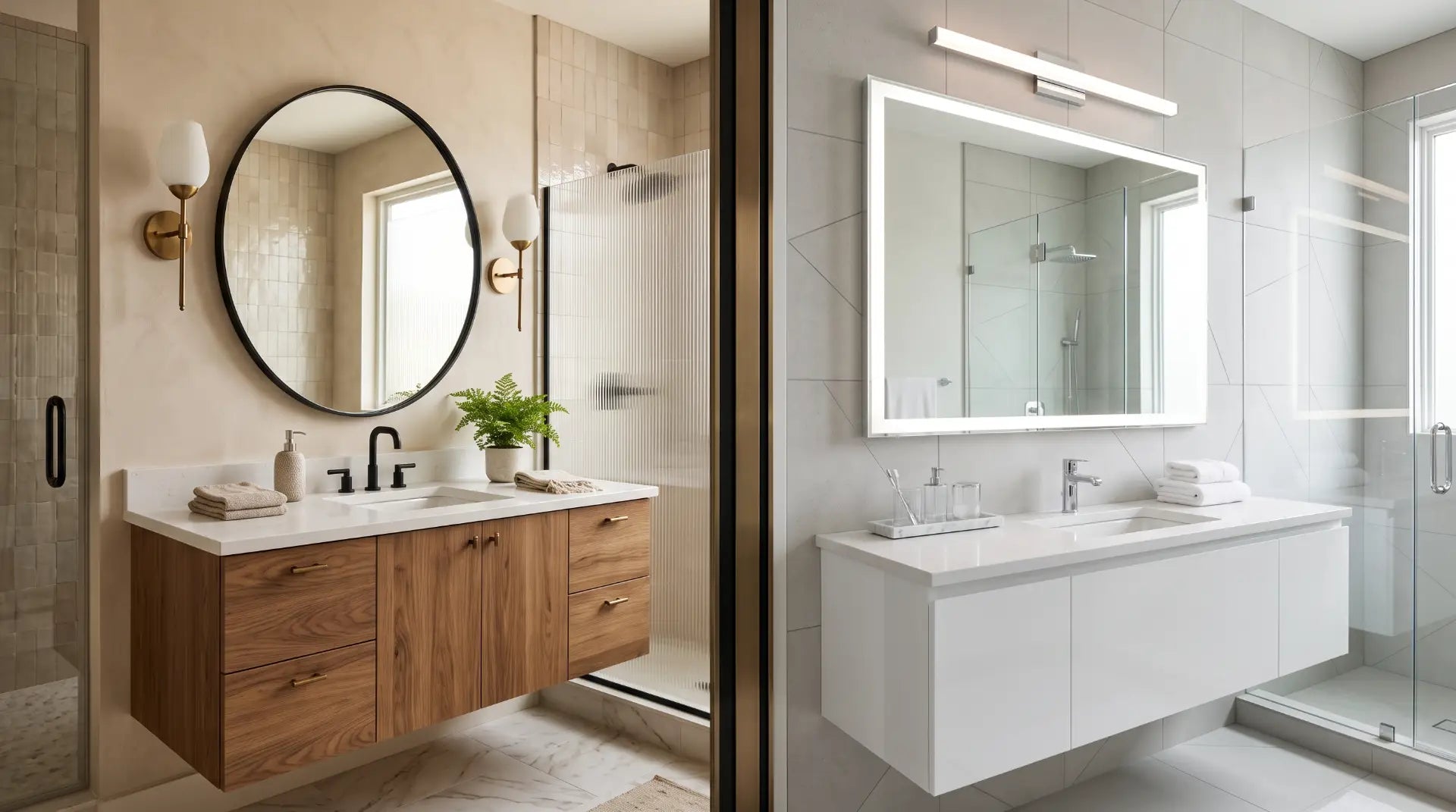
Shape is a design decision - not a personal preference. There are specific bathroom types, vanity widths, and room geometries where each shape works better. Here's the honest breakdown.
The question "round or rectangle" sounds like personal taste - but it's mostly a design geometry question. The guiding rule in interior design is that mirror shape should echo the dominant lines of the surrounding space. Angular, geometric rooms with flat-front vanities, rectangular tile, and sharp-edged hardware signal a rectangular mirror. Softer, more organic rooms with curved faucets, arched windows, or warm-toned natural materials signal a round or oval mirror.
The second rule is proportional: round mirrors are constrained by the fact that their height and width are equal. A round mirror that's proportionally wide for a vanity is also proportionally tall - and that becomes a ceiling clearance and visual proportion issue on wider vanities. Rectangles scale with vanity width without creating that height constraint, which is why they dominate wide vanities and double-sink setups.
This guide works through seven specific categories where the correct answer diverges between shapes - giving you an objective basis for the decision rather than leaving it to preference.
A round mirror looks better in a soft-modern powder room with warm textures and organic lines. A rectangle looks better above a 48-inch flat-front vanity with geometric tile. There isn't a universally better shape - there's a shape that's correct for each specific bathroom context. This guide helps you identify which context you're in.
A round mirror introduces a curved element into a space that is almost entirely defined by right angles - flat walls, rectangular vanity cabinets, rectangular tile, rectangular windows. That contrast is the reason round mirrors photograph so well and why they became a defining design trend from 2022 through 2026: the circle is the only common shape in a bathroom that doesn't look like everything else, which gives it instant visual distinctiveness.
The round mirror also has a softening effect that interior designers call "tension relief" - the curve relaxes the feeling of a room with too many hard lines and angles. In a bathroom that feels cold or clinical, a round mirror (particularly in a warm-finish frame like unlacquered brass or aged bronze) shifts the room's emotional register toward warmth and personality without requiring any structural change.
The practical constraint: a round mirror's diameter is simultaneously its height. A 28-inch round mirror above a 36-inch vanity is proportionally correct in width - but it's also only 28 inches tall, which on an 8-foot ceiling with standard vanity height can feel compact if the wall field between the vanity and the ceiling is tall. On a lower wall field (7-foot ceilings, or a very high backsplash), round mirrors work proportionally in height as well as width.
A rectangular mirror is the form most naturally matched to the US bathroom's dominant design logic: it echoes the rectangle of the vanity below it, the rectangle of the window beside it, and the grid of the tile behind it. When correctly sized - 75-85% of the vanity width, height scaled to the wall field between the vanity and any overhead fixture or ceiling - a rectangular mirror is nearly invisible in its correctness. It reads as designed without demanding attention.
The practical advantages of a rectangle come from the independence of its height and width. A 48-inch wide, 30-inch tall rectangle sits perfectly above a 60-inch vanity without any ceiling clearance issue. A 36-inch wide, 36-inch tall rectangle fills the wall field on a shorter-ceiling bathroom without the proportional constraints of a circle. LED mirrors - essentially all of which are rectangular - benefit from this flexibility in two directions, which is one reason why the growth of the LED mirror category has reinforced the rectangle's position as the default primary bathroom mirror shape.

The dominant design style of the bathroom is the clearest signal for mirror shape. Modern and contemporary bathrooms - characterized by flat-front vanity cabinets, geometric tile (subway, large-format square, herringbone), clean-line hardware, and cool-neutral finishes - are naturally served by rectangular mirrors, which share the same geometric vocabulary as everything else in the room. A round mirror in a strongly modern bathroom looks deliberately contrarian rather than designed, unless the other design elements include curved or organic elements that give the circle context.
Transitional and soft-modern bathrooms - warm-toned walls, natural wood vanity faces, rounded faucet profiles, aged brass hardware, or any organic element like stone countertops with natural veining - are the natural home for round mirrors. The circle relates to the curves already present and reads as part of a composed design rather than a shape imposed on the wrong room. Traditional bathrooms with decorative detailing (crown molding, shaker-door vanities, ornate hardware) support either shape depending on the specific aesthetic direction: an arched-top rectangle suits formal traditional; a simple round suits casual-traditional.
Vanity width is the most decisive factor in the round-vs-rectangle question, and the one most guides understate. For single-sink vanities up to 36 inches wide, a round mirror in the 22-28-inch diameter range sits correctly - it's proportionally appropriate in width and the height constraint (equal to the diameter) doesn't create a clearance or proportion problem at standard ceiling heights.
Above 36 inches, the round mirror's width-equals-height constraint becomes increasingly problematic. A 40-inch vanity would want a 28-32-inch round mirror for correct width proportion - but a 32-inch circle is also 32 inches tall, which on a standard 8-foot ceiling leaves very little wall space between the top of the mirror and the ceiling or light fixture above. For 42-inch and above vanities, a rectangular mirror almost always produces a better proportion because its height can be set independently of its width. This is why the rectangle dominates primary bathroom renovations with wider vanities in the US market - it's not fashion, it's geometry.
| Vanity Width | Round Mirror Diameter | Rectangle Width | Notes |
|---|---|---|---|
| 24" | 16-20" | 18-22" | Round works well at this scale |
| 30" | 20-24" | 22-26" | Round works well, either shape correct |
| 36" | 22-28" | 28-32" | Round upper limit for clean proportion |
| 42" | 26-30" (height constraint) | 34-38" | Rectangle preferred - round height restricts |
| 48" | 32-36" (height very limiting) | 40-44" | Rectangle strongly preferred |
| 60" (double) | Two 24-28" rounds per sink | 52-56" single or two 24-26" | Two rounds or two rectangles - both work |
| 72"+ | Two 26-30" rounds per sink | Two 28-34" rectangles | Always two individual mirrors - never one wide |

Rectangle mirrors and lighting fixtures have a natural visual relationship: the flat top edge of the mirror defines a clear horizontal datum for a bar light above it, and the bar's horizontal form echoes the mirror's horizontal width. The bar appears to float directly above the mirror as a deliberate composition. This relationship breaks down with a round mirror - a horizontal bar light above a circular mirror connects to the mirror's top edge only at one point (the top of the curve), which makes the bar look less compositionally anchored to the mirror below it.
For round mirrors, side sconces flanking the mirror at eye level (60-65 inches from the floor) produce a far better visual result than a bar above - the vertical form of a single sconce on each side echoes the circle's vertical and horizontal extremes, creating a visual "frame" around the round mirror that feels designed. The sconce pairing also provides superior grooming light quality, illuminating the face from both sides rather than from above only. For more on lighting placement with each mirror shape, see our bathroom light fixtures guide.
LED mirrors are almost exclusively rectangular - the integrated LED strip runs along the perimeter of the glass and works best in rectangular or square formats where the strip can form a consistent, even frame. If an LED mirror is in your specification, a rectangle is the default shape choice that all current LED mirror products are designed around.

If expanding perceived space is the primary goal, a large frameless rectangular mirror outperforms a round mirror. The reason is simple: a rectangle fills more of the wall field with reflective surface area, which reflects more ambient light back into the room and creates a stronger visual expansion effect. A 36-inch wide × 30-inch tall rectangle reflects substantially more of the room than a 28-inch round mirror in the same position, because the rectangle has no "missing corners." For a small bathroom in a building like a Chicago or New York apartment where square footage is genuinely limited, an oversized frameless rectangle is the correct specification for maximum space expansion.
Round mirrors have a different - and legitimate - spatial advantage: the curved edge softens the angularity of a small bathroom without adding visual weight. A small bathroom that feels boxy and clinical benefits more from a round mirror's organic quality than from an additional rectangular element that reinforces the boxy feeling. The choice between "more light and visual space" (rectangle) versus "softer, less boxy feel" (round) is a design judgment call specific to the individual bathroom's character.

For double-sink vanities 60 inches and wider, two individual mirrors - one per sink - almost always produce a better design result than a single wide mirror spanning the full vanity. This applies regardless of shape: two matched round mirrors or two matched rectangles both work well and both anchor each sink zone visually. The proportion of each individual mirror should follow the single-sink sizing rules relative to each sink zone width rather than the full vanity width.
The shape decision for a double-sink setup is primarily a style decision using the same rules as a single-sink bathroom. A matching pair of round mirrors above a soft-modern double vanity with natural wood tones and brass hardware is a beautiful 2026 composition. A pair of frameless LED rectangles above a contemporary double vanity with flat-front cabinetry is equally correct and provides integrated lighting without a separate fixture. Either approach works; the critical rule is that both mirrors must match - shape, frame, and finish.

From a resale and design longevity perspective, rectangular mirrors carry an advantage through their neutrality. A frameless rectangle - particularly a large, borderless example - is the least trend-specific mirror form. It will not read as dated the way a specific frame style or color might, because the rectangle itself is not a trend - it's a fundamental form that predates contemporary design categories.
Round mirrors are more trend-sensitive. The circular bathroom mirror surged in popularity in 2022-2024 and remains strong in 2026, but design trends move in cycles. A round mirror in a heavy decorative frame that reads strongly as a 2023 design choice may feel period-specific in a decade the way certain 2010s design choices do now. A simple, frameless round mirror in a brass or matte black ring has more longevity than a heavily styled round frame, but it still carries more trend-specificity than a frameless rectangle. For homes being renovated with resale in mind in the next 5 years, a well-proportioned frameless rectangle is the lower-risk specification.

There's a third shape category that resolves the round-vs-rectangle tension for many US bathrooms: mirrors with softened geometry - rounded corners on a rectangle, oval forms, arched tops, or stadium shapes (rectangle with semicircle top). These shapes carry the proportional advantages of a rectangle (independent height and width, scales with vanity width) while introducing the curvilinear softness of a round form.
The Vanity Art Alder LED mirror at Bathify is a direct example of this approach: a 24"×31.5" rectangle with rounded corners - a frameless LED mirror that reads as more organic than a hard-cornered rectangle and more substantial in scale than a round mirror of the same overall size. It works in modern bathrooms without the rigidity of a sharp-cornered rectangle, and in transitional bathrooms without the scale limitations of a round. The rounded-corner rectangle is the 2026 category most likely to satisfy anyone who is genuinely uncertain between the two classic shapes.
4 rounds drawn (Style: depends on bathroom; Double sinks: either works; Space: depends on goal; Third option: hybrid). Rectangle wins on functional categories - proportioning, lighting, and resale. Round wins on style for the right bathroom type, which is a score the numbers don't capture.
| Factor | Round Mirror | Rectangle Mirror | Better For |
|---|---|---|---|
| Design effect | Softens angular rooms, creates contrast | Echoes dominant room geometry | Style specific |
| Vanity width under 36" | Excellent - correct proportions | Also works well | Round (at this size) |
| Vanity width 42"-60"+ | Height-width constraint becomes problematic | Scales freely - no height constraint | Rectangle |
| Bar light above mirror | Poor visual connection (curved top edge) | Natural composition (flat top edge) | Rectangle |
| Side sconces flanking | Excellent - sconces frame the circle | Also works well | Round (better pairing) |
| LED mirror compatibility | Not available as LED | All LED mirrors are rectangular | Rectangle |
| Space expansion effect | Moderate - less reflective area | Strong - more reflective area | Rectangle |
| Room softening effect | Excellent - curved form relaxes angular rooms | Limited - reinforces angularity | Round |
| Double-sink setups | Two rounds (one per sink) | Two rectangles or one wide | Either works |
| Powder room impact | Excellent - strong design statement | Also works - frameless is elegant | Round (more distinctive) |
| Resale neutrality | More trend-sensitive | More timeless - less trend-specific | Rectangle |
| Price range | $50-$400+ | $40-$500+ | Similar ranges |
- The bathroom has warm tones, natural materials, or organic elements
- The vanity is 36 inches wide or under (single sink)
- You want a statement piece in a powder room
- Side sconces are planned - round + sconces is the correct pairing
- The bathroom style is transitional, soft-modern, or warm contemporary
- You want to intentionally break the room's angular pattern
- The vanity is 42 inches or wider
- This is a double-sink vanity and one wide mirror is preferred
- An LED mirror is in the specification - all are rectangular
- A bar light above the mirror is planned
- The bathroom is strongly modern or contemporary with geometric tile
- Resale value in the next 5 years is a consideration

The Reynolds delivers what a modern bathroom actually needs from a rectangular mirror: a barely-there matte black iron frame that surrounds the glass with a sleek line of color without adding visual weight. The minimalist form works in both modern and contemporary bathrooms where the mirror should read as part of the wall composition rather than a decorative focal point. At 24"×36", it's correctly proportioned above a 30-36-inch single-sink vanity. Iron construction with quality matte black finish - the combination of material and color that defines modern bathroom hardware in 2026.

The Eros stands apart from standard rectangular mirrors through its antique brass-coated corner elements - hardware details that add identity and character to a format that typically reads as neutral. The beveled center creates a depth effect in the glass surface rather than a flat mirror. This is the correct rectangular mirror for a bathroom with warm hardware (antique brass faucet, gold pulls), warm-toned tile, or any traditional or transitional context where the mirror should carry some personality rather than disappear into the wall.

The Edwin is the perfect choice for the homeowner undecided between round and rectangle: a rectangular mirror with rounded corners and a bronze-plated metal frame that bridges both shapes' design qualities. The rounded edges soften the rectangle without committing to the full circle, making it compatible with both angular-modern bathrooms (where the rectangle's proportional correctness applies) and warmer transitional bathrooms (where the rounded corners and bronze finish create the softening effect). A smart choice for bathrooms in the design middle ground - and the specification that echoes what Vanity Art built into the Alder LED mirror's rounded-corner frameless format.

The Alder's rounded corners make it the LED mirror pick for bathrooms that want LED functionality (integrated task light, anti-fog, touch dimming) without the rigidity of a hard-cornered rectangle. The 4000K neutral-white LED provides balanced grooming accuracy - warmer than 5500K daylight and more accurate than 3000K warm white. 24"×31.5" scales correctly above single vanities from 24-36 inches wide. Mounts vertically or horizontally.
Rectangle wins on function; round wins on style - for the right bathroom.
If your bathroom is strongly modern with geometric tile and a wide vanity, a rectangle is correct - it scales with the vanity, works naturally with a bar light, and is available in LED formats. If your bathroom is transitional or warm-modern with a single sink under 36 inches, a round mirror paired with side sconces creates the most visually distinctive and designed composition available at the vanity.
Choose rectangle if: the vanity is 42 inches or wider, an LED mirror is in the spec, a bar light above is planned, the bathroom is strongly modern, or resale in the next 5 years is a consideration.
Choose round if: the vanity is 36 inches or under, the bathroom has warm tones and organic materials, side sconces are planned, this is a powder room where design impact matters most, or the bathroom has too many hard angles and needs relief.
Undecided? A rounded-corner rectangle - like the Edwin framed mirror or the Vanity Art Alder LED - is the hybrid specification that works in both contexts without fully committing to either. It's the correct answer for any bathroom that has elements of both design directions.
Shop Round & Rectangle Mirrors at Bathify
Round mirrors, rectangle mirrors, LED mirrors, and framed mirrors from Reynolds, Eros, Edwin, Vanity Art, and ICO Bath. Free shipping on orders over $50, USA-wide.


