







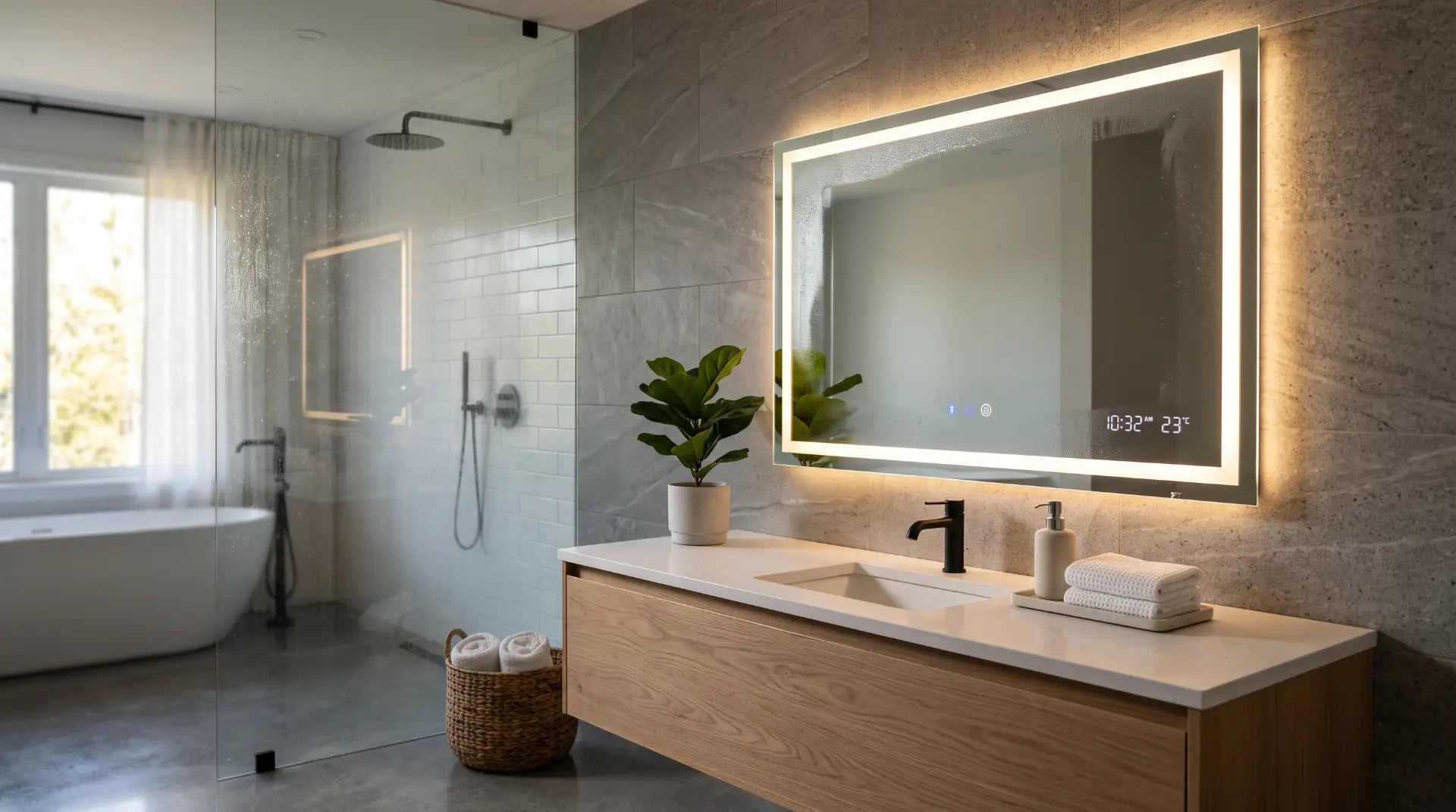
Six smart mirror features, one honest verdict. This guide breaks down every tech integration - Bluetooth speakers, LED lighting, anti-fog, displays, voice assistant, and touch controls - and tells you exactly which ones improve your daily routine and which ones inflate the price tag.
The term "smart mirror" is applied loosely. In marketing copy, it gets attached to any LED mirror with a touch sensor - which, by 2026, describes most LED mirrors on the US market at any price point. True smart mirrors add at least one connectivity or information feature on top of the LED mirror baseline: Bluetooth audio streaming, a digital info display, Wi-Fi-based data feeds, or voice assistant integration.
The practical distinction matters because you're being asked to pay a premium for the "smart" label, and that premium ranges from $50 to $1,200+ depending on which features are included. Understanding what each technology layer actually does - and whether it belongs in a bathroom environment - is what this guide exists to clarify. A standard LED bathroom mirror with touch dimming, anti-fog, and adjustable color temperature delivers accurate grooming lighting for $100-$300. A smart mirror adds features beyond that baseline - some of which genuinely improve the daily routine and some of which add complexity without proportional benefit.
If you already know which feature you're evaluating - Bluetooth, display, voice assistant - jump directly to that section. If you're starting from scratch, the Six Features overview below gives you a ranked summary of value before you read the deep dives. The FAQ at the bottom covers the most-searched smart mirror questions with direct, no-hedging answers.
Not all smart mirror features deliver equal value. Here is every feature you'll encounter in the US market in 2026, rated by how much genuine daily-use improvement each one provides versus a standard LED mirror.
The foundation of any smart mirror. Adjustable brightness, adjustable color temperature (2700K-6500K), and a resistive anti-fog heating element. Standard on all mid-range LED mirrors ($150+). If a mirror lacks these, it's not worth calling smart - or buying.
The most practical smart mirror upgrade for daily users of music, podcasts, or news during morning routines. Integrated speaker eliminates a countertop device, works without Wi-Fi, pairs to phone in seconds. Typical 5W drivers deliver clear audio in a tile bathroom environment. Worth paying for.
Touch sensor on/off and dimming control - standard on LED mirrors above $100. Memory function saves last brightness and color temperature setting so the mirror restores your preferred configuration automatically. A small but genuinely appreciated convenience after the first week of use.
A small LED or LCD panel showing time, temperature, and date. Useful if your bathroom has no clock and you leave your phone outside. Time/date/temp displays function without Wi-Fi; live weather requires a Wi-Fi connection. Adds $30-$80 to mirror cost depending on implementation.
Alexa or Google Assistant compatibility built into the mirror or via Bluetooth-tethered smart speaker. Genuinely useful for existing smart home users who want bathroom voice control. Adds $100-$300+ to cost. Requires stable Wi-Fi in the bathroom. For non-smart-home households: minimal benefit.
Two-way mirror glass over an embedded display panel showing calendar, weather, news, or smart home dashboards. Starts at $500-$800 entry, $1,500+ for premium installations. Requires reliable bathroom Wi-Fi, hardwired power, and a phone-off mindset. Only for committed smart home users.
If you're evaluating smart mirror features and need to prioritize one, this is it. A Bluetooth speaker integrated into a bathroom mirror delivers a real, daily-use improvement for anyone who listens to music, podcasts, or news while getting ready. It eliminates the separate Bluetooth speaker sitting on the vanity countertop, keeps the counter clear, and is permanently positioned at an appropriate distance and angle for bathroom audio. Unlike display features that require Wi-Fi or voice features that require a smart home ecosystem, Bluetooth audio requires exactly two things: your smartphone and a paired mirror.
The audio quality from built-in mirror speakers is adequate for the environment. Most integrated speakers in the $200-$500 price range use 5W drivers - not audiophile quality, but clear enough for music, podcast dialogue, and news briefings in a tiled bathroom, which is a reverb-rich acoustic environment that amplifies and fills sound naturally. The main limitation is bass response: bathroom tile echo adds some low-end energy, but a 5W integrated speaker won't produce the bass weight of a dedicated Bluetooth speaker. For voice calls and podcasts, this isn't relevant. For bass-heavy music, expect modest output.
Check the Bluetooth version. Bluetooth 5.0 and above provides stable connectivity up to 30 feet with significantly lower latency than older Bluetooth 4.x implementations. In a bathroom environment where your phone may be in an adjacent room or on a shelf across from the mirror, BT 5.0 stability matters. Budget mirrors sometimes use older Bluetooth implementations that drop connection when your phone locks screen or when there's a wall between devices. Confirm BT 5.0 before purchasing.

Before evaluating any smart feature, confirm the mirror's LED system is genuinely capable. Smart mirror marketing can obscure weak core specs behind impressive-sounding tech features. A mirror with a substandard LED strip and Bluetooth speaker is less useful than a quality LED mirror without Bluetooth. The LED system is what you interact with every single day.
The minimum spec for a primary bathroom smart mirror in 2026 is CRI 90+, adjustable brightness from 10-100%, and adjustable color temperature across at least the 3000K-6000K range. CRI (Color Rendering Index) measures how accurately a light source renders color relative to natural daylight (CRI 100). Below CRI 90, you'll apply makeup indoors that looks different outside, misjudge skin tone, and over-apply product without realizing it. Any smart mirror that doesn't specify CRI or lists CRI 80 is selling you a feature set instead of a functional product. For the complete guide to LED lighting types, see our backlit vs front-lit bathroom mirrors guide.
Anti-fog in a smart mirror functions identically to anti-fog in a standard LED mirror: a low-voltage resistive heating pad behind the glass warms the mirror surface just above the ambient dew point, preventing condensation from forming during and after a hot shower. It's controlled via the touch panel - typically a dedicated button or tied to the main power switch. Energy draw is minimal, typically 30-60 watts for a standard vanity mirror, equivalent to one incandescent bulb. For a full technical breakdown of anti-fog technology, see our anti-fog bathroom mirrors guide.
Evaluate the LED system before evaluating any smart feature. Ask: what is the CRI? What is the brightness range? Is the lighting front-facing or backlit? A CRI 90+ front-lit mirror without Bluetooth outperforms a CRI 80 backlit mirror with Bluetooth for daily grooming. Get the core function right first, then assess what the smart features add on top. The ICO Bath and Vanity Art mirrors at Bathify all specify their LED performance so you can verify before purchasing.

Smart mirror displays come in two distinct types that behave very differently in practice. The first is a small LED info panel - typically a 2-4 inch segment display embedded in the mirror frame or a corner of the glass - showing time, date, and ambient temperature. This operates without Wi-Fi, requires no setup beyond initial clock setting, and is as reliable as a digital clock. The second type is a full display overlay: an embedded LCD panel behind two-way mirror glass that shows calendar events, weather, news feeds, or smart home dashboards. This requires a stable Wi-Fi connection, regular software updates, and significantly more cost.
For most US bathrooms, the small LED info panel is the more practical choice. The time/temperature display answers the questions people actually have during a morning routine (What time is it? Is it cold outside?) without requiring Wi-Fi infrastructure or adding software complexity. The full display overlay is appropriate for the tech-forward homeowner who has already built out a smart home ecosystem and wants the bathroom included - but for everyone else, a phone or a $12 counter clock serves the same function at negligible cost.
Voice assistant integration in a bathroom mirror adds genuine value for one specific household type: homes already using Amazon Alexa or Google Assistant across multiple rooms, with routines set up for lighting, music, and information queries. If that describes your home, adding the bathroom to your voice assistant network via a smart mirror gives you consistent, hands-free control during a routine where your hands are often occupied - applying skincare, shaving, brushing teeth. The practical commands are: play music, check weather, add to shopping list, adjust bathroom light brightness (if smart bulbs are paired).
For everyone else - households without a smart home ecosystem, or those using voice assistants only casually - the feature adds cost, Wi-Fi dependency, and a microphone in your bathroom without meaningful benefit. The most effective way to add voice control to an existing bathroom is a wall-mounted smart display (Echo Show 5, Google Nest Hub) positioned near the vanity - which achieves the same functionality at lower cost than a full smart display mirror, and can be moved or upgraded independently of the mirror.
Ecosystem compatibility matters more than feature count. A mirror with Alexa built-in doesn't work with Google Home or Apple HomeKit. Before purchasing a voice-integrated mirror, confirm it supports your existing ecosystem. Locking your bathroom into a competing voice platform creates friction rather than convenience. If you use multiple ecosystems or are undecided, a Bluetooth-speaker mirror paired with a separate, repositionable smart speaker is the more flexible choice.

Touch sensor controls are the smart feature with the highest adoption rate precisely because they're so simple: tap once to turn the LED on, long press to dim, another tap for anti-fog, a color temperature toggle to switch between warm and cool white. No app, no Wi-Fi, no pairing. By 2026, touch sensors are standard on virtually all LED mirrors above $100 in the US market - which means this feature distinguishes a basic LED mirror from the entry tier of smart mirrors.
Memory function is the understated upgrade within touch controls. A mirror with memory saves your last-used brightness level and color temperature, restoring those settings the next time you switch on. Without memory, the mirror defaults to factory settings (typically full brightness, maximum color temperature) every time it's powered on, requiring you to re-set your preferences daily. The practical difference is obvious after the first week: a mirror that remembers your 70% brightness and 3500K setting is meaningfully more convenient than one that resets to 100% and 6500K every morning. This is a spec worth confirming before purchasing - it's noted in product descriptions for mirrors that include it.
The smart mirror market spans a wider price range than any other mirror category, from $100 LED mirrors with a touch sensor up to $2,500+ full display installations. Understanding what each tier realistically delivers prevents both overspending on features you won't use and underspending on a mirror that misses critical functionality.
This table covers every feature category across the three main mirror types you'll encounter when shopping for a bathroom upgrade in 2026. Use it to confirm which tier matches your actual needs before committing to a price point.
| Feature | Standard LED Mirror ($100–$200) | Mid Smart Mirror ($200–$500) | Premium Smart Mirror ($500+) |
|---|---|---|---|
| LED Lighting | Basic backlit or front-lit | CRI 90+, adjustable CCT | CRI 90+, dual-lit, stepless dimming |
| Anti-Fog | Some Models | Standard | Standard |
| Touch Sensor | Standard | Standard | Standard |
| Memory Function | Rarely | Many Models | Standard |
| Bluetooth Speaker | No | Some Models | Most Models |
| Digital Info Display | No | Some Models | Most Models |
| Wi-Fi Connectivity | No | No | Premium Only |
| Voice Assistant | No | No | Select Models |
| Full Screen Display | No | No | $800+ Only |
| Requires Wi-Fi | No | No | Display features only |
| LED Lifespan | 25,000–50,000 hrs | 50,000 hrs | 50,000 hrs |
| Hardwire Required | Plug-in or hardwire | Plug-in or hardwire | Hardwire recommended |
Bathify carries LED mirrors from ICO Bath and Vanity Art - the two most reliable mid-range LED mirror brands in the US market. Neither brand overpromises on smart features; both deliver the LED baseline - CRI-rated lighting, touch sensors, adjustable color temperature, anti-fog - at consistent build quality. Here are the verified picks that match different smart mirror use cases.

The Camden is the most complete LED mirror in Bathify's current collection - front and backlighting independently controlled, adjustable color temperature, touch sensor dimming, anti-fog, and 5-year LED warranty. The 60"×36" size is ideal for double-sink vanities in the 60-72" width range. Front lighting delivers the grooming-accurate illumination that backlit-only mirrors miss; backlighting handles evening ambient use. The dual-lit configuration is the smart mirror setup that replaces a separate vanity bar fixture entirely, covering both task and ambiance from one unit.

The Eden brings ICO Bath's full feature set - front and backlighting, adjustable color temperature, dimmable touch control, anti-fog, 5-year warranty, copper-free glass with safety film backing - in a 30"×36" size that works for single-sink vanities in the 30-36" width range. The available finishes (Brushed Bronze, Brushed Gold, Matte Black) allow it to coordinate with transitional and contemporary hardware. If you're fitting a single vanity and want every LED feature ICO Bath offers, the Eden is the right call at this size.

Vanity Art's 60"×27" delivers front and back illumination via 5500K daylight-balanced LEDs with touch sensor controls for warm, cool, and natural light switching. The frameless design mounts vertically or horizontally, giving installation flexibility that most fixed-orientation mirrors don't offer. A flat, distortion-free glass surface with all mounting hardware included makes this an accessible large-format option. Strong choice for vanities in the 60-72" range where the price-to-size ratio matters more than adjustable color temperature.

The Hudson brings ICO Bath's full LED feature set - dual-lit, adjustable color temperature, dimmable, anti-fog, 5-year warranty - to a compact 32"×30" format suited to vanities in the 30-36" width range, powder rooms, and guest baths where a full-width mirror would overwhelm a smaller wall. The 32" width hits the sizing rule sweet spot for a 36" vanity (mirror should be 4-8" narrower than vanity on combined sides) while maintaining the lighting quality that makes the ICO Bath line worth the premium over generic alternatives.
Smart mirror installation requirements escalate with feature tier. A plug-in LED mirror with touch sensor requires one outlet behind the mirror position and two wall anchors - a straightforward DIY install that takes 30-45 minutes. A hardwired LED mirror connects to a bathroom junction box and requires a GFCI-protected circuit - a job that's within reach for anyone comfortable with basic residential wiring, or a single-trip job for an electrician. A full smart display mirror with Wi-Fi, voice assistant, and embedded display may require both hardwired power and a professional installation to ensure the embedded display is properly calibrated and the junction box is correctly positioned.
Plan your outlet before purchasing a plug-in smart mirror. Most bathroom walls don't have an outlet directly behind the mirror position - the outlet is typically at counter level, not mirror level. A plug-in LED mirror in this situation requires either running a cord down the wall (visible and unclean) or adding an outlet behind the mirror (requires an electrician). Hardwired installation is cleaner for any mirror that will be permanently positioned above a vanity. Check your wall before you order. For the full installation walkthrough, see our how to install a bathroom mirror guide.
Wi-Fi requirement for display features: If you purchase a smart mirror with live data display (weather, calendar, news), confirm Wi-Fi signal strength in the bathroom before purchasing. Bathrooms - particularly interior bathrooms with no exterior walls - often have weak Wi-Fi coverage due to tile and drywall signal attenuation. A 2.4 GHz Wi-Fi signal typically penetrates bathroom walls better than 5 GHz. If coverage is marginal, a Wi-Fi extender or mesh node positioned near the bathroom is a $30-$80 investment that resolves connectivity issues before they become a daily frustration with a $600+ mirror.
Match the smart features to your actual morning routine - not to the marketing
Daily audio listener (music/podcasts/news): Prioritize Bluetooth speaker. It's the single smart mirror feature that delivers daily value without requiring Wi-Fi, an ecosystem, or professional installation. Budget $250-$500 for a quality LED mirror with integrated Bluetooth at this spec level.
Primary bathroom, grooming focus: A quality LED mirror with CRI 90+, front-facing or dual lighting, adjustable color temperature, touch dimming, and anti-fog covers every functional need. The ICO Bath Camden or Eden at Bathify delivers this spec with a 5-year LED warranty. You don't need Bluetooth or a display for this use case.
Smart home household (Alexa/Google ecosystem): A voice-integrated mirror or a quality LED mirror paired with a wall-mounted Echo Show 5 near the vanity. The separate smart speaker option is more flexible - it can be repositioned, upgraded, or moved to a different room if needed, while a voice-embedded mirror is permanent.
Powder room or occasional-use bathroom: A standard frameless or framed mirror with a separate light bar - or an entry-level LED mirror without smart features. Smart mirror premium is wasted on a bathroom used once or twice daily for 60 seconds. Spend the budget on the primary bathroom instead.
Renovation or new construction: Plan for hardwired power and a wall outlet behind the mirror position during rough-in - before drywall goes up. Adding the outlet later requires cutting and patching. The investment is minimal during construction and gives you full flexibility for any LED or smart mirror tier at the finish stage.
Shop LED Mirrors at Bathify
ICO Bath and Vanity Art LED mirrors - touch sensor, anti-fog, adjustable color temperature, and dual-lit options. Free shipping on orders over $50. Shipped across the USA.


