







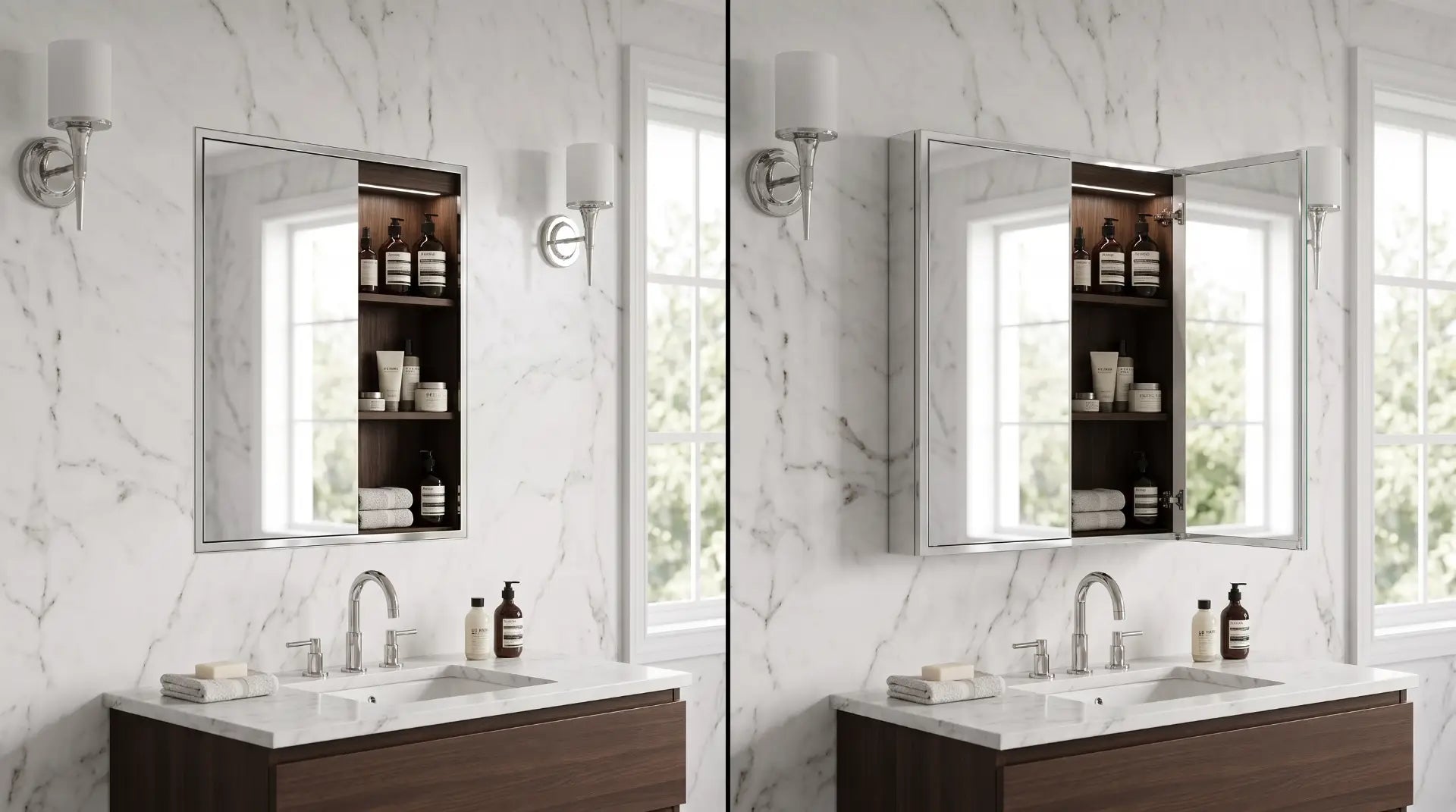
The complete pre-purchase checklist: wall requirements, rough opening sizes, what renters can't do, what DIYers can, and which type actually fits your bathroom.
The choice between a recessed and surface-mount medicine cabinet isn't just a style preference - it's a structural decision that depends entirely on what's inside your wall and how much clearance your bathroom layout can spare. Pick the wrong type for your situation and you're either staring at a cabinet that juts awkwardly into the room or you're cutting into a wall you can't actually open. Getting this right before you buy saves a return shipment and a lot of frustration on installation day.
Most competitors' guides on this topic skip the practical pre-purchase checklist: the wall probing, the stud-spacing math, the rough opening framing that changes everything at 16-inch versus 24-inch stud spacing. This guide covers all of it with actual numbers, so you arrive at the right decision before a single item ships to your door. Whether you're renovating a master bath in Houston, replacing a dated cabinet in a Seattle rental, or finishing a powder room in a Chicago condo, the same framework applies.
Read the wall requirements section before you browse products. Knowing what your wall can support narrows your cabinet selection to options that will actually work in your bathroom - and prevents ordering something you can't install.
Both types serve the same purpose - mirrored storage above or beside the vanity - but they achieve it through completely different relationships with your wall. Understanding that difference is the starting point for every decision that follows.
The cabinet body sits inside the wall cavity. Only the door and frame project outward - typically less than 1 inch. The result is a built-in look with zero depth penalty in the bathroom footprint. Requires cutting a rough opening between studs and potentially re-framing the cavity.
The entire cabinet body mounts to the face of the wall. Projects 4 to 6 inches outward into the room. No rough opening, no cutting studs - anchor to the wall surface using screws into studs or toggle bolts. Installs in under an hour on almost any wall type.
This is the section most buyers skip - and the source of most medicine cabinet returns. Before ordering any recessed cabinet, you need to confirm three things about your specific wall: the framing type, the cavity depth, and what's running through it. Surface-mount buyers have it simpler, but still need to locate studs for a safe hang.
Standard US wood-frame construction uses 2×4 studs spaced 16 inches on center, creating a wall cavity approximately 3.5 inches deep (the actual lumber dimension of a 2×4). This is the baseline that most recessed medicine cabinets are designed to fit. However, a significant number of US homes - particularly post-1990 construction in cold climates like Minneapolis and Denver - use 2×6 exterior walls for better insulation, giving 5.5 inches of cavity depth. Interior walls in these homes may still be 2×4.
Probe before you order. Drill a small inspection hole at your planned cabinet location (inside an outlet box plate is a discreet spot). Insert a bent wire and sweep it around - you're checking for insulation, pipes, ducts, or wiring that would block a rough opening. In most US master bathrooms, the wall above the vanity is a dry interior partition with clear cavity. Exterior walls and shared plumbing walls are the exceptions to watch for.
Surface-mount cabinets work on essentially any wall type - drywall, plaster, tile, concrete, brick - as long as you have the right fasteners. The critical requirement is weight-appropriate anchoring. A loaded medicine cabinet weighs 25 to 60 pounds depending on size. In standard drywall over wood studs, anchor at least two points directly into studs. For tile walls, use tile drill bits with masonry anchors. For concrete or brick in apartments (common in New York, Chicago, and Boston high-rises), concrete sleeve anchors rated for 60+ lbs total load are the correct choice.
Medicine cabinet sizing has its own logic because recessed units are constrained by stud spacing. The most common cabinet widths in the US market correspond directly to how many studs need to be cut to create the rough opening - which determines installation complexity and cost.
For height, most recessed medicine cabinets run 26 to 36 inches tall. The rough opening height only needs to accommodate the cabinet body plus ½ inch clearance - no load-bearing header is needed for these openings since medicine cabinets sit between studs (non-structural). Standard mounting height positions the bottom of the cabinet 54 to 60 inches from the floor, with the center of the mirror at eye level for the primary user.
Match cabinet width to vanity width, not wall width. A good rule for single vanities: choose a cabinet within 2 to 4 inches on each side of the vanity. For a 24-inch vanity, a 24-inch cabinet is ideal. For a 36-inch vanity, go 30 to 36 inches. Oversizing looks awkward; undersizing wastes the visual opportunity the cabinet creates. See our bathroom mirror sizing guide for the full width calculation method.
Here's every meaningful dimension compared directly so you can make the call for your bathroom in one pass.
| Feature | Recessed (Inset) | Surface-Mount |
|---|---|---|
| Wall projection | ≤ 1" (door + frame only) | 4-6" into room |
| Installation complexity | Moderate-High (drywall cut, framing) | Low (screws, anchors) |
| Install time (DIY) | 3-5 hours | 30-60 minutes |
| Works in rental apartments | Rarely | Yes |
| Works on concrete/brick walls | No | Yes |
| Requires stud location | Yes | Yes (for safe hang) |
| Requires drywall cutting | Yes | No |
| Cabinet depth available | 3.5-5" (wall-limited) | 4-7" (no wall limit) |
| Visual profile | Built-in, seamless | Box on wall (frameless = cleaner) |
| Works above tiled wall | With effort | Yes |
| Resale value impact | Higher (built-in look) | Moderate |
| Best small bathroom choice | Yes | If no room to cut |
| LED/smart cabinet availability | Wide selection | Wide selection |
The right cabinet type for your bathroom comes down to four factors: wall construction, bathroom size, whether you own or rent, and how much installation work you're willing to do. Here's how to read your situation.
You own the home, your bathroom has standard wood-frame interior walls, and you're working with a small-to-medium bathroom where the 4 to 6 inches a surface-mount projects would feel intrusive. Recessed is also the right call when you want a genuinely finished, built-in look - the kind of aesthetic you'd find in a professionally designed bathroom in Austin or Nashville where the cabinet reads as part of the wall, not furniture attached to it. If you're renovating anyway and the drywall is open or coming down, adding a recessed rough opening costs almost nothing in extra effort.
You rent, your walls are tile or concrete or otherwise uncuttable, or you want a same-weekend installation with zero structural work. Surface-mount is also the correct choice for bathrooms in older pre-war buildings common in New York City, Chicago's Wicker Park, and Boston's Back Bay - where walls are plaster over brick or concrete and a recessed opening is genuinely not an option without expensive masonry work. Frameless surface-mount units with a full-mirror door are the closest thing to invisible: when closed, most guests can't tell it's a cabinet at all.
You're not sure what's inside your wall, you're in the middle of a renovation with uncertain timeline, or you're buying a cabinet for a home where the bathroom may change. Dual-mount cabinets give you both options. Install surface-mount today and recess it later when the bathroom gets a full tile renovation - the same cabinet works either way without returning it.
In a bathroom under 50 square feet - which covers most US secondary bathrooms - a recessed medicine cabinet is the single highest-impact space decision you can make. It replaces a flat mirror with no visual bulk, adds 4 to 5 inches of concealed storage, and makes the room feel larger by keeping the wall plane clean. The installation effort is almost always worth it in a small space.
Bathify carries recessed, surface-mount, and dual-mount medicine cabinets from ICO Bath, Kube, Vanity Art, and Cutler Kitchen & Bath - with free shipping across the USA. Here are the top picks across categories.

The Jackson is Bathify's most versatile medicine cabinet - engineered for both recessed and surface-mount installation in a single unit. The integrated LED lighting is dimmable with adjustable color temperature, USB ports support device charging inside the cabinet, and a 3× magnifying mirror is built into the door interior. Touch-activated controls connect to a standard light switch. Copper-free glass with safety film backing is a premium spec you won't find at Home Depot or Lowe's at this price point. The 24" × 36" size fits above most single vanities up to 36" wide and is the right starting point for most US master bathrooms.

The 30-inch version of the Jackson carries all the same specs as the 24" - LED, USB, 3× magnifier, adjustable color temperature, 5-year warranty - scaled up for larger vanity configurations. Ideal above double vanities in the 48 to 60-inch range or as a single wide unit above a 36-inch single vanity. The wider format means cutting one stud for a recessed rough opening, so factor in the additional framing step. As a surface-mount, it installs cleanly with no modification and the 30-inch width gives you substantial storage capacity for a two-person bathroom.
![[Premium Quality Bathroom Products & Accessories Online]-Bathify](https://cdn.shopify.com/s/files/1/0633/9467/6967/products/A750-4.jpg?v=1648818315)
The Kube 30" is a three-way mirrored cabinet - front, edges, and interior - giving you a true vanity experience when opened. European soft-close hardware on both doors is a premium touch at this price. Two adjustable tempered glass shelves handle deep storage for full-size toiletries. Works as either surface-mount or recessed, making it a practical choice for bathrooms mid-renovation. The mirrored-edge design means there's no harsh frame line visible when the door is open - it reads as a clean extension of the wall mirror plane.

The Vanity Art Numi uses a horizontal sliding door system instead of swing-out doors - a meaningful advantage in smaller bathrooms where door clearance in front of the cabinet is limited. The sliding mechanism means you can access the interior and use the mirror simultaneously, which is a genuinely useful feature when two people share the same bathroom. LED strip lighting delivers excellent brightness for grooming. At 25 inches wide, it pairs cleanly with 24-inch vanities and installs on any wall surface without modification - ideal for renters in New York, LA, or Chicago apartments where wall cutting isn't permitted.

The Kato's 11.5-inch width makes it the right answer for powder rooms, single-sink powder bath alcoves, or flanking storage beside a wider mirror. At 30 inches tall with a clean frameless finish, it reads as a purposeful storage element rather than an afterthought. Soft-close hinges and adjustable shelving cover the functional basics. Made in Canada with particle board and melamine construction - a practical, durable combination for bathroom humidity levels when properly sealed. The narrow profile means it often installs between existing studs without cutting, making recessing possible without framing work.
These are the pre-install steps that most guides bury at the end - but they're more useful before you order than after you unbox. Read them now.
Mark your stud locations first. Use a stud finder and mark both sides of every stud in your planned cabinet zone with painter's tape. Most US walls have studs at 16-inch intervals but older homes (especially pre-1960 construction in Boston, New York, and Philadelphia) can have irregular spacing. Confirm actual spacing before buying a cabinet sized around 16-inch on-center assumptions.
Order the rough opening kit if your cabinet includes one. Many dual-mount cabinets ship with a rough-opening template that shows exactly what to cut. Use it. Rough opening dimensions are typically 0.5 inches larger than the cabinet body on each side for shimming and leveling tolerance. Don't cut exactly to cabinet dimensions.
Identify and reroute before cutting. Use a non-contact voltage tester on the wall before cutting. If your planned opening is within 12 inches of an outlet, switch, or light fixture, there may be wiring in the cavity. A licensed electrician reroute for a bathroom outlet runs $150 to $300 in most US markets - inexpensive compared to the alternative of cutting through a live circuit.
Use a long level - not a short one. A 24-inch level is the minimum for hanging a cabinet that's 20 inches wide or wider. The longer the level, the more accurate the horizontal read. A cabinet that's 2 degrees off level looks noticeably crooked when the door is open - the door gap will be wider on one side than the other.
Anchor into studs where possible, even if toggle bolts are an option. Toggles work but they can fail in humid bathroom environments over time as the drywall softens slightly around the anchor point. Two stud anchors plus one toggle is more reliable than four toggles.
The Right Choice Depends on Your Wall - Not Your Preference
If you own your home and have standard wood-frame walls: Go recessed. The installation effort is real but finite, and the result - a flush, built-in cabinet that adds meaningful storage without consuming bathroom depth - is categorically better than surface-mount in any bathroom under 80 square feet. The ICO Bath Jackson (24" or 30") in recessed configuration is the best single recommendation for US homeowners tackling this decision in 2026.
If you rent, or have concrete/tile/brick walls: Surface-mount is your only practical option, and it works extremely well. A frameless LED surface-mount unit like the Vanity Art Numi or the ICO Bath Jackson in surface-mount configuration installs cleanly on any wall and looks like a purposeful design choice rather than a concession. Pair it with our vanity light guide to complete the above-vanity zone properly.
If you're mid-renovation or unsure: Buy a dual-mount cabinet now. Install surface-mount immediately, and convert to recessed later when the drywall or tile is open anyway. The Kube 30" Mirrored Cabinet is the most flexible dual-mount pick in Bathify's current lineup for this scenario.
On sizing: Don't undersize. The most common medicine cabinet regret is buying a 16-inch unit that looks like a mailbox above a 36-inch vanity. Size the cabinet width to 75 to 100% of the vanity width for a proportional result. For complete sizing logic, see our bathroom mirror sizing guide.
Shop Medicine Cabinets at Bathify
Recessed, surface-mount, and dual-mount medicine cabinets from ICO Bath, Kube, Vanity Art, and Cutler Kitchen & Bath - all with free shipping across the USA on orders over $50.


