







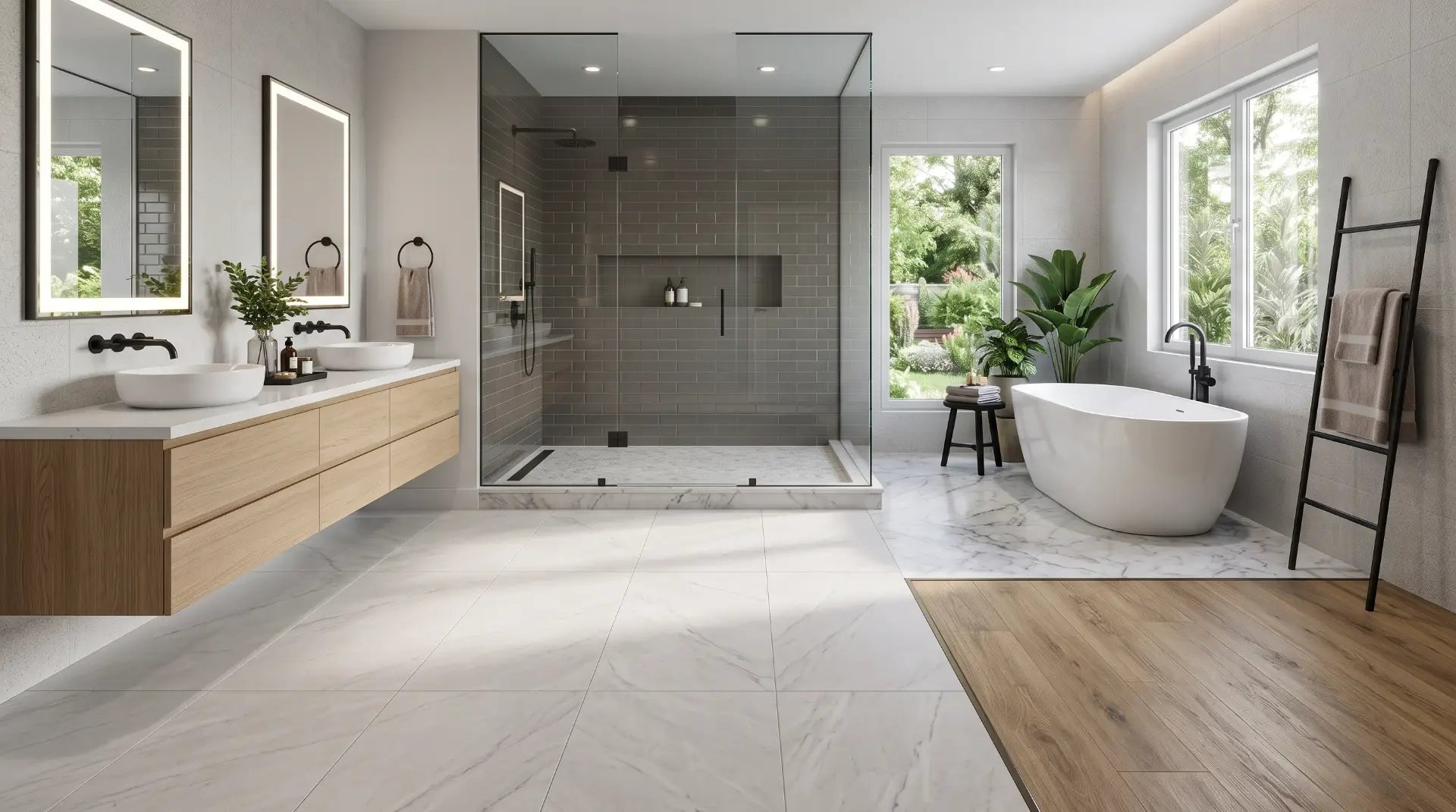
The floor is the hardest-working surface in the bathroom - the only one that has to be waterproof, slip-safe, and beautiful all at once. This guide compares every material on real 2026 costs, waterproofing, and slip resistance, then tells you exactly which ones to avoid.

In a bathroom, the floor is the only surface that has to do everything at once. It gets standing water, dropped bottles, wet feet, steam, cleaning chemicals, and years of daily traffic - and it has to stay waterproof, stay safe underfoot, and still look good the whole time. Every other surface in the room can afford a weakness. The floor cannot. Choose the wrong material and you are not looking at a cosmetic regret; you are looking at water getting into the subfloor, tiles that turn into a skating rink when wet, or a plank floor that swells and lifts within a year.
That is why flooring deserves to be decided early in a bathroom project, not last. This guide covers every material worth considering in the US market in 2026 - porcelain, ceramic, natural stone, and the vinyl family - with honest 2026 installed costs, straight answers on waterproofing and slip safety, and a clear list of the materials you should keep out of a bathroom entirely. By the end you will know exactly which floor is right for your bathroom, your budget, and your climate.
If you already know your material, jump straight to that section using the table of contents. If you're starting from scratch, read the Six Materials overview first, then use the cost table and slip-safety rule to narrow it down. Every section links to a deeper Bathify guide on that specific topic - porcelain vs ceramic, non-slip tiles, marble, vinyl, heated floors, grout, and more - so you can go as deep as your project needs.
Nearly every bathroom floor in the US comes down to six materials. Four of them belong in a bathroom; two are here so you know how to spot the tempting-but-wrong options. Understanding the category first prevents the most common mistake - falling for a look in a showroom before confirming it can actually survive a wet floor.

The densest, hardest tile - effectively waterproof and nearly impossible to stain or scratch. Comes in wood-look, stone-look, concrete-look, and large-format. The default choice for a primary bathroom you want to keep for decades. Roughly $12-$35/sq ft installed.

Softer and more porous than porcelain but glazed on top, so a quality glazed ceramic still works well on a bathroom floor. Cheaper to buy and easier to install. Best for guest baths, powder rooms, and budget renovations. Around $7-$20/sq ft installed.

Marble, travertine, slate, and limestone deliver a look no manufactured tile fully matches, and add resale appeal. The trade-off is real: stone is porous, stains, and needs sealing. Choose honed (not polished) for grip. Roughly $15-$50/sq ft installed.

100% waterproof plank flooring that looks like wood or stone, feels warmer and softer than tile, and installs over most existing floors. The smartest budget and rental-friendly option. SPC (rigid core) is the toughest version. About $3.50-$10/sq ft installed.

Rolled in wide sheets for a seamless, fully waterproof surface with almost no seams for water to reach. The most affordable real bathroom floor at $2.50-$6.50/sq ft installed. Reads more utilitarian than plank, but hard to beat for a laundry-adjacent or rental bath.

Solid hardwood, laminate, cork, bamboo, and carpet all fail in a full bathroom - they warp, swell, or trap moisture and mold. If you love the warmth of wood, get the look safely with wood-look porcelain or waterproof luxury vinyl instead. See the "what to avoid" section below.

If you want one answer for "best bathroom flooring" and nothing else, it is porcelain tile. Porcelain is fired hotter and denser than ordinary ceramic, which gives it a water absorption rate at or below 0.5% - meaning it is effectively waterproof through the body of the tile, not just the surface. It is one of the hardest flooring surfaces you can put in a home, shrugging off scratches, dropped bottles, and heavy foot traffic, and it is unaffected by the steam and humidity that destroy softer materials.
The other reason porcelain dominates is versatility. Modern printing means a porcelain tile can convincingly imitate oak planks, Carrara marble, or poured concrete while keeping porcelain's durability and waterproofing. That lets you get the warm look of a wood floor or the drama of marble without any of the maintenance risk. It also pairs perfectly with in-floor radiant heating, because dense tile conducts and holds heat efficiently. The main downsides are that porcelain is cold and hard underfoot (solved with heating and bath mats) and that its density makes it heavier and harder to cut, which is why professional installation is the norm.
Match the finish to the location. For a bathroom floor, choose a matte or textured porcelain, never high-gloss polished - polished porcelain looks stunning on a wall but turns slick when wet. A textured, wood-look, or stone-look porcelain gives you the grip you need. The differences between porcelain and ceramic go deeper than price; see the full breakdown in our porcelain vs ceramic tile guide.

Ceramic tile is porcelain's more affordable cousin. It is made from a softer, more porous clay and finished with a hard glaze on top. That glaze is the key: a quality glazed ceramic seals the surface against water, so on a bathroom floor it performs well and costs noticeably less than porcelain - both to buy and to install, because it is easier to cut and lay. For a guest bathroom, a powder room, a rental, or any project where budget matters more than lifetime durability, ceramic is a perfectly sound choice.
Where ceramic falls short is toughness. Because the body under the glaze is softer and more porous, a chip exposes a lighter, unglazed interior that shows more than a chip in through-body porcelain, and ceramic is more prone to cracking under heavy impact. In a heavily used primary bathroom you plan to keep for 20 years, porcelain's extra durability usually justifies its cost. In a lower-traffic bathroom, ceramic delivers most of the benefit for less money. The full cost-and-durability comparison is in our porcelain vs ceramic bathroom tile guide.

Nothing manufactured fully replicates real marble, travertine, slate, or limestone. Natural stone brings genuine depth, veining, and variation to a bathroom floor, and it carries real resale weight in higher-end homes. If a spa-like, high-luxury bathroom is the goal and the budget allows, stone earns its place. But it is the one flooring category where the marketing photos hide a maintenance reality you need to plan for.
Stone is porous. Marble in particular stains from anything acidic - toothpaste, certain cleaners, spilled products - and etches (loses its shine in spots) on contact. It must be sealed on installation and resealed periodically, and it needs pH-neutral cleaners for life. There is also a safety point most showrooms skip: polished marble is slippery when wet and a poor choice for a bathroom floor. Always specify a honed (matte) finish for grip. If you love the look but not the upkeep, a high-quality marble-look porcelain gives you 90% of the aesthetic with none of the sealing or staining. The honest pros, cons, and real maintenance schedule are laid out in our marble bathroom floors guide.

Short answer: yes, when you buy the right kind. Modern luxury vinyl is not the peel-and-stick tile of the past. Luxury vinyl plank (LVP) and its rigid-core version SPC (stone plastic composite) are engineered to be 100% waterproof - water cannot damage the plank itself - which makes them genuinely bathroom-appropriate. They look convincingly like wood or stone, feel warmer and softer underfoot than tile, are quieter to walk on, and most click-together floating versions can be installed over an existing floor by a confident DIYer in a weekend.
The trade-offs are honest ones. Vinyl reads as less premium than tile or stone and adds less resale value; heavy fixtures can dent a softer LVP over time (SPC resists this far better); and while the plank is waterproof, a floating vinyl floor still needs proper edge sealing at the tub, toilet, and walls so water cannot get underneath through the seams. For a budget renovation, a basement or guest bath, a rental, or anyone who wants warmth underfoot without heated floors, luxury vinyl is the smartest value in the guide. Our full durability breakdown - LVP vs SPC, floating vs glue-down, and how it performs long-term - is in the vinyl plank flooring for bathrooms guide.
Half of choosing a bathroom floor is knowing what not to buy. These materials look tempting in a showroom or in a whole-house flooring quote, but they are not built for standing water and humidity, and installing them in a full bathroom is the single most expensive flooring mistake homeowners make.
| Avoid | Why It Fails in a Bathroom | Use Instead |
|---|---|---|
| Solid Hardwood | Absorbs water; cups, warps, and gaps with humidity and any standing water. Refinishing can't fix water damage from below. | Wood-look porcelain or LVP |
| Laminate | Fiberboard (HDF) core swells permanently once water reaches the seams - and in a bathroom it will. No recovery once it puffs. | SPC / luxury vinyl plank |
| Cork | Naturally absorbent; traps moisture, harbors mold, and degrades in a wet room even when sealed. | Luxury vinyl or ceramic |
| Carpet | Holds moisture against the subfloor, breeds mold and mildew, and never fully dries in a humid room. | Any waterproof hard floor |
| Bamboo | Behaves like hardwood - swells and warps with moisture despite its "green" reputation. | Wood-look porcelain or LVP |
| Polished / Glossy Tile & Marble | Waterproof but dangerously slippery when wet - a fall risk on any bathroom floor. | Matte / honed / textured finish |
Flooring cost has three parts: the material, the labor to install it, and the prep work underneath. The figures below are typical 2026 US ranges for a bathroom floor, installed. Labor is usually the larger share for tile and stone, and it climbs with intricate patterns (herringbone, diagonal, mosaic) and with any subfloor or waterproofing work. A typical small US bathroom floor of 35-50 sq ft lands around $1,000-$3,500 installed, but material choice moves that number a lot.
| Material | Material Only /sq ft | Installed /sq ft | Typical 40 sq ft Bath | Best For |
|---|---|---|---|---|
| Sheet Vinyl | $1-$3.50 | $2.50-$6.50 | $100-$260 | Lowest budget, rentals |
| Luxury Vinyl (LVP/SPC) | $2-$6 | $3.50-$10 | $140-$400 | Value, DIY, warmth underfoot |
| Ceramic Tile | $1-$5 | $7-$20 | $280-$800 | Budget-conscious tile look |
| Porcelain Tile | $3-$10 | $12-$35 | $480-$1,400 | Best all-round primary bath |
| Natural Stone / Marble | $5-$20 | $15-$50 | $600-$2,000 | Luxury, high-end resale |
Add-on costs to budget for: removing old flooring runs about $2-$7 per sq ft (tile removal is the most laborious); a waterproofing membrane or backer prep adds roughly $2-$4 per sq ft and is worth every cent in a bathroom; subfloor repair (common after a past leak) can add substantially; and electric radiant floor heating adds about $8-$15 per sq ft on top of the flooring. Intricate layouts and large-format porcelain both add labor because of extra cutting and precision.

A bathroom floor gets wet by definition, so slip resistance is not optional - it is the one spec you should refuse to compromise on, especially in a home with kids or older adults. The industry measure is DCOF (Dynamic Coefficient of Friction). As a rule, choose a floor tile rated DCOF 0.42 or higher for any wet area. Quality manufacturers publish this number; if a tile doesn't disclose it, treat that as a warning sign for floor use.
Beyond the number, texture and size do the practical work. A matte, textured, or honed surface grips far better than a polished one, and more grout lines mean more traction - which is exactly why small mosaic tiles are the standard for shower floors and a smart choice near tubs. You do not have to sacrifice style for safety: textured wood-look porcelain, honed stone, and slip-rated matte tiles all look excellent. Our dedicated guide to the best non-slip bathroom floor tiles covers the specific finishes and ratings to look for, style included.

Tile size changes how big a bathroom feels, not just how it looks. Large-format tiles (typically 12"×24" and up) create fewer grout lines, which reads as calmer, cleaner, and more expansive - the reason they dominate modern bathrooms and are the single easiest way to make a small bathroom look bigger. Fewer grout lines also mean less grout to clean and seal over the years. The catch is that large tiles need a very flat subfloor and enough slope where drainage matters, and they cut down poorly around tight fixtures.
Small mosaic tiles do the opposite job. Their many grout lines add grip (ideal for shower floors and slip-prone zones) and let the floor follow curves and slopes, but too much mosaic across a whole floor can feel busy and is more work to keep clean. The usual winning combination is large-format porcelain on the main floor for a spacious feel, with a coordinating mosaic on the shower pan for traction and drainage. The full trade-off - including which makes your specific bathroom look larger - is in our large format vs small mosaic tile guide.

Grout is the detail most people decide in thirty seconds and then live with for a decade. Color choice is a genuine design decision: a grout that matches your tile makes the floor read as one seamless surface and hides dirt well, while a contrasting grout turns the tile layout into a graphic pattern - striking, but it shows every imperfection and every bit of grime. For most bathroom floors, a mid-tone grout a shade or two off the tile is the safe choice: it neither disappears nor demands constant cleaning. Pure white grout on a floor is the classic regret - it stains and greys within months. Our bathroom grout color guide walks through choosing a color you won't regret.
On maintenance: standard cement grout is porous and should be sealed after installation and periodically after, or you can specify epoxy grout, which is essentially stain- and water-proof and skips the sealing (at higher cost and trickier installation). Even sealed grout needs occasional cleaning - and there is a right and wrong way to do it that protects the sealer. Our guide to cleaning bathroom tile grout covers the products that actually work without wrecking the seal.

For a primary bathroom in a cold climate, radiant floor heating is one of the highest-satisfaction upgrades in the whole house - stepping onto a warm tile floor on a winter morning is the kind of luxury people notice every single day. Electric radiant mats sit under the tile and add roughly $8-$15 per sq ft on top of the flooring. They pair best with tile and stone, which conduct and hold heat efficiently, and they take the biggest downside of porcelain - its coldness underfoot - completely off the table.
The economics have one rule: install it during a renovation, when the floor is already open. Retrofitting heat under an existing floor means tearing it up first, which is where the cost balloons. It is less worthwhile under vinyl (which insulates against the heat and has temperature limits) and in a guest bath you rarely use. Because a radiant mat heats a small area and runs only when needed, day-to-day operating cost is modest. Our full breakdown of types, real installed costs, and whether it pays off for your situation is in the heated bathroom floors guide.

Running the same tile across the main floor, the shower, and even the walls is a popular way to make a small bathroom feel larger and more cohesive - and you can absolutely do it. The one place to pause is the shower floor. A shower pan needs two things the main floor doesn't: enough traction for bare wet feet, and enough flexibility to follow the slope down to the drain. Large tiles struggle with both.
The standard solution is to use your large-format tile on the main floor and shower walls for that seamless look, then switch to a smaller mosaic (usually 2 inches or smaller) - often in the same tile line or a coordinating color - on the shower floor itself. The extra grout lines give grip and let the tile conform to the slope. Whatever you choose for the shower pan, confirm its slip rating (DCOF 0.42+). The complete rules for mixing and matching are in our shower tile vs floor tile guide.

Patterned and encaustic-look tiles - bold geometrics, Moroccan motifs, vintage cement looks - can turn a bathroom floor into the room's whole personality. Used well, they are the cheapest way to give a small bathroom a big design moment. Used carelessly, they fight with everything else in the room and date quickly. The trick is restraint and containment: let the pattern be the star and keep everything around it calm - solid walls, simple fixtures, quiet grout - so the floor has room to shine.
Patterned floors work especially well in small, self-contained spaces like a powder room, where a bold floor feels like a jewel box rather than an overload. In a larger bathroom, consider using the pattern as a defined "rug" area rather than wall-to-wall. And for durability and slip safety, choose patterned porcelain (printed pattern, porcelain body) over genuine cement encaustic, which is porous and high-maintenance. Our patterned bathroom tile guide shows how to use them tastefully without regret.
Installation difficulty varies more than material cost. Sheet vinyl and click-together luxury vinyl plank are genuinely DIY-friendly - a careful homeowner can floor a small bathroom in a weekend, and mistakes are rarely catastrophic. Tile and stone are a different level. A bathroom floor isn't just about laying tile flat; it is about getting the waterproofing membrane right, the subfloor dead level, the slope correct where it matters, and the layout balanced around fixtures - and errors here (a missed membrane, an uneven substrate) show up later as cracked tiles or water in the subfloor.
For tile and especially natural stone, hiring a professional is usually worth it: pros own the tools, know the waterproofing systems, and deliver a floor that lasts decades. If you do want to tackle a simple tile floor yourself, our beginner walkthrough covers the full sequence - prep, layout, membrane, setting, and grouting - step by step in the how to tile a bathroom floor guide. Do the vinyl yourself; get help with the stone.
| Attribute | Porcelain | Ceramic | Natural Stone | Luxury Vinyl | Sheet Vinyl |
|---|---|---|---|---|---|
| Waterproof | Yes | Glazed | Sealed | Yes | Yes |
| Durability | Excellent | Good | Very Good | Good | Fair |
| Warm underfoot | No* | No* | No* | Yes | Yes |
| Works w/ heated floor | Best | Yes | Yes | Limited | No |
| Maintenance | Very Low | Low | High (seal) | Very Low | Very Low |
| DIY-friendly | No | Moderate | No | Yes | Yes |
| Resale value | High | Moderate | Highest | Moderate | Low |
| Installed /sq ft | $12-$35 | $7-$20 | $15-$50 | $3.50-$10 | $2.50-$6.50 |
| Best for | Primary bath, forever floor | Budget, guest bath | Luxury, resale | Value, DIY, rentals | Lowest budget |
*Tile and stone are cold underfoot on their own - add radiant floor heating to solve this.
Match the floor to how the bathroom is used - then never compromise on waterproofing or slip safety
Primary bathroom, keeping it long-term: Porcelain tile - matte or textured finish for grip, wood-look or stone-look for warmth of style. Add radiant floor heating if you're renovating and live somewhere cold.
Budget renovation, rental, or fast DIY: Luxury vinyl plank (SPC for the toughest core). 100% waterproof, warm and soft underfoot, and installable in a weekend over most existing floors.
Lowest possible budget: Sheet vinyl - seamless, fully waterproof, and the cheapest real bathroom floor there is. Ideal for a laundry-adjacent or utility bath.
Luxury bathroom, high-end resale: Natural stone or marble in a honed finish - budget for sealing and pH-neutral care, or get 90% of the look maintenance-free with marble-look porcelain.
Guest bath or powder room: Glazed ceramic tile (great value) or a bold patterned porcelain to make a small space memorable.
Any wet zone / shower floor: Smaller mosaic with more grout lines for traction, DCOF 0.42+, matte finish. Never polished tile or polished marble on a floor.
A floor is never chosen in isolation - it has to work with the vanity, the tub, the drain, and the way you keep the room warm and dry. Bathify doesn't sell flooring, but these are the fixtures that make a new floor look intentional and perform the way it should. Getting them to coordinate with your tile or vinyl is what separates a finished bathroom from a floor with furniture standing on it.

The vanity is the largest object standing on your floor, so its finish sets the whole palette. As a rule, pair warm-toned floors (wood-look, travertine, beige stone) with warm wood or cream vanities, and cool-toned floors (grey porcelain, marble, concrete-look) with white, grey, or black vanities. A floating wall-mount vanity also shows off more of a beautiful floor and makes a small bathroom feel larger - the same trick as large-format tile.
Shop: Bathroom Vanities at Bathify → · Freestanding Vanities →

A freestanding tub is the centerpiece a beautiful floor deserves - and because it sits directly on the finished floor, it needs a dead-level, fully waterproof, slip-resistant surface around it (matte porcelain or honed stone is ideal). The Vanity Art Palma is a flatbottom freestanding soaking tub with a non-slip base, a natural match for a spa-style tiled floor.
Shop: Vanity Art Palma Non-Slip Freestanding Tub → · All Freestanding Tubs →

If you're running one continuous tile floor into a curbless shower - the biggest flooring trend in modern bathrooms - the drain choice matters. A linear (trough) drain lets the floor slope in a single direction, which means you can use larger tiles right into the shower instead of a fussy four-way slope, keeping that seamless look. It's the detail that makes a same-tile-everywhere floor actually work.

If you're adding radiant heat to a tile floor, a wall-mounted towel warmer completes the upgrade - warm feet and a warm towel are the two things that make a bathroom feel genuinely spa-like. The Tuzio Savoy is a clean, wall-mounted towel warmer in chrome or white that suits both modern and transitional bathrooms, and it doesn't take up any floor space.
Finish Your Bathroom at Bathify
Once the floor is down, the fixtures make the room. Explore vanities, freestanding tubs, shower drains, mirrors, and towel warmers - from Vanity Art, Kube Bath, ICO Bath, and more. Free shipping on orders over $50, shipped across the USA.


