







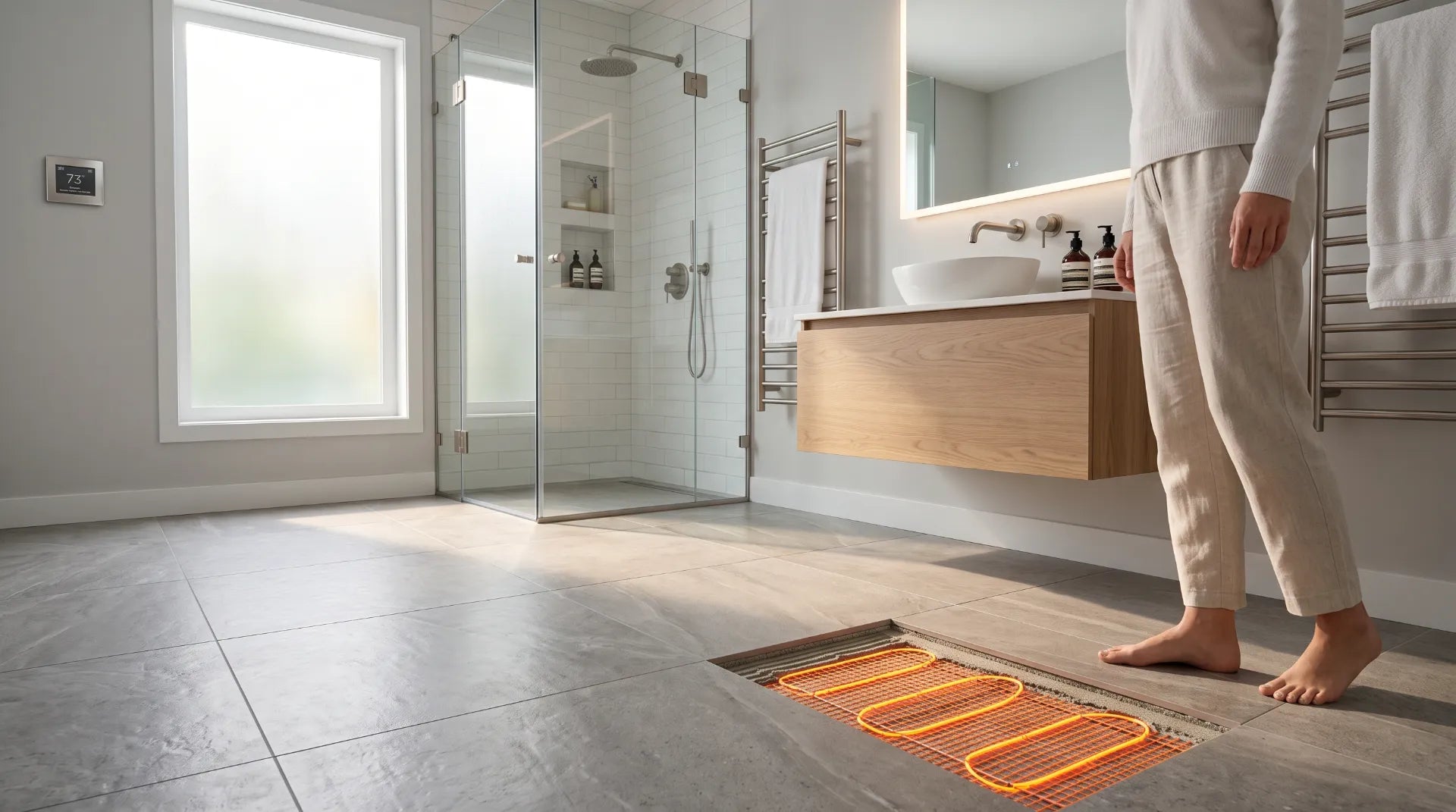
No cold tile shock in January. This guide breaks down what a heated bathroom floor actually costs in 2026, how electric and hydronic systems differ, what it costs to run, and an honest answer on whether it's worth it for your bathroom.

Every other bathroom upgrade - the vanity, the mirror, the fixtures - is something you look at. A heated floor is something you feel, every single day, the moment bare feet hit tile. That's a different kind of return on investment than most bathroom spending, and it's why heated floors consistently rank among the highest-satisfaction upgrades in post-renovation homeowner surveys, even when they're one of the smaller line items in the total project budget.
It's also one of the most misunderstood upgrades in bathroom design. Homeowners often assume it means ripping open walls, installing a boiler, or accepting a four-figure electric bill increase - none of which is accurate for the system most bathrooms actually use. This guide covers what a heated bathroom floor really costs in 2026, the real differences between electric, hydronic, and panel-based systems, what it costs to operate month to month, and a straight answer on when the investment makes sense and when it doesn't.
If you already know you want radiant heat and just need numbers, jump straight to the cost breakdown and the retrofit cost calculator. If you're still deciding, read the system types and the honest pros-and-cons section first, then use the worth-it decision framework near the end to land on an answer for your specific bathroom.

Radiant floor heating warms a room from the ground up instead of blowing warm air through vents. A heating element - either thin electric cable/mesh or PEX tubing carrying hot water - runs underneath the finished floor surface, usually embedded in the tile mortar bed or a thin self-leveling layer just below it. The element warms the floor itself, which then radiates that heat upward into the room and to anyone standing on it.
This matters for a bathroom specifically because it solves the one thing central forced-air heating never quite fixes: cold tile. A furnace can keep a bathroom's air at 72°F while the floor itself sits closer to 55-60°F, because tile and stone hold almost no residual warmth and constantly pull heat from bare feet. A radiant floor heats the actual surface you're standing on, which is why a heated bathroom floor feels dramatically warmer than the room's air temperature would suggest.
Every heated bathroom floor on the US market falls into one of four installation formats. The material underneath - electric cable, water-filled tubing, or a preformed panel - determines the cost, the installation complexity, and whether the project is realistic for a single bathroom or only makes sense as part of a whole-home system.
Thin heating cable pre-attached to a fiberglass mesh you roll out and embed directly into the tile mortar bed - typically adding only about 1/8" to finished floor height. The default choice for a standard rectangular or near-rectangular bathroom floor.
The same electric cable as a mat, sold loose so it can be hand-spaced around toilets, curved vanities, or an irregular footprint. Costs less per square foot in materials but takes longer to install, since spacing has to be laid and secured by hand.
Hot water circulates through PEX tubing beneath the floor, supplied by a boiler or dedicated water heater. Cheaper to run at scale but requires plumbing infrastructure that rarely pencils out for a single bathroom unless the home already has a hydronic system.
Rigid, grooved insulation boards with the heating cable pre-routed and an uncoupling membrane built into the same layer. Faster to install than a standalone mat since it replaces two steps at once, at a modest material cost premium.
For a single bathroom in an existing US home, an electric mat or panel system is almost always the right call. Hydronic only makes financial sense if the home already has a boiler and hydronic loop running to other rooms - installing one from scratch just to heat one bathroom floor rarely justifies the cost.
The heating system itself is only one line item in the total project cost. The table below shows installed cost per square foot for the heating element alone, followed by a full itemized breakdown for a realistic bathroom retrofit including flooring, thermostat, and electrical work.
| System Type | Installed Cost* | Typical Bathroom Total | Running Cost | Best For |
|---|---|---|---|---|
| Electric Mat / Cable | $8-$15 / sq ft | $500-$1,700 | $0.15-$0.35 / hr | Retrofits, single bathrooms |
| Insulated Panel | $10-$18 / sq ft | $700-$2,000 | $0.15-$0.35 / hr | Renovations needing a fast install |
| Hydronic (PEX) | $7-$17 / sq ft | $1,500-$4,500+ | $0.05-$0.15 / hr | New construction, whole-home systems |
*Materials plus typical installation labor for the heating system only. Excludes new flooring, thermostat, electrician or plumber hookup, and subfloor prep - see the full itemized breakdown below.
Here's what a typical existing-bathroom retrofit actually adds up to, using an electric mat system under new porcelain tile - the most common real-world scenario for a US primary bathroom.
Two things worth noting: the tile line item is the largest cost in this whole project, and it's a cost you'd pay whether or not you add radiant heat - if you're already re-tiling a bathroom floor, adding the heating mat is a relatively small marginal cost on top of a job you're doing anyway. That's the single biggest factor in whether heated floors make financial sense: installing them during an already-planned floor replacement is dramatically cheaper than tearing up a perfectly good floor just to add heat.
This is where most homeowners overestimate the real cost. An electric radiant floor draws roughly 0.03-0.05 kWh per square foot per hour. For a 35 sq ft heated bathroom area running 4 hours a day at the national average electricity rate, that works out to $0.15-$0.35 per hour of operation, or approximately $15-$25 per month on a programmable schedule.
Most owners don't run the system continuously - a floor-sensing thermostat is programmed to warm the floor for 30-45 minutes before the household wakes and again before evening showers, then shuts off the rest of the day. Set up this way, the monthly cost is comparable to running a hair dryer for the same total hours, not the significant utility bill increase people often assume.
Not every bathroom flooring material conducts heat equally well, and this decision should be made before the heating system is purchased, not after.
| Material | Heat Conductivity | Radiant-Heat Rated | Notes |
|---|---|---|---|
| Porcelain Tile | Excellent | Yes | The standard choice - dense, thin, transfers heat efficiently |
| Ceramic Tile | Excellent | Yes | Performs nearly as well as porcelain, slightly more porous |
| Natural Stone | Good | Yes | Higher thermal mass - warms slower, holds heat longer |
| Rated Waterproof LVP | Moderate | Check rating | Only if the manufacturer explicitly rates it for radiant heat |
| Solid Hardwood / Carpet | Poor | Not recommended | Insulates against the heat; also a poor bathroom material choice generally |
Tile and stone remain the default recommendation for a bathroom floor regardless of whether you add radiant heat - they're also the correct choice for moisture resistance. If you're still deciding between materials, our porcelain vs ceramic tile comparison breaks down which performs better underfoot and under a radiant system, and our large format vs mosaic tile guide covers how tile size affects installation over a heating mat.
Installing radiant heat during new construction or a full bathroom gut-renovation is the cheapest and least disruptive path - the subfloor is already exposed, so the heating mat is simply one more layer in a floor build-up that's happening regardless. A retrofit into an existing bathroom costs meaningfully more, generally 50-80% above new-construction pricing, because the existing floor has to be demolished and removed before the heating element can go in.
Lowest incremental cost - the mat installs directly on the subfloor before tile goes down, with no demolition specific to the heating system. This is the ideal time to add radiant heat if you're on the fence.
Old flooring must be removed, the subfloor inspected and leveled, and floor height transitions to adjoining rooms checked before the mat goes in. Budget an extra day or two of labor beyond a standard tile job.
A typical bathroom-scale electric installation - retrofit or new construction - takes one to two days from floor prep through tile setting, not counting cure time before the system is safe to run (electric mortar typically needs 24-72 hours to fully cure before the heat is activated).
Eliminates cold tile shock every single day. Operates silently with no forced-air noise or draft. Frees up wall space since no baseboard heater is needed. Genuinely low running cost when scheduled with a programmable thermostat. Widely viewed as a desirable upgrade in colder-climate home listings.
Meaningful upfront cost if it's not bundled into a floor replacement already happening. Retrofitting into an existing bathroom means losing the floor for several days. Warms the floor, not the whole room - it's a comfort upgrade, not a replacement for your main heating system. Repairing a failed element means pulling up flooring, though quality electric systems rarely fail within their warranty period.
The honest answer depends less on the technology and more on timing and how the bathroom is actually used. Three questions settle it for most homeowners:
Worth it if you're already re-tiling a daily-use bathroom in a cold-winter climate
Yes, install it if you're already tearing up the floor of a primary bathroom for a renovation, you live somewhere with a real winter, and the bathroom sees daily use. The marginal cost on top of a floor job you're doing anyway is small relative to how much daily comfort it adds - this is the scenario where heated floors have the best cost-to-satisfaction ratio of nearly any bathroom upgrade.
Skip it or wait if your current floor is in good condition and you'd be demolishing it solely to add heat, if the bathroom is a rarely-used guest bath or powder room, or if you're in a mild climate where cold floors are a minor seasonal annoyance rather than a daily issue. In these cases the payback in comfort rarely justifies the cost of an isolated retrofit.
If a full radiant floor retrofit isn't the right project right now - budget, timing, or a floor that's not due for replacement - a heated towel warmer delivers a genuinely similar warmth payoff for a fraction of the cost and zero floor demolition. It won't warm the tile underfoot, but it solves the other half of "cold bathroom" discomfort: stepping out of a hot shower into a cold towel. Most models install on existing wall studs in under an hour.
See wall-mounted and freestanding options at Bathify: Shop Towel Warmers
Finish the Warm-Bathroom Upgrade at Bathify
Bathify doesn't sell flooring or radiant heat systems - but if you're planning the warm-bathroom upgrade, pair your new floor with a heated towel warmer, a matching medicine cabinet, or a full vanity refresh. Free shipping on orders over $50, shipped across the USA.


