







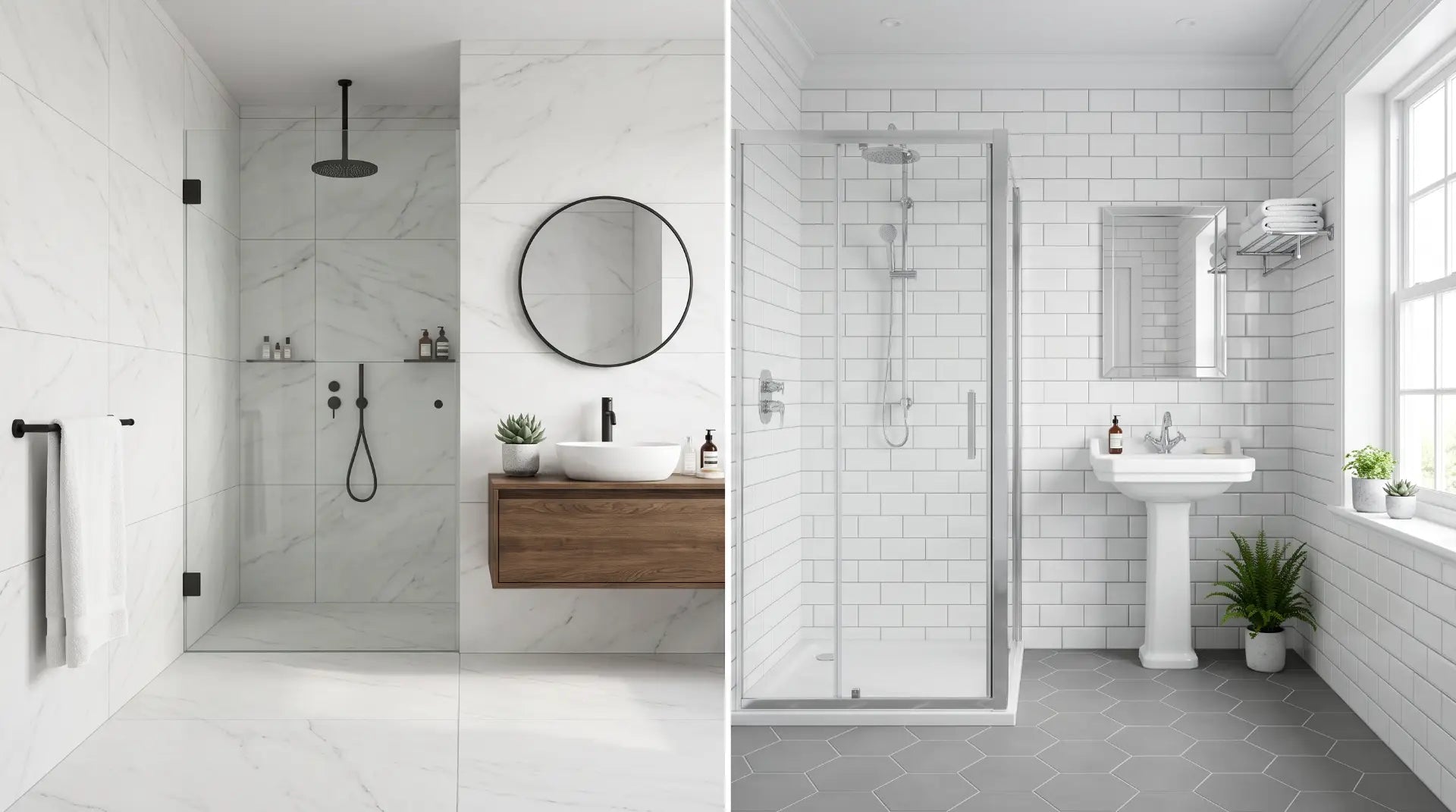
The actual differences that matter - water absorption rates, PEI ratings, COF for wet safety, installed cost, and exactly where each tile type belongs in a bathroom.
Most porcelain vs ceramic tile articles end up telling you some version of "porcelain is better but ceramic is cheaper" - and leave you with nothing actionable. That framing misses the real problem: people buy the wrong tile for the wrong location inside the bathroom itself, not just the wrong tile overall. A gorgeous polished porcelain tile on a bathroom floor is a slip hazard. A ceramic wall tile used on a shower floor is a maintenance nightmare and a structural failure waiting to happen. The distinction between porcelain and ceramic is one layer of the decision. The other layers - PEI rating, COF, water absorption, rectified versus non-rectified, grout joint width, subfloor compatibility - are where the real buying mistakes happen.
This guide cuts through the surface-level comparison to give you the technical framework US homeowners need before ordering bathroom tile. Whether you're tiling a 45-square-foot powder room in Dallas or a master bath wet room in Seattle, the same set of specifications governs whether your tile installation will still look good in ten years or start failing in three. Understanding them before you buy is the difference between a successful renovation and an expensive one.
This blog is a supporting guide within Bathify's full Bathroom Flooring Guide, which covers all major flooring materials side-by-side. For the big-picture overview before diving into tile specifics, start there.
Both porcelain and ceramic are fired clay tiles - they're made through broadly the same process. The differences come down to clay composition, firing temperature, and resulting density. These three variables determine every performance characteristic that matters in a bathroom.
Made from refined kaolin clay with very low impurity content, fired at 2,200°F or higher. The extreme heat densifies the clay body into a vitrified (glass-like) structure. Water absorption ≤ 0.5% by ANSI standard. Full-body porcelain has color throughout the tile body - chips and scratches are less visible because the color runs all the way through.
Made from a coarser red or white clay body, fired at 1,800-2,000°F. Less dense than porcelain, with water absorption of 0.5-3% for floor-grade and up to 20% for wall-only tiles. The color and pattern exist only in the glaze layer on the surface - a chip exposes the raw clay body underneath. Easier to cut and lighter to handle than porcelain.
One of the most persistent misconceptions in tile buying is that a ceramic tile with a thick, hard glaze is equivalent to porcelain for floor use. It is not. The glaze is a surface coating - typically 1/32 to 1/16 inch thick. The structural tile body beneath it is still the porous, less-dense ceramic clay. In a bathroom floor scenario, the glaze can chip, and once chipped, the exposed ceramic body absorbs water rapidly at the damage point. In a shower floor that sees water daily, this creates a progressive failure: water enters the chip, degrades the grout bond at the tile edge, and begins working its way into the substrate. Porcelain's full-body vitrification means a chip is a cosmetic issue, not a water-ingress point.
How to tell porcelain from ceramic in the store: Look at the tile's edge (the unglazed side). Porcelain has a uniform, dense, fine-grained edge - often white or gray throughout. Ceramic shows a coarser, slightly sandy texture with a visible color difference between the clay body and the glaze. You can also check the specification sheet: ANSI A137.1 certification and "≤ 0.5% water absorption" are the two markers that confirm true porcelain classification.
Every bathroom tile purchase should involve reading a spec sheet. Three numbers on that sheet determine whether the tile is appropriate for your application - and most buyers skip all three. Here's what each means and what thresholds to require.
The PEI scale runs from 0 to 5 and measures how well a tile's surface withstands foot traffic abrasion. It applies to the glazed surface - not the tile body - and was originally developed for porcelain enamel finishes but is now used universally for tile grading.
The coefficient of friction measures how much grip a tile surface provides underfoot when wet. It's the most safety-critical tile spec for bathroom floors, and the one most buyers never look at. The ADA (Americans with Disabilities Act) sets a minimum wet COF of 0.60 for accessible surfaces - this is the threshold you should meet on any bathroom floor used by anyone in your household.
The COF trap: polished and high-gloss tile finishes - popular for their luxury look - typically have wet COF ratings of 0.30 to 0.45. That's substantially below the safe threshold. A polished porcelain floor tile is an objectively more dangerous surface when wet than an unfinished concrete floor. Use matte, textured, or satin finishes on bathroom floors. Reserve polished and high-gloss finishes for bathroom walls, shower walls, and backsplash areas where no foot traffic occurs.
Water absorption is measured as a percentage of the tile's weight gained after submersion. ANSI A137.1 classifies tiles into four categories based on this figure, and the category determines where a tile can safely be installed in wet areas. For bathroom applications, the category matters more than the exact percentage.
The porcelain-vs-ceramic decision is inseparable from the floor-vs-wall decision. Most of the buying mistakes in bathroom tiling happen because people treat the two surfaces as interchangeable when they have fundamentally different requirements. Here's the correct framework.

For bathroom floors, you need a tile that meets three requirements simultaneously: PEI 3 minimum (ideally 4-5), COF ≥ 0.60 wet, and water absorption ≤ 3% (vitreous or impervious). Porcelain meets all three by default in any floor-rated product. Floor-rated ceramic can meet them too, but you must verify each specification individually - not all ceramic marketed as "floor tile" meets all three thresholds. In a primary bathroom used daily by a family in a home with hard-soled footwear traffic, porcelain with PEI 4-5 is the right call. For a powder room that sees light use, PEI 3 floor-rated ceramic is a legitimate, budget-conscious choice.

Shower floors have the most demanding requirements of any tile application in the home: continuous water exposure, potential standing water between uses, required slope toward drain, and the constant wet-foot slip risk. On a shower floor, use only impervious porcelain (≤ 0.5% absorption) with a COF of at least 0.60 wet. Mosaic tiles - porcelain in small format, typically 1×1 or 2×2 inch - are ideal for shower floors specifically because their small size accommodates the floor slope more naturally and the high grout-line density provides additional grip. Large-format tile on a shower floor requires precise slope cuts and is harder to achieve safely for a DIYer. See our guide on shower tile vs bathroom floor tile for the complete application breakdown.

Wall tiles have no traffic requirements, so PEI rating doesn't matter - focus on aesthetics, water resistance, and grout joint width. Both porcelain and ceramic perform well on bathroom walls when properly installed over a moisture-resistant substrate. For shower walls, use tiles with absorption ≤ 3% (vitreous or impervious). Wall tile can be polished or high-gloss - the slip risk that disqualifies polished tile from floors doesn't apply on vertical surfaces. This is where large-format, polished porcelain tiles shine: the reflective surface bounces light around the shower enclosure and creates an expansive feel. Standard ceramic subway tile remains a reliable, time-tested choice for shower walls - the glaze provides adequate moisture resistance for non-submerged wall use.
Running the same tile from the bathroom floor up the shower walls and across shower floor is a popular design choice in 2026 - it creates a spa-like, seamless aesthetic. To do this correctly, the tile must meet the most demanding spec on the list: impervious porcelain with COF ≥ 0.60 and PEI 4+. Choose a matte or textured finish that performs safely on floors, and accept that the wall installation will look slightly less lustrous than a polished option would. The design coherence is worth the trade-off in most cases.
Every spec that matters for a bathroom tile decision, compared directly.
| Specification | Porcelain | Ceramic (Floor Grade) |
|---|---|---|
| Clay composition | Refined kaolin (very fine) | Coarser red or white clay |
| Firing temperature | 2,200°F+ (vitrified) | 1,800-2,000°F |
| Water absorption | ≤ 0.5% (impervious) | 0.5-3% (vitreous to semi-vitreous) |
| PEI (floor grade) | Typically 3-5 | 3-4 (floor rated); 0-2 (wall only) |
| Hardness (Mohs) | 6-7 | 5-6 |
| Suitable for shower floors | Yes | Not recommended |
| Full-body color | Yes (most products) | No - glaze only |
| Chip visibility | Low (color runs through) | High (clay body exposed) |
| Weight (per sq ft) | 4-6 lbs | 2-4 lbs |
| Ease of cutting (DIY) | Harder - needs diamond blade | Easier - standard wet saw |
| Tile cost per sq ft | $3-$10+ (mid-range) | $1.50-$5 (mid-range) |
| Install cost premium | $1-$2/sq ft higher labor | Baseline |
| Freeze-thaw resistance | Excellent | Poor - exterior use not recommended |
| Large format availability | Wide (12×24 to 48×48+) | Limited above 18×18 |
| Best for bathrooms | All areas - floors, walls, showers | Walls, powder rooms, light-use floors |
Most online comparisons quote material cost per square foot, which gives you an incomplete picture. What you spend out of pocket is the installed cost - material plus labor, adhesive, grout, and waste allowance (typically 10-15% overage). Here's what a standard US bathroom tile project realistically costs, broken down by tile type and market.
Labor rates vary significantly by US market. In Phoenix, Dallas, and Charlotte, tile installation labor runs $8-$15 per square foot. In New York City, Los Angeles, and San Francisco, expect $18-$30 per square foot for comparable work. This means the same tile job that costs $700 total in Phoenix could cost $1,600 in Manhattan - labor dominates the final number far more than the material cost difference between porcelain and ceramic. If you're in a high-cost labor market, the price gap between porcelain and ceramic narrows significantly as a percentage of total project cost, which changes the value calculation in favor of upgrading to porcelain.
For the best total value, consider the 10-year cost. A ceramic floor tile that starts showing wear at year 4 and needs re-grouting at year 6 has a different 10-year cost than a porcelain floor tile that still looks new at year 10. Factor in grout maintenance, potential re-tiling, and the disruption cost of a bathroom out of service when comparing upfront material costs. In high-traffic primary bathrooms, porcelain's durability advantage typically justifies the premium over a 10-year horizon.
Rectification is a manufacturing step that almost no tile buyer knows to ask about - but it dictates grout joint width, which determines the final look of the installation. It's especially critical for large-format tile, which is increasingly popular in US bathrooms in 2026.
During firing, all tiles shrink and warp slightly - the amount varies piece by piece. Non-rectified tiles have size variations of up to ¼ inch, which means wider grout joints (3/16 inch minimum) are required to mask the size inconsistency. Rectified tiles are mechanically cut after firing to precise, uniform dimensions - size variation is held to less than 1/32 inch, allowing grout joints as narrow as 1/16 inch (a "large-format minimum joint").
Tighter grout joints created by rectified tile also mean less grout surface to clean - a practical benefit in bathrooms where grout maintenance is an ongoing reality. Our dedicated grout color guide covers how to choose grout that minimizes visible maintenance effort alongside your tile choice.
Understanding how tile fails in bathrooms is as useful as knowing how it performs when everything goes right. These are the most common real-world tile failures in US bathrooms - most of them preventable with the right tile selection and installation practices.
Tile - both porcelain and ceramic - is a rigid material with essentially no flex. If the subfloor moves, the tile cracks. The standard allowable deflection for a tile installation is L/360 - meaning the subfloor can deflect no more than 1/360th of the span length under load. Most US homes with OSB or plywood subfloors meet this in theory, but in practice, older homes with 3/4-inch subfloor over 16-inch joist spacing often don't. Before tiling over an existing floor, bounce-test the subfloor: if you feel any spring or movement, the subfloor needs reinforcement before tile goes down. Porcelain is marginally more susceptible to subfloor-flex cracking than ceramic because it's harder and less able to absorb micro-movement - both require a properly rigid substrate, but porcelain is less forgiving of marginal installations.
The most common tile-related injury in US bathrooms is a slip on a polished or high-gloss tile floor. As covered in the COF section, polished porcelain frequently has a wet COF of 0.30-0.40 - well below the ADA minimum of 0.60. This isn't a design problem; it's a spec-reading problem. Homeowners see polished large-format porcelain on Pinterest, order it without checking the COF, and install it on the bathroom floor. The tile looks extraordinary. It's also genuinely dangerous when wet. If a polished tile appeals to you, use it on walls only and choose a complementary matte or textured tile for the floor.
When glazed ceramic tile is used on a shower floor - an application it isn't suited for - the continuous water and soap exposure degrades the grout at the tile edges over time. As grout deteriorates, it allows micro-movement at the tile joints. A ceramic tile, which has a glazed surface over a more brittle clay body, is more susceptible to edge chipping from this micro-movement than impervious porcelain. The result is a shower floor that starts showing chips and cracks at grout joints within 3-5 years - not from impact, but from the cumulative effect of water infiltration and subfloor micro-movement at inadequately bonded grout joints.
In climates with freezing winters - Chicago, Minneapolis, Denver, Boston, and most of the northern US - bathrooms that share an exterior wall or are connected to outdoor spaces like mudrooms and enclosed porches can experience temperature swings near the tile installation. Ceramic tile, with its higher water absorption, is susceptible to freeze-thaw damage: absorbed water expands as it freezes, causing the tile to crack from within. Porcelain's near-zero absorption makes it essentially immune to freeze-thaw damage. For any bathroom in a cold-climate US market that has exposure to exterior conditions - including unheated tiled mudroom floors transitioning to bathrooms - specify porcelain only.
The right tile type depends on which bathroom you're tiling and how it's used. Here's the direct recommendation by room type.
Porcelain, PEI 4 minimum, COF ≥ 0.60 wet, matte or textured finish on the floor. The primary bathroom is the highest-wear tile installation in a home - used multiple times daily, often by multiple people, with footwear, pets, and cleaning chemicals in regular contact with the floor surface. This is where the porcelain investment pays off most clearly over a 10-year period. For walls and shower walls, polished porcelain with any absorption rating is fine - the performance premium of impervious porcelain matters most on the floor and shower floor. If you're tiling the shower floor as part of the same project, see our notes on non-slip bathroom floor tiles for the specific COF thresholds to require.
Either porcelain or floor-rated ceramic (PEI 3+) on the floor, depending on budget. A guest bathroom used a few times per week has dramatically lower wear demands than a primary bathroom, and floor-rated ceramic with a PEI 3 rating is a legitimate, durable choice for this application. The cost savings are real - $400 to $700 less on a typical 50-square-foot bathroom - and the performance is adequate for the use case. Verify COF regardless of tile type: a guest bathroom is still a wet surface and needs adequate slip resistance.
A powder room is the best application case for ceramic tile. There's no shower, no shower floor, no continuous water exposure - just a sink and toilet in a space used intermittently throughout the day. Floor-rated ceramic (PEI 3) handles this easily, the design options in ceramic are wide, and the cost savings over porcelain are meaningful for what is typically a small (25-45 square foot) space. Powder rooms also tolerate less durable tile with greater wall space relative to floor area, giving you the option to use high-design ceramic wall tile (PEI 0-2) on the walls while using floor-rated ceramic on the floor.
Impervious porcelain (≤ 0.5% water absorption) throughout - floor, walls, and any built-in niche or bench surfaces. No exceptions for the shower floor. The shower is the wettest, most water-intensive surface in the bathroom, and it's the one place where cutting corners on tile quality creates real structural risk rather than just aesthetic wear. For the floor, choose mosaic porcelain (1×1 or 2×2 inch) or a textured large-format porcelain cut to accommodate the drain slope. For a breakdown of all the configuration options, our shower tile vs floor tile guide covers the complete decision.
Porcelain for Floors and Showers. Ceramic Where It Makes Sense.
For any bathroom floor and all shower surfaces: Specify porcelain with PEI 4 or higher, wet COF ≥ 0.60, and a matte or textured finish. Full-body porcelain is preferable for floors where chips will be more visible on the surface. This is the spec combination that produces a bathroom floor that still performs and looks good after a decade of daily use.
For bathroom walls and shower walls: Both porcelain and ceramic work well. Polished or high-gloss finishes are appropriate here - the COF concern that disqualifies them from floor use doesn't apply on vertical surfaces. Ceramic subway tile on shower walls is a time-tested choice. Large-format polished porcelain on shower walls is a premium option with a dramatic visual effect. The choice is aesthetic, not performance-driven.
For powder rooms and guest bathrooms with light traffic: Floor-rated ceramic (PEI 3, COF ≥ 0.60) is a legitimate choice that meaningfully reduces project cost without meaningful sacrifice in performance. Verify the spec sheet before ordering - not all ceramic marketed as floor tile actually carries a PEI 3 or higher rating.
The one non-negotiable: Never use wall-rated tile (PEI 0-2) on any bathroom floor. This is the most common and most preventable tile installation mistake in US residential bathrooms. Check the spec sheet before ordering, every time.
Complete Your Bathroom Renovation at Bathify
Bathify carries premium vanities, shower systems, faucets, and accessories that pair with any tile choice - with free shipping across the USA on orders over $50. Build the full bathroom, not just the floor.


