







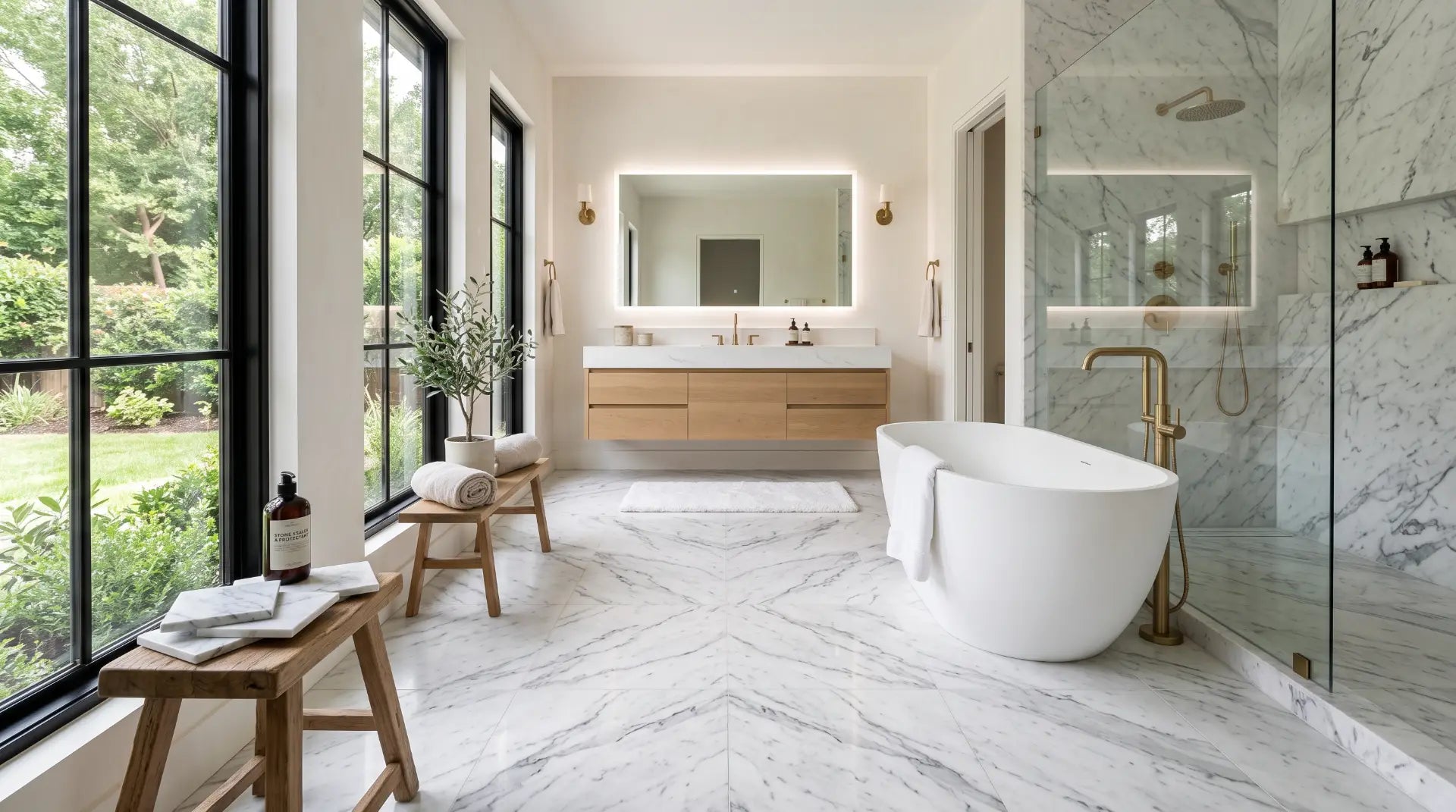
The honest guide to marble floors - what they actually cost installed, which marble types hold up in wet environments, how often you really need to seal them, and the daily habits that keep them looking flawless versus the ones that ruin them.
Marble bathroom floors are everywhere in design inspiration right now - on renovation accounts, in luxury hotel lobbies, in the bathrooms of houses that sell for twice the asking price. They're also the subject of more homeowner regret than almost any other flooring material. The gap between those two realities comes down almost entirely to how honestly the material was presented before purchase.
Most content about marble bathroom floors falls into one of two camps: the design-forward piece that treats it as an aspirational material with no serious caveats, or the cautionary article that makes marble sound so fragile it belongs only in showrooms. The truth is in between. Marble is a genuinely spectacular bathroom flooring material that requires genuine ongoing commitment. This guide gives you both sides with the specificity to actually make an informed decision - real cost ranges by marble type, exactly what a sealing schedule looks like, the cleaning products that will etch your floor on contact, and the types of damage you can fix versus the ones that require a stone restoration professional. If you're also exploring porcelain or ceramic alternatives, we'll cover how they compare head-to-head at the end.
Unlike porcelain tile, which is manufactured to exact specifications, marble is quarried. Veining pattern, background color, and absorption rate vary between slabs from the same quarry and dramatically between quarries worldwide. Always order from a single lot and inspect samples in your actual bathroom lighting before committing - the color temperature of your bathroom lighting will shift how marble reads more than almost any other flooring material.
Not all marble performs equally in wet environments. The differences in hardness, porosity, and vein structure between marble types are significant enough to affect your daily maintenance burden and long-term durability. Here's what you're actually choosing between when you shop for marble floor tile in the US market.

Soft white to blue-gray background with fine, feathery gray veining. The most available and most affordable natural marble in the US. Hardness is moderate (Mohs 3-4). Slightly more porous than Calacatta. Honed finish is strongly recommended for floors - polished Carrara shows scratches faster than polished harder stones. Material cost: $8-$20/sq ft.

Bright white background with dramatic, wide gold or gray veining. Often confused with Carrara - the distinction is that Calacatta is whiter, more expensive, and has bolder vein contrast. Slightly denser than standard Carrara. Material cost: $25-$60/sq ft. Best suited to primary bathrooms where the floor is a design centerpiece and maintenance commitment is understood.

Bright white background with bold, sweeping gray veining that is more dramatically directional than Calacatta. Rarer and more expensive. Material cost: $40-$100+/sq ft. Limited supply means consistent lot matching can be difficult - critical for large floor areas. Best for powder rooms and smaller applications where wow factor outweighs budget constraints.

Deep black marble with crisp white veining from Spain. Dramatically different from white marbles - it shows water spots and calcium deposits more easily, requiring more frequent wiping. Material cost: $15-$35/sq ft. Works best in bathrooms with hard water softeners or frequent squeegee wiping. Honed finish on floors is critical - polished Nero Marquina in a wet environment becomes a daily battle with water marks.

Rich brown to dark chocolate marble with cream or gold veining. Works well in bathrooms with walnut vanities, bronze fixtures, and warm wood accents. More forgiving of water spots than black marble due to its mid-tone color. Material cost: $12-$30/sq ft. Often underutilized in US bathrooms, where white marble dominates - a genuinely different aesthetic for homeowners who want warmth over brightness.

Blue-gray quartzite-adjacent marble with soft, flowing veining. One of the few marbles that naturally complements blue or gray bathroom color palettes without the stark contrast of black marble. More quartzite-like in hardness than traditional Italian marbles. Material cost: $20-$50/sq ft. Not widely stocked at big-box retailers - primarily available through stone fabricators and specialty tile suppliers.
Ask for the absorption rate (water absorption %) when purchasing marble tile. This specification, provided by the manufacturer or quarry, directly predicts how demanding the sealing schedule will be. Marble with absorption rates above 0.5% needs sealing every 6 months in a heavily used bathroom. Below 0.3%, annual sealing is usually sufficient. Most US tile distributors can provide this on request.
Marble floor cost estimates online are almost always underquoted - they list the tile material cost and leave out installation labor, underlayment, sealer, transition strips, and the periodic resealing costs over the floor's lifetime. Here's the complete picture for a standard 60 sq ft primary bathroom floor in a US market with median labor rates.
For context: a high-quality porcelain marble-look tile for the same 60 sq ft bathroom typically runs $3-$8/sq ft in materials and $8-$14/sq ft installed - a total first-year cost of $660-$1,320. Over a 20-year period, the marble floor costs more upfront, requires sealing every 1-2 years ($400-$800 lifetime DIY cost), and may require one professional honing job ($300-$800). The porcelain alternative requires no sealing, no honing, and tolerates acid-based cleaners. The gap narrows when you factor in that natural marble, properly maintained, looks genuinely better in person - the depth and translucency of actual stone is not replicated by any porcelain product available today.
Most marble floor pros-and-cons lists online are either too positive (written by tile retailers) or too negative (written by people who didn't seal theirs). Here's the complete, unhedged version.
| Factor | Reality | Verdict |
|---|---|---|
| Visual Depth | No manufactured tile matches the three-dimensional translucency of natural marble under light. The look is genuinely unique to natural stone. | Pro |
| Resale Value | Marble bathrooms consistently appraise higher in the US luxury market. A well-maintained marble floor adds perceived value disproportionate to its actual cost in homes above the median price point. | Pro |
| Temperature Underfoot | Cool in summer, cold in winter. In climates with long heating seasons (Chicago, Minneapolis, Denver), this matters daily. Pairable with electric radiant heating - see our heated floor guide. | Neutral |
| Longevity | 50-100+ year lifespan with proper maintenance. Ancient Roman buildings still have intact marble floors. No modern flooring material matches this timeline. | Pro |
| Acid Etching | Contact with acidic substances (vinegar, citrus, most common bathroom cleaners) permanently dulls the surface. This is chemistry, not a defect - calcium carbonate reacts to acid. Cannot be avoided by sealing alone. | Con |
| Slip Resistance When Wet | Polished marble has a coefficient of friction (COF) below 0.42 when wet - below the ADA standard of 0.60. Honed marble performs significantly better. Any polished marble floor in a shower or wet zone is a safety issue without a bath mat. | Con - Honed Only |
| Porosity & Staining | Unsealed marble absorbs oils, hair products, cleaning residue, and water quickly. Properly sealed and maintained, staining is largely preventable - but a dropped bottle of dark shampoo on unsealed marble leaves a permanent shadow. | Manageable |
| Chipping & Cracking | Marble chips more easily than porcelain from dropped hard objects. Edge and corner chips on floor tiles are the most common physical damage complaint. Not repairable invisibly - a chipped marble tile typically requires replacement. | Con |
| Installation Complexity | Marble requires white thinset (grey thinset telegraphs through thin marble slabs), experienced installers, and more careful layout due to vein direction matching. Cost is 20-40% higher than standard tile installation. | Con - Higher Cost |
| Unique Character | Every marble floor is one-of-a-kind. Natural veining variation means your bathroom cannot be duplicated. For homeowners who value individuality, this is a significant pro. | Pro |
The surface finish of your marble tile affects slip safety, scratch visibility, maintenance burden, and the overall aesthetic of the room. This is a decision that cannot be changed after installation without professional intervention - choose deliberately.

Mirror-like reflective surface that maximizes the visual depth of marble veining. Shows scratches, etches, and water spots most visibly. Slippery when wet - not recommended for shower floors or primary bathroom floors without consistent mat coverage. Best suited for powder rooms with minimal water exposure and dry foot traffic.

Smooth but matte surface - no reflective sheen. The correct finish for bathroom floors. Hides scratches and minor etches far better than polished. Provides adequate slip resistance for a typical bathroom floor (not shower floor). Slightly more porous than polished marble, so sealing is slightly more critical. Gives a soft, spa-like aesthetic that works with both contemporary and traditional bathroom designs.

Marble tiles processed to have rounded, worn edges and a rougher, aged surface texture. High slip resistance - excellent for wet zones. Suits Mediterranean, Tuscan, and old-world bathroom aesthetics. The textured surface collects more dirt and requires more thorough grout cleaning. Sizes are typically smaller (4×4 inch or mosaic formats). Not the right choice for a modern or contemporary bathroom design.

Increasingly popular finish where the marble surface is brushed to create a slight texture while retaining a modern, controlled appearance. Hides fingerprints and water spots better than honed. Good slip resistance. More expensive to source than honed or polished. Works exceptionally well with large-format marble tiles (24×24 or 24×48 inch slabs) in contemporary primary bathrooms.
Sealing is the single most important maintenance step for a marble bathroom floor. It does not make marble acid-proof - nothing does - but it dramatically reduces the rate at which liquids, oils, and dissolved minerals penetrate the stone. An unsealed marble floor in a bathroom used daily will show staining within weeks. A properly sealed floor can go years without visible staining from normal bathroom use.
Use a penetrating (impregnating) stone sealer - not a topical/surface sealer. Topical sealers sit on the surface, can peel, and trap moisture beneath. Penetrating sealers soak into the pore structure of the stone and allow the marble to breathe while significantly reducing absorption. Products widely available in the US: Miracle Sealants 511 Impregnator, Aqua Mix Sealer's Choice Gold, and Black Diamond Stoneworks Ultimate Sealer are all solid penetrating options found at Home Depot and Lowe's.
Clean the floor thoroughly and allow it to dry completely - at least 24 hours in a well-ventilated bathroom, 48 hours in a humid climate like Houston or Miami. Apply sealer with a foam applicator or lint-free cloth, working it into the stone surface evenly. Allow to penetrate for the time specified on the product label (typically 5-20 minutes). Wipe off all excess sealer before it dries on the surface - dried sealer residue leaves a hazy film that is difficult to remove. Allow full cure time (usually 24-48 hours) before wet use.
The water bead test is the correct way to check sealer status. Drop several small beads of water on various areas of the marble floor, including grout lines. If water beads up and stays on the surface for 5+ minutes, the sealer is active. If water absorbs and darkens the stone within 15-30 seconds, reapply sealer immediately. Do not wait for visible staining - by that point, penetration has already occurred.
The chemistry is simple but non-negotiable: marble is calcium carbonate. Acid dissolves calcium carbonate. Any cleaner with a pH below 7 will etch the marble surface. The problem in the real world is that most common household cleaners - even many marketed as "natural" or "eco-friendly" - are acidic. Vinegar-based cleaners, citrus-based cleaners, bathroom tile sprays, and toilet bowl cleaners will all damage marble floors if they contact the surface.
| Product / Method | Safe for Marble? | Notes |
|---|---|---|
| pH-Neutral Stone Cleaner (Marble Life, Black Diamond, Method Stone) | Yes | The correct everyday cleaner. Spray, mop or wipe, no rinse needed. |
| Warm Water + Few Drops Dish Soap | Yes | Acceptable for daily mopping. Rinse soap residue thoroughly - soap film dulls the finish over time. |
| Dry Microfiber Mop (daily) | Yes | Best daily routine. Removes grit that scratches marble on foot traffic. |
| Vinegar / White Vinegar | Never | pH 2-3. Etches marble immediately on contact. Permanent dull spots result. |
| Lemon Juice / Citrus Cleaners | Never | pH 2-3. Same etching chemistry as vinegar. |
| Bleach / Hydrogen Peroxide | Never | Oxidizing agents bleach marble's natural color and damage stone structure over time. |
| Grout Cleaners (most commercial brands) | Never on marble | Almost all contain acid to dissolve grout haze. Use only stone-safe grout cleaners. See our grout cleaning guide. |
| Abrasive Scrub Pads | Never | Scratches polished and honed surfaces. Use only soft cloths or soft-bristle brushes. |
| Steam Mop | With caution | High heat can crack the stone over time with repeated use. Occasional use is low-risk; daily steam mopping is not recommended. |
Wipe the floor with a dry microfiber cloth after every shower or bath. This removes the standing water that leaves mineral deposits (especially in hard water cities like Phoenix, Las Vegas, and Denver) and the soap residue that dulls the surface over time. Two minutes, every use. This single habit is more protective than any sealer on the market.
Marble is repairable in ways that porcelain is not - but the extent of what's DIY-fixable versus what requires a stone restoration professional is often misunderstood. Here's the honest breakdown.
Small, fresh etch marks (dull spots from a brief acid contact) on polished marble can be improved with a marble polishing powder like Miracle Sealants Marblex or Tenax Ager. Work the powder with a damp cloth in circular motions. Results vary by etch severity - this improves minor marks but won't fully restore deep chemical etching.
Entire-floor or large-section dullness from years of acidic cleaning requires professional diamond honing and repolishing. A stone restoration company grinds a thin layer from the marble surface to expose fresh stone, then polishes back to the desired finish. Cost: $3-$8/sq ft for a standard bathroom. Results look like new marble - genuine restoration is marble's superpower over tile.
White mineral rings (common in Phoenix, Las Vegas, and other hard water cities) can be removed with a non-acidic calcium remover specifically formulated for natural stone - products like Bio-Clean Hard Water Stain Remover or CLR-free stone-safe equivalents. Never use standard CLR or lime/rust removers - they are strongly acidic and will etch the marble permanently.
Small corner chips can be filled with a color-matched epoxy filler (Tenax Marmoline or similar), which is cured with UV light and then sanded flush - invisible from standing height. Cracks across a tile face typically require full tile replacement, which means sourcing from the same dye lot. This is why storing 10-15% leftover tiles from the original installation is strongly recommended.
The porcelain marble-look tile category has improved dramatically over the past decade. Digital printing technology can now reproduce Carrara and Calacatta veining patterns with striking accuracy at 1/3 to 1/8 the material cost. For some homeowners and bathrooms, porcelain is the right call. For others, natural marble is clearly worth the premium. Here's how to make that decision honestly.
| Consideration | Natural Marble | Porcelain Marble-Look |
|---|---|---|
| Visual authenticity | Irreplaceable depth and translucency - visible in person, especially in natural light | Excellent digital reproduction at distance; repeated pattern detectable close-up on large floors |
| Material cost | $8-$100+/sq ft by grade | $3-$12/sq ft for premium porcelain |
| Sealing required | Yes - annually | No sealing needed |
| Acid resistance | Etches on contact | Fully acid-resistant |
| Scratch hardness | Mohs 3-4 (softer) | Mohs 6-7 (much harder) |
| Slip resistance (honed) | Adequate for bathroom floors | Adequate to excellent depending on product |
| Restorable after damage | Yes - professional honing | No - must replace |
| Uniqueness | Every slab genuinely unique | Repeating digital pattern, especially visible on large floors |
| Resale premium | Recognized by buyers and appraisers in the luxury market | Not distinguished from marble by most buyers at first glance |
| Best application | Primary bathrooms, powder rooms, homes above median price point where maintenance is feasible | Investment properties, bathrooms with children, homeowners wanting zero-maintenance stone aesthetic |
Marble Repays Commitment - and Punishes Neglect
Choose marble if: you're renovating a primary bathroom you'll live in for at least 5-10 years, your household can commit to pH-neutral cleaners consistently, you're willing to seal once a year, and you value the genuine depth and uniqueness of natural stone over a lower-maintenance alternative. In a bathroom with good natural light, properly maintained marble is the most beautiful flooring material available.
Choose Carrara honed over polished: for any bathroom floor that sees regular foot traffic and water exposure. Honed Carrara hides etches, provides better slip resistance, and delivers the same natural stone character without the daily anxiety of a mirror-polished surface catching every scuff and water spot.
Choose porcelain marble-look if: you want the marble aesthetic with zero sealing, acid-safe cleaning, and a harder surface. The current generation of Italian-made porcelain marble-look tiles from brands like Marazzi, Atlas Concorde, and Fiandre is genuinely impressive - the tradeoff is that it doesn't read as natural stone in person when examined closely.
For powder rooms specifically: marble is almost always the right choice. The small floor area (often 25-35 sq ft) keeps material costs low even for premium Calacatta, water exposure is minimal, and the visual impact in a guest-facing space justifies every penny of the premium.
Whatever material you choose for the floor, finishing the space with the right vanity, mirrors, and fixtures makes the difference between a functional bathroom and a genuinely beautiful one. Browse Bathify's full vanity collection and bathroom mirrors to complete the look - free shipping on orders over $50 across the USA.
Complete Your Bathroom Renovation at Bathify
A marble floor deserves fixtures that match. Bathify carries premium vanities, LED mirrors, faucets, and accessories that complete the luxury look - all with free shipping across the USA on orders over $50.


