







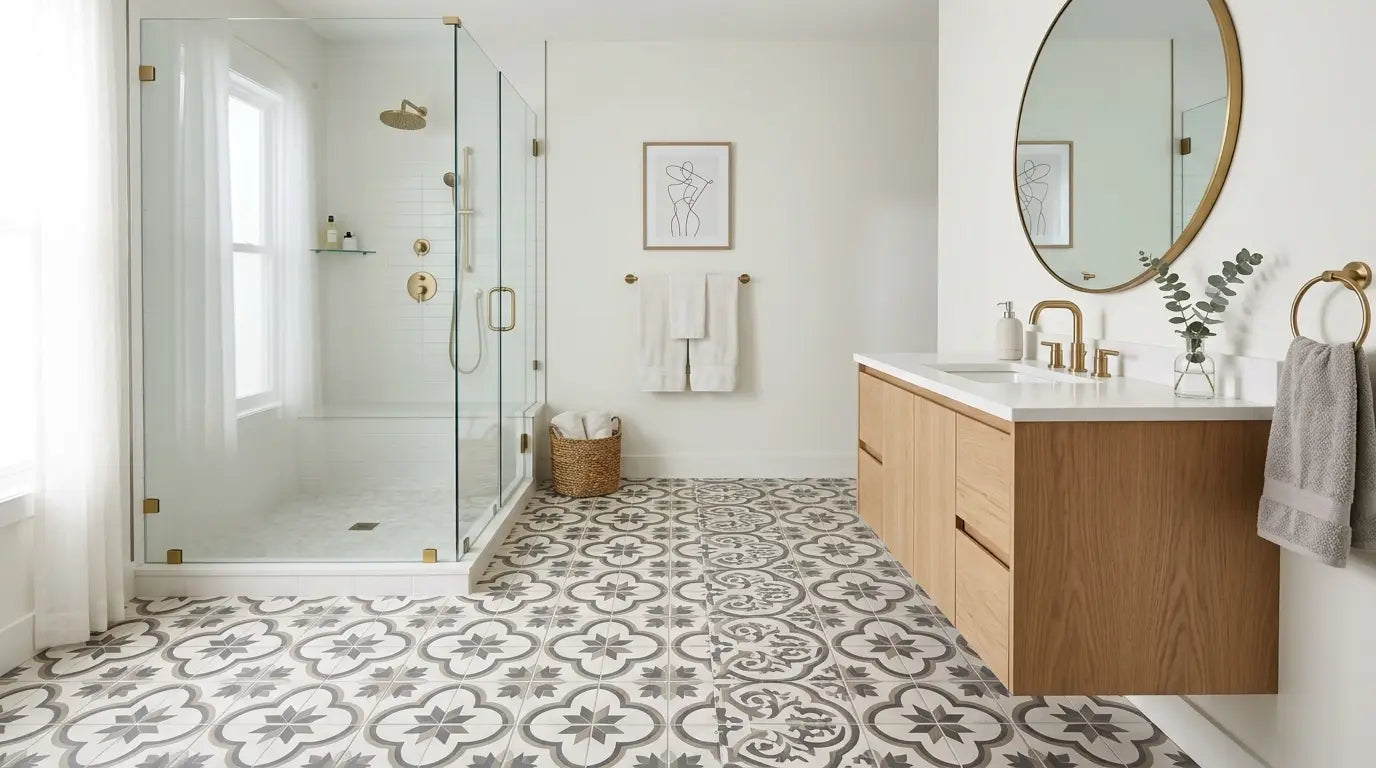
Encaustic, checkerboard, Moroccan geometrics, hex florals - patterned tile is the single fastest way to make a bathroom feel designed instead of default. It's also the easiest surface decision to get wrong. This guide covers the coverage rule, the real maintenance cost, and the grout mistake that ruins more patterned floors than any other single error.
For most of the last decade, the safe bathroom floor was large-format matte porcelain in a warm neutral - and it's still the most-installed option in the US for good reason. But the National Kitchen & Bath Association has flagged patterned tile as one of the defining bathroom flooring trends heading into 2026, and the shift makes sense: after years of quiet, resale-ready neutrals, homeowners are looking for a floor that reads as a deliberate design choice rather than a placeholder. A patterned floor does something a solid-color floor structurally cannot - it gives a small room a focal point without needing a single additional accessory.
The problem is that patterned tile fails in a very specific, very visible way when it goes wrong. Unlike a paint color you can repaint in an afternoon, a patterned tile floor is a multi-week, multi-thousand-dollar installation that's difficult and expensive to undo. Get the scale, the coverage, or the grout color wrong, and you're living with the mistake for years, not until the next weekend project. This guide exists to prevent that outcome - covering exactly how much pattern a bathroom can carry before it tips from "designed" into "overwhelming," which patterned tile materials are worth the maintenance and which aren't, and the specific grout error that has ruined more encaustic floors than any other single mistake.
If you already know which pattern style you want, jump to the Six Patterns overview via the table of contents, then read the Coverage Rule section before ordering anything - it's the single decision that determines whether the floor feels intentional or chaotic. If you're deciding between real encaustic/cement tile and patterned porcelain, the maintenance comparison and the FAQ answer that directly.
"Patterned tile" isn't one category - it's six visually distinct styles with very different costs, maintenance demands, and ideal use cases. Knowing which family a tile belongs to before you fall for a photo on Pinterest prevents the most common patterned-tile mistake: choosing a look without understanding what living with the material actually requires.

The original patterned bathroom floor - color poured or fired into the tile body rather than printed on top. Unmatched depth and authenticity, but porous, requires sealing before and after grouting, and needs resealing every 1-3 years.

A single repeat, two colors - the lowest-risk patterned floor because it reads as classic rather than trendy. 2026's version softens the classic black-and-white into cream/taupe or charcoal/warm-white for a less clinical look.

Larger, more intricate repeats - star-and-cross, arabesque, and medallion layouts. The most visually dominant pattern family, and the one most likely to overwhelm a room if the coverage rule isn't respected.

Small-format hex tile with a printed floral, leaf, or graphic motif on porcelain. The extra grout lines from the small format actually improve slip resistance - one of the few patterned styles that works well on a shower floor.

Technically not a printed pattern at all - a solid-color plank tile laid in a zig-zag or interlocking layout. Delivers visual movement and texture with the maintenance profile of plain porcelain, since the tile itself carries no design.

Digitally printed marble, granite, and glass-chip speckling on a standard porcelain body. Reads as pattern from across the room but is genuinely low-contrast up close, which makes it one of the safest choices for a small bathroom.
Every patterned bathroom that feels overdone fails for the same structural reason: there's no neutral surface left for the eye to rest on. Pattern works as a focal point precisely because it contrasts with something quiet around it. Cover the floor, both walls, and the shower surround in the same bold print, and the room stops reading as "designed" and starts reading as visual noise - no matter how beautiful the individual tile is.
The fix is a coverage discipline, not a taste judgment. Decide which single surface will carry the pattern before you shop for tile, and hold every other surface in the room to a solid, quiet finish.

Almost everything sold as "encaustic tile" in the US today is technically cement tile - hand-poured pigmented cement pressed into a mold, not fired clay. The two terms get used interchangeably, and for buying purposes the distinction matters less than the shared property both materials have: they are genuinely porous, and porous means every decision from sealing to grout color to daily cleaning products has to be made around that fact.
This isn't a reason to avoid cement tile - it's one of the most beautiful bathroom floor materials available, with a handmade depth of color that no printed porcelain fully replicates. But it's worth going in with accurate expectations, because the gap between "how cement tile looks in a photo" and "what cement tile requires to keep looking that way" is wider than for almost any other bathroom material.
Cement tile must be sealed with a penetrating sealer before grouting and again after - typically 2-3 coats each time, applied with a clean foam roller and allowed to cure between coats. Skipping or rushing this step is the single biggest cause of permanent staining. Budget real installation time for this: a full cement tile floor can take 7-10 days from delivery to finished seal, most of it drying time, not labor.
What it actually costs and requires, in plain numbers:
The acid sensitivity is worth calling out specifically because it's easy to miss: standard bathroom cleaners and even some soap and shampoo formulations are acidic enough to etch unsealed or under-sealed cement tile. If cement tile is on your shortlist, plan on switching to a dedicated pH-neutral stone-and-cement cleaner for that floor - the same all-purpose bathroom spray used everywhere else in the house isn't safe on this surface.
High-definition digital printing has closed most of the visual gap between printed porcelain and real cement tile over the last several years. A quality patterned porcelain tile replicates the color depth and pattern repeat of encaustic and Moroccan designs on a fully glazed, non-porous porcelain body - which means the sealing, resealing, grout-staining risk, and acid sensitivity that define cement tile simply don't apply. For the full breakdown of how porcelain and ceramic differ as bathroom materials generally, see our porcelain vs. ceramic tile guide.
The honest tradeoff is authenticity, not durability. Printed porcelain has a flatter, more mechanically uniform surface than handmade cement tile, and under raking light or close inspection, the difference between a printed pattern and an inlaid one is visible. For most bathrooms - and especially for a shower floor, a rental property, or a household unwilling to commit to a resealing calendar - that tradeoff is the right one to make.
| Factor | Real Encaustic / Cement Tile | Patterned Porcelain |
|---|---|---|
| Water absorption | High - porous, must be sealed | Under 0.5% - virtually impervious |
| Sealing required | Yes - before & after grouting | No |
| Resealing schedule | Every 1-3 years | Never |
| Grout color risk | High - dark grout can stain the tile | Low - most grout colors are safe |
| Acid / cleaner sensitivity | High - pH-neutral cleaners only | Low - standard bathroom cleaners fine |
| Best for shower floor | With extra care | Yes |
| Cost (material, per sq ft) | $10-30 | $4-14 |
| Pattern authenticity | Handmade variation, deep color | Digitally uniform, flatter surface |
Not every patterned tile style belongs on every surface. A pattern's format and finish determine where it performs safely, not just where it looks best.
Small-format hex and mosaic patterns work best here - more grout lines genuinely improve traction. A minimum COF 0.42 / R10 slip rating applies regardless of pattern. See our non-slip bathroom floor tile guide for rated options.
Any of the six pattern styles work on a dry main floor zone. This is where scale matters most - see our large format vs. small mosaic guide for how tile size changes perceived room size.
The wall behind an open vanity or freestanding tub can carry a pattern too bold for a floor, since it's viewed rather than walked on. Keep the floor solid when the wall carries the pattern.
A powder room has no shower to compete with and is used briefly by guests - it's the one room in the house where floor-to-ceiling pattern genuinely works as a design statement rather than a risk.
Grout choice matters more with patterned tile than with any other floor decision, because the grout line either frames the pattern cleanly or breaks it into a busy grid. This is a large enough topic on its own that we cover it in full in our bathroom grout color guide - but the rules specific to patterned tile are worth stating directly here.
Pattern scale needs to change with room size - a print that reads as an elegant statement in a primary bathroom can visually swallow a 5x8 powder room, and the reverse is also true: a delicate, small-repeat pattern that's perfectly proportioned for a powder room can disappear into insignificance across a large primary bathroom floor.
If radiant heat is part of the plan for a primary bathroom remodel, most cement and porcelain patterned tile is compatible - confirm with the specific manufacturer before ordering, and see our heated bathroom floors guide for full cost and system breakdown. For anyone still deciding between tile and a lower-cost alternative before committing to a pattern at all, our vinyl plank flooring guide and marble bathroom floors guide cover the other major material paths, and our step-by-step tile installation guide walks through what the project actually involves once a tile is chosen.
Once the floor carries the pattern, the vanity's job changes - it needs to anchor the room rather than compete with it. These pairings from Bathify's current vanity lineup are chosen specifically to sit quietly against a patterned floor rather than fight it.

For a warm-toned encaustic or terracotta Moroccan floor, a natural white oak or walnut finish keeps the palette cohesive instead of competing with the tile's pigment. The wood grain reads as texture, not pattern, so it never doubles up against a busy floor.

Against a bold black-and-white checkerboard or a high-contrast encaustic floor, a clean white floating vanity is the neutral anchor the coverage rule calls for. Floating installation also exposes more of the patterned floor - the visual payoff a wall-mounted vanity is built for.

In a powder room where the floor is already the statement, a matte black or navy vessel-sink vanity in the same restrained palette keeps the room from having two competing focal points - the vanity becomes part of the composition instead of a second attraction.
For the mirror, the same coverage discipline applies: a frameless or thin-frame mirror in a neutral finish lets a patterned floor stay the focal point. Browse Bathify's full mirror collection or matching vanity mirrors sized to pair with any of the vanities above.
All six styles side by side - material, cost, maintenance, and where each performs best.
| Pattern Style | Typical Material | Cost / Sq Ft | Maintenance | Best Room Size | Shower-Safe |
|---|---|---|---|---|---|
| Encaustic / Cement | Unfired cement or fired clay | $10-30 | High - sealing & resealing | Any, with care | With extra sealing |
| Checkerboard | Porcelain or ceramic | $4-12 | Low | Small - large | Yes |
| Moroccan / Geometric | Printed porcelain | $5-14 | Low | Medium - large | Yes |
| Hexagon & Floral | Small-format porcelain | $5-15 | Low | Any | Yes - best shower option |
| Herringbone / Chevron | Solid-color plank tile, patterned layout | $4-13 | Low | Any | Yes |
| Terrazzo-Look | Printed porcelain | $4-13 | Low | Small - large | Yes |
Every overwhelming patterned bathroom we've seen traces back to one of these five decisions - all avoidable before a single tile is ordered.
How Much Pattern Is Right for You
Let one surface carry the pattern - almost always the floor - and hold everything else in the room to a solid, quiet finish. That single discipline prevents the majority of patterned-tile regrets, regardless of which of the six styles you choose.
If you want the authentic depth of real cement or encaustic tile and are willing to seal it on schedule and clean it with pH-neutral products, it remains the most beautiful patterned floor available. If you want the look without the maintenance commitment - especially for a shower floor or a rental - patterned porcelain delivers most of the visual impact with none of the sealing, staining, or acid-sensitivity risk.
Whichever material you choose, view a physical sample under your bathroom's actual lighting, confirm the grout color rule for that specific material, and keep the vanity, countertop, and mirror deliberately quiet. That's the complete formula for a patterned floor that reads as designed for as long as you own the house.
Shop Vanities & Mirrors to Pair With Your Floor
Bathify doesn't stock tile, but we do carry the vanities, mirrors, and hardware that make a patterned floor look intentional - floating and freestanding vanities, frameless mirrors, and finish options in every tone from warm oak to matte black. Free shipping on orders over $50. Shipped across the USA.


