







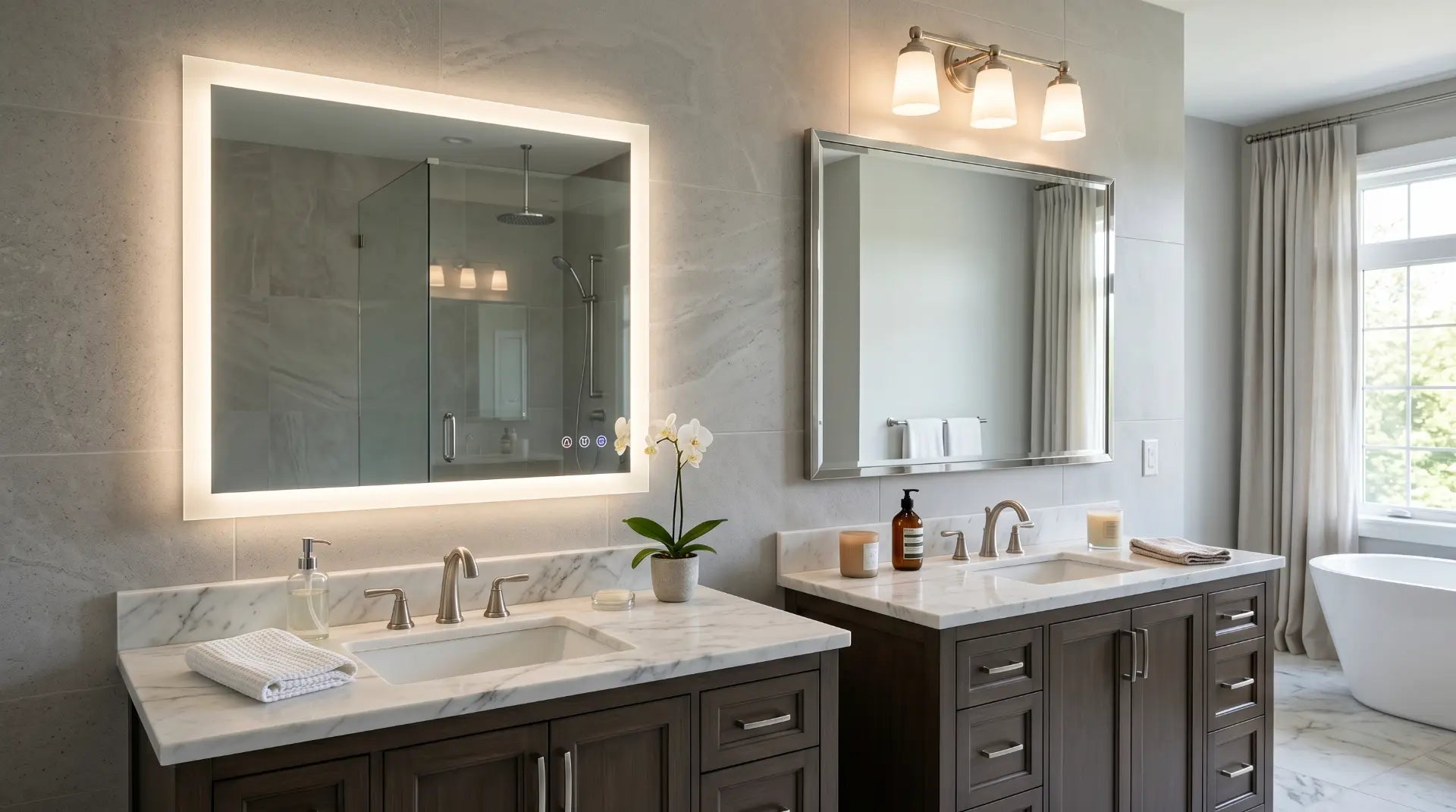
One does a single job. The other replaces your mirror and your vanity light at once. This honest comparison breaks down cost, lighting, anti-fog, installation, and lifespan - so you know exactly when the LED upgrade pays off and when a regular mirror is the smarter buy.
For a primary bathroom you use every single day, an LED mirror is worth the upgrade - and the math is closer than the sticker price suggests. The reason is simple: a regular mirror only does half the job. It reflects, but it doesn't light. You still need a separate vanity light bar above it, and once you add that fixture's cost and installation, the total often matches or exceeds a single LED mirror that handles both reflection and grooming light in one unit.
Where a regular mirror still wins is in the rooms where lighting performance barely matters: a powder room, a guest bath, a rarely used secondary bathroom, or any space where you already have good, well-placed lighting and just need a mirror. In those cases, paying extra for integrated LEDs is spending money on a benefit you won't use.
The rest of this guide breaks down each factor - lighting, true cost, anti-fog, installation, lifespan, and resale - so you can match the right mirror to your actual bathroom rather than to the marketing. If you want the broader picture across every mirror category first, start with our complete bathroom mirrors buying guide.
If grooming - makeup, shaving, skincare - actually happens at this mirror every day, buy the LED mirror. If the mirror is mostly for a quick glance in a low-traffic room, a regular framed or frameless mirror is all you need. Frequency of use is the deciding factor, not budget.
Before comparing them, it helps to be precise about what "LED mirror" and "regular mirror" each include - because the difference is bigger than just a strip of lights.
A mirror with LED strips built into the glass - either backlit (a halo glow around the perimeter) or front-lit (light directed at your face). Most mid-range models add a touch sensor for on/off and dimming, adjustable color temperature, and an anti-fog heating element. It replaces the need for a separate vanity light bar entirely.
A standard bathroom mirror - framed (with a wood or metal border) or frameless (clean polished or beveled edge). It reflects only and contains no lighting, no touch controls, and no anti-fog. It depends entirely on the room's existing light fixtures, which is why it's almost always paired with a separate vanity light bar or sconces.
That last point is the crux of the whole comparison: a regular mirror is one product that does one thing, while an LED mirror is effectively two products in one. Every fair cost and value judgment below flows from that fact. For a closer look at the two LED lighting styles, see our guide on backlit vs front-lit bathroom mirrors.

This is the single biggest functional gap between the two, and it's the one you feel daily. A regular mirror reflects whatever light is already in the room - and in most US bathrooms, that's a ceiling fixture or a light bar mounted above the mirror. Light from above casts shadows downward across the face: under the eyes, beneath the nose, along the jaw. For applying makeup, shaving cleanly, or examining skin, those shadows are exactly where you need to see clearly, and they're the hardest spots to light from a ceiling fixture.
An LED mirror solves this by lighting your face from the mirror plane itself - the same plane you're looking into. A front-lit LED mirror projects light forward onto your face, eliminating the overhead shadows entirely and giving even, full-face illumination. Backlit models produce a softer halo that's beautiful for ambiance but less effective as a primary task light. Either way, the light comes from where you actually need it rather than from above.
Color temperature decides accuracy. A neutral-white 4000K LED is the professional standard for grooming - bright and true-to-color without the harshness of cooler daylight tones. Many LED mirrors also offer adjustable color temperature (warm / natural / cool) via the touch sensor, letting you set warm light for ambiance and neutral light for makeup. A regular mirror gives you zero control here - you're stuck with whatever bulb is in the room. For the full breakdown, read our bathroom lighting color temperature guide.
There's a practical test for whether this matters to you: stand at your current mirror at the time of day you usually groom and watch for shadows on your face. If they're there - and in most bathrooms they are - an LED mirror is a daily, tangible improvement, not a luxury. If your existing lighting already lights your face evenly (for example, you have well-placed side sconces), the lighting advantage of an LED mirror shrinks considerably. To plan lighting around your mirror, see how to choose the right bathroom light fixtures.
On a price tag alone, a regular mirror looks cheaper - and it is, as a standalone object. But comparing a regular mirror's price to an LED mirror's price isn't a fair comparison, because the regular mirror can't light your face. To use it for grooming, you have to add a separate vanity light. Once that's in the math, the gap narrows or disappears.
| Cost Element | Regular Mirror Setup | LED Mirror Setup |
|---|---|---|
| The mirror itself | $40 - $300 | $100 - $500 (light included) |
| Separate vanity light bar | $60 - $200 (required for grooming) | $0 - already built in |
| Light fixture install / wiring | Added cost if no fixture exists | One connection, mirror only |
| Anti-fog | Not available | Included on most models $150+ |
| Wall space used | Mirror + fixture above it | Mirror only |
The takeaway: if your bathroom needs both a mirror and grooming light - which describes nearly every primary bathroom - the LED mirror frequently lands at a similar or lower total cost while doing more, taking less wall space, and requiring one electrical connection instead of two. The regular mirror only wins on total cost when you already have good lighting in place and genuinely just need the reflective surface.

A regular mirror has no defense against steam - after a hot shower it fogs over completely, and you either wipe it (leaving streaks) or wait for it to clear. Most mid-range and premium LED mirrors include an anti-fog heating element: a thin, low-voltage pad behind the glass that warms the surface just enough to stop condensation from forming, keeping the mirror clear during and right after a shower.
If you groom immediately after showering - which most people do - this is a small luxury that becomes a daily expectation fast. It's also maintenance-free, unlike anti-fog sprays that wear off and need reapplying every few weeks. One caveat: anti-fog is standard on LED mirrors above roughly $150, but entry-level LED models sometimes omit it, so confirm it's listed in the specific model's features. For the full mechanism and best options, see our anti-fog bathroom mirrors guide.
This is the one area where the regular mirror is genuinely simpler. A standard mirror mounts with brackets or adhesive and needs no electrical connection at all - it's a true DIY job in under an hour. An LED mirror needs power, which means either a hardwired connection to a GFCI-protected bathroom circuit or a nearby outlet for plug-in models.
In practice this is less daunting than it sounds. Many LED mirrors, including ICO Bath models at Bathify, offer both hardwired and plug-in options, and the touch controls can be connected to a wall switch for convenience. Hardwiring is a straightforward connection for anyone comfortable with basic residential wiring, though a licensed electrician is recommended - especially because bathroom circuits must be GFCI-protected by code. If you're replacing an existing vanity light, the wiring is often already there to tie into.
The most common hesitation about LED mirrors is this: the LED strip is sealed behind the glass, so you can't swap it like a bulb - what happens when it burns out? It's a fair question, and the honest answer is reassuring. Quality LED diodes are rated for around 50,000 hours of use. At a couple of hours a day, that's well over a decade of service before any meaningful dimming, and reputable brands back the lighting with warranties - ICO Bath mirrors at Bathify, for example, carry a 5-year warranty. If a diode fails within that window, it's handled as a warranty claim, not a DIY repair.
On running cost, LED mirrors are extremely efficient - quality models use roughly 80% less energy than traditional bulbs, and the anti-fog pad (when present) draws only 30-60 watts and runs only during showers. The impact on a power bill is negligible. A regular mirror, of course, uses no power itself, but the vanity bulbs it relies on may not be LED, which can quietly cost more to run over time.
A 50,000-hour rating outlasts most bathroom renovations. The realistic risk isn't the LEDs wearing out from use - it's a rare manufacturing defect, which is exactly what the warranty covers. Buy from a reputable brand with a stated warranty (Vanity Art, ICO Bath) and this concern is effectively neutralized.
Bathrooms sell homes, and modern, well-lit bathrooms photograph and show better. An LED mirror reads as an updated, contemporary fixture - the kind of detail that makes a bathroom feel finished and current in listing photos and walkthroughs. It signals a recently renovated space, which is exactly the impression sellers want to create. A plain builder-grade mirror, by contrast, reads as original or untouched.
This doesn't mean an LED mirror "pays for itself" in a literal appraisal sense - few single fixtures do. But as one of the lowest-cost, highest-visibility upgrades you can make without touching plumbing, it punches above its price in perceived value. For a primary or shared bathroom in a home you may eventually sell, it's a sensible, low-risk improvement. A frameless LED mirror is also finish-neutral, so it won't clash with future hardware updates a buyer or you might make.
| Factor | LED Mirror | Regular Mirror |
|---|---|---|
| Built-in lighting | Yes | No |
| Shadow-free face lighting | Yes | No (depends on room) |
| Adjustable color temperature | Many models | No |
| Anti-fog | Most models $150+ | No |
| Touch sensor / dimming | Yes | No |
| Needs separate light fixture | No | Yes |
| DIY install (no wiring) | Moderate (power needed) | Easy (no power) |
| Mirror-only price | $100 - $500 | $40 - $300 |
| Total cost with grooming light | Often similar or lower | Mirror + light bar + install |
| Energy efficiency | High (~80% less than bulbs) | Depends on room bulbs |
| Resale / modern appeal | Strong | Neutral |
| Best for | Primary bath, daily grooming | Powder room, guest bath, low use |
The upgrade pays off clearly in these situations:
It's your primary bathroom. Daily grooming - makeup, shaving, skincare - is exactly what LED mirrors are built for, and the shadow-free, color-accurate light is a tangible everyday improvement.
Your current lighting casts face shadows. If you rely on a ceiling fixture or an overhead light bar, an LED mirror fixes the shadow problem that no regular mirror can.
You're renovating or replacing the vanity light anyway. The wiring is already exposed, so consolidating into an LED mirror is the efficient move - one fixture instead of two.
You want anti-fog and a modern look. A clear post-shower mirror plus the updated, finished aesthetic an LED mirror brings are reasons enough on their own for many homeowners.
You care about resale. It's a low-cost, high-visibility upgrade that makes the bathroom show better.
A regular mirror is the right, money-saving choice in these cases:
It's a powder room or guest bath. Low-traffic spaces where detailed grooming rarely happens don't justify paying for integrated lighting you won't use.
You already have excellent, well-placed lighting. If side sconces or a well-positioned setup already lights your face evenly, the LED mirror's main advantage largely disappears.
You want a specific framed look. Traditional and transitional bathrooms often call for a framed mirror in a finish that echoes the faucet and hardware - a design role LED mirrors (typically frameless) don't fill. See our round vs rectangle mirror guide for shape and style help.
You're on a tight budget with no wiring access. If there's no outlet or existing fixture to tie into and a true plug-and-play, no-electrician install is the priority, a regular mirror keeps it simple.
If you've decided the LED upgrade is right for your bathroom, these are standout options across Bathify's LED mirror lineup from Vanity Art and ICO Bath.

The cleanest all-round LED mirror for a primary bathroom. Its integrated 4000K LED strip - the professional grooming standard - delivers natural, even brightness without harsh shadows, exactly the upgrade over a regular mirror this guide describes. The frameless design with soft rounded corners suits modern and transitional bathrooms alike, and a built-in touch sensor handles on/off and lighting adjustment. Distortion-free surface, mounts vertically or horizontally.

For buyers who want maximum control over the lighting, the Eden offers both front-lit and backlit options, is fully dimmable, and allows adjustable color temperature - so you can set warm light for ambiance and neutral light for makeup. Copper-free glass with a safety film backing adds durability, and ICO's user-friendly touch controls can connect to a wall switch. Backed by a 5-year warranty, it answers the lifespan concern directly.

A minimalist 28"×28" square frameless mirror with crisp 5500K daylight-balanced LEDs - the cooler, bright end of the spectrum that some users prefer for detailed skincare and precise tasks. Touch sensor control, energy-efficient performance, and a clean modern profile that fits compact and spacious bathrooms equally. Includes mounting hardware for a straightforward install.

An LED mirror with a built-in 3X magnifying mirror and touch sensor - ideal if your case for upgrading is precision work like brows, lashes, or close shaving that a regular mirror simply can't support. The bright, clear LED illumination plus integrated magnification covers both everyday and detail grooming in one fixture.
Match the mirror to how the room is actually used - not to the price tag
Primary bathroom, daily grooming: Buy the LED mirror. The shadow-free, color-accurate light is a daily improvement, anti-fog is a real convenience, and once you account for the vanity light a regular mirror still needs, the total cost is often a wash. Choose a 4000K model (like the Vanity Art Alder) for grooming accuracy, or an adjustable-color-temp model (like the ICO Bath Eden) if you want full control.
Powder room, guest bath, or low-use space: A regular framed or frameless mirror is the smarter, cheaper buy. You won't miss lighting you don't use, and the money is better spent elsewhere.
Traditional / transitional style with a framed look: A regular framed mirror in a finish that matches your hardware is the right design call - LED mirrors are typically frameless and fill a different role.
Tight budget, no wiring access, true plug-and-play needed: A regular mirror keeps installation to a one-hour, no-electrician job.
Bottom line: The LED mirror is worth it when grooming happens at that mirror every day. Otherwise, a regular mirror does the job for less. For the full picture across every mirror type, see the complete bathroom mirrors guide.
Shop LED Mirrors at Bathify
Frameless LED mirrors with touch sensors, anti-fog, and adjustable lighting - from Vanity Art and ICO Bath. Free shipping on orders over $50. Shipped across the USA.


