







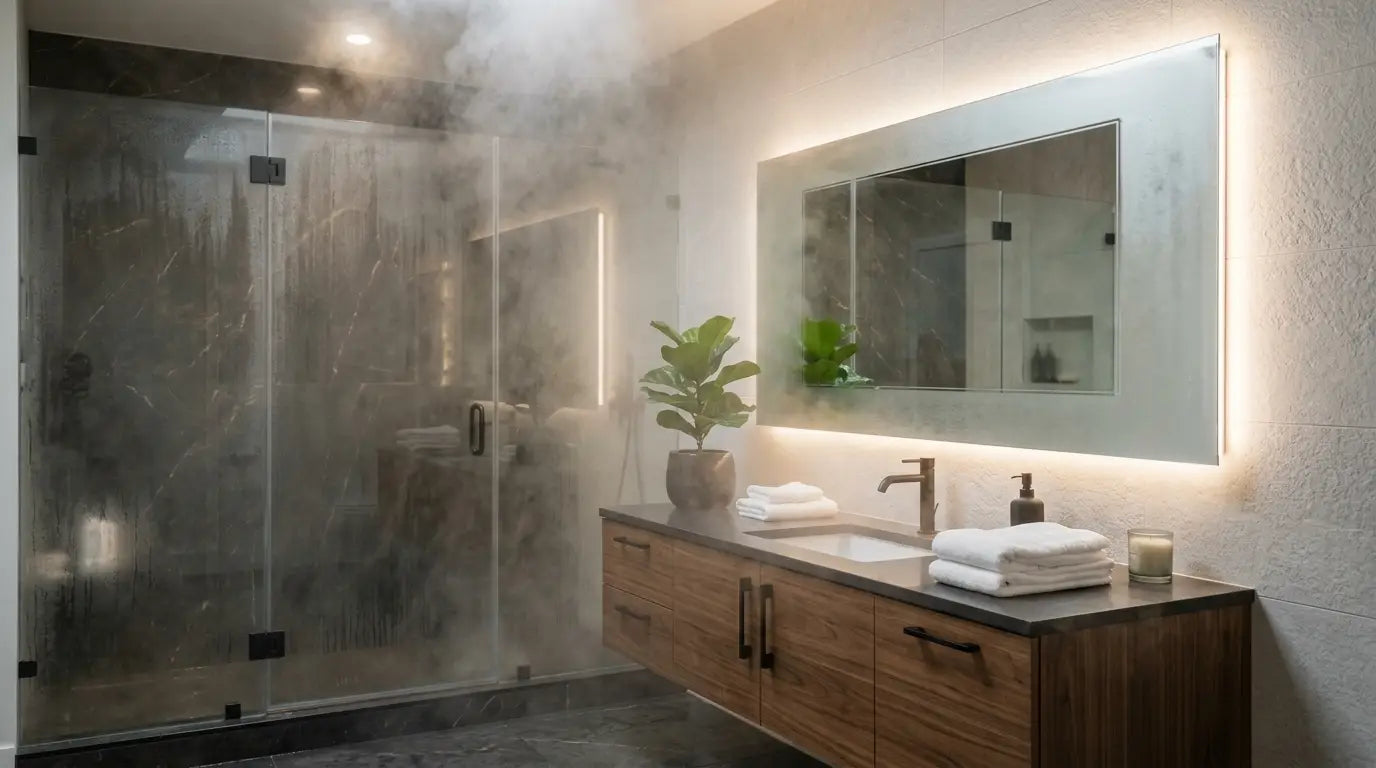
The physics behind a mirror that never fogs, why your exhaust fan isn't solving the problem, and exactly what spec to check before buying.
Mirror fogging is condensation, not a mirror defect - and understanding the mechanism explains why some fixes work and others don't. Hot shower steam fills the bathroom air with water vapor. When that warm, humid air touches a surface cooler than the air's "dew point" (the temperature at which water vapor condenses into liquid), the water vapor converts to tiny liquid droplets on that surface. A bathroom mirror - typically close to room temperature before the shower starts, several degrees cooler than the steam-saturated air during a hot shower - is exactly the kind of surface this happens on.
This is precisely the same physics as a cold glass of iced water sweating on a humid day, or eyeglasses fogging when you walk from a cold car into a warm room. The surface temperature is below the surrounding air's dew point, so water vapor condenses on contact. The fix, in both cases, is the same: either remove the humidity from the air (impractical mid-shower) or raise the surface temperature above the dew point so condensation physically cannot form. That second approach is exactly what a heated anti-fog mirror does.
Many US homeowners assume an exhaust fan should prevent mirror fogging, and are confused when a properly running, adequately sized fan doesn't stop it. The reason is timing: condensation on a cold mirror happens within seconds of hot steam reaching the glass - well before an exhaust fan has had time to meaningfully reduce the room's humidity level. A fan removes humid air from the room gradually, over the course of several minutes; mirror fogging happens essentially instantly as the first wave of steam contacts the cold glass surface.
This doesn't mean exhaust fans are pointless - they remain essential for overall bathroom humidity control, mold prevention, and clearing the room after the shower ends. But a fan is solving a different problem than mirror fogging, and expecting it to prevent condensation on a specific cold surface during active steam exposure is asking it to do something it's not designed to do. The only way to prevent condensation on the mirror itself is to either keep the glass surface warm (heated mirror) or treat the surface so condensation doesn't form as visible droplets (spray/film coating).
A heated anti-fog mirror uses a thin, flat resistive heating element - similar in principle to a car's rear-window defroster - mounted directly to the back of the mirror glass, typically applied as an adhesive pad covering most of the mirror's surface area. When powered on, the element raises the glass temperature a few degrees above the surrounding air, just enough to keep the surface above the dew point throughout a typical shower. Since the mechanism prevents condensation from forming in the first place rather than removing it after the fact, a properly functioning heated mirror stays completely clear throughout a shower, with no fogging at any point.
Turn it on before, not during. Because the heating pad needs a few minutes to bring the glass to operating temperature, the most effective use pattern is activating the defogger when you start the shower (or even a couple minutes before), rather than waiting until the mirror has already begun fogging. Most LED mirrors with anti-fog can be activated independently of the lighting function via the touch sensor.

A properly functioning heated anti-fog mirror prevents condensation from forming at all - the glass stays clear throughout the shower because its surface never drops below the dew point. This is a complete solution, not a reduction in fogging.
Anti-fog sprays and wipe-on coatings work through a different mechanism: they create a thin surfactant film on the glass that causes water vapor to condense as a thin, even sheet rather than discrete droplets that scatter light and obscure the reflection. This reduces the visible fogging effect but doesn't eliminate condensation entirely - in heavy steam conditions or with degraded coating, some fogging effect remains visible, particularly at the edges of the treated area or after the coating has worn thin. Sprays generally perform best immediately after application and degrade gradually with each use.

Anti-fog sprays and wipe-on treatments are inexpensive upfront - typically $8-$20 per bottle, with each application covering many uses before reapplication is needed. There's no mirror replacement cost since these products apply to any existing mirror.
A mirror with built-in anti-fog heating typically costs more than an equivalent mirror without it - the premium varies by brand and size but is often in the $30-$80 range compared to a non-heated version of a similar mirror. However, once purchased, there's no ongoing cost: no recurring spray purchases, no reapplication labor. Over a multi-year ownership period, the total cost of repeated spray purchases (potentially $100-$300+ over several years of monthly reapplication) often exceeds the one-time premium of a heated mirror, making the heated option the better long-term value despite the higher upfront cost.

A built-in heated anti-fog mirror requires zero ongoing maintenance once installed - there's no coating to reapply, no schedule to track, no product to purchase. It simply works every time it's activated, for the life of the mirror.
Sprays and wipe-on films require active maintenance: reapplication every 1-4 weeks depending on the specific product and how heavily the bathroom is used, plus the discipline to actually remember and complete that reapplication. In practice, many homeowners apply anti-fog spray once, experience good results for a few weeks, then forget to reapply and are back to a fogging mirror within a month - making the "maintenance-free" claim of many spray products somewhat misleading in real-world use.

Anti-fog spray application is the simplest possible installation: spray onto a clean, dry mirror surface, wipe to an even film with a soft cloth, and let it dry. No tools, no electrical work, takes about five minutes. This works on any existing mirror regardless of age or mounting type.
A built-in heated mirror requires either purchasing a new mirror with the feature integrated (standard mirror installation - see our mirror installation guide for wall-mount methods) plus an electrical connection for the heating element, which follows the same process as any LED mirror hardwire or plug-in installation. Retrofitting a heating pad onto an existing mirror is possible with aftermarket adhesive defogger pads but requires removing the mirror, applying the pad, and running a power connection - a meaningfully more involved project than spray application.
Anti-fog sprays and films require no electricity at all - a genuine advantage if minimizing any added energy draw is a priority. A heated anti-fog mirror draws 30-80 watts when active, comparable to a single incandescent light bulb. Over a typical 20-30 minute shower routine, the actual electricity cost is a small fraction of a cent in most US electricity markets, making this a minor practical difference for the large majority of households - but it's a real, non-zero difference compared to a spray that uses no power whatsoever.
Not every LED mirror includes anti-fog heating, and the feature is sometimes implied by marketing language without being explicitly confirmed in the spec sheet. Before purchasing any mirror expecting anti-fog performance, verify these specifics directly on the product listing or by contacting the retailer.
| Factor | Built-In Heated Pad | Anti-Fog Spray | Adhesive Film |
|---|---|---|---|
| Effectiveness | Complete prevention | Reduces visible fog | Reduces visible fog |
| Upfront cost | $30-$80 premium on mirror | $8-$20 per bottle | $15-$40 per kit |
| Ongoing cost | Negligible electricity | $8-$20 every 1-4 weeks | Replace film every 1-3 months |
| Maintenance | None | Reapply regularly | Reapply/replace periodically |
| Installation | New mirror or pad retrofit + electrical | 5-minute spray application | 15-20 min adhesive application |
| Works on existing mirror | Only via aftermarket retrofit | Yes - any mirror | Yes - any mirror |
| Energy use | 30-80W when active | None | None |
| Visual impact on mirror | None - invisible when off | None - clear coating | Slight - film edge sometimes visible |
| Best for | New mirror purchase, primary bath | Existing mirror, budget fix | Existing mirror, longer-lasting than spray |
Bathify carries a wide range of LED mirrors across Vanity Art and ICO Bath. Anti-fog heating availability varies by model - always check the individual product page's feature list to confirm before ordering if anti-fog is a priority for your bathroom.

The ICO Bath Camden and Eden series are premium dual-lit (front and backlit) mirrors with independently dimmable controls, adjustable color temperature, copper-free safety glass, and a 5-year warranty - confirmed features at this price tier across the US LED mirror market. ICO Bath's mirrors are positioned at the high end of Bathify's LED collection, and anti-fog heating is a feature commonly included at this tier across the category. Confirm anti-fog inclusion directly on the specific product page before ordering, since exact feature sets can vary by size and configuration.
Shop: ICO Bath Camden 60"×36" → · Eden 36"×36" → · Eden 30"×36" →

Vanity Art's LED mirror lineup at Bathify spans multiple sizes and configurations: the Cube 20"×31" medicine cabinet-style mirror with sliding door storage, the Glow 28"×43" large-format mirror, the Frame 30"×27" standard rectangle, the Zoom 31"×31" with built-in 3x magnifying mirror, and the Lumi 28"×28" frameless square with 5500K daylight LED. All confirmed to include touch sensor control. As with the ICO Bath series, confirm anti-fog heating specifically on each product's individual feature list before purchasing, since it is not universally included across every model in this price tier.
Shop: Cube 20"×31" → · Glow 28"×43" → · Frame 30"×27" → · Zoom 31"×31" →
For a primary bathroom, a built-in heated mirror is the only genuinely permanent solution
The physics of mirror fogging means there are really only two approaches that work: keep the glass warm (heated pad) or treat the surface so condensation doesn't form visible droplets (spray or film). An exhaust fan, however well-sized, does not solve mirror-specific fogging because the condensation happens faster than any fan can clear the room's humidity.
Choose a built-in heated anti-fog mirror if: this is a primary bathroom used daily, you want a zero-maintenance permanent solution, and you're willing to pay a modest upfront premium for a feature you'll never have to think about again.
Choose anti-fog spray or film if: you have an existing mirror you don't want to replace, your budget is tight, or fogging is an occasional annoyance rather than a daily frustration - and you're willing to maintain a reapplication schedule.
Either way: always confirm the specific anti-fog feature explicitly on the product listing before purchasing an LED mirror expecting this functionality - LED lighting and anti-fog heating are independent features that don't automatically come bundled together.
Shop LED Mirrors at Bathify
Premium LED mirrors from ICO Bath and Vanity Art - free shipping on orders over $50, USA-wide, with a 30-day return policy.


