







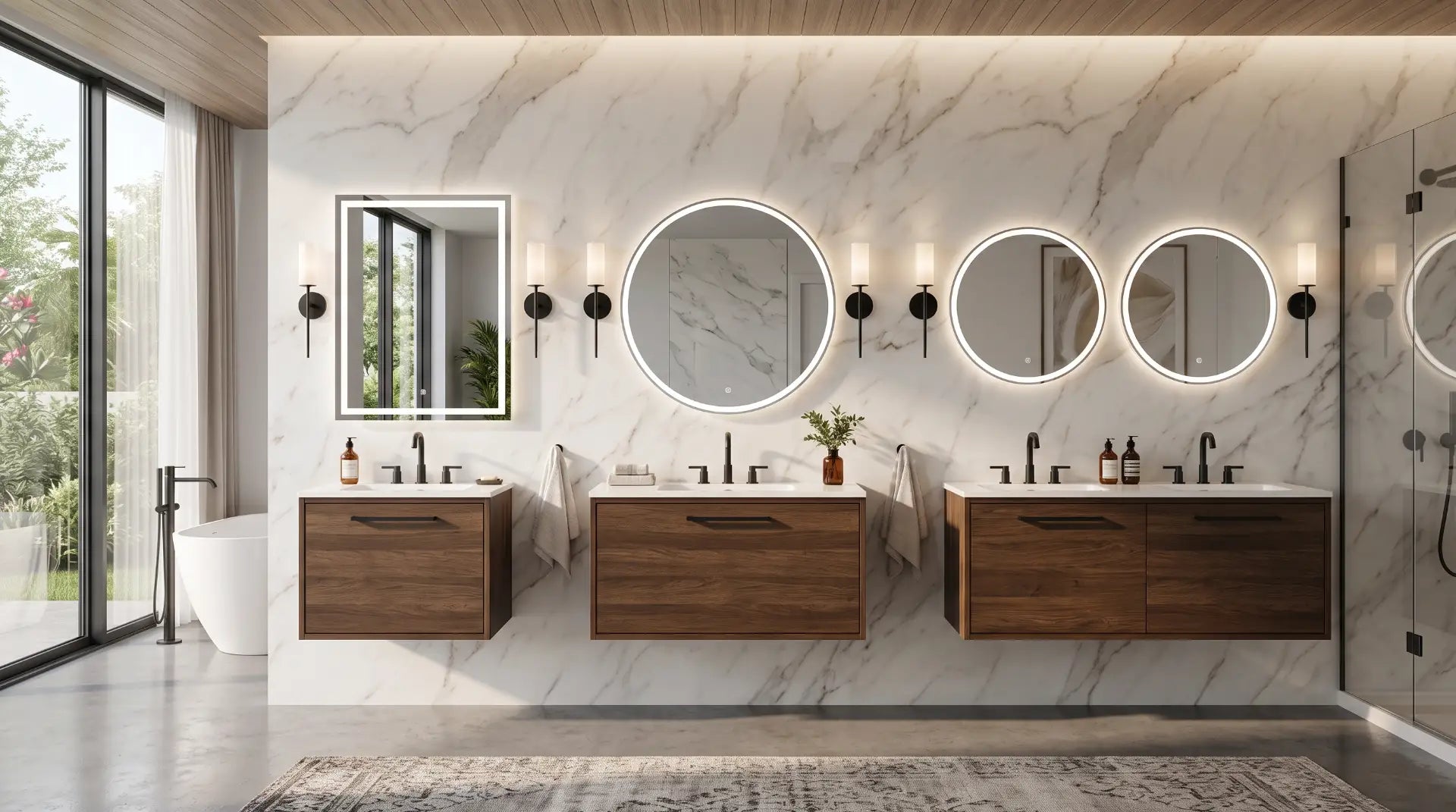
The single most common bathroom mirror mistake is the wrong size. This guide gives you the exact width, height, and mounting-height rules by vanity size - plus a quick-reference chart, round-mirror math, and double-vanity layouts that stay balanced.
More bathroom mirrors are bought in the wrong size than in any other wrong attribute - wrong color temperature, wrong shape, wrong finish all come second. It happens because the mirror is usually the last decision in a renovation, chosen from whatever fits the leftover budget or looked good in a showroom without a vanity underneath it. The result is predictable: a mirror that floats too small above a wide vanity like an afterthought, or one so large it crowds the light fixtures and swallows the wall above it.
The good news is that mirror sizing is not a matter of taste - it follows a small set of proportional rules that interior designers use to get it right every time. Once you know the width rule, the height rule, and the correct mounting height, you can size a mirror for any bathroom in under a minute. This guide walks through each rule in plain numbers, covers the exceptions (side sconces, vessel sinks, tall ceilings, double vanities, powder rooms), and finishes with verified picks from Bathify sorted by the vanity size they fit. For the full context on every mirror category and feature, this article is the sizing chapter of our complete bathroom mirrors buying guide.
If you just want the number, read the next two sections - the core rule and the quick-reference chart give you a mirror width for your vanity in seconds. If you have a specific situation (double sink, vessel sink, side sconces, a tiny powder room, or a round mirror), jump to that section via the table of contents. The measurement walkthrough near the end shows exactly how to check your own wall before you buy.
Here is the rule that covers the vast majority of bathrooms: a bathroom mirror should be a few inches narrower than the vanity - roughly 4 to 8 inches less than the total vanity width, leaving about 2 to 4 inches of reveal on each side. The mirror should never be wider than the vanity below it in a standard bathroom. For a 48-inch vanity, that means a 40 to 44-inch mirror. For a 30-inch vanity, a 24 to 28-inch mirror.
Height is not a fixed number - it is set by the space between the countertop and whatever is above the mirror. Start the bottom edge about 5 to 10 inches above the countertop (roughly 4 to 6 inches above the faucet), and stop the top 2 to 3 inches below the overhead light fixture or the ceiling, whichever comes first. On a standard 8-foot ceiling with a normal vanity height, that produces a mirror somewhere between 30 and 40 inches tall. That's the entire framework - everything else in this guide is an exception or a refinement of these two rules.
This is the sizing chart to bookmark. It gives the proportional mirror width for every common US vanity size, based on the vanity-width-minus-reveal rule. Use it as a starting point, then adjust for the exceptions covered later (side sconces reduce these widths; small powder rooms can push to the top of the range or beyond).

The vanity-width-minus-reveal rule produces a balanced look because the small margin of wall on each side lets the mirror sit inside the vanity's footprint rather than overhanging it. Overhang is what makes a mirror look oversized and awkward - the eye reads a mirror wider than the cabinet below as a mistake, even when it can't articulate why.
There is a second, tighter approach worth knowing: sizing the mirror to the sink or faucet width rather than the full vanity width. On a wide single vanity with a lot of countertop on either side of one sink, a mirror sized to span the vanity can feel heavy. Sizing it closer to the sink zone - so it reads as a focused feature centered over the basin - often looks more intentional. This is especially true for a single sink set off-center in a wide vanity, where the mirror should center on the sink, not the cabinet.
Center on the sink, not the cabinet. Plumbing is not always centered in the vanity. Always mount the mirror centered over the sink basin and faucet, even if that means it's slightly off-center relative to the cabinet. A mirror centered on the cabinet but offset from the sink looks wrong the moment someone stands at the faucet.
One more width note: a frameless mirror reads slightly larger than a framed mirror of identical dimensions, because the glass runs all the way to the edge with no border eating into the perceived size. If you're between two widths, a frameless mirror can take the smaller of the two and still feel generous. More on that in the framed-vs-frameless section below, and in our dedicated round vs rectangle mirror guide.

Mirror height is the dimension most people guess at, and it's the one that's actually determined by your wall - not by a catalog number. The height of the mirror is set by the vertical gap between the countertop and whatever sits above the mirror, which is almost always either an overhead vanity light bar or the ceiling.
Work from two anchor points. The bottom edge should sit about 5 to 10 inches above the countertop - high enough to clear the backsplash and faucet handles, low enough that the mirror still relates to the sink. The top edge should stop 2 to 3 inches below an overhead light fixture, or 2 to 3 inches below the ceiling if there's no light above the mirror. The distance between those two points is your mirror height. On a standard 8-foot ceiling with a 32 to 36-inch vanity, that math usually lands you between 30 and 40 inches of mirror height.
| Setup | Bottom Edge | Top Edge | Typical Mirror Height |
|---|---|---|---|
| 8-ft ceiling, light bar above mirror | 5-10" above counter | 2-3" below light bar | 30-36" |
| 8-ft ceiling, side sconces (no top light) | 5-10" above counter | 2-3" below ceiling / crown | 36-40" |
| 9-ft+ ceiling | 5-10" above counter | Taller mirror or lower mount | 40-48"+ (or mount shorter mirror lower) |
| Vessel sink on counter | Raise 3-4" to clear tall faucet | 2-3" below fixture / ceiling | 30-40" (mounted higher overall) |

Size and placement are two different decisions. Once you have the right mirror dimensions, mounting height determines whether it actually works for the people using it. The guiding principle is simple: center the mirror at eye level. For most households, that puts the vertical center of the glass around 60 to 65 inches from the finished floor.
Because "eye level" varies from person to person, size the mounting height to the range of people who'll use the bathroom. In a shared or primary bath, bias the center slightly higher so the tallest user still sees the top of their head, since a shorter user can always see themselves in a mirror hung a touch high, but a taller user is cut off by one hung too low. The horizontal centering rule from earlier still applies - center over the sink and faucet, not the cabinet.
Tape a template on the wall first. Before drilling, cut a paper or cardboard rectangle to the mirror's exact dimensions and tape it to the wall at your planned height. Stand at the sink, check that everyone in the household sees their full face, and confirm the clearances above and below. Five minutes with painter's tape prevents the most common install regret. For the full mounting process - wall-mount brackets, cleats, and adhesive methods - see our how to install a bathroom mirror guide.

Tall ceilings (9 feet and up): A standard 30 to 36-inch mirror can look lost under a 9 or 10-foot ceiling. You have two good options. Go taller - a 40 to 48-inch mirror (or a stacked portrait orientation) fills the wall in proportion. Or keep a standard mirror but mount it at the correct height relative to the vanity and accept the wall space above, treating that space with a light fixture or leaving it clean. What you should not do is float a small mirror high on the wall to "fill" the gap; that breaks the eye-level rule and looks off at the sink.
Vessel sinks: A vessel sink sits on top of the counter rather than dropping into it, which raises both the basin and the faucet several inches. Everything moves up: mount the mirror 3 to 4 inches higher than you would for an undermount sink so the bottom edge clears the taller faucet and the mirror still centers at eye level. The mirror's dimensions don't change - only its mounting height does.

our lighting choice changes the width rule. This is the exception most sizing articles skip, and it's the one that most often trips people up.
Overhead light bar: If your vanity light is a horizontal bar mounted on the wall above the mirror, the standard width rule applies unchanged - the mirror sits below the bar and can run the full recommended width. Just make sure the mirror's top edge stops 2 to 3 inches below the bar.
Side-mounted sconces: If you're using two sconces flanking the mirror (a designer-favorite look that lights the face more evenly than a top bar), the mirror has to get narrower to leave room for them. Reduce the mirror width to roughly 60 to 70 percent of the vanity width so the sconces have clearance on each side. A 48-inch vanity with side sconces typically takes a 28 to 32-inch mirror rather than a 40 to 44-inch one. Plan the sconce and mirror widths together, not separately.
Mirror width and lighting layout are a single design decision, not two. Decide first whether you want a top light bar (full-width mirror) or side sconces (narrower mirror), then size the mirror to match. Our guides on how to choose bathroom light fixtures and the best bathroom vanity lights of 2026 walk through both layouts in detail. If you'd rather skip the separate fixture entirely, an LED mirror with built-in lighting removes the sconce-clearance problem altogether.
For single-sink vanities, the width chart above is all you need. Double vanities are where sizing decisions get interesting - and where the most common expensive mistake happens: buying one giant mirror to span two sinks.
For double vanities 60 inches and wider, two individual mirrors almost always look better than one wide mirror. Each mirror anchors its own sink, keeps the proportions balanced, and lets you flank each with its own sconce if you want. A single 60-inch mirror spanning two sinks tends to read as too tall relative to its width and doesn't give either sink a clear visual home. Size each mirror to roughly 60 to 70 percent of its half of the vanity - so on a 60-inch double vanity, two mirrors around 24 to 26 inches wide each.
A single continuous mirror can still work in two cases: when you specifically want an uninterrupted, space-expanding look, and when your lighting is one long horizontal bar rather than paired fixtures. Even then, keep the mirror proportional - a very long, short mirror across a double vanity rarely looks intentional. Matching mirrors from Bathify's matching vanity mirrors collection make the paired look easy to pull off, and you can browse vanities built for two sinks in the double sink vanities collection.

Round and oval mirrors follow a different rule because their height and width are linked. The guideline: the diameter should be roughly two-thirds of the vanity width. A 36-inch vanity pairs cleanly with a 24 to 28-inch round mirror; a 30-inch vanity with a 20 to 24-inch round. This keeps the round mirror generous enough to be functional without letting it dominate the wall.
The catch with round mirrors is height. Because the diameter is both the width and the height, a round mirror sized for correct width can feel short on a tall wall. A 28-inch round mirror that's proportionally correct in width above a 36-inch vanity is also only 28 inches tall, which may look undersized against a 9-foot ceiling. For that reason, round mirrors are at their best on single vanities up to about 36 inches wide with standard ceilings. On wider vanities, use two round mirrors - one over each sink - or switch to a rectangular or oval shape for better proportion.
Shape is ultimately a design decision - both round and rectangular mirrors reflect equally well - but it interacts with size, so it's worth deciding shape and size together. For a full breakdown of which shape suits which bathroom, see our round vs rectangle bathroom mirror guide, and browse options in the round mirrors and rectangle mirrors collections.
Everything so far has said a mirror should be narrower than the vanity. Small bathrooms and powder rooms are the deliberate exception. In a tight space, an oversized mirror - one sized right up to the vanity width, or even a couple of inches beyond it - is one of the highest-impact, lowest-cost upgrades you can make, because a large mirror reflects light and visually doubles the sense of space.
The move that works best in a small bath is a large frameless mirror. Frameless glass reads larger than framed at the same dimensions and doesn't add visual weight to an already-tight room. A mirror that spans nearly the full vanity width, mounted at correct eye level, makes a powder room feel meaningfully larger than a modest mirror centered with wide margins. An all-mirrored medicine cabinet - mirrored on the door, edges, and interior - amplifies the effect further by reflecting depth from multiple surfaces.
In a small bath, size up, not down. Where a standard bathroom wants a few inches of reveal on each side, a powder room benefits from a mirror at or just past the vanity width. Pair it with a frameless design and you get maximum reflected light with minimum visual clutter - the single most effective way to make a small bathroom feel bigger without touching the layout.

Medicine cabinets follow the same width and height rules as mirrors, with one extra constraint: if you're installing a recessed cabinet, its width is limited by your wall framing. Standard US walls are framed with studs 16 inches on-center, which leaves a clear cavity of roughly 14 to 15 inches between studs. Most recessed medicine cabinets are designed to fit within that single-bay opening, which is why so many are around 15 to 16 inches wide on the recessed portion, even when the mirrored face is larger.
Surface-mount medicine cabinets have no such limit - they mount on the finished wall and can be as wide as any mirror. If you want a wide medicine cabinet (24 inches or more) on a standard stud layout, surface-mount is usually the practical route, since a wider recessed unit requires cutting a stud and adding a header. For the full recessed-versus-surface-mount decision, including install difficulty and when each makes sense, that guide is coming in this series - in the meantime, the medicine cabinet section of the complete mirrors guide covers the essentials, and you can browse options in the medicine cabinets collection.
Five measurements tell you exactly what mirror to buy. Grab a tape measure and work through these in order.
Measure the full width of the vanity cabinet. Subtract 4 to 8 inches - that's your target mirror width. For side sconces, target 60 to 70% of vanity width instead.
Mark the horizontal center of the sink basin and faucet - not the cabinet. The mirror centers on this line, even if it's offset from the cabinet center.
Measure from the countertop up to the bottom of your light bar (or the ceiling). Subtract about 8 to 13 inches total for the clearances - the remainder is your max mirror height.
Confirm the mirror's vertical center lands near eye level for the household - roughly 60 to 65 inches off the floor. Bias higher if users are tall.
Cut paper to the mirror's dimensions, tape it up at your planned height, and stand at the sink. Adjust until it looks and works right, then buy to that size.
Match your target width against the quick-reference chart above. If your number lands in the listed range for your vanity, you're sized correctly.
| Mistake | Why It Looks Wrong | The Fix |
|---|---|---|
| Mirror too small | Floats above a wide vanity like an afterthought; wide margins of wall on each side | Size to vanity width minus 4-8"; use the chart |
| Mirror wider than vanity | Overhangs the cabinet and crowds the light fixtures; reads as oversized | Keep it inside the vanity footprint (except small baths) |
| Hung too high or low | Tall users get cut off, or the mirror sits awkwardly above the sink | Center at eye level, ~60-65" from floor; tape-test first |
| Big gap above on tall ceiling | A short mirror under a 9-ft ceiling looks undersized | Go taller, or mount a standard mirror lower to the vanity |
| One wide mirror over a double sink | Reads as a letterbox slot; neither sink gets a visual anchor | Two individual mirrors, one per sink |
| Ignoring the sconce clearance | Full-width mirror leaves no room for side sconces | Reduce mirror to 60-70% of vanity width for sconces |
Once you know your target width, here are correctly-sized LED mirrors from Bathify sorted by the vanity size they fit. All mount vertically or horizontally, so you can orient them to suit your ceiling and lighting.

A clean, frameless LED mirror with soft rounded corners, sized right for a 24 to 30-inch vanity. The 4000K LED strip - the professional grooming standard - gives natural, even light without harsh shadows. Touch sensor for on/off and lighting adjustment, distortion-free surface, and it mounts vertically or horizontally, so you can run it tall on an 8-ft wall or wide over a compact vanity.

A 30-inch-wide LED mirror that lands squarely in the recommended range for a 30 to 36-inch vanity. The 5500K daylight-balanced LED strip delivers high color accuracy for makeup and detail grooming, with up to 50,000 hours of LED life and about 80% less energy use than traditional lighting. Tempered, shatter-resistant glass and a built-in on/off switch; mounts vertically or horizontally.

The 36-inch-wide Align sits in the sweet spot for a 42 to 48-inch vanity (or as a generous width over a 36-inch vanity). Integrated 5500K LEDs give bright, low-power daylight illumination, and the touch sensor switches between warm, cool, and natural settings. Flat, distortion-free surface for accurate reflection; mounts either orientation.

When you have a 9-foot ceiling or want a statement portrait mirror that fills vertical space, this 43-inch-tall LED mirror is the answer. The tall orientation keeps the eye-level center correct while filling the wall in proportion, and the touch-sensor LED lighting runs the full height for even face illumination. Ideal over a 30 to 36-inch vanity on a tall wall.

For a wide single vanity or a seamless look over a large space, the Camden runs a full 60 inches with both front and backlighting. Each ICO mirror is dimmable with adjustable color temperature and copper-free glass with a safety-film backing, backed by a 5-year warranty. Touch controls that can also tie into a wall switch. If you want one continuous statement mirror over a large vanity, this is the size to reach for.

The correct way to size a 60-inch-plus double vanity: two individual mirrors, one anchoring each sink. A pair of Eden 30"×36" LED mirrors gives each sink its own front-and-backlit, dimmable mirror with adjustable color temperature - balanced proportions and a cohesive, intentional look that a single wide mirror can't match. Browse coordinated options in the matching vanity mirrors collection.
Shop: ICO Bath Eden 30"×36" LED Mirror → · Matching Vanity Mirrors →
Size the mirror to the vanity, place it at eye level, adjust for the exceptions
Standard single vanity: Mirror width = vanity width minus 4 to 8 inches. Bottom edge 5 to 10 inches above the counter; top 2 to 3 inches below the light or ceiling. Center over the sink at ~60 to 65 inches from the floor.
Side sconces instead of a top light: Reduce mirror width to 60 to 70% of the vanity width to leave clearance for the sconces on each side.
Double vanity (60"+): Two individual mirrors, one per sink, each about 60 to 70% of its half of the vanity - not one wide mirror.
Round mirror: Diameter ≈ two-thirds of vanity width. Best on single vanities up to 36 inches; use two rounds on wider layouts.
Small bathroom / powder room: Break the rule on purpose - size the mirror up to (or just past) the vanity width, ideally frameless, to reflect light and expand the space.
Tall ceiling or vessel sink: On 9-ft ceilings, go taller or mount lower to avoid a blank gap. For vessel sinks, raise the whole mirror 3 to 4 inches to clear the taller faucet.
Shop Correctly-Sized Mirrors at Bathify
LED mirrors, round and rectangle mirrors, and medicine cabinets in every size - from Vanity Art, ICO Bath, and KubeBath. Free shipping on orders over $50. Shipped across the USA.


