







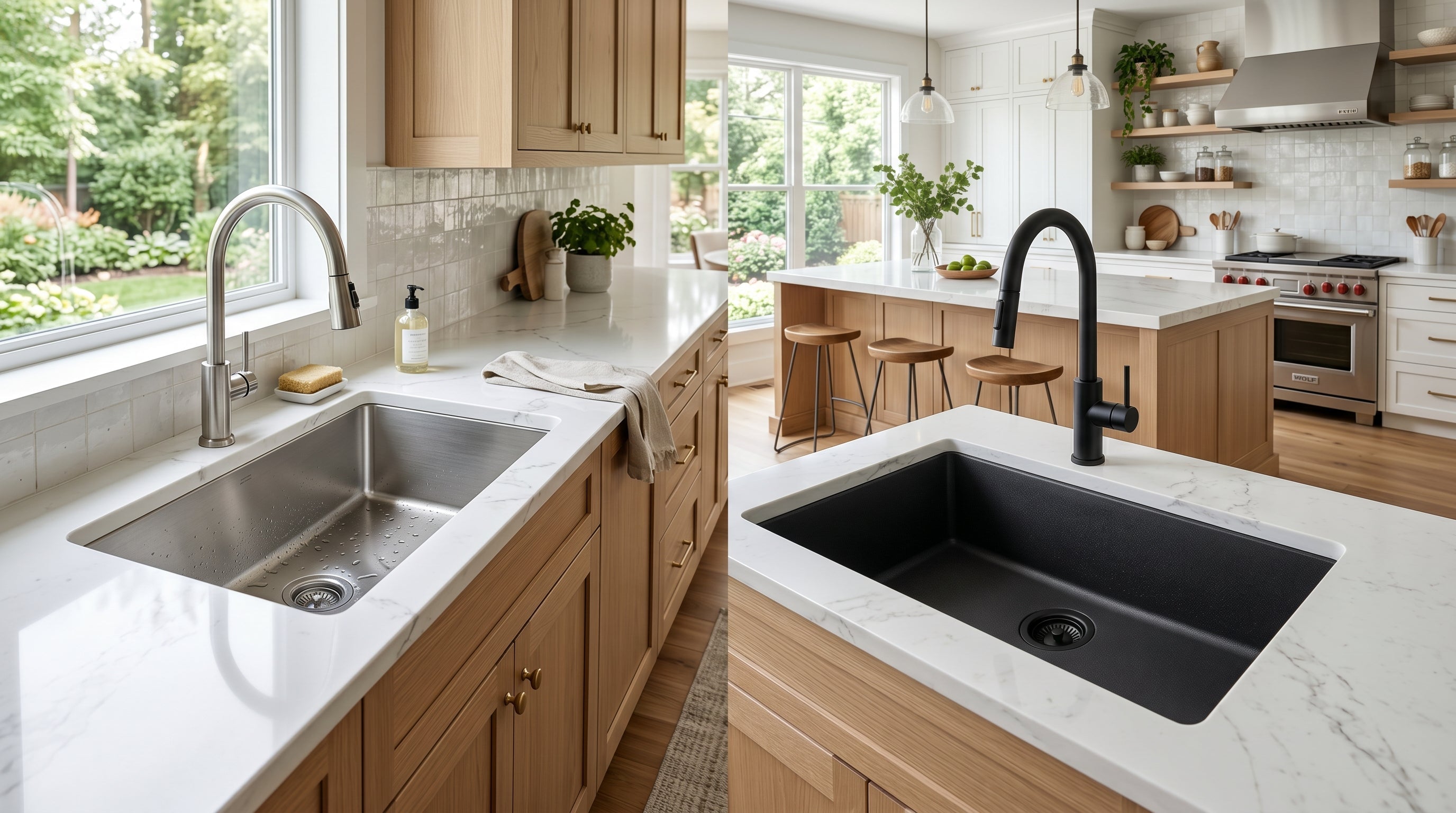
The two materials dominating American kitchen sink installations in 2026 compared across every criterion that matters in daily use - durability, noise, maintenance, heat resistance, color, cost, and ten-year performance. Not a draw. Each wins in specific, definable conditions.
Stainless steel and granite composite account for the overwhelming majority of kitchen sink material decisions in the US market, and it is not because the other options - fireclay, cast iron, copper - are poor. It is because these two materials hit the intersection of durability, price, availability, and design compatibility in a way that no other material does as broadly. Understanding precisely how they differ determines which one is right for your kitchen - and this guide makes that distinction in concrete, testable terms.
The comparison is not clean. Stainless steel wins on some criteria. Granite composite wins on others. Neither is universally superior, and the decision comes down to your kitchen's specific combination of design intent, maintenance preference, household cooking intensity, and countertop material. This guide works through every criterion systematically and ends with a six-question decision tool that produces a clear answer for your specific situation.
A kitchen sink is one of the two or three fixtures in your home you cannot easily swap later. Replacing a sink means cutting a countertop, replumbing the drain, and often modifying the cabinet base - a project that costs $500 to $1,500 in labor and materials on top of the new sink price. Most American homeowners live with their sink choice for 15 to 20 years. This is not a decision to make based on what's on sale or what photographs best. It is a decision to make based on how your household actually uses a kitchen. This guide helps you make it correctly once.
- Budget is $250-$550 for a primary kitchen sink
- You want a workstation sink with an integrated prep ledge system
- Your kitchen has mixed hardware finishes or is not committed to a color palette
- You want the broadest size availability - from 22" compact to 36" wide
- You frequently use heavy cast iron or enameled cookware in the sink
- You're replacing a stainless sink and want zero installation complications
- Your kitchen hardware is matte black or dark and you want the sink to match
- Kitchen noise is a priority - composite is naturally quiet with no pads required
- You place hot pots directly from the stove into the sink regularly
- You want a surface that hides water spots, minor scratches, and wear over time
- Budget extends to $300-$600 for the material quality you want
- You have a Silgranit or BLANCO composite product available from Bathify
Understanding the physical composition of each material explains why the performance differences exist, rather than requiring you to take them on faith from a marketing claim. The differences are not subtle marketing distinctions - they are fundamental material science differences that produce measurably different real-world behaviors.

Stainless steel sinks are formed from sheets of 304-grade stainless steel alloy - a mixture of iron, chromium (minimum 10.5%), nickel, and trace elements. The chromium content creates a passive oxide layer on the surface that resists corrosion and rusting when exposed to water and air. The steel sheet is stamped or drawn into the sink basin shape, with weld seams at the rim and drain. The gauge number - 16, 18, or 20 - describes the sheet thickness: lower number means thicker steel. A 16-gauge sheet is 1.5mm thick. An 18-gauge sheet is 1.2mm. A 20-gauge sheet is 0.9mm. Thickness directly determines rigidity, dent resistance, and the degree to which impact noise propagates through the metal wall.

Granite composite sinks are manufactured by binding crushed granite stone powder - typically 80% by weight - with an acrylic resin binder under high pressure and heat. The result is a solid, non-porous material with the hardness characteristics of stone and the moldability of a composite. BLANCO's proprietary SILGRANIT formulation, available at Bathify, uses quartz sand from the hardest element of natural granite as the base material. The resin binder determines durability over time - higher-quality binders resist UV yellowing and thermal stress cycling better than low-quality alternatives. The finished sink is significantly harder than stainless steel - measured at approximately 7 on the Mohs scale vs. stainless steel's approximately 5.5 - which explains the material's superior scratch resistance.

Stainless steel deforms elastically before failing - it dents rather than cracks. This behavior means that a heavy cast iron skillet dropped directly onto a 16-gauge basin floor will produce a visible dent but will not crack, chip, or fracture the sink. The basin remains fully functional after impact. At 16-gauge, denting requires significant force - a dropped stockpot or heavy object. At 18-gauge, denting occurs more readily and from lighter impacts over repeated use. The practical implication: in households with children who frequently drop heavy items at the sink, or households that use extremely heavy cast iron cookware daily, stainless steel's deform-not-fracture behavior is the more forgiving failure mode. A dent is cosmetic. A crack is structural.

Granite composite is significantly harder than stainless steel under normal daily-use conditions - it resists surface compression from cookware, utensils, and general contact in a way that even 16-gauge stainless cannot match. However, the material's hardness means it responds to extreme impact differently: rather than deforming, composite can crack or chip under a very sharp, concentrated impact - a heavy cast iron pot dropped from height at the basin edge, or a large tool dropped with a point-contact landing. In practice, this failure mode is rare in residential kitchens under normal use. BLANCO's SILGRANIT, available at Bathify, is engineered with an impact resistance that exceeds most composite formulations. For households that cook without extremely heavy-handed treatment of the sink, composite's everyday surface hardness is the superior material property.

Stainless steel does scratch under daily use - this is not a defect, it is the material's normal behavior. A brushed satin finish accumulates directional scratches that align with the existing grain of the brushing, which means the scratch pattern develops into a uniform texture that most homeowners find visually acceptable and that becomes part of the sink's natural patina. The important distinction is finish type: a brushed satin finish (the standard on most quality stainless sinks) hides scratch accumulation far better than a polished mirror finish, where each new scratch is immediately visible against the reflective surface. If your household is rough on kitchen surfaces, specify brushed satin stainless, not polished.

Granite composite is harder than stainless steel - approximately 7 vs. 5.5 on the Mohs hardness scale - which translates directly into significantly better resistance to surface scratching from utensils, cookware, and cleaning tools. The matte surface of most composite sinks additionally conceals light marks and contact traces better than a reflective steel surface. Under microscopic examination, granite composite does accumulate micro-scratches over years of use, but they are not visible to the naked eye under normal kitchen lighting and at normal viewing distances. The practical result for households that frequently use metal utensils at the sink, or that set sharp-edged cookware directly on the basin floor: granite composite is the measurably better material for maintaining visual surface quality over a 10-year period.

Stainless steel is an excellent conductor of sound and vibration. An undampened stainless sink produces a loud metallic ring when items fall into the basin, and a constant audible hiss during high-pressure water use. In an open-plan kitchen where the sink area is in the same acoustic space as the living room and dining area, an undampened stainless sink is noticeably louder than any composite or fireclay alternative. The solution is a two-system sound-dampening specification: spray-on undercoating that covers 70 to 80% of the exterior basin surface, combined with rubber isolation pads at the mounting points. Together, these reduce impact and flow noise by 40 to 60%. The critical purchase note: both systems must be present. Pads without undercoating is partial dampening. Undercoating without pads allows vibration to transmit through the mounting contact points. Specify both when confirming any stainless sink purchase.

Granite composite is a dense, solid material with low acoustic resonance. When items drop into a composite basin, the stone matrix absorbs the impact energy rather than transmitting it through the material as vibration. During water flow, the dense surface generates no sympathetic vibration - there is no metallic hiss and no hollow ring. The result: a granite composite sink in an open-plan kitchen is nearly acoustically invisible during normal use. No sound-dampening pads are required. No undercoating is necessary. The material's inherent density handles noise management entirely, and the kitchen is quieter for it. For households where the sink-area noise bleeds into a living space or an open-plan family room - a significant consideration in the open layouts that dominate American new construction - granite composite's natural silence is a daily quality-of-life advantage.
Stainless steel has no practical upper heat limit under residential kitchen conditions - it handles temperatures far beyond anything a residential oven, stove, or dishwasher produces without structural damage. However, stainless steel conducts heat efficiently, which means placing an extremely hot pot directly on the basin floor will transfer significant heat to the basin wall and drain fitting. This is not a safety concern in normal use, but in kitchens where food safety requires careful temperature management, or where small children interact with the sink, the heat transfer from a just-off-the-stove stockpot left in a stainless basin is worth considering. In terms of thermal shock - the damage that occurs when a very hot surface contacts cold water rapidly - stainless is essentially immune. It handles the thermal differential without cracking or warping.
BLANCO's SILGRANIT granite composite - available at Bathify - is rated to handle temperatures up to 536°F without cracking, discoloring, or warping. This means a Dutch oven pulled directly from a 500°F oven can be placed into the basin immediately without risk of material failure. Beyond the maximum temperature rating, granite composite has significantly lower thermal conductivity than stainless steel - the material does not transfer heat from the placed object to the surrounding basin surface with the same efficiency. This matters practically: a hot pot in a composite basin heats the local contact area, not the entire basin floor. For households that routinely work with high-heat cookware and use the sink as a landing zone for hot items straight from the stove or oven, granite composite's heat handling is the functionally superior specification.

Stainless steel is the lowest daily-maintenance kitchen sink surface available. The cleaning routine is: rinse after each use, wipe dry to prevent mineral deposits. That is the complete protocol for a stainless sink in good condition. No special cleaners are required. No periodic sealing or conditioning is needed. Mild dish soap and a soft cloth handle weekly cleaning. The stainless surface is highly resistant to most kitchen staining agents - coffee, wine, and acidic foods do not permanently stain it. Hard water mineral deposits (white chalky buildup) are the most common maintenance issue and are removed easily with diluted white vinegar applied for five minutes and rinsed thoroughly. The one discipline required: wipe dry after use in hard water areas. Standing water in an undried basin leaves visible mineral circles that require the vinegar treatment to remove. This takes thirty seconds per use.

Granite composite's maintenance profile is finish-color dependent in a way that stainless steel's is not. In dark finishes - matte black and charcoal - the composite surface is extremely forgiving: water spots are invisible, minor food residue disappears with a rinse, and light surface contact marks blend into the dark matte texture. The daily maintenance is comparable to stainless - rinse and wipe - with the additional annual step of applying food-safe mineral oil to the dry basin to restore the matte sheen. In light finishes - white, off-white, and light gray - granite composite requires noticeably more vigilance. Hard water mineral deposits that are barely visible on stainless are starkly visible against a white composite surface. Coffee and tea staining requires prompt rinsing to prevent surface absorption through the resin binder over time. The recommendation is unambiguous: in light-color composite, daily discipline is higher. In dark composite, it's comparable to stainless.

Stainless steel's brushed silver-gray finish is one of the most universally design-compatible fixture materials available in any product category. It pairs with white quartz countertops, dark granite, wood surfaces, concrete, and virtually every cabinet color and style - traditional, transitional, contemporary, industrial, or Scandinavian. It visually aligns with stainless appliances and does not compete with bold countertop or cabinet material choices. For kitchen designs where the countertop or cabinetry is the intended focal point, stainless steel is the sink choice that stays subordinate to the composition and never reads as a clash. The limitation: stainless steel does not provide a color statement. If you want the sink itself to anchor the kitchen's color palette - a black sink against white quartz as a bold, intentional design element - stainless doesn't deliver that impact.

Granite composite is available in the widest color range of any kitchen sink material: matte black, charcoal, anthracite, rock gray, truffle, white, off-white, and several natural stone-inspired tones depending on the manufacturer. BLANCO SILGRANIT sinks at Bathify are available in a broad palette of nature-inspired colors that coordinate with contemporary kitchen trends. This color range enables the granite composite sink to serve as a deliberate design element rather than a neutral fixture - the matte black BLANCO Diamond Super Single against Calacatta quartz, for example, creates a contrast focal point that anchors the kitchen's color narrative. The limitation: committing to a specific composite color means committing the kitchen's visual palette to that choice for the life of the sink. A matte black sink requires hardware, fixtures, and accents that complement rather than conflict with that dominant color.

A 33-inch stainless steel undermount sink weighs 10 to 25 lbs depending on gauge and configuration - light enough for a single person to maneuver during installation and light enough that it places no structural demands on the countertop or cabinet beyond normal fastener load. This makes stainless the most installation-flexible of the two materials: it can be installed in undermount, top-mount, or workstation configurations in standard base cabinets without any structural assessment. Its lower weight also makes it practical for kitchen island installations and butler's pantry sinks where base cabinet construction may be lighter than a primary cabinet run. For retrofit installations where access under the sink is limited, the lower weight of stainless makes single-person handling feasible in a way that composite's heavier equivalent cannot match.

A 33-inch granite composite undermount sink weighs 40 to 80 lbs depending on size and thickness - three to five times heavier than a comparable stainless sink. This weight requires confirming that the base cabinet and countertop support structure can hold the additional load before purchasing. In standard American kitchen base cabinets with a stone countertop and proper undermount clips, this weight is within normal design load tolerances - it is not an extreme demand. However, in older homes with lighter cabinet construction, in island installations with thinner cabinet bases, or in any situation where the countertop is not firmly supported at the sink perimeter, the additional weight should be assessed by a contractor before purchase. A composite sink that fractures a countertop or causes a cabinet to sag due to inadequate support is a $1,500 to $3,000 problem.
Quality 16-gauge stainless steel sinks begin at $300 to $400 for a well-specified undermount single bowl - a price point where composite sinks are typically not available in equivalent quality. At comparable quality levels ($350 to $550), stainless provides 16-gauge construction, full sound dampening, and a lifetime or 10-year warranty - all the specs that determine long-term performance. The ten-year cost of ownership for stainless steel is also low: no special cleaning products are required, no periodic maintenance treatments are needed, and the material does not degrade in a way that requires additional expenditure. The only unpredictable cost is a plumber's visit if the sink develops a leak at the drain fitting or supply connection - an event that is equally probable for composite.
Quality granite composite sinks begin at $300 to $350 at the entry level but reach their best material quality in the $400 to $700 range - specifically BLANCO SILGRANIT products, where the 80% granite stone content and high-quality resin binder produce a material that genuinely outperforms budget composite alternatives. The annual mineral oil conditioning treatment adds approximately $5 to $15 per year to the cost of ownership - negligible. Over a 15-year lifespan, the price premium for granite composite over comparable stainless is typically $100 to $200 for quality-equivalent models. Whether that premium is justified depends on how much you value the color flexibility, noise reduction, heat handling, and scratch resistance advantages that composite provides. For households where those advantages align with real daily-use needs, the premium is clearly justified.
The most useful way to evaluate any kitchen sink material is to project what it looks like after ten years of daily use in a typical American household. Year-one appearance tells you nothing about material quality - every sink looks good on installation day. Year-ten appearance tells you everything.
A 16-gauge stainless steel sink at year ten in an actively used kitchen will show a directional scratch pattern - uniform, grain-aligned surface marks that have developed into a consistent patina. This patina is not damage. It is the material's normal aging trajectory, and most homeowners find it visually acceptable and characterful in a way that a pristine factory finish is not. The basin will not have experienced structural failure, cracking, or corrosion at the surface. The drain fitting and supply connections may require servicing. If adequate sound dampening was installed originally, the acoustic performance will be unchanged. If the sink was specified at 18-gauge rather than 16-gauge, there may be minor denting visible at high-impact areas - this is the most likely visible quality differentiation between a properly specified and an under-specified stainless sink at year ten.
A quality granite composite sink - BLANCO SILGRANIT specifically - at year ten in an actively used kitchen will look visually very close to its installation-day appearance, particularly in dark finishes. The matte surface has not developed visible scratching. The color has not faded or changed. The material has not cracked or chipped under normal residential use. The annual mineral oil treatments have maintained the depth and evenness of the matte finish. In light finishes - white or off-white - the year-ten appearance depends entirely on the daily rinsing discipline practiced by the household. Consistent daily rinsing and prompt attention to hard water deposits produces a surface that looks nearly new. Inconsistent rinsing produces surface staining that may require periodic deep cleaning with a composite-specific cleaner. The light-composite maintenance story at year ten divides sharply between disciplined and casual households.
If you want your sink to look nearly identical at year ten to year one - and you are committed to daily discipline - choose dark granite composite. If you want a sink that ages gracefully and forgivingly with minimal daily maintenance discipline - where the natural patina development is acceptable or even appealing - choose 16-gauge brushed stainless steel. The ten-year performance gap between properly specified versions of each material is not large. The performance gap between a properly specified and an under-specified version of the same material is much larger. 16-gauge stainless and 80% granite composite are the specifications where both materials deliver their ten-year performance promise.
Every product below ships free to the continental US from Bathify. These are not generic category descriptions - they are specific sinks available in the collection with verified material specs.
The BLANCO Diamond Super Single is the standard-bearer for granite composite performance at Bathify. Manufactured using SILGRANIT - BLANCO's proprietary formulation made from quartz sand, the hardest element of natural granite - the Diamond delivers an 80%-plus stone content that places it in the top tier of composite sink durability. The generous single-bowl configuration gives you the full unobstructed basin that the vast majority of American primary kitchens benefit from, sized to fit a standard 36-inch base cabinet. The SILGRANIT surface is non-porous, resists staining and scratching at the level expected from a true stone composite, and handles heavy cookware and high heat without the surface degradation that lower-grade composite materials experience over time. Available in a range of colors at Bathify, including neutral tones that complement contemporary and transitional kitchen designs.
View the BLANCO Diamond Super Single at Bathify →The Performa Cascade takes BLANCO's SILGRANIT composite material and adds an integrated second level inside the basin - a raised platform that creates a separate zone for drying, depositing, and draining dishes while the main bowl remains available for active washing. This two-level design delivers workstation-style functionality in a granite composite material - the combination of composite's noise management and heat resistance with the workflow efficiency of a zone-divided basin. The included colander fits precisely onto the cascade level, creating a dedicated produce-rinsing station above the main drain area. For households that want composite's material advantages without sacrificing the organized prep functionality of a workstation design, the Performa Cascade is the specific product at Bathify that answers both requirements simultaneously.
View the BLANCO Performa Cascade at Bathify →The ERICA delivers 80% natural granite composite construction in a matte black single bowl at a more accessible price point than the BLANCO SILGRANIT range, making it the entry point for dark-finish composite in the Bathify collection. The matte black surface is the specific configuration that drives the majority of granite composite sink purchases in the US market currently - the finish that defines contemporary American kitchen design in 2025 and 2026. The ERICA includes a strainer, fasteners, and a cutting template for installation. Note the made-to-order lead time of 4 to 6 weeks for this product - plan your purchase timeline accordingly if the ERICA is part of a broader kitchen renovation with a scheduled installation date.
View the ERICA Granite Sink at Bathify →The BLANCO Quatrus R0 represents the stainless category at Bathify with the precision and build quality that distinguishes German-engineered fixtures from their volume-production alternatives. The zero-radius corners - right-angle interior corners rather than the rounded corners that appear on most consumer stainless sinks - maximize usable basin floor area and create the architectural, minimalist profile that defines contemporary stainless aesthetics. At 22 inches, the Quatrus R0 is specifically dimensioned for compact applications - kitchen islands, butler's pantries, and smaller kitchens - where a standard 33-inch sink would be over-scaled. The BLANCO limited lifetime warranty covers this sink against manufacturing defects, and the Quatrus is designed to be paired with BLANCO's accessory system of floating grids, colanders, cutting boards, and drying mats for full workstation functionality.
View the BLANCO Quatrus R0 at Bathify →| Criterion | Stainless Steel | Granite Composite | Winner |
|---|---|---|---|
| Impact resistance | Dents - does not crack; 16-gauge resists denting well | Harder daily surface; chips under extreme sharp impact (rare) | SS for heavy impact households |
| Scratch resistance | Scratches - brushed finish develops uniform patina | Harder (Mohs 7 vs 5.5); scratches are nearly invisible | Granite composite |
| Noise management | Loud without dampening; 40-60% reduction with full pads + coating | Naturally quiet - no dampening required | Granite composite |
| Heat resistance | Unlimited temp resistance; conducts heat from hot items | 536°F rated; lower thermal conductivity | Granite composite |
| Stain resistance | Excellent - easy wipe-down, no special products | Excellent in dark; light colors show mineral deposits | SS overall; composite dark colors tied |
| Daily maintenance | Lowest maintenance of any sink material | Low in dark colors; medium in light colors | Stainless steel |
| Color options | Brushed silver only (various brush textures) | Black, charcoal, gray, white, stone tones - widest range | Granite composite |
| Design compatibility | Universal - works with any hardware and kitchen style | Best when kitchen palette is committed to that color | SS for neutral; GC for color statement |
| Weight | 10-25 lbs - installation-flexible | 40-80 lbs - verify cabinet support | Stainless steel |
| Installation complexity | Standard - DIY-friendly in undermount and top-mount | Standard but heavier; professional recommended for large models | Stainless steel |
| Price range (quality) | $300-$550 for quality 16-gauge undermount | $350-$700 for quality SILGRANIT/80% composite | SS for budget; tie at $400+ |
| Workstation availability | Widely available in workstation format | Limited - BLANCO Performa Cascade available at Bathify | Stainless steel |
| 10-year appearance | Uniform scratch patina - natural aging, broadly acceptable | Near-new in dark colors with basic maintenance | Granite composite (dark finishes) |
| Repair / replacement | Cannot buff out dents or scratches - cosmetic only | Cannot repair chips invisibly - structural issue if it occurs | Tie - neither is reparable to invisible standard |
Stainless steel wins on versatility, maintenance, and price. Granite composite wins on color, noise, heat resistance, and scratch resistance in households where those advantages align with real daily use.
The correct choice between these two materials is not about which is objectively better - it is about which advantages your household actually uses. A household that cooks in a closed kitchen, uses mixed hardware finishes, drops heavy cast iron into the sink regularly, and values minimum daily maintenance discipline should choose 16-gauge stainless steel with full sound dampening. It handles every condition well, costs less, installs more easily, and delivers 15 years of reliable performance without a single maintenance protocol beyond rinsing and wiping.
A household in an open-plan kitchen with committed matte black hardware, that frequently places hot cookware directly into the sink, and that is willing to follow a daily rinse discipline - should choose BLANCO SILGRANIT granite composite in black or charcoal. It will be quieter in the living space, more visually intact at year ten, more forgiving of heat, and more resistant to surface scratching. The $50 to $150 price premium over comparable stainless is earned by those specific advantages in those specific conditions.
The materials where this decision goes wrong: 18-gauge stainless (under-specified regardless of price), light-color granite composite for a household without daily maintenance discipline, and budget composite with less than 75% stone content (functionally closer to painted plastic than to stone). Get the specification right for whichever material you choose, and either will serve you reliably for the life of your kitchen.
Shop stainless and granite composite sinks at Bathify
Browse BLANCO SILGRANIT, granite composite, and stainless steel kitchen sinks - all with free shipping on orders over $50 to the continental US.


