







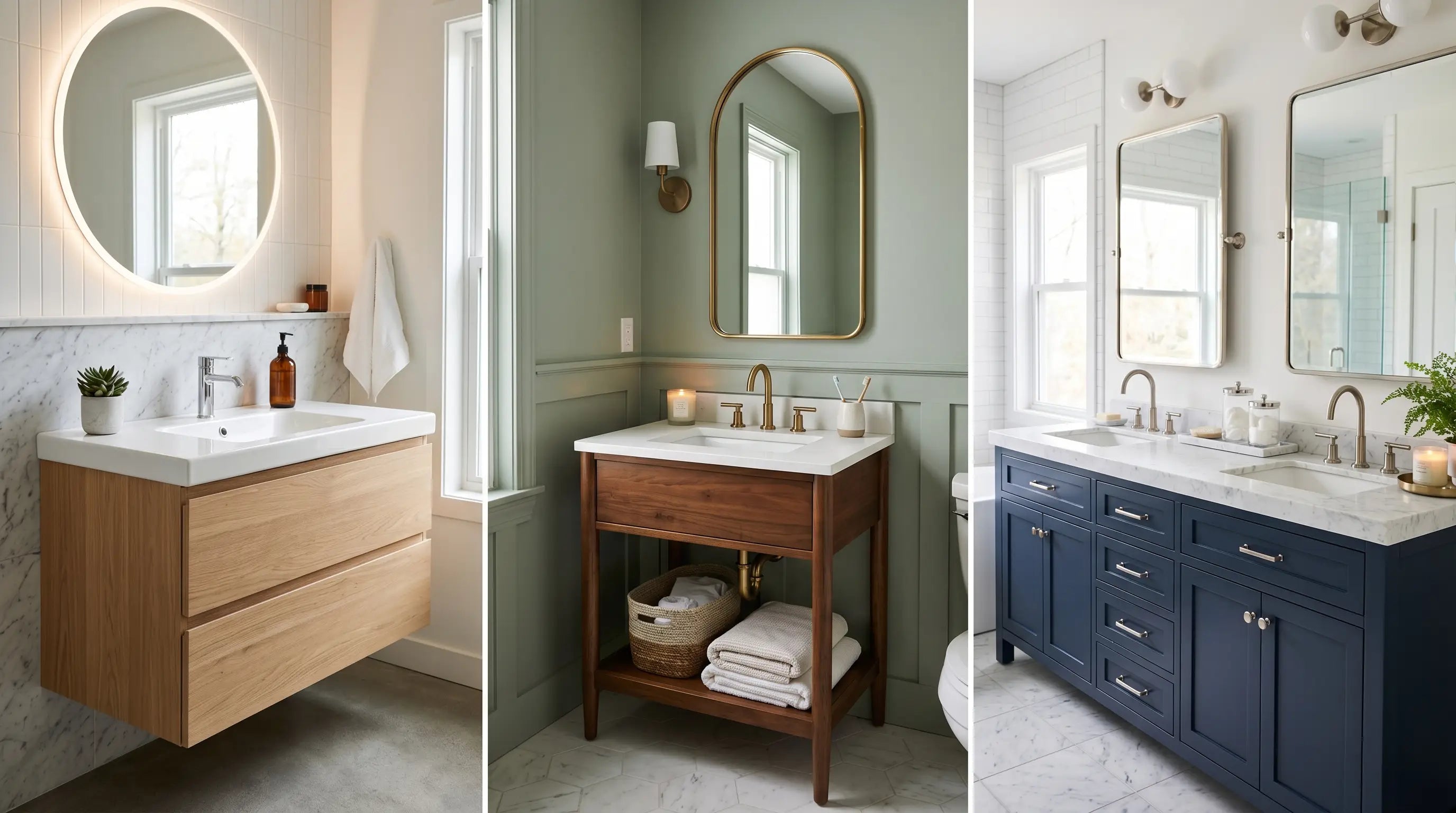
The bathroom vanity is the most complex single purchase in any bathroom renovation - it determines storage, style, plumbing layout, and daily usability all at once. This guide covers every decision, in the right order, so you get it right the first time.
The bathroom vanity is often the last thing homeowners think to research carefully - and the thing they most regret getting wrong. Unlike tile or paint, a vanity is a structural installation: replacing it means disconnecting plumbing, patching walls, and starting over. Getting the size, type, material, and style right the first time saves thousands of dollars and years of frustration.
This guide walks through every decision in the order it actually matters. Most people start with aesthetics - they fall in love with a style online and then try to fit it into their bathroom. The right approach starts with the space, the plumbing, and the use case, and arrives at style last. Follow the steps in order and you won't waste a single measurement or purchase decision.
The global bathroom vanities market reached $43.15 billion in 2025, nearly doubling by 2035, driven by one consistent force: American homeowners continue investing in bathrooms at record rates because the returns are real. Mid-range bathroom remodels recoup approximately 80% of cost at resale per Zillow's 2026 data - among the top three interior renovation returns available. The vanity is typically 20–30% of total bathroom renovation spend and carries disproportionate influence over buyer perception. Getting it right isn't just about your own daily experience. It's one of the most financially rational home decisions you can make.
Every vanity decision flows from four spatial measurements. Measure these before looking at a single product, because these numbers are your hard constraints. A vanity that doesn't fit isn't a style preference - it's a non-starter.
Available wall width. Measure the width of the wall space where the vanity will sit, from whatever stops it on each side - a wall corner, a door frame, the toilet clearance zone, or a window casing. This is your absolute maximum vanity width. Subtract 1–3 inches from each side to allow for installation and visual breathing room.
Available depth. Measure from the wall to the point where the vanity would interfere with door swings, shower door clearances, or traffic flow. Standard vanity depth is 21–22 inches for the cabinet plus approximately 1 inch for the countertop overhang. Shallow vanities (16–18") are available for tight spaces. The NKBA recommends a minimum of 30 inches of clear floor space in front of the vanity - measure from the planned vanity front to the nearest obstacle.
Plumbing rough-in location. Photograph or note where the drain centerline sits relative to each side wall, and the height of the hot and cold supply lines. Moving drain plumbing costs $500–$1,500+ depending on the installation. Most budget decisions favor keeping the plumbing where it is - which means the vanity must accommodate it, not the other way around.
Toilet clearance. Standard building codes require at least 18 inches from the centerline of the toilet to the edge of any adjacent fixture or cabinet. NKBA recommends a minimum of 15 inches from the toilet centerline to the nearest vanity edge. Measure this now.
Write down these four numbers before visiting any store or website: available wall width, available depth, drain centerline distance from left wall, and toilet-to-nearest-obstacle clearance. These numbers make 80% of vanity models immediately appropriate or immediately eliminated - saving you hours of browsing and the most common buyer's error (ordering a vanity that physically won't fit or requires moving plumbing).
The choice between a wall-mounted (floating) and floor-mounted (freestanding) vanity is not primarily an aesthetic decision - it's a structural and installation one. Both have clear strengths. The right choice depends on your wall construction, your bathroom's size, your installation budget, and the look you're designing toward.
Mounts directly to the wall with no floor contact. Creates an open, airy appearance that visually expands smaller bathrooms. Growing 15–20% year-over-year in popularity and the dominant style choice for contemporary and modern bathrooms in 2026.
Fully customizable: 32–36" from floor is typical, but can be set to any height for accessibility or user preference. This is floating's most practical advantage over freestanding.
Must anchor to wall studs or solid blocking. 2×6 or 2×8 blocking inside the wall is the professional standard. Cannot be wall-mounted into drywall alone - the weight requires structural backing.
Sits on the floor, either with legs or a toe-kick. The most familiar vanity type in American homes. In 2026, freestanding vanities are trending toward a "furniture" aesthetic - pieces with decorative legs and heirloom profiles that feel collected rather than built-in.
Standard 32–36" from floor. Vessel sink installations may use a 28–30" cabinet to compensate for the elevated basin. Height is fixed at manufacture; cannot be customized post-installation.
Easier installation than floating - no structural wall preparation required. Connects to existing plumbing supply lines and drain with standard plumbing connections. More accessible for DIY installation.
- Visually expand a small or medium bathroom
- Set a custom height for your household
- Achieve a contemporary or modern aesthetic
- Make floor cleaning easy (robot vacuums accessible)
- Add LED under-cabinet lighting effect
- Walls without studs or blocking in the right location
- Rental property (wall modification not permitted)
- Budget installation without professional wall prep
- Heavy vanity (above 150 lbs) needing special blocking
- Primary bathroom needing maximum under-counter storage
The most common floating vanity installation failure is insufficient wall backing. Before ordering a floating vanity, verify that studs are present in the right location, or that your contractor will install horizontal blocking between studs specifically to support the vanity. A floating vanity with inadequate wall support will fail - often pulling drywall with it. If wall structure is uncertain, a freestanding vanity is the safer and often the better value choice.
Six in ten homeowners say they want a double vanity, according to NKBA's 2025 data. But the right answer depends on one question: how many people use this bathroom simultaneously in the morning? If the answer is two or more, a double sink is genuinely worth the added cost. If the answer is one at a time, a single sink with a wider countertop is almost always a better functional choice.
Double sink vanities start at 60" wide - which requires a minimum 66–72" of wall space (with clearances). A 60" single-sink vanity offers roughly 45–50 inches of usable countertop versus 25–30 inches per person in a double-sink version of the same width. The single-sink 60" vanity also provides more drawer storage, since the center drain doesn't interrupt the best drawer positions.
- Two people regularly get ready at the same time
- You have a dedicated primary bathroom for a couple
- You have 60"+ of available wall space with clearances
- Plumbing can accommodate two drain/supply lines without major rerouting
- Resale value in your market rewards double sinks (primary bath)
- Only one person uses the bathroom at a time
- You prioritize countertop space over simultaneous use
- Budget is tight - double sinks add $500–$2,000 in plumbing costs
- Wall space is under 60" (double not feasible)
- Powder room or guest bath (single always appropriate here)
Adding a second sink to a bathroom that currently has one means adding a second drain, second P-trap, and two additional supply lines. In most existing bathrooms, this requires moving the existing drain or adding a new stub-out - costs range from $500 to $1,500+ depending on how accessible the plumbing is. If the bathroom already has rough-in for two sinks (common in primary baths of newer homes), the upgrade is straightforward. If it doesn't, factor this into your true cost comparison between a 60" single-sink and 60" double-sink vanity.
Standard vanity widths in the US market range from 18" to 72". Here's how to match the right size to the right bathroom type. The most popular category - 38 to 47 inches - accounts for 43.88% of all bathroom vanity sales, per Grand View Research's 2024 market data. This range hits the sweet spot between storage capacity and fit in the majority of American bathrooms.
Height. Standard vanity height is 32-36 inches from floor to countertop surface. The NKBA recommends a range of 32-43 inches to match user height and habits. Modern "comfort height" vanities at 36" are increasingly popular because they reduce back strain for average adults. If the household includes children, consider a lower height or a dedicated step platform.
Depth. Standard vanity cabinet depth is 21–22 inches, with the countertop adding approximately 1 inch of overhang. Shallow-depth vanities (16–18 inches) are available for tight spaces. Verify depth will not block door swings before ordering.
The cabinet box material is the single most important quality indicator in any bathroom vanity. It determines whether the vanity lasts 5 years or 25 in the most humidity-intensive room in the home. Trend data shows 72% of upgrading homeowners choose solid wood, per recent market research - because they've seen what happens to cheaper alternatives in bathroom conditions.
| Cabinet material | Humidity resistance | Typical lifespan | Best used for | Verdict |
|---|---|---|---|---|
| Solid hardwood | HIGH (with proper sealing) | 20–40 years | Primary baths; investment-quality vanities | Best choice |
| Plywood (furniture-grade) | HIGH - more stable than solid wood in humidity | 15–25 years | Any bathroom; mid-range to premium | Excellent choice |
| MDF (medium-density fiberboard) | MODERATE - swells with moisture if not sealed | 5–12 years (bathroom) | Powder rooms; low-humidity guest baths only | Use with caution |
| Particleboard | LOW - absorbs moisture, swells, and delaminates | 3–7 years (bathroom) | Budget builds; not recommended for primary baths | Avoid |
| PVC / thermofoil | VERY HIGH - fully waterproof | 10–20 years | High-humidity bathrooms; rental properties; wet zones | Good for humid spaces |
| Metal (stainless / aluminium) | VERY HIGH - corrosion-resistant | 20+ years | Industrial / contemporary styles; high-use shared baths | Specialty choice |
To test vanity construction quality before purchasing: open a door and look inside the cabinet box at the corner joints. Dovetail drawer joinery and mortise-and-tenon corner construction indicate solid wood or quality plywood manufacturing. Visible particle or sawdust grain at cut edges indicates particleboard or low-grade MDF. A cabinet that looks premium from the outside can reveal its true material quality in seconds with this test. James Martin Vanities and similar premium-tier brands make this distinction visually obvious - it's worth inspecting in person when possible.
The countertop is what you look at, touch, and clean every day. Material choice determines maintenance requirements, visual impact, and how well the surface holds up to cosmetics, water, and cleaning products. Engineered quartz is the #1 choice for bathroom vanities, selected by 42% of renovating homeowners per market data, followed by natural quartzite (20%), granite (15%), and marble (13%).
| Countertop material | Porosity | Maintenance | Typical cost range | Best for |
|---|---|---|---|---|
| Engineered quartz | Non-porous (sealed in manufacture) | Wipe clean; never needs sealing | $50–$120 per sq ft | Any bathroom; best overall value |
| Marble (natural) | Porous - requires regular sealing | Seal every 6–12 months; etches from acids | $60–$200+ per sq ft | Master baths; luxury aesthetic; low-traffic use |
| Granite (natural) | Low porosity - seal at installation | Seal annually; scratch-resistant | $40–$120 per sq ft | Family bathrooms; heavy-use surfaces |
| Solid surface (Corian-type) | Non-porous | Scratches can be sanded out; no sealing | $35–$80 per sq ft | Family bathrooms; kids' baths; easy DIY repair |
| Concrete | Porous without sealing | Seal regularly; prone to staining if unsealed | $70–$150 per sq ft | Industrial / modern design bathrooms |
| Wood (sealed) | Porous - needs marine-grade sealing | Re-seal every 1–2 years; avoid standing water | $50–$200 per sq ft | Statement vanities; dry-use areas near sink |
| Porcelain / ceramic tile | Non-porous (tile itself); grout is porous | Grout sealing; avoid cracking at joints | $15–$60 per sq ft installed | Budget bathrooms; matching tile walls |
Vanity with top included: More convenient and typically less expensive overall. The countertop comes pre-cut for the sink, pre-drilled for the faucet, and is engineered to fit the specific cabinet. Limits countertop material choice - usually only one or two options per vanity.
Vanity without top (cabinet only): Allows complete freedom of countertop and sink selection. Requires separate measurement for the countertop slab, sink cutout, and faucet drilling. Adds cost and complexity but enables a fully custom result. The countertop should be 1 inch wider and 1 inch deeper than the cabinet for overhang.
Style is the decision that comes last in the buying process - but it's the one most homeowners start with. Once space, mount type, sink count, size, and materials are determined, style narrows the field considerably and becomes a much easier decision.
Clean lines, flat-front doors, minimal hardware, and integrated storage. Colors stay neutral - white, warm off-white, light oak, walnut, or muted sage and terracotta in 2026. Hardware is either hidden or extremely minimal. The dominant style for urban apartments, new construction, and any bathroom designed to feel intentionally spa-like. Floating vanities are nearly always the right pairing for this style.
The most commercially popular style in American bathrooms - it bridges traditional and modern without committing fully to either. Shaker-style doors, subtle hardware, quartz countertops, and neutral color palettes define the category. Transitional vanities age well, coordinate with the widest range of tile choices, and tend to deliver the strongest resale value because they appeal to the broadest buyer audience.
The 2026 version of traditional vanities leans toward what designers call the "furniture aesthetic" - pieces with decorative legs, heirloom profiles, and materials that feel collected rather than installed. Think warm wood tones, antique brass hardware, and detailing that references period furniture rather than utilitarian bathroom cabinetry. These vanities work equally well floating or freestanding.
Apron-front sinks, shaker-style doors, natural wood tones, and oil-rubbed bronze or vintage brass hardware. A strong design statement that works in homes with farmhouse or transitional architecture. Tends to be freestanding rather than floating, with exposed legs or a toe-kick finish.
In 2026, warm metals have overtaken matte black as the leading hardware finish. Brushed brass, champagne bronze, and polished nickel are the dominant choices for contemporary and transitional bathrooms. The rule remains the same as always: choose one finish and apply it consistently to every metal surface in the bathroom - faucet, pulls, light fixtures, towel bar, and toilet paper holder.
Brushed brass / champagne bronze: The fastest-growing finish in bathroom design. Works with warm wood vanities, marble countertops, and earth-tone walls. Pairs with white oak and walnut vanity tones particularly well.
Matte black: Still strong in contemporary bathrooms, particularly with white or light-gray tiles. Better at hiding fingerprints than polished finishes. Trending downward slightly as warm metals rise, but far from gone.
Brushed nickel: The most versatile and enduring choice. Coordinates with virtually any tile, paint color, or vanity finish. The safest option for homes planning to sell within 3–5 years.
Polished chrome: Timeless and clean. Shows water spots and fingerprints more than matte finishes. The right choice for traditional and transitional bathrooms coordinating with chrome plumbing fixtures.
The pulls and knobs on a bathroom vanity are the "jewelry moment" - replacing builder-grade hardware is one of the highest-impact, lowest-cost upgrades available. In 2026, heavier pulls with weighty, satisfying tactile quality are replacing thin, stamped hardware. Look for hardware with a comfortable edge radius (no sharp corners), a hand feel that signals quality (solid brass vs. hollow zinc), and a finish that matches your faucet from the same product family.
The most effective low-cost vanity upgrade: replace the factory hardware with a quality set of solid brass pulls in a coordinated finish. New hardware that coordinates with your faucet transforms even a budget vanity into something that reads as intentionally designed. Budget $3–$12 per pull/knob × the number of doors and drawers. On a 60" double vanity with 4 drawers and 4 cabinet doors, replacing hardware costs $50–$120 and delivers a disproportionate visual improvement.
Eight in ten homeowners explicitly seek vanities with customizable storage modules, per NKBA 2025 data. Yet most people underestimate how much the drawer and door configuration affects daily usability. A beautiful vanity with poor storage layout leads to cluttered countertops and frustration within weeks of installation.
Drawers are universally more functional than cabinet doors for daily-use bathroom items. They provide full visibility of contents without requiring you to kneel or reach into a dark cabinet space. Deep drawers accommodate bottles upright; shallow drawers organize flat items like makeup. The best vanities provide three categories of drawer depth: shallow (2–4" for jewelry and small items), medium (5–7" for daily skincare products), and deep (10"+ for hair tools and bottles).
Cabinet doors are most appropriate for under-sink plumbing access - where the P-trap and supply lines prevent useful drawer installation - and for storing bulk items like spare towels, cleaning supplies, and backup products.
Soft-close drawer glides are non-negotiable for any vanity above the budget tier - they prevent slamming, extend hardware life, and feel qualitatively different from standard slides every single time you use them. Built-in electrical outlets inside the cabinet for hair tools are increasingly standard in 2026 premium vanities. Nine in ten designers cite lighting quality as a critical vanity area consideration, making integrated LED cabinet lighting increasingly worth the premium in primary bathroom installations.
In double-sink vanities, the drain and P-trap beneath each sink occupy significant under-cabinet space - usually eliminating the best drawer positions directly beneath each basin. Look for "plumber-friendly" double vanity designs that locate drains toward the sides or rear of the cabinet, preserving center drawer capacity. An offset sink design on a single-sink vanity also maximizes counter space on one side and drawer space below the extended cabinet run on the other.
Bathroom vanity prices range from under $200 to over $10,000. The difference isn't always visible at a glance - but it shows up over time in material failure, hardware degradation, and the daily experience of using a well-made versus poorly-made cabinet. Here's what to expect at each tier.
Particleboard or lower-grade MDF box construction; standard hardware finishes (chrome or brushed nickel only); limited style selection; vanity-with-top combos only. Appropriate for: powder rooms, rental properties, guest bathrooms with very light use, and any situation where a 5–8 year lifespan is acceptable. Installation is typically DIY-friendly.
Plywood or quality MDF construction; full range of styles and finishes; soft-close hardware; better hardware quality; more countertop material options. The sweet spot for most primary guest bathroom installations. This tier represents the best value-to-quality ratio and is the category most associated with the 70–80% ROI data from remodeling reports. Most Bathify vanities are positioned in this tier.
Solid hardwood or premium plywood box; dovetail drawer joinery; genuine stone countertops; premium hardware in all finishes; semi-custom sizing options. For primary bathrooms that see daily use by multiple people and where both quality and aesthetics are priorities. James Martin Vanities sits at the high end of this tier as the "gold standard" for American-made pre-assembled vanities.
Fully custom sizing, wood species, finish, door style, and hardware. Built by cabinetmakers for a specific space. No compromises on any dimension. Appropriate for renovation budgets where the bathroom is a primary investment area or for architecturally distinctive spaces where standard sizing doesn't work.
Labor costs for vanity replacement range from $665 to $3,300 per project (This Old House, 2025), depending on complexity. A simple vanity swap in an existing bathroom with no plumbing changes runs $665–$1,200 in labor. Moving plumbing adds $500–$1,500+. A floating vanity installation requiring wall blocking preparation adds $300–$700. Budget 30–40% of the vanity purchase price for professional installation in most scenarios.
Floating vanities with LED underlighting. Floating vanities are growing 15–20% year-over-year. The addition of LED strip lighting beneath the cabinet - casting a soft ambient glow on the floor - has become the signature contemporary bathroom move. Functionally, it also provides a dim nighttime orientation light.
Warm wood finishes (white oak and walnut). Natural wood-faced vanities are outpacing painted options in designer specifications for the first time in a decade, per NKBA 2026 survey data. White oak in particular - with its consistent grain and warm honey tone - is the most specified natural wood finish in new construction and renovation.
Warm earth-tone colors. The cool-gray era is officially over. Sage green, forest green, terracotta, warm taupe, and deep navy are the leading color choices for 2026 painted vanities. Sherwin-Williams named Universal Khaki as their 2026 Color of the Year - a warm, organic beige-yellow that works as a vanity color with warm hardware.
Fluted and textured door fronts. Fluted (reeded) wood panels on vanity doors create dimension, shadow, and artisanal craft without relying on loud color or ornate detailing. This is the "quiet luxury" move in bathroom design - a texture that reads as expensive without announcing itself.
Smart technology integration. Built-in USB-C charging ports inside drawers, LED-lit interiors that activate when doors open, and anti-fog LED mirrors are transitioning from luxury features to standard expectations. Eight in ten homeowners demand integrated power outlets within vanity cabinets, per NKBA 2025.
All-white bathrooms with white vanities and polished chrome hardware. Cool gray painted vanities with blue undertones. Barn-door styled vanity hardware. Overly intricate traditional ornamental detail that reads as period reproduction rather than contemporary interpretation.
This pillar guide gives you the framework for every decision. Each supporting guide below covers one specific topic in full detail - with exact measurements, product comparisons, and expert buying criteria.
- Available wall width measured; subtract 1–2" for clearance; note maximum vanity width
- Available depth measured; verify door swings won't interfere; note NKBA 30" clear floor space in front
- Drain centerline measured from both side walls; note if plumbing can stay in place
- Toilet clearance measured; minimum 18" from cabinet edge to toilet centerline (15" min per NKBA)
- Mount type decided: floating (verify wall blocking available) or freestanding
- Sink count decided: single (under 48" or single-user) or double (60"+ wall space, two simultaneous users)
- Vanity-with-top vs. cabinet-only decided
- Width selected (18"–72" range; 36" most common single; 60" most common double)
- Height selected (32–36" standard; 36" "comfort height" most popular)
- Depth verified (21–22" standard; 16–18" shallow option for tight spaces)
- Cabinet material verified: solid hardwood or furniture-grade plywood preferred for primary baths
- Countertop material selected: quartz recommended for lowest maintenance; marble for premium aesthetic
- Style identified: modern, transitional, traditional, farmhouse - coordinates with existing tile and architectural style
- Hardware finish chosen first: brushed brass, brushed nickel, matte black, or polished chrome - all hardware in bathroom must match
- Drawer configuration reviewed: deep drawers preferred over cabinet doors for daily-use items
- Soft-close hardware confirmed (mandatory above budget tier)
- Under-sink plumbing clearance verified for double vanities (P-trap and supply line positions)
- Total budget planned: vanity + countertop + installation + plumbing (if moving) + accessories
- Installation method confirmed: DIY (freestanding, basic swap) or professional (floating, plumbing changes)
- Lead time checked: in-stock vs. special order (4–12 weeks for custom)
Shop Bathroom Vanities at Bathify
Single and double sink vanities in every size, style, and finish - from 18" powder room options to 72" master bath statements. Expert guidance available. Free shipping on orders over $50.


