







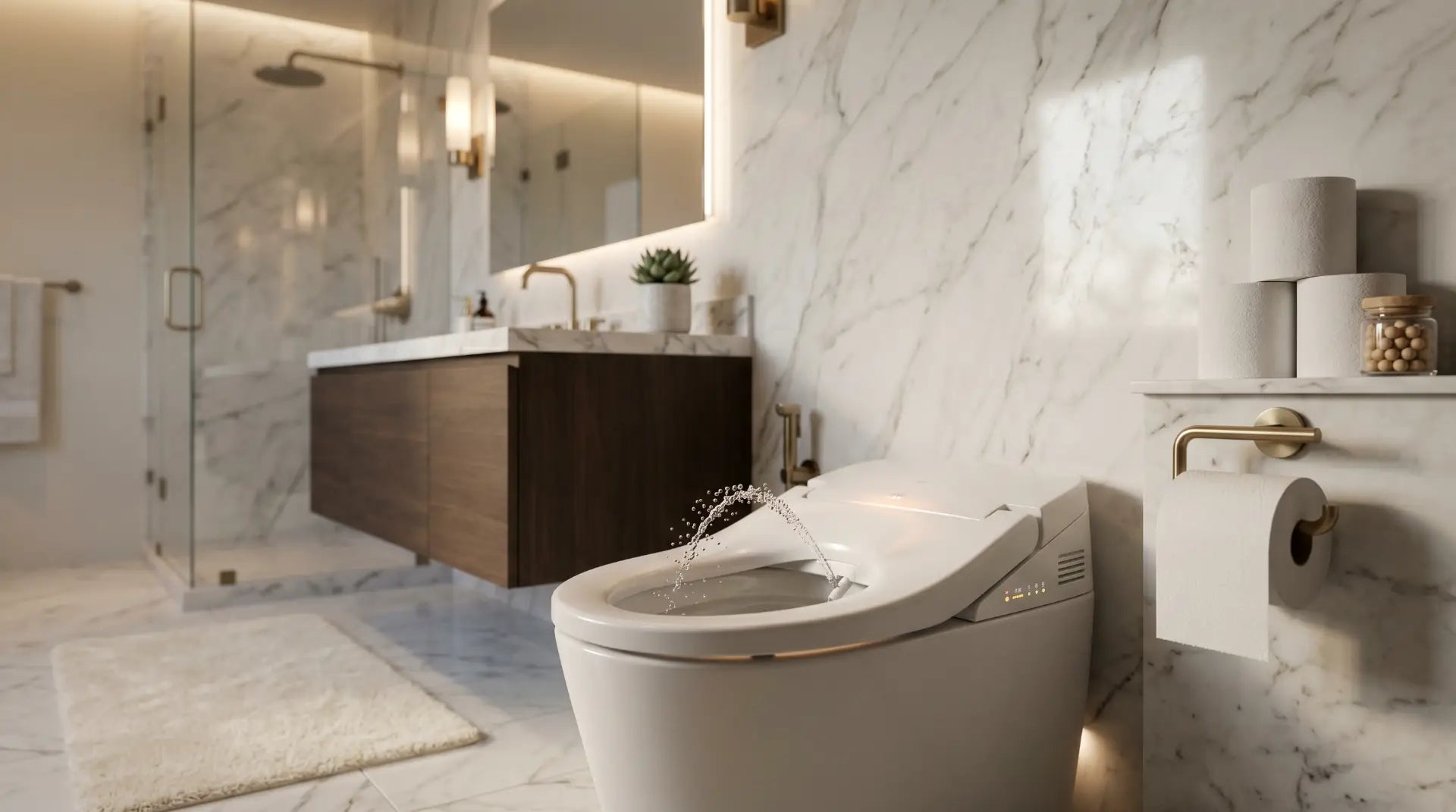
Bidets have been the norm in Japan and Europe for decades. Americans are finally catching on - but the decision deserves more than hype. Here is the honest comparison: real cost math, what the hygiene science actually says, the environmental numbers, and a straight answer on who should switch.
- The Real Question Nobody Asks First
- Quick Comparison: Bidet vs. Toilet Paper at a Glance
- The Cost Math: What You Actually Spend Per Year
- Hygiene: What the Evidence Actually Says
- Environmental Impact: The Water Numbers That Surprise Everyone
- Types of Bidets: Which One Fits Your Bathroom & Budget
- The Real Objections, Addressed Honestly
- Who Should Switch - and Who Probably Shouldn't
- What to Look for When Buying a Bidet Seat or Attachment
- Pre-Purchase Checklist
- Frequently Asked Questions
- More From This Series
The bidet debate in the US tends to get stuck at the surface level - cultural awkwardness, vague claims about "better hygiene," and influencers promising you'll never go back. None of that helps you make a decision. The more useful framing is this: a bidet is a plumbing fixture with a specific function, a specific cost, specific installation requirements, and specific benefits that are measurable. Toilet paper is a consumable with an ongoing cost, a significant environmental footprint, and real limitations as a cleaning method.
This article treats both the same way you'd evaluate any household purchase - with numbers, sourced evidence, and honest acknowledgment of where the data supports the claim and where it doesn't. If you are considering a bidet seat or attachment for your toilet, this is the information you actually need to make the call.
For most US households, a non-electric bidet attachment pays for itself within months, reduces toilet paper spending by 75-80%, and provides a genuinely more thorough clean than wiping alone. The caveats are real: cold water on entry-level models takes some adjustment, shared bathrooms require user flexibility, and the medical evidence for specific health benefits is promising but not yet conclusive. The decision is not complicated once you see the actual numbers.
The financial case for a bidet is the clearest part of this comparison. Toilet paper is an invisible expense - most households don't track it - but the annual numbers are significant, and the bidet payback period is short enough to matter for most budgets.

The average American adult uses approximately one roll of toilet paper per week - about 50 rolls per year. At mid-tier pricing of $0.80-$1.20 per roll, that is $40-$60 per person annually. Premium brands push this higher. For households buying 2-ply quilted rolls in bulk, the actual per-roll cost is often $1.00-$1.40, which means a single person spending carefully still reaches $50-$70 per year, and a family of four reaches $200-$400 depending on paper quality and usage habits.
These numbers may seem modest individually, but they compound over time. A family spending $300 per year on toilet paper will spend $3,000 over a decade - a figure that changes the calculus on a $50 bidet attachment considerably.
| Household Size | Rolls / Year | Annual TP Cost (Mid-Tier) | Annual TP Cost (Premium) | 10-Year Total |
|---|---|---|---|---|
| 1 person | ~50 rolls | $40-$60 | $70-$100 | $400-$1,000 |
| 2 people | ~100 rolls | $80-$120 | $140-$200 | $800-$2,000 |
| 4 people | ~200 rolls | $160-$240 | $280-$400 | $1,600-$4,000 |
| 6 people | ~300 rolls | $240-$360 | $420-$600 | $2,400-$6,000 |
The math below uses conservative assumptions: a $50 non-electric attachment, 75% reduction in toilet paper use (most bidet users still keep a small amount for pat-drying), and negligible water cost addition (~$4-$6/year for a family of four at typical US municipal water rates).
The water cost of bidet use is frequently overstated as an objection. Each bidet rinse uses approximately 1/8 gallon of water. At 2 uses per day per person and US average water rates of $0.004-$0.010 per gallon, the annual water cost per person is roughly $0.60 to $1.46. For a family of four, add $2.40 to $5.84 per year in water costs. This is not a meaningful expense - it is less than the cost of two rolls of toilet paper.
A non-electric bidet attachment has a payback period of 3-4 months for a family of four and 8-12 months for a single person. After that, the household saves $75-$300 per year indefinitely, depending on household size and paper quality. Electric bidet seats ($300-$800) take 2-5 years to recoup their cost, but the comfort and feature advantages are proportionally higher. The cost argument for bidet adoption is one of the strongest in bathroom fixture purchasing and is largely independent of any hygiene or environmental argument.
The hygiene argument for bidets is made frequently and often without nuance. Here is the state of the evidence as of 2026, including where it supports bidet use and where it does not.

Water removes more residue than dry wiping. This is the most basic and well-supported point. Wiping with dry paper smears fecal material across the skin surface rather than removing it. Water rinsing carries material away from the body. This principle underlies why surgeons wash their hands rather than wipe them, and it applies the same way in anal cleansing. Studies measuring residual bacteria after bidet use versus toilet paper use consistently find lower bacterial counts after water cleaning.
Reduced skin friction and irritation. Toilet paper - especially lower-quality paper - causes mechanical friction on perianal skin that can irritate, abrade, and over time contribute to skin breakdown. For individuals with hemorrhoids, anal fissures, inflammatory bowel disease, postpartum recovery, or sensitive skin, the reduction in friction from bidet use is a tangible comfort benefit. Dermatologists frequently recommend bidets for patients with these conditions, not as a treatment but as a way to reduce ongoing irritation during healing.
Reduced UTI risk for women (theoretical, emerging evidence). Fecal bacteria - particularly E. coli - is the leading cause of urinary tract infections in women, typically introduced through wiping from back to front or through contamination of the perineal area. A bidet's front-wash nozzle, directed front-to-back, cleans the area with water rather than redistributing bacteria with paper. The logical case is sound, though large-scale randomized controlled trials specifically linking bidet use to UTI reduction are not yet available.

Bidets are not a proven treatment for hemorrhoids or anal fissures. A 2022 systematic review published in Evidence-Based Complementary and Alternative Medicine (Wiley / PMC) - the most comprehensive review of bidet use in perianal disease to date - found that habitual bidet use had no impact on the odds of developing hemorrhoidal symptoms, and that habitual bidet use may actually increase the odds of developing pruritus ani (anal itching). Two case series in the same review found that habitual bidet use may cause perianal burns or anterior anal fissures, typically from excessive pressure or high water temperature. The review's conclusion: "The current evidence does not identify using bidets as a treatment modality for perianal disease."
This does not mean bidets are harmful - the review also found no evidence that they make hemorrhoids worse, and they remain useful for comfort and reducing friction during symptomatic episodes. It means the claim that "bidets cure or treat hemorrhoids" is not supported by current evidence, and some users with these conditions should use moderate pressure and appropriate water temperature.
- Start at the lowest pressure setting and increase slowly to personal comfort - high pressure on sensitive tissue causes irritation
- Use warm water where available - 37-39°C (99-102°F) for comfort; avoid cold water during acute anal discomfort
- Direct the spray from the front/side, not directly at swollen tissue during an active flare
- Limit wash duration to 20-40 seconds - over-washing strips natural skin oils and can cause pruritus ani
- Pat dry gently - do not rub; rubbing reintroduces friction that wiping with toilet paper causes
- Avoid daily use at maximum pressure as the sole hygiene method - this is the pattern most associated with pruritus ani in the literature
Water cleaning is more effective than dry wiping for residue removal and causes less skin friction - these points are clear and well-supported. The specific medical claims made by bidet marketers (treats hemorrhoids, prevents UTIs) are plausible and have emerging support, but are not yet conclusively proven. Use a bidet because it is cleaner, not because it is a medical device. And if you have an existing perianal condition, use it with moderate pressure and attention to technique.
The most common objection to bidets on environmental grounds is water use - "doesn't washing with water waste more water than using paper?" The answer is one of the most counterintuitive facts in household sustainability, and the numbers are not close.
Toilet paper is one of the most resource-intensive consumer products relative to its actual useful life - it is used for a few seconds and then disposed of permanently. The inputs required to manufacture a single roll of standard virgin-pulp toilet paper (the type that accounts for 80-90% of the US market) are significant at every stage of production.
| Resource | Per Roll | Per Person / Year (~50 rolls) | US National / Year (~15B rolls) |
|---|---|---|---|
| Water (manufacturing) | ~37 gallons | ~1,850 gallons | ~437 billion gallons |
| Wood fiber | ~1.5 lbs | ~75 lbs | 15 million trees / year |
| Electricity | ~1.3 kWh | ~65 kWh | 17.3 terawatts / year |
| Chlorine bleach | Significant | - | 253,000 tons/year - produces dioxins in waterways |
The deforestation impact is particularly stark: Americans collectively use approximately 15 billion rolls of toilet paper per year, requiring the felling of roughly 15 million trees annually - primarily from Canada's boreal forest. This is logging at industrial scale for a product used for seconds. The carbon emissions from this logging, transport, and manufacturing are estimated at 26.4 million metric tonnes annually - roughly a quarter of the carbon from all US passenger vehicles in a given year.
Bidets do not eliminate toilet paper use entirely for most people - most users keep 2-4 sheets for pat-drying - but reducing consumption by 75-80% at scale is a meaningful environmental change. If 10% of US households switched to bidet use tomorrow, the reduction in toilet paper demand would be equivalent to preserving millions of trees and hundreds of billions of gallons of manufacturing water per year.
The intuitive concern that bidets "waste water" is precisely inverted. Toilet paper production consumes an estimated 37 gallons of water per roll at the manufacturing stage; a bidet uses 1/8 gallon per wash. Switching to a bidet is one of the highest-leverage individual environmental actions available in a standard American bathroom - comparable to switching from a gas to an electric vehicle in terms of the resource consumption it eliminates from your daily routine.
There are four distinct bidet formats in the US market, each with a different price point, installation requirement, and feature set. The right choice depends almost entirely on your bathroom configuration and budget - not brand preference.
A non-electric bidet attachment is a flat device that slides between your existing toilet seat and toilet bowl, connecting to the water supply via a T-valve at the supply line. Your existing seat remains in place on top of it. No electrician, no plumber, no tools beyond an adjustable wrench. Installation typically takes 10-20 minutes. These attachments run entirely on your home's existing water pressure - no electricity, no cord, no circuit board to fail.
The main limitation is water temperature: entry-level models provide cold water only. Cold water is startling on first use but most users adjust within a few days. Warm-water models that connect to both the hot and cold supply lines are available ($60-$120) but require access to the hot water line beneath or near the toilet - which is not always convenient depending on bathroom layout. Browse bidet seats and attachments at Bathify →
An electric bidet seat replaces your existing toilet seat entirely and plugs into a GFCI outlet near the toilet. It provides instant or tank-heated warm water - eliminating the cold-water adjustment period entirely - along with a heated seat, warm air dryer (which can eliminate toilet paper use completely), adjustable pressure, front and rear nozzles, and in higher-end models: deodorizer, night light, auto-open/close lid, and memory settings for different users.
The installation requirement that limits options is the GFCI outlet. Building codes require GFCI outlets in bathrooms, so most US bathrooms have one - but it must be within reach of the toilet for the bidet's power cord. If the outlet is only near the sink, a new outlet may need to be added. Check your bathroom layout before ordering. Shop electric bidet seats at Bathify →
- GFCI outlet confirmed within reach of toilet - check distance before ordering
- Toilet bowl shape confirmed: elongated or round - bidet seats are shape-specific; incorrect shape will not mount correctly
- Toilet type confirmed: standard two-piece or one-piece - some electric seats require specific clearance at the rear of the bowl
- If TOTO Washlet+: confirm toilet is TOTO-compatible to use the cord-concealment system
A smart toilet integrates the bidet function directly into the toilet body - there is no separate seat attachment, no visible cord, and no plumbing junction at the water supply line. The result is the cleanest installation aesthetically and the most seamless user experience. These units include all the features of a premium electric bidet seat - heated seat, warm water wash, air dryer, auto flush, deodorizer - in a single fixture that replaces the toilet entirely. This is the standard specification in high-end US bathroom renovations and the format that has been standard in Japan for decades.
The practical barrier is cost and installation: smart toilets start at approximately $1,000 and rise to $5,000+ for premium TOTO, Kohler, or Swiss Madison units. Installation requires a licensed plumber and an electrician (for the dedicated GFCI circuit), and in many bathrooms a new electrical rough-in. This is a full bathroom fixture investment, not a bidet accessory. Best specified during a bathroom renovation when the electrical and plumbing work is already open.
A handheld bidet sprayer (sometimes called a "bidet shower" or "health faucet") is a handheld nozzle mounted on a hose that connects to the toilet's water supply line. It works like a small kitchen sink sprayer - you control the spray direction, pressure, and duration manually by holding the wand. It is the most common bidet format in South and Southeast Asia, and it has growing adoption in US rental bathrooms and apartments where seat modification is not permitted.
The advantage is flexibility: it works for anal cleansing, feminine hygiene, cleaning the toilet bowl, and even cleaning cloth diapers. The limitation is that it requires one hand to operate, the learning curve for targeting is slightly steeper than a seat-mounted nozzle, and water temperature is always cold (it connects to the cold supply line). For households with children or individuals with limited hand mobility, a seat-mounted bidet is generally more practical.
| Objection | The Honest Answer | Verdict |
|---|---|---|
| "The cold water is too jarring" | True for non-electric models on first use. Most users adjust within a few days. If cold water is a genuine dealbreaker, spend the extra $20-$50 for a warm-water non-electric model (connects to hot and cold), or upgrade to an electric bidet seat that heats water on demand | Solvable |
| "There's no outlet near my toilet" | True in some older homes and apartments. A non-electric bidet attachment or handheld sprayer solves this without any electrical work. If you want an electric seat long-term, a licensed electrician can add a GFCI outlet for $150-$300 - still a positive ROI given the long-term savings | Solvable |
| "I rent - I can't modify the bathroom" | Non-electric attachments and handheld sprayers connect to the existing water supply T-valve without any permanent modification. They uninstall in 10 minutes and leave zero damage. Most landlords have no grounds to object; many explicitly permit them | Fully compatible with renting |
| "What about guests who don't know how to use it?" | A real social friction point, but a minor one. Keep a roll of toilet paper accessible for guests who prefer it. A small card or label on the bidet controls takes 30 seconds to create and eliminates 90% of the confusion | Manageable |
| "Don't you still need paper to dry off?" | Yes, for most bidet types. 2-4 sheets for pat-drying is standard - which reduces consumption by 75-80% rather than 100%. Electric seats with air dryers eliminate this entirely. The savings calculation above already accounts for remaining paper use | Honest and accounted for |
| "Bidets spread bacteria if the nozzle isn't clean" | Quality bidet seats and attachments have self-cleaning nozzles that retract and rinse before and after use. The nozzle should not contact the body during use - it sprays water, it doesn't touch. As with any plumbing fixture, regular cleaning of the nozzle itself (with a soft cloth and mild soap) every few weeks maintains hygiene | Addressed by product design |
| "The upfront cost is too high" | At $30-$50 for a non-electric attachment, this objection only holds if you plan to use it for less than 3-4 months. At that price point, the ROI is among the fastest of any home improvement purchase. The more expensive objection - electric seats at $300-$800 - has a longer payback period (2-4 years) but is a legitimate budget consideration for households that prefer to start with an attachment | Non-electric removes this barrier entirely |
1. Dual nozzle (rear + front wash). Single-nozzle bidets require physical repositioning to use the front wash - impractical and largely defeats the purpose for women. A dual nozzle with separate rear and front wash positions is the non-negotiable minimum for complete hygiene coverage for all users.
2. Self-cleaning nozzle. The nozzle should retract when not in use and rinse itself (with clean water from the supply line) before and after each use cycle. This is a standard feature on quality attachments and seats at $50+; budget models often skip it. Look for it explicitly in the product specification.
3. Adjustable pressure with a clear minimum setting. A bidet with only one pressure level - especially a strong one - is uncomfortable and potentially harmful for sensitive users. The adjustment range and the feel of the minimum setting matter more than the maximum. If the product page does not mention pressure adjustment, assume it is single-speed.
4. Slim profile (for attachments). Thick attachments raise the toilet seat height and create a gap at the front of the seat - uncomfortable and harder to keep clean. A profile of 0.25 inches or less keeps the seat geometry unchanged. Check the stated thickness before purchasing.
5. T-valve quality and fit. The T-valve connects the bidet to the toilet's water supply line. Cheap T-valves leak or fail at the connection point - this is the most common source of bidet installation problems. Metal-bodied T-valves are significantly more reliable than plastic ones. Confirm compatibility with your toilet's supply line fitting (7/8" and 3/8" are the two US standard sizes).
- Toilet supply line fitting size confirmed: 7/8" or 3/8" - the T-valve must match your fitting size
- Toilet bowl shape confirmed: elongated or round - most attachments fit both, but verify product listing
- Dual nozzle (rear + front) confirmed in product spec
- Self-cleaning nozzle confirmed in product spec
- Profile thickness under 0.25" confirmed if seat height sensitivity is a concern
- T-valve material confirmed as metal - not plastic
- GFCI outlet confirmed within cord reach of toilet - typically 4-5 feet
- Toilet bowl shape confirmed: elongated or round - electric seats are NOT interchangeable between shapes
- Toilet model confirmed as compatible if buying TOTO Washlet+ (Washlet+ requires a specific matching TOTO toilet for cord concealment)
- Seat hinge clearance confirmed - one-piece toilets with limited tank-to-seat clearance may require a specific mounting bracket
- Features confirmed: heated seat, warm water, air dryer, adjustable pressure, front/rear wash, self-cleaning nozzle
- Household members briefed - show them the controls before installation day; no surprises on first use
- A few rolls of toilet paper kept accessible for pat-drying (or for guests) - do not remove all paper from the bathroom on day one
- Cleaning schedule noted: wipe nozzle exterior with soft damp cloth every 2-4 weeks; avoid abrasive cleaners
Shop bidets, toilet seats & smart toilets at Bathify
From $50 non-electric attachments to premium TOTO Washlets and integrated smart toilets - every format, free shipping on orders over $50 across the US.


